
Wheel Loader vs Skid Steer: Which Machine Fits Your Worksite Better?
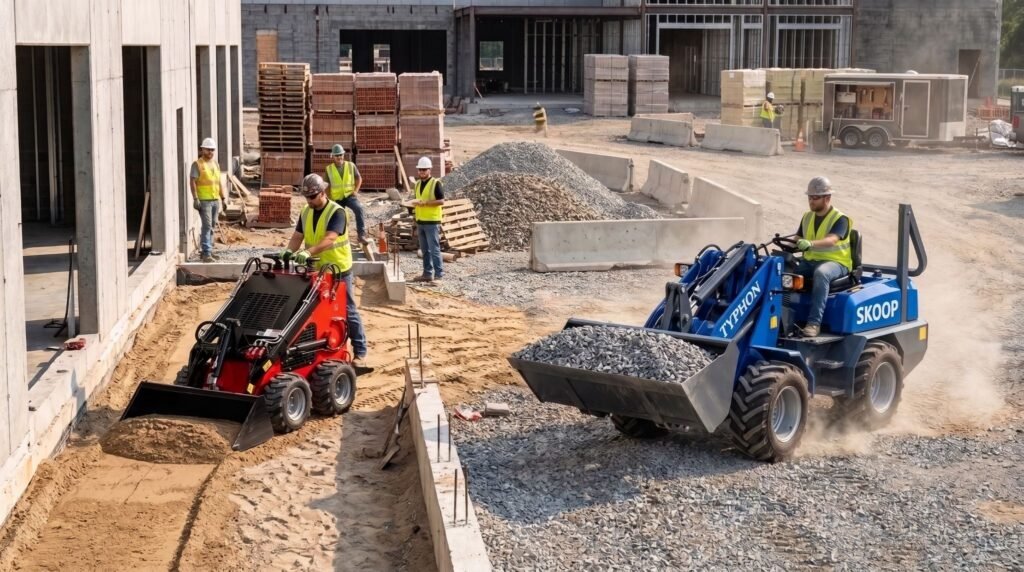
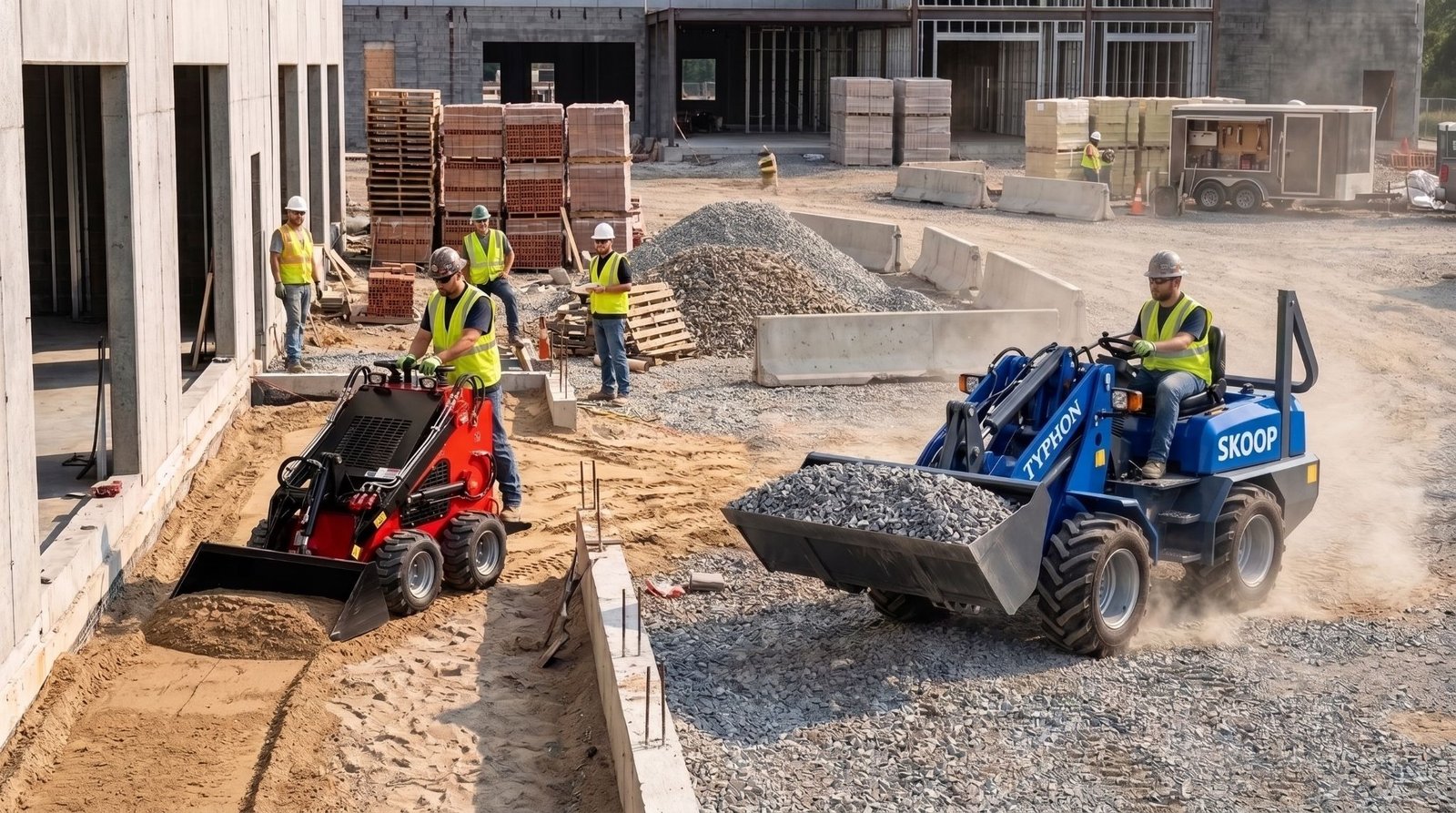
You've got a stockpile to move, a tight corner to work around, and a budget that won't stretch to two machines this year. So the question lands on your desk: wheel loader or skid steer? They both scoop, lift, and load, and from across the yard they seem to do the same job. But put them to work and the differences show up fast, in how much they carry, where they fit, and what they cost to run.
A wheel loader makes its case in open, high-volume work where every pass needs to move serious material. Larger buckets, faster travel speeds, and stronger breakout force mean fewer trips and quicker cycle times when you're loading trucks or working stockpiles. It’s built to stay in motion on predictable ground where space isn’t a limitation.
A skid steer takes the opposite advantage: access. It can turn in its own footprint, slip into narrow spaces, and switch from bucket work to forks, augers, or grapples without changing machines. That flexibility matters most when the jobsite is broken up, constantly changing, or too tight for a larger machine to move comfortably.
How Each Machine Works and What Sets Them Apart
Before you can choose, you need to understand what's actually rolling under you. Both machines lift and carry with a front-mounted bucket, but their build, steering, and scale shape everything else, from the loads they handle to the spaces they fit.
Wheel Loaders: Built for Volume
A wheel loader is a large, four-wheeled machine with a big front bucket and articulated steering, meaning it bends in the middle to turn. That design lets it carry heavy, high-volume loads across a site and lift them well above truck-bed height.
Wheel loaders shine on high-throughput work. They move stockpiles, load trucks, and handle aggregate, sand, and soil by the ton. Their size and stability let them run all day on the kind of bulk material handling that would take a smaller machine dozens of trips.
Skid Steers: Built for Agility
A skid steer is a compact, four-wheeled (or tracked) machine that steers by driving one side faster than the other, pivoting nearly in place. That tight turning and small footprint let it work where a larger machine simply can't fit.
A skid steer is built for confined sites, varied tasks, and fast attachment changes, switching from bucket to fork to auger in about a minute and working where larger machines cannot fit. A wheel loader is designed for high-capacity material handling on open ground. One moves bulk efficiently, the other moves anywhere and adapts quickly to different jobs.
Load Capacity and Lifting Performance
The size of the loads you move most days should weigh heavily on your choice. One machine is built to haul volume; the other trades raw capacity for reach and flexibility. Match the wrong one to your work, and you'll pay for it in wasted trips.
Where the Wheel Loader Wins
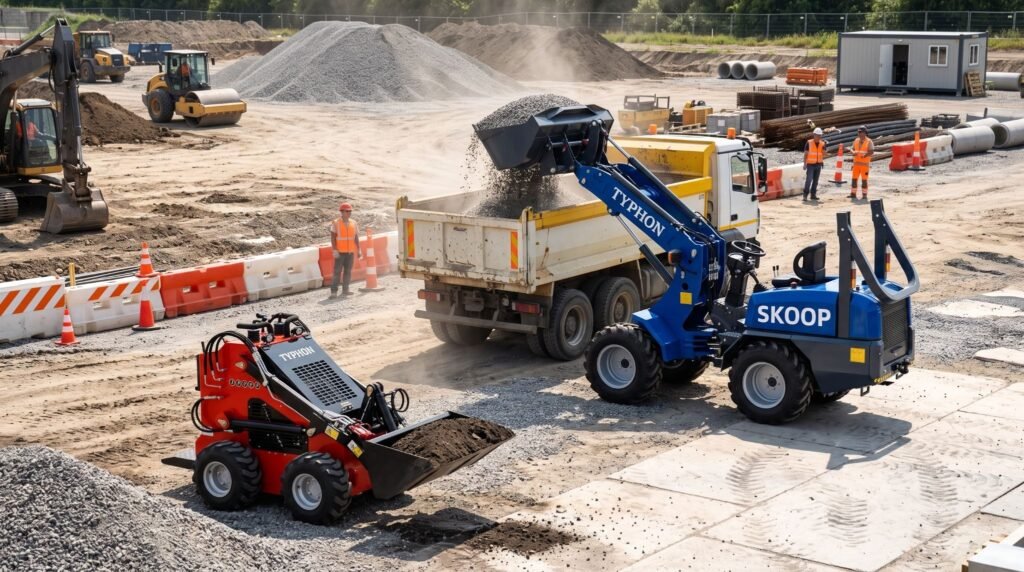
Load capacity is the wheel loader's home turf. Its larger bucket carries far more material per pass, and its lift height clears the sides of dump trucks and hoppers with room to spare.
For high-volume loading, that difference compounds fast. Fewer, bigger scoops mean fewer cycles, less fuel per ton moved, and trucks filled in a fraction of the time a smaller machine would need.
Where the Skid Steer Holds Its Own
A skid steer carries less per load and lifts lower, but for many jobs that's plenty. On residential sites, landscaping work, and light material handling, its capacity matches the task without the bulk or cost of a larger machine.
Where a skid steer falls short is in sustained bulk loading. When you're cycling material from a large stockpile into multiple trucks, the shorter travel and smaller bucket size mean more trips and slower overall output compared to a wheel loader working at a steady rhythm.
Wheel loaders carry more per pass, reach higher into trucks and hoppers, and maintain consistent high-volume loading throughout the day. Skid steers still perform well on lighter loads and general handling tasks, but for continuous, high-throughput material movement, the wheel loader clearly takes the lead. In practice, the choice comes down to whether your job demands volume or flexibility.
Maneuverability and Jobsite Fit
Raw power means little if the machine can't work where you need it. How each one turns, fits, and moves around your site often decides the choice before capacity ever enters the picture. Tight urban lots and wide-open yards reward very different machines.
Tight Sites Favor the Skid Steer
A skid steer's small frame and pivot steering make it the clear pick for confined spaces. It turns in its own footprint, slips through narrow gates, and works close to walls, fences, and structures where a wheel loader would be stuck at the edge.
On residential jobs, interior demolition, tight urban lots, and landscaping work, that compact agility is exactly what the job demands. The machine goes in, works the whole area, and gets out without a spotter for every move.
Open Yards Favor the Wheel Loader
Give a wheel loader room to run and it rewards you. Its articulated steering, higher travel speed, and stable frame make short work of moving material across large sites, quarries, and open yards.
It covers ground quickly between the stockpile and the truck, and its size becomes an advantage in open space but a limit in tight areas. A skid steer fits confined lots and close work, while a wheel loader moves material faster across open yards. The choice comes down to layout: tight access or wide-open ground.
Attachment Versatility
A machine that does one job well is useful, but one that does a dozen jobs earns its keep every day. Both machines take attachments, yet they differ sharply in how many tools they run and how easily they switch between them.
The Skid Steer's Deep Toolbox
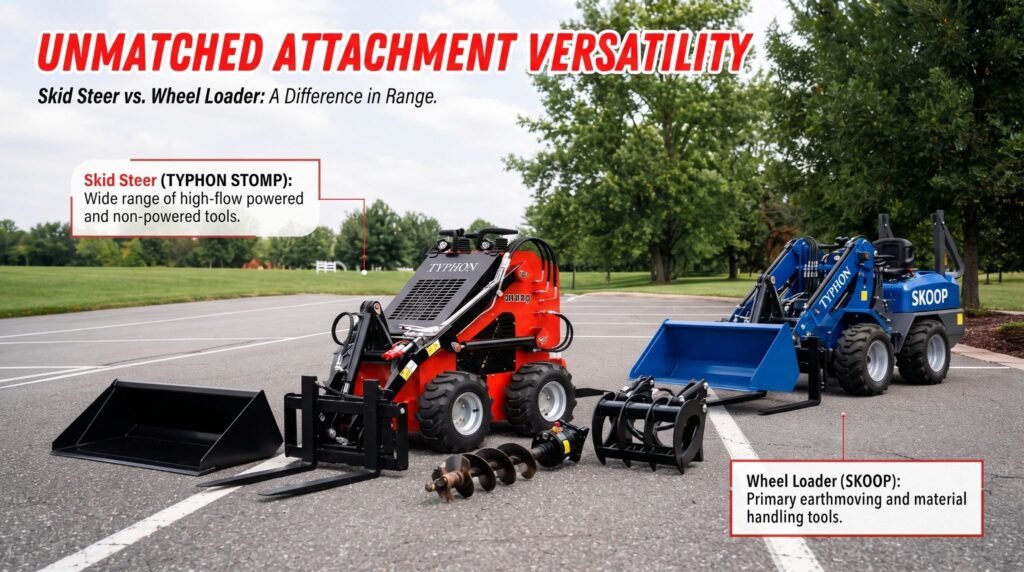
Attachment range is where the skid steer pulls ahead. Its universal quick-attach plate accepts a huge lineup of tools, and most swap out in about a minute without leaving the cab.
That versatility turns one machine into many, allowing it to switch between handling and loading materials, digging posts or trenches, clearing brush and preparing sites, and breaking down or moving demolition debris, making it a practical all-in-one solution for contractors working across different types of jobs.
The Wheel Loader's Focused Range
Wheel loaders can also run attachments, extending their capability beyond basic loading, but their lineup is more focused on heavy-duty, high-volume work rather than broad task variety. They commonly use high-capacity buckets for bulk material, pallet forks for heavy lifting, grapple buckets for debris handling, and snow pushers or blades for clearing large areas.
In comparison, a skid steer offers a wider and faster-changing attachment range, making it more adaptable across different job types. Wheel loaders excel when the priority is moving large amounts of material efficiently, while skid steers are better suited for switching between many different tasks throughout the day.
Which Machine Suits You Best
There's no single winner here, only the right match for your work, your site, and your budget. Line up each machine against how you actually operate, and the choice gets clear fast.
When a Wheel Loader Makes Sense
Choose a wheel loader if your work centers on moving heavy material in volume. Loading trucks, clearing stockpiles, handling aggregate, and running open yards or quarries all play to its strengths.
If you cycle material across large, open sites day after day, the loader's speed and capacity pay for themselves in fuel and hours saved per ton moved.
When a Skid Steer Makes Sense
Choose a skid steer if versatility and tight-site access matter most. Residential jobs, landscaping, light demolition, and varied task lists all fit its compact size and deep attachment range.
Contractors who need one machine to handle many different jobs, or who work in confined spaces, will get far more use out of a skid steer than a single-purpose loader.
Weigh the Full Picture
Before you commit, look at the whole operation rather than a single task:
- Material volume: High and heavy favors the wheel loader.
- Site space: Tight and obstacle-heavy favors the skid steer.
- Task variety: Many different jobs favor the skid steer.
- Travel distance: Long hauls across open ground favor the loader.
- Budget and fleet fit: Match the machine to your most frequent work.
Takeaway: Match the machine to the material you move most and the space you work in, and you'll get the productivity you're paying for without overbuying capability you won't use.
Conclusion
Choosing between a wheel loader and a skid steer is really about the rhythm of your work. A wheel loader fits operations that stay consistent, moving piles, loading trucks, and shifting bulk material across open, predictable ground where every cycle benefits from extra bucket capacity and speed. A skid steer fits a different pattern entirely, where the job changes often, spaces are tighter, and switching from digging to lifting to grading happens throughout the same day.
Instead of focusing on specs alone, look at how your projects actually unfold from start to finish. One machine rewards steady, repetitive material flow, while the other rewards flexibility across mixed tasks and confined areas. When the machine matches that daily pattern, work feels smoother, fewer adjustments are needed, and productivity comes from using the right movement style rather than forcing one machine into the wrong role.
Frequently Asked Questions
Which machine causes less ground disturbance on finished surfaces?
It depends on the setup, but tracked skid steers generally cause the least disturbance because they spread weight over a large footprint, reducing ground pressure on lawns and soft surfaces. Wheeled skid steers can mark or rut soft ground more, though less than a heavy wheel loader. A wheel loader's size and weight put more pressure on the surface, which matters on finished or sensitive sites. Match the machine and tire or track choice to how delicate your working surface is.
Do wheel loaders and skid steers share attachments?
Generally, no. The two machines use different coupler systems and are engineered for different weights and hydraulic capacities, so attachments rarely swap directly between them. Skid steers use the widely adopted universal quick-attach plate, which fits a broad range of skid steer tools across brands. Wheel loaders use their own mounting standards for heavier work. If running shared tooling matters to your fleet, confirm coupler compatibility before buying, since crossover typically requires an adapter and isn't always practical.
For a growing fleet, which machine offers more flexibility?
A skid steer usually adds more flexibility to a small or growing fleet. Its wide attachment range lets one machine cover many roles, so you can bid varied work without buying separate equipment for each task. A wheel loader is the stronger choice once your volume of heavy material handling justifies a dedicated machine for it. Many contractors start with a skid steer for its versatility, then add a wheel loader as bulk-loading demands grow, letting each machine do what it does best.