
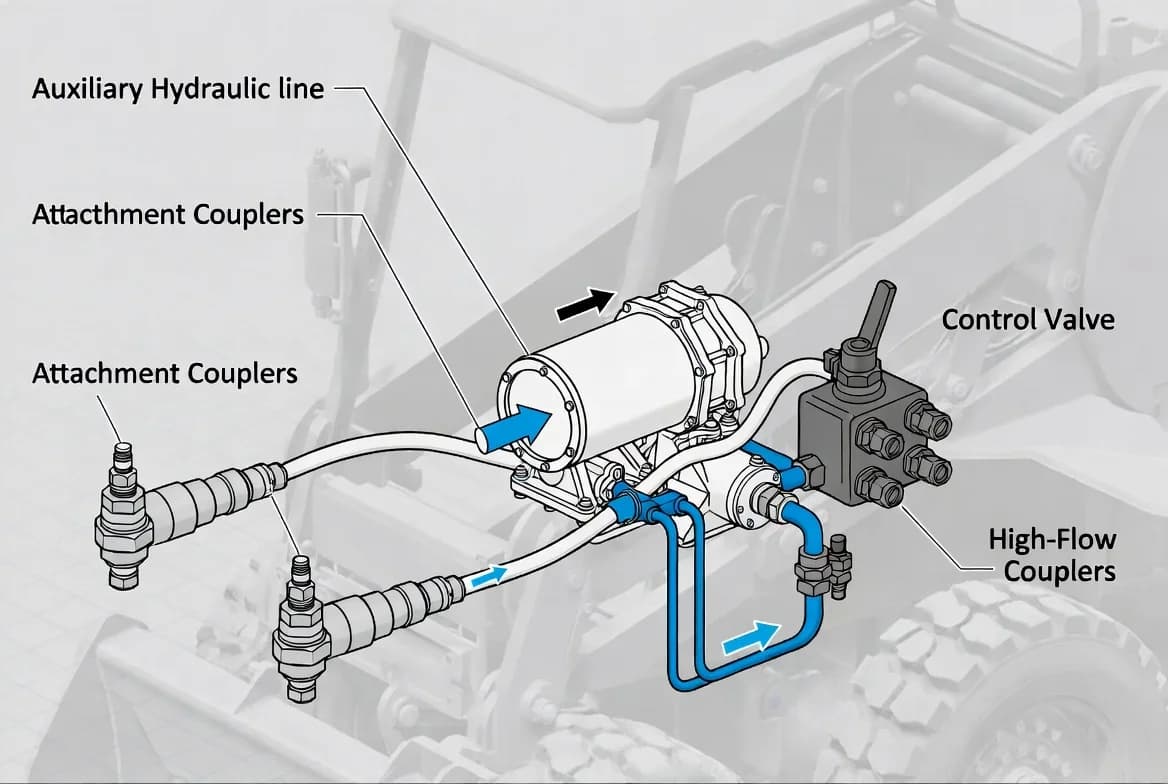
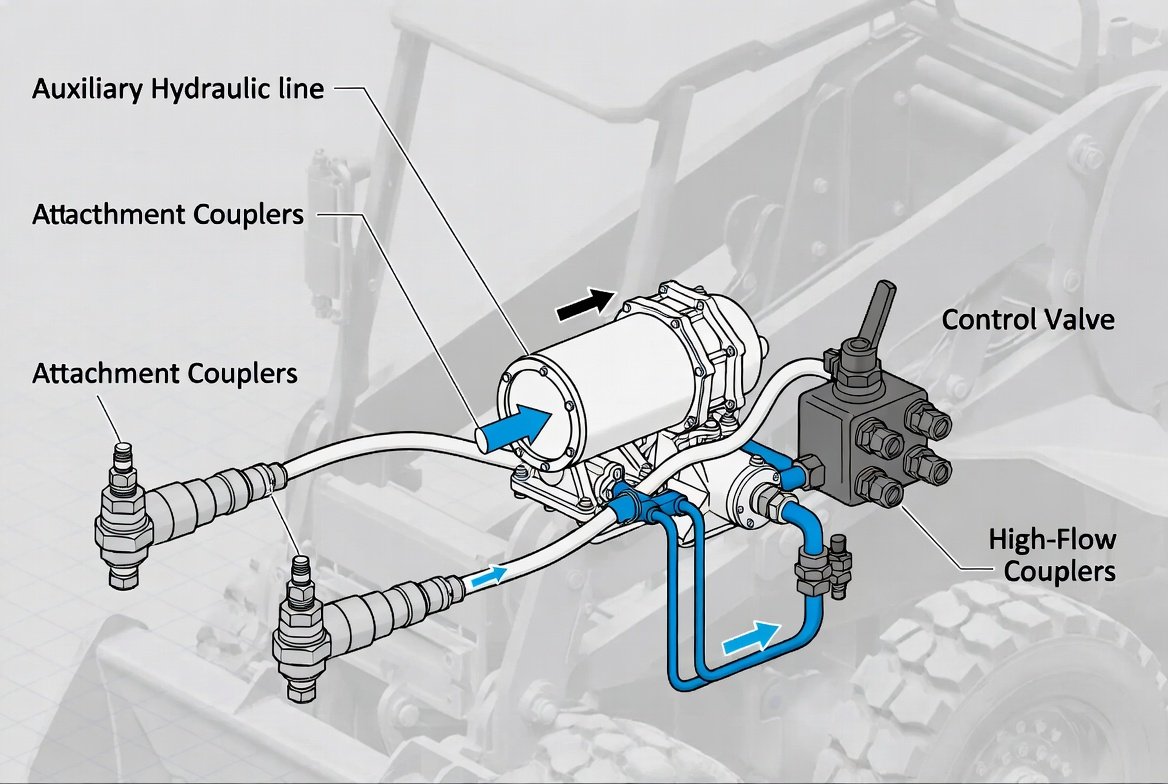
Auxiliary hydraulic flow is the pressurized oil that a skid steer or compact track loader supplies to power external attachments such as grapples, augers, breakers, snow blowers, and cold planers. Without adequate auxiliary flow and pressure, even the best-designed attachment will perform poorly or not at all. Understanding how auxiliary hydraulics are generated, controlled, and specified is essential for matching the machine to the tools it will operate.
The main hydraulic system of a skid steer powers the lift arms, tilt function, and drive motors. An auxiliary circuit taps into this system (or uses a dedicated section of the pump) to supply oil to the quick-coupler ports at the front of the machine. The operator controls the auxiliary flow with a switch, trigger, or proportional roller on the joystick. Many modern machines offer variable-flow control so that the operator can fine-tune the speed of the attachment.
Flow Rate, Pressure, and Power
Auxiliary performance is defined by two primary numbers: flow rate (usually in gallons per minute or litres per minute) and system pressure (in psi or bar). Hydraulic power available to the attachment is proportional to the product of flow and pressure. A machine that delivers high flow at high pressure can power demanding tools such as large cold planers or high-capacity snow blowers. A machine with modest flow may still operate simpler tools such as grapples or small augers effectively.
Flow rate determines the speed of the attachment’s hydraulic motor or cylinder. Pressure determines the force or torque the attachment can generate. Both must be within the attachment manufacturer’s recommended range. Supplying significantly more flow or pressure than the attachment is designed for can damage the tool; supplying less results in sluggish or incomplete performance.
Circuit Types and Control
Most machines provide a continuous-flow auxiliary circuit that can be locked on for tools that require constant oil supply (for example, a rotary broom or a mulcher). Many also offer a momentary or intermittent circuit for tools that need short bursts of flow (for example, a hydraulic breaker or a grapple open/close function). High-end machines may have two independent auxiliary circuits, allowing simultaneous operation of two functions or the use of more complex attachments that require dual hydraulic lines.
Electrical connectors at the front of the machine often accompany the hydraulic couplers. These provide power for attachment-mounted solenoids, lights, or electronic controllers. Matching both the hydraulic and electrical interfaces is necessary for full-function attachments.
Couplers, Hoses, and Contamination Control
Flat-face quick couplers are the industry standard because they minimize oil spillage and dirt ingress during connection and disconnection. Keeping the couplers clean and capped when not in use is one of the most effective ways to protect the entire hydraulic system. Dirt introduced through the auxiliary ports travels directly into the main hydraulic circuit and can damage pumps, valves, and cylinders.
Hose routing and length also matter. Excessively long or poorly supported hoses increase pressure drop and the risk of abrasion. When operating high-flow attachments, the pressure drop through undersized hoses or restrictive couplers can significantly reduce the power delivered to the tool.
Matching Machine to Attachment
Before purchasing or renting an attachment, compare its required flow and pressure with the machine’s published auxiliary specifications. Allow a small margin—typically 10–15 percent—so that the attachment is not constantly operating at the extreme limit of the machine’s capability. If the machine offers both standard-flow and high-flow modes, verify which mode is required and whether the attachment’s case-drain or return-line requirements are compatible.
In summary, auxiliary hydraulic flow is the lifeblood of powered attachments. Understanding flow rate, pressure, circuit control, and contamination prevention enables operators and equipment managers to select compatible tools, achieve full performance, and protect the hydraulic system from premature wear.
Get More Expert Guides & Updates
Subscribe for Machinery.org guide updates and product learning content.