
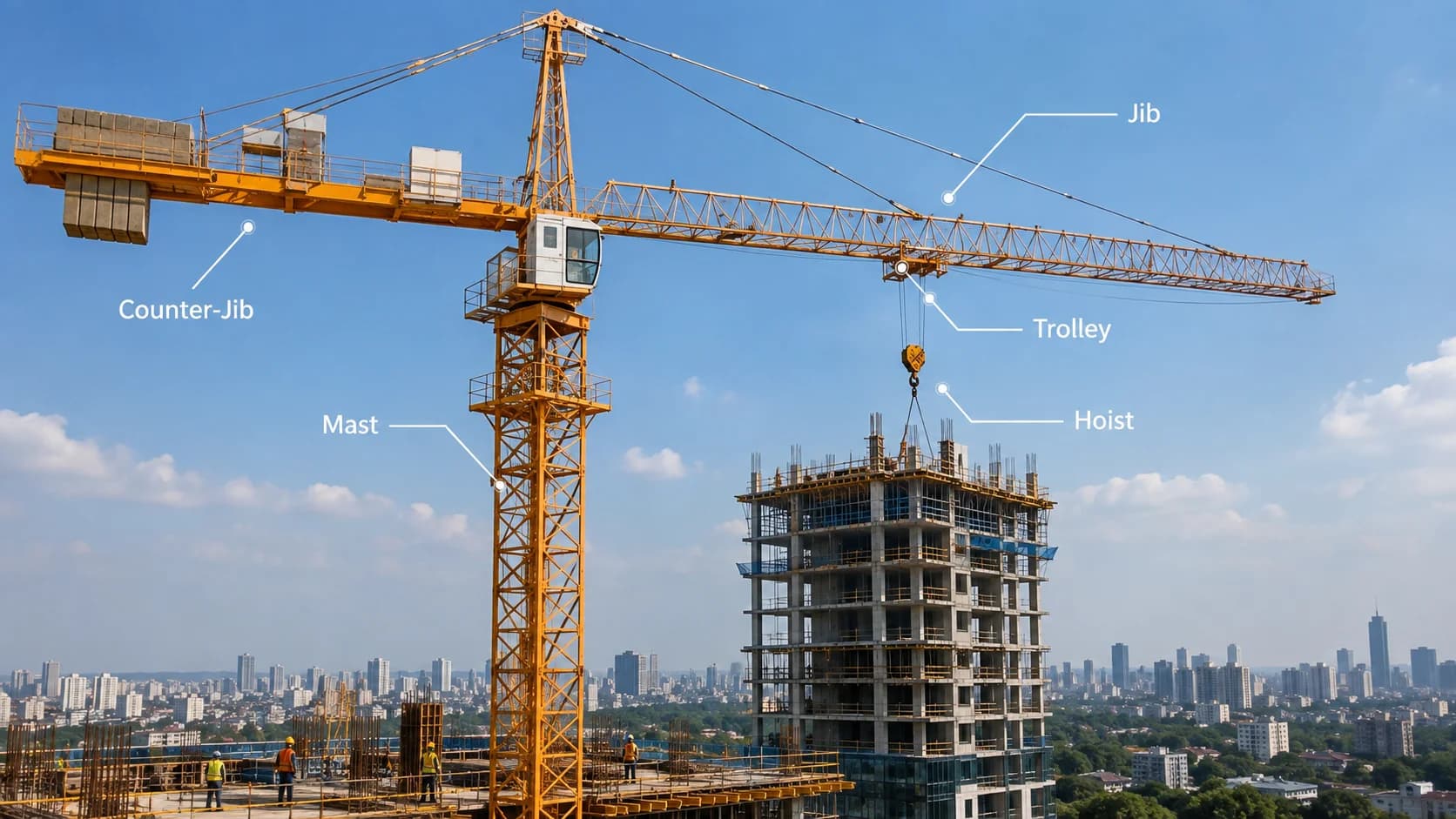
Tower cranes dominate skylines because they combine height, reach, and efficient material movement inside a compact footprint. Their shape can look simple from the ground, but every major component has a distinct structural or operational purpose. The mast carries vertical and horizontal forces into the foundation or building ties. The slewing unit allows the upper crane to rotate. The jib reaches over the jobsite, while the counter-jib carries counterweights and machinery that balance the working side. A trolley travels along many horizontal jibs to change load radius, and the hoist system raises or lowers the hook. Understanding how these parts interact makes tower crane planning far easier to follow. This beginner guide explains the main components, the movement of loads, basic capacity concepts, tie-ins and climbing, common tower crane types, operating limitations, and the roles of the people who keep a tower crane working safely on a busy construction project.
Use this guide with the exact manufacturer documentation. Capacities, configuration limits, inspection criteria, and operating procedures vary by crane model and jurisdiction.
The Mast and Foundation: The Crane’s Vertical Backbone
The mast is built from modular steel tower sections connected together to create the required height, and its geometry is designed to carry compression, bending, torsion, and the forces created by slewing and lifting. Confirm this point against the exact crane data and the actual field condition before proceeding.
The mast normally transfers loads into a specially engineered foundation, base frame, or building-supported arrangement that must match the crane design and site conditions. Confirm this point against the exact crane data and the actual field condition before proceeding.
As free-standing height increases, wind and overturning effects become more demanding, so many tall installations use ties that connect the mast to the building at engineered levels. Confirm this point against the exact crane data and the actual field condition before proceeding.
Mast sections, bolts or pins, ladders, platforms, tie frames, and climbing components require inspection because small connection problems can become critical in a tall structure. Confirm this point against the exact crane data and the actual field condition before proceeding.
The crane base location is chosen early in project planning because it affects reach, foundation design, building sequence, access for erection cranes, and eventual dismantling. Confirm this point against the exact crane data and the actual field condition before proceeding.
Marking the crane center, support locations, load path, and landing area before setup makes the assumptions visible to the entire lifting team.
Jib, Counter-Jib, and the Balance of the Upper Crane
The working jib is the long horizontal or luffing structure that carries the trolley or load line and establishes the crane working radius. Confirm this point against the exact crane data and the actual field condition before proceeding.
The counter-jib extends in the opposite direction and usually supports counterweights, hoist machinery, electrical equipment, and other components needed to balance and operate the crane. Confirm this point against the exact crane data and the actual field condition before proceeding.
Counterweights are engineered parts of the crane configuration; their quantity, location, and installation sequence must follow the manufacturer erection plan rather than field judgment. Confirm this point against the exact crane data and the actual field condition before proceeding.
On a hammerhead or flat-top tower crane, the jib generally remains horizontal while the trolley changes radius; on a luffing-jib crane, the jib angle changes to move the load inward or outward. Confirm this point against the exact crane data and the actual field condition before proceeding.
The entire upper structure rotates around the slewing ring, so adequate oversailing, collision control, and clearance must be considered wherever nearby structures or cranes are present. Confirm this point against the exact crane data and the actual field condition before proceeding.
When uncertainty remains, conservative planning is more reliable than using every unit of theoretical capacity. Keep usable margin for normal variation in weight, radius, and positioning.
Trolley, Hoist, Hook, and Load Movement
The trolley travels along the jib on many tower cranes and changes the horizontal distance between the mast and the hook without moving the crane base. Confirm this point against the exact crane data and the actual field condition before proceeding.
The hoist mechanism winds or pays out wire rope to raise and lower the hook, and the reeving arrangement influences line speed, hook capacity, and rope loading. Confirm this point against the exact crane data and the actual field condition before proceeding.
Tower crane motions can occur separately or in combination: hoisting changes height, trolleying or luffing changes radius, and slewing rotates the load around the mast. Confirm this point against the exact crane data and the actual field condition before proceeding.
Smooth coordinated motion reduces load swing, shock loading, and unnecessary stress on the crane and helps the signal person and rigging crew maintain control at the landing area. Confirm this point against the exact crane data and the actual field condition before proceeding.
Limits and control systems help prevent travel beyond designed ranges, but operators still depend on planning, visibility, communications, and disciplined control inputs. Confirm this point against the exact crane data and the actual field condition before proceeding.
After weather changes, relocation, or a configuration change, reconfirm the condition that controls the lift instead of assuming the earlier setup is still valid.
How Tower Crane Capacity Changes with Radius
Tower crane capacity is usually highest closer to the mast and lower toward the end of the jib because the load moment increases as the working radius grows. Confirm this point against the exact crane data and the actual field condition before proceeding.
Many tower cranes have a maximum load rating and a separate tip-load rating, and neither number describes capacity at every point along the jib. Confirm this point against the exact crane data and the actual field condition before proceeding.
The load chart must match the installed jib length, reeving, counterweight, tower height or configuration where applicable, and any manufacturer-specific operating mode. Confirm this point against the exact crane data and the actual field condition before proceeding.
Rigging and hook equipment contribute to the suspended weight and must be considered when comparing the load to the allowable capacity at the planned radius. Confirm this point against the exact crane data and the actual field condition before proceeding.
A lift that is acceptable at the pickup point may become unacceptable if the trolley moves farther out during the swing, so the complete path should be checked before lifting. Confirm this point against the exact crane data and the actual field condition before proceeding.
A short handover record of configuration, key dimensions, support assumptions, rigging, and restrictions helps prevent the next shift from using an outdated plan.
Climbing, Tie-Ins, and Increasing Tower Height
Some tower cranes are erected to full free-standing height, while others climb as the building rises by inserting mast sections with a climbing frame or by using internal climbing arrangements. Confirm this point against the exact crane data and the actual field condition before proceeding.
Climbing is a specialized engineered operation with strict limits on wind, crane orientation, balance, temporary support, hydraulic climbing equipment, and the sequence of adding or removing mast sections. Confirm this point against the exact crane data and the actual field condition before proceeding.
Building ties transfer lateral forces between the mast and the structure, so tie locations, anchorage details, building strength, and installation timing must be coordinated with the structural engineer and crane supplier. Confirm this point against the exact crane data and the actual field condition before proceeding.
Every change in tower height or tie condition can affect crane behavior and permitted configuration, which is why current records and the manufacturer climbing plan are essential. Confirm this point against the exact crane data and the actual field condition before proceeding.
The project schedule should allow time for climbing operations because the crane may be unavailable for normal lifting while the climbing system is prepared, operated, and inspected. Confirm this point against the exact crane data and the actual field condition before proceeding.
For example, a lift can change when the crane must be positioned farther away than planned. Recalculate the working condition rather than treating the extra radius as insignificant.
Common Tower Crane Types and Where They Fit
Hammerhead cranes use a horizontal jib and tower head, providing a familiar arrangement for general high-rise and large building work where oversailing space is available. Confirm this point against the exact crane data and the actual field condition before proceeding.
Flat-top or topless cranes reduce upper structural height and can simplify multi-crane sites where several jibs must pass above or below one another. Confirm this point against the exact crane data and the actual field condition before proceeding.
Luffing-jib cranes raise and lower the jib to vary radius, making them valuable on congested urban sites where the crane must keep its operating envelope compact. Confirm this point against the exact crane data and the actual field condition before proceeding.
Self-erecting tower cranes are smaller systems designed for relatively rapid setup and lower-rise work, often providing efficient material handling without a large conventional tower crane erection sequence. Confirm this point against the exact crane data and the actual field condition before proceeding.
Selecting among tower crane types depends on required radius, capacity, hook height, site boundaries, air rights, nearby cranes, erection access, project duration, and dismantling strategy. Confirm this point against the exact crane data and the actual field condition before proceeding.
On a congested project, the limiting condition may occur later in the swing or at the set point, so check the complete lift envelope before mobilization.
Field Planning Checklist
Before the lift begins, convert the planning discussion into a short field checklist. A checklist does not replace judgment; it makes sure the agreed assumptions are visible and repeatable. The following items should be adapted to the exact crane, manufacturer instructions, project lift plan, and local requirements:
- Confirm foundation and base design.
- Verify mast section type and connection condition.
- Review installed jib and counter-jib configuration.
- Confirm counterweight quantity and placement.
- Check hoist, trolley, and slewing limits.
- Review load chart by radius.
- Confirm tie-in and climbing plan.
- Coordinate nearby crane operating zones.
- Establish signal and radio procedures.
- Plan dismantling access before the site becomes congested.
A useful completion rule is that every unchecked item must have an owner and a reason. If the crew cannot confirm a load weight, support condition, configuration setting, or communication method, that uncertainty should be resolved before the lift proceeds. This is particularly important when a change appears small, because crane capacity and stability can be sensitive to geometry and support conditions.
Common Planning Mistakes to Avoid
- Using a crane’s advertised maximum capacity as though it applies at every radius and boom length. The better practice is to identify the assumption during planning, assign a clear verification method, and stop when the field condition no longer matches the basis of the lift.
- Assuming site ground is adequate because trucks or smaller equipment have already driven over it. The better practice is to identify the assumption during planning, assign a clear verification method, and stop when the field condition no longer matches the basis of the lift.
- Leaving rigging, hook, attachment, counterweight, support, or configuration details until the crane is already set up. The better practice is to identify the assumption during planning, assign a clear verification method, and stop when the field condition no longer matches the basis of the lift.
- Treating alarms, limiters, or electronic displays as replacements for a planned load chart and physical inspection. The better practice is to identify the assumption during planning, assign a clear verification method, and stop when the field condition no longer matches the basis of the lift.
- Continuing after site conditions, weather, crane level, access, or load geometry changes from the approved plan. The better practice is to identify the assumption during planning, assign a clear verification method, and stop when the field condition no longer matches the basis of the lift.
Frequently Asked Questions
What is the difference between a jib and a counter-jib?
The jib is the working arm that carries the trolley or load line. The counter-jib extends in the opposite direction and supports counterweights and often machinery. Together they balance the upper structure around the tower. Always confirm model-specific limits in the crane manual and project plan.
Why does a tower crane need ties to the building?
When the required height exceeds the permitted free-standing configuration, engineered ties can restrain the mast laterally and transfer forces into the building. Tie spacing and anchorage are project-specific engineering items. Always confirm model-specific limits in the crane manual and project plan.
What does the trolley do?
On many horizontal-jib tower cranes, the trolley moves along the jib and changes the hook radius. Moving outward increases radius and usually reduces allowable capacity; moving inward generally improves available capacity. Always confirm model-specific limits in the crane manual and project plan.
Can a tower crane rotate freely in the wind when not operating?
Many tower cranes have a manufacturer-defined out-of-service or weather-vane condition, but the exact procedure varies. The operator and site must follow the crane manual, local requirements, and the approved storm plan. Always confirm model-specific limits in the crane manual and project plan.
Who plans tower crane erection and climbing?
These operations require coordination among the crane supplier, qualified erection crew, engineers, project management, and other competent personnel. They should never be improvised from general crane knowledge. Always confirm model-specific limits in the crane manual and project plan.
Conclusion
Good crane work is built on disciplined preparation. The most useful habit is to keep connecting the planned lift back to measurable facts: actual load, actual radius, actual configuration, actual support condition, and actual clearance. When those facts remain inside the manufacturer limits and the crew understands the plan, the crane can be used efficiently without relying on guesswork. When one of those facts changes, the plan should change with it. Treat the load chart, setup information, rigging data, safety systems, and site conditions as one connected system, and involve qualified personnel whenever the lift is unusual, close to a limit, or affected by uncertain ground or structural conditions.
Get More Expert Guides & Updates
Subscribe for Machinery.org guide updates and product learning content.