
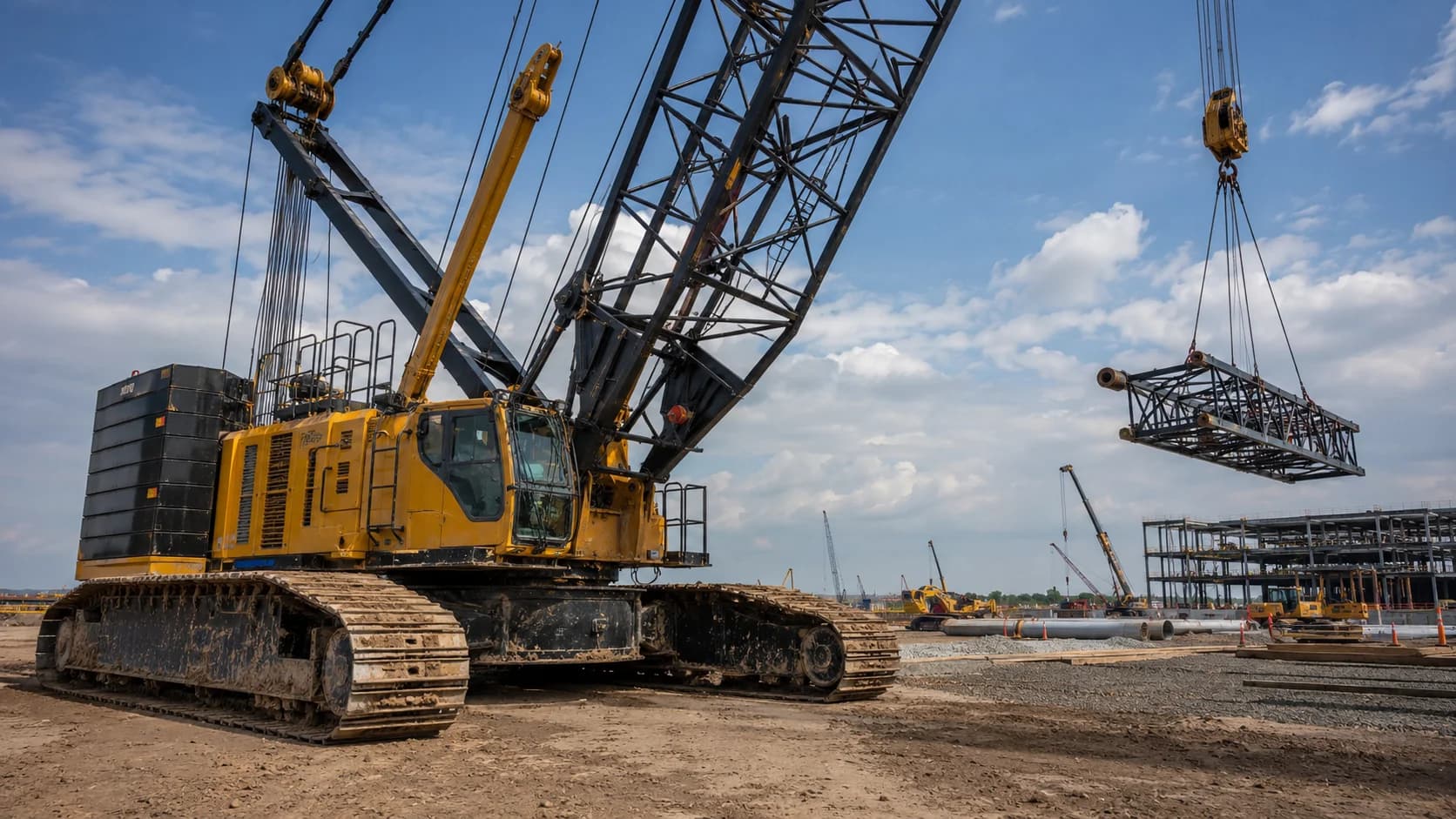
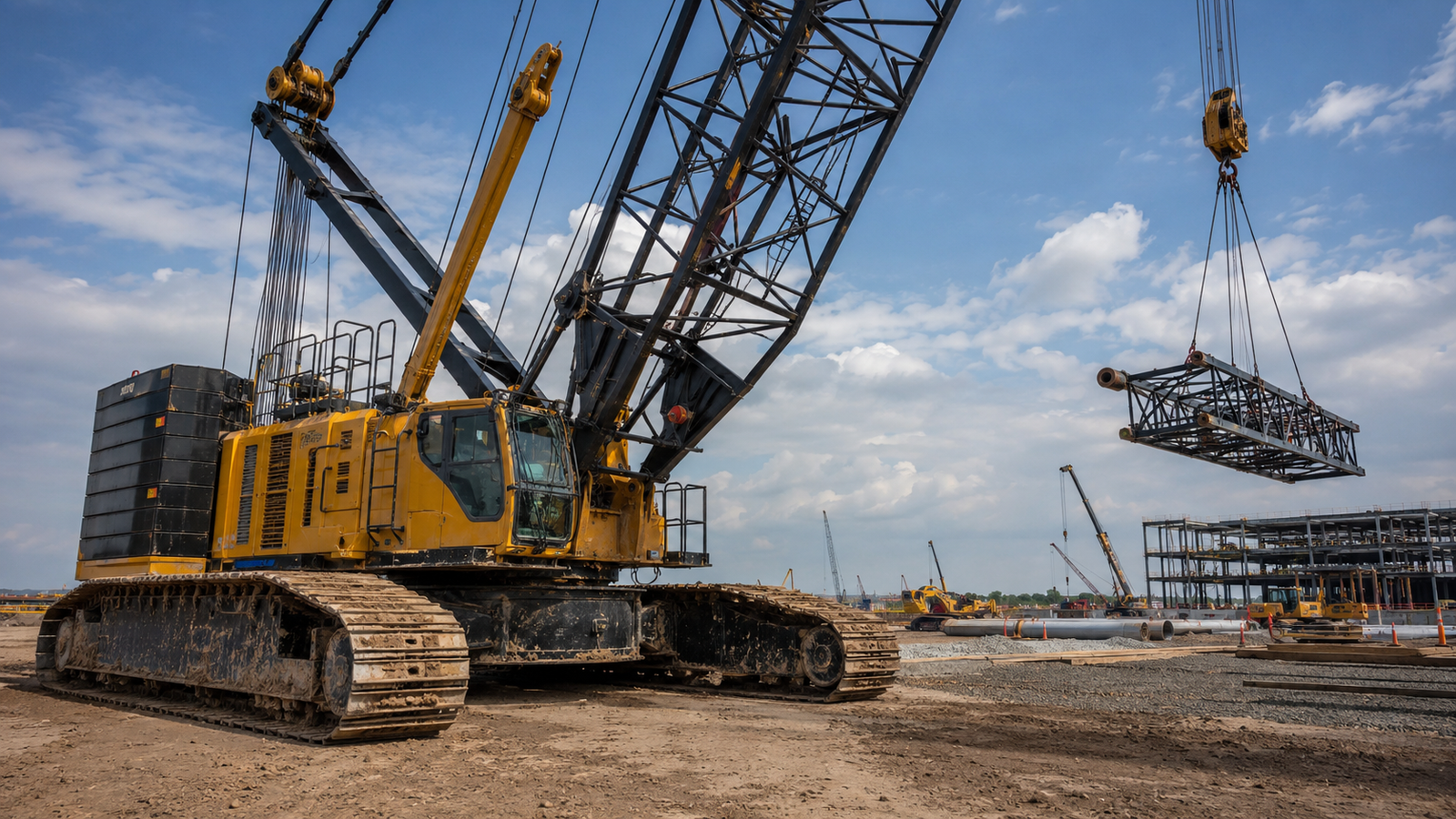
Crawler cranes are built for heavy lifting where ground conditions, large working radii, long lattice booms, and sustained jobsite mobility matter more than highway speed. Instead of outriggers, a crawler crane distributes its weight through wide tracks. That large contact area can reduce average ground pressure compared with concentrated outrigger reactions, but it does not make the crane independent of soil capacity. The crane can still overload weak fill, underground utilities, slabs, embankments, or poorly prepared working platforms. Crawler cranes also use configurations that may include lattice main booms, luffing jibs, fixed jibs, counterweights, carbody weights, derrick systems, and specialized heavy-lift attachments. This guide explains how crawler cranes achieve stability, how ground pressure should be considered, how boom configuration changes capacity, why travel with a load requires special attention, and which types of projects benefit most from crawler crane capability.
Use this guide with the exact manufacturer documentation. Capacities, configuration limits, inspection criteria, and operating procedures vary by crane model and jurisdiction.
How Crawler Crane Stability Works
Crawler crane stability comes from the relationship between crane weight, counterweight, track footprint, superstructure position, boom geometry, and the suspended load rather than from deployable outriggers. Confirm this point against the exact crane data and the actual field condition before proceeding.
The wide track stance provides a substantial support base, but allowable capacity still changes with boom length, radius, attachment configuration, counterweight, and the manufacturer chart. Confirm this point against the exact crane data and the actual field condition before proceeding.
Swinging the upper structure changes how forces are transmitted through the carbody and tracks, so ground reactions are not always uniform from side to side or front to rear. Confirm this point against the exact crane data and the actual field condition before proceeding.
The crane should be operated on a level, prepared surface within manufacturer tolerances because slope can shift load distribution and reduce available stability margin. Confirm this point against the exact crane data and the actual field condition before proceeding.
Stability is only one limit; structural strength of the boom, gantry, carbody, track frames, wire rope, and other components may control capacity in parts of the chart. Confirm this point against the exact crane data and the actual field condition before proceeding.
When uncertainty remains, conservative planning is more reliable than using every unit of theoretical capacity. Keep usable margin for normal variation in weight, radius, and positioning.
Ground Pressure and Working Platform Design
Average ground pressure is useful for early planning, but actual track reactions can vary during lifting and can become concentrated near portions of the crawler footprint. Confirm this point against the exact crane data and the actual field condition before proceeding.
A competent ground assessment should consider soil type, compaction, recent excavation, buried services, culverts, voids, basements, retaining structures, and water conditions beneath the crane path. Confirm this point against the exact crane data and the actual field condition before proceeding.
Engineered working platforms may use compacted aggregate, timber mats, steel mats, geosynthetics, or combinations selected to spread load and control settlement. Confirm this point against the exact crane data and the actual field condition before proceeding.
The platform must support not only the crane at rest but also travel, slewing, boom erection, counterweight installation, and the worst planned lifting reactions. Confirm this point against the exact crane data and the actual field condition before proceeding.
Drainage and weather matter because a platform that is adequate when dry can soften, rut, or lose bearing capacity after heavy rain, thawing, or repeated crawler traffic. Confirm this point against the exact crane data and the actual field condition before proceeding.
After weather changes, relocation, or a configuration change, reconfirm the condition that controls the lift instead of assuming the earlier setup is still valid.
Lattice Boom Setup and Configuration
Crawler crane lattice booms are assembled from engineered sections in a prescribed sequence, and each insert, pendant, pin, and connection must match the manufacturer configuration. Confirm this point against the exact crane data and the actual field condition before proceeding.
Longer boom systems increase reach and hook height but add boom weight, wind area, and structural demand, so the capacity chart changes as boom length changes. Confirm this point against the exact crane data and the actual field condition before proceeding.
Luffing jibs can add high reach and flexible radius control on large projects, but they introduce additional reeving, backmast or derrick components, and configuration-specific operating limits. Confirm this point against the exact crane data and the actual field condition before proceeding.
Boom erection and lowering can create critical loading conditions that differ from normal lifting, making adequate ground space, proper boom support, and the correct erection procedure essential. Confirm this point against the exact crane data and the actual field condition before proceeding.
Configuration records should be controlled carefully because a chart for the wrong boom insert combination, counterweight package, or attachment can produce a dangerous capacity error. Confirm this point against the exact crane data and the actual field condition before proceeding.
A short handover record of configuration, key dimensions, support assumptions, rigging, and restrictions helps prevent the next shift from using an outdated plan.
Traveling and Pick-and-Carry Considerations
Crawler cranes can often travel within a jobsite and some configurations permit travel with a suspended load, but only within manufacturer limits for load, boom position, radius, travel direction, and ground conditions. Confirm this point against the exact crane data and the actual field condition before proceeding.
Travel introduces dynamic effects from starting, stopping, steering, surface irregularities, track climbing, and load swing, all of which can create forces not present in a stationary lift. Confirm this point against the exact crane data and the actual field condition before proceeding.
The travel path should be inspected for slopes, soft areas, transitions, buried hazards, overhead obstructions, and sufficient width for the crawler footprint and counterweight tail swing. Confirm this point against the exact crane data and the actual field condition before proceeding.
The load should be kept controlled and positioned as required by the manufacturer, with travel speed minimized and unnecessary steering avoided when a suspended load is permitted. Confirm this point against the exact crane data and the actual field condition before proceeding.
A pick-and-carry plan should identify who controls the movement, how the route is kept clear, how tag lines are used if appropriate, and what conditions require the operation to stop. Confirm this point against the exact crane data and the actual field condition before proceeding.
For example, a lift can change when the crane must be positioned farther away than planned. Recalculate the working condition rather than treating the extra radius as insignificant.
Counterweight, Carbody Weights, and Assembly Logistics
Large crawler cranes often arrive in multiple transport loads and require an assembly area where track frames, counterweights, boom sections, hook blocks, and accessories can be safely installed. Confirm this point against the exact crane data and the actual field condition before proceeding.
Counterweight packages can be substantial, and the crane may use additional carbody weights or suspended ballast systems depending on the model and heavy-lift configuration. Confirm this point against the exact crane data and the actual field condition before proceeding.
Assembly itself may require an assist crane, forklifts, trailers, cribbing, and a planned sequence so components can be placed without trapping equipment or obstructing future boom assembly. Confirm this point against the exact crane data and the actual field condition before proceeding.
Transport weights and dimensions influence route planning, permits, staging space, and the number of trucks required, which can make crawler crane mobilization a significant part of project cost. Confirm this point against the exact crane data and the actual field condition before proceeding.
Disassembly planning should begin before the crane is erected because later construction may occupy the very space needed to lower the boom and load components for transport. Confirm this point against the exact crane data and the actual field condition before proceeding.
On a congested project, the limiting condition may occur later in the swing or at the set point, so check the complete lift envelope before mobilization.
Best Jobsite Applications for Crawler Cranes
Crawler cranes are well suited to heavy industrial construction, bridge work, power plants, wind projects, marine construction, large civil projects, and sites requiring long-duration lifting from prepared ground. Confirm this point against the exact crane data and the actual field condition before proceeding.
Their ability to work without outriggers can reduce repeated setup time when the crane must reposition around a broad project, provided the travel surface is engineered for the machine. Confirm this point against the exact crane data and the actual field condition before proceeding.
Long lattice boom and luffing systems can provide large hook heights and radii that are difficult to achieve efficiently with smaller telescopic cranes. Confirm this point against the exact crane data and the actual field condition before proceeding.
Crawler cranes are less attractive when highway mobility, rapid one-day setup, limited assembly space, or very frequent moves between distant sites are the dominant project requirements. Confirm this point against the exact crane data and the actual field condition before proceeding.
The best choice depends on total project productivity rather than headline capacity alone, including mobilization, assembly, ground preparation, operating duration, and dismantling cost. Confirm this point against the exact crane data and the actual field condition before proceeding.
Marking the crane center, support locations, load path, and landing area before setup makes the assumptions visible to the entire lifting team.
Field Planning Checklist
Before the lift begins, convert the planning discussion into a short field checklist. A checklist does not replace judgment; it makes sure the agreed assumptions are visible and repeatable. The following items should be adapted to the exact crane, manufacturer instructions, project lift plan, and local requirements:
- Obtain crane configuration and reaction data.
- Assess soil and buried features.
- Design and maintain a suitable working platform.
- Verify crawler track condition and adjustment.
- Confirm boom inserts, pendants, and pins.
- Match chart to boom and counterweight setup.
- Plan assembly and assist-crane access.
- Review travel-with-load restrictions.
- Inspect route for slopes and weak areas.
- Plan dismantling space and transport sequence.
A useful completion rule is that every unchecked item must have an owner and a reason. If the crew cannot confirm a load weight, support condition, configuration setting, or communication method, that uncertainty should be resolved before the lift proceeds. This is particularly important when a change appears small, because crane capacity and stability can be sensitive to geometry and support conditions.
Common Planning Mistakes to Avoid
- Using a crane’s advertised maximum capacity as though it applies at every radius and boom length. The better practice is to identify the assumption during planning, assign a clear verification method, and stop when the field condition no longer matches the basis of the lift.
- Assuming site ground is adequate because trucks or smaller equipment have already driven over it. The better practice is to identify the assumption during planning, assign a clear verification method, and stop when the field condition no longer matches the basis of the lift.
- Leaving rigging, hook, attachment, counterweight, support, or configuration details until the crane is already set up. The better practice is to identify the assumption during planning, assign a clear verification method, and stop when the field condition no longer matches the basis of the lift.
- Treating alarms, limiters, or electronic displays as replacements for a planned load chart and physical inspection. The better practice is to identify the assumption during planning, assign a clear verification method, and stop when the field condition no longer matches the basis of the lift.
- Continuing after site conditions, weather, crane level, access, or load geometry changes from the approved plan. The better practice is to identify the assumption during planning, assign a clear verification method, and stop when the field condition no longer matches the basis of the lift.
Frequently Asked Questions
Do crawler cranes have low ground pressure?
They spread load over large tracks, which can reduce average pressure compared with concentrated supports, but actual reactions vary during lifting. A crawler crane can still overload weak soil or underground structures, so the working platform must be assessed. Always confirm model-specific limits in the crane manual and project plan.
Can a crawler crane travel with a load?
Some cranes and configurations permit it under defined conditions. The operator must follow the manufacturer chart and travel restrictions, and the route must be level, strong, clear, and suitable for the dynamic effects of movement. Always confirm model-specific limits in the crane manual and project plan.
Why are crawler cranes often used for long projects?
Once assembled on a prepared site, they can combine high capacity, long boom configurations, and jobsite mobility without repeatedly setting outriggers. That can improve productivity when many lifts are spread across a large project. Always confirm model-specific limits in the crane manual and project plan.
Does a longer lattice boom always reduce capacity?
Capacity depends on the complete configuration and radius, but a longer boom generally adds weight and structural demand. Always use the exact chart for the installed boom, jib, counterweight, and reeving arrangement. Always confirm model-specific limits in the crane manual and project plan.
What is a crane working platform?
It is a prepared surface designed to support the crane during assembly, travel, and lifting. It may include compacted aggregate, mats, geosynthetics, or other engineered layers depending on soil and load requirements. Always confirm model-specific limits in the crane manual and project plan.
Conclusion
Good crane work is built on disciplined preparation. The most useful habit is to keep connecting the planned lift back to measurable facts: actual load, actual radius, actual configuration, actual support condition, and actual clearance. When those facts remain inside the manufacturer limits and the crew understands the plan, the crane can be used efficiently without relying on guesswork. When one of those facts changes, the plan should change with it. Treat the load chart, setup information, rigging data, safety systems, and site conditions as one connected system, and involve qualified personnel whenever the lift is unusual, close to a limit, or affected by uncertain ground or structural conditions.
Get More Expert Guides & Updates
Subscribe for Machinery.org guide updates and product learning content.