
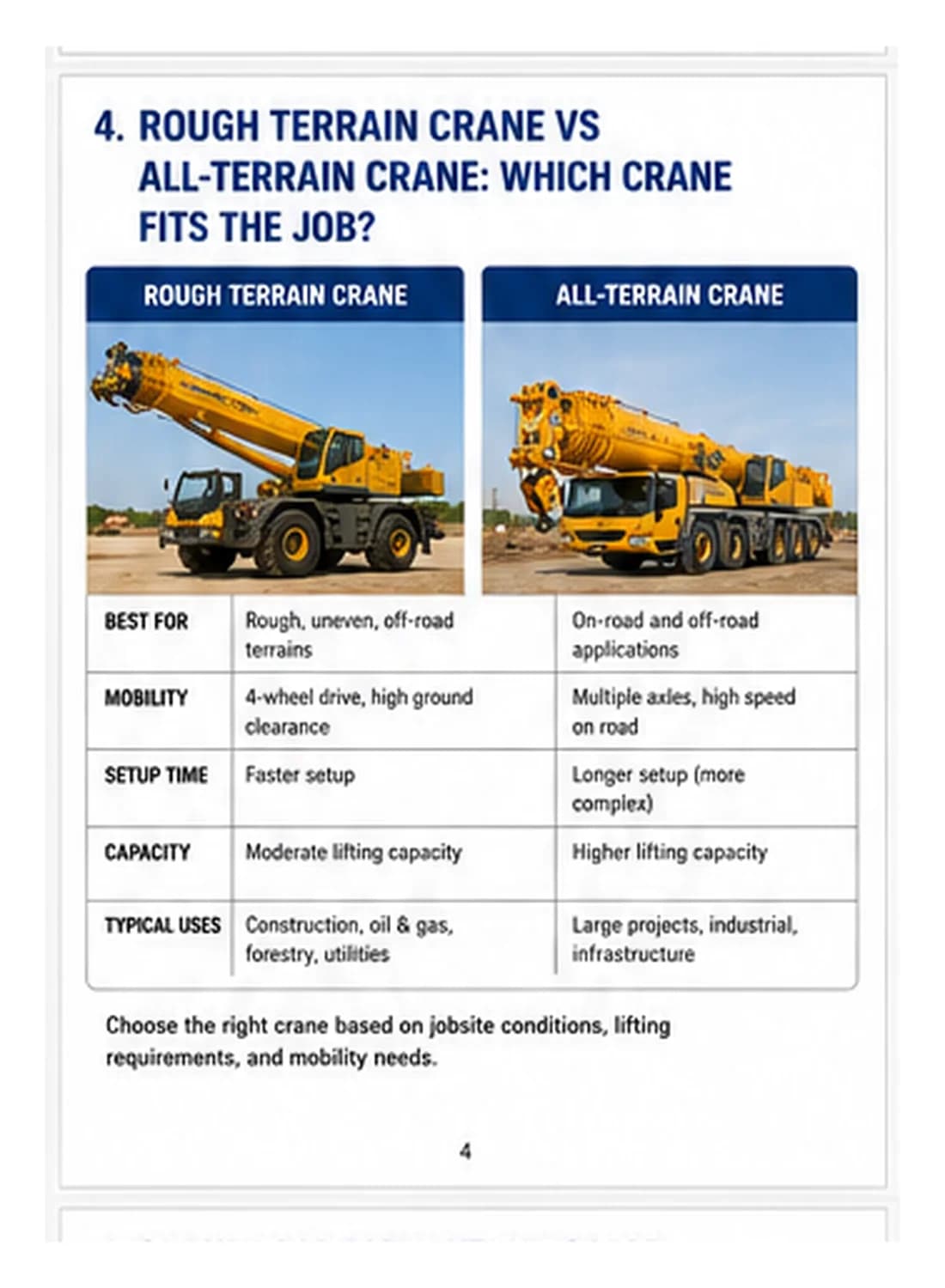
Rough-terrain and all-terrain cranes are both mobile telescopic cranes, but they are optimized for different kinds of mobility. A rough-terrain crane is designed primarily for movement and setup inside a jobsite. It commonly uses two axles, large off-road tires, high ground clearance, all-wheel steering, and a compact carrier that can maneuver over uneven surfaces. An all-terrain crane combines jobsite capability with a multi-axle road carrier designed for higher-speed travel between sites. It is generally more complex, more expensive, and available in much larger capacities and boom systems. Choosing between them is not simply a question of which crane can lift more. The better choice depends on road travel, site access, ground condition, setup area, required radius and height, lift frequency, transport permits, mobilization cost, and how long the crane will remain on site. This guide compares the two categories from a practical project-planning perspective.
Use this guide with the exact manufacturer documentation. Capacities, configuration limits, inspection criteria, and operating procedures vary by crane model and jurisdiction.
Carrier Design and Mobility
Rough-terrain cranes are built around compact off-road carriers with large tires and steering systems intended to maneuver within construction sites, industrial yards, and uneven work areas. Confirm this point against the exact crane data and the actual field condition before proceeding.
All-terrain cranes use multi-axle carriers engineered to travel efficiently on public roads while still providing suspension, steering, and traction suitable for controlled jobsite access. Confirm this point against the exact crane data and the actual field condition before proceeding.
The compact wheelbase of a rough-terrain crane can be valuable in tight sites, but long-distance road travel normally requires separate transport rather than driving the crane from project to project. Confirm this point against the exact crane data and the actual field condition before proceeding.
An all-terrain crane can reduce mobilization time between nearby sites because the base machine is roadable, although counterweights, jibs, and accessories may still move on separate trucks. Confirm this point against the exact crane data and the actual field condition before proceeding.
Turning radius, axle count, steering modes, overall length, bridge limits, road regulations, and gate dimensions should be checked before assuming either crane can reach the planned setup location. Confirm this point against the exact crane data and the actual field condition before proceeding.
After weather changes, relocation, or a configuration change, reconfirm the condition that controls the lift instead of assuming the earlier setup is still valid.
Off-Road Performance and Ground Conditions
Rough-terrain cranes are typically strongest where the surface is unpaved, irregular, or space is constrained, but they still require a firm and level setup area for lifting. Confirm this point against the exact crane data and the actual field condition before proceeding.
All-terrain cranes can handle many construction surfaces, yet their larger size and axle loads may make access more demanding on soft roads, temporary bridges, or tight internal haul routes. Confirm this point against the exact crane data and the actual field condition before proceeding.
Neither crane type should be treated as a substitute for ground assessment because lifting normally transfers high concentrated reactions through outriggers and pads. Confirm this point against the exact crane data and the actual field condition before proceeding.
Approach slopes, mud, loose fill, overhead lines, drainage ditches, turning areas, and edge distances can determine whether a crane that looks suitable on paper can physically reach the setup point. Confirm this point against the exact crane data and the actual field condition before proceeding.
A site access walk should evaluate both arrival and departure, including how the carrier will turn, position, deploy outriggers, and leave after surrounding construction has progressed. Confirm this point against the exact crane data and the actual field condition before proceeding.
A short handover record of configuration, key dimensions, support assumptions, rigging, and restrictions helps prevent the next shift from using an outdated plan.
Capacity, Boom Reach, and Lift Envelope
All-terrain cranes are available across a broad range of capacities and often offer long telescopic booms, jib systems, and heavy counterweight packages for large construction and industrial lifts. Confirm this point against the exact crane data and the actual field condition before proceeding.
Rough-terrain cranes commonly cover smaller to medium capacity work very efficiently, especially where the crane remains inside one site and performs repetitive picks at moderate height and radius. Confirm this point against the exact crane data and the actual field condition before proceeding.
The useful comparison is not nominal tonnage but the load-chart capacity at the actual radius, boom length, outrigger configuration, and counterweight condition required by the project. Confirm this point against the exact crane data and the actual field condition before proceeding.
A larger crane may provide more capacity margin but can demand more setup space, higher ground reactions, additional counterweight trucks, and more expensive mobilization. Confirm this point against the exact crane data and the actual field condition before proceeding.
Required hook height, maximum radius, obstruction clearance, tail swing, boom overhang, and jib needs should be plotted before selecting a crane category. Confirm this point against the exact crane data and the actual field condition before proceeding.
For example, a lift can change when the crane must be positioned farther away than planned. Recalculate the working condition rather than treating the extra radius as insignificant.
Setup Time, Outriggers, and Site Productivity
Both crane types typically rely on outriggers for rated stationary lifting, and the time required to position, level, mat, configure, and counterweight the crane should be included in the daily plan. Confirm this point against the exact crane data and the actual field condition before proceeding.
A rough-terrain crane that stays on one project may be able to reposition relatively quickly within the site, subject to manufacturer requirements and the need to re-level and re-establish supports. Confirm this point against the exact crane data and the actual field condition before proceeding.
An all-terrain crane may require more counterweight handling on larger configurations, but it can offer major productivity advantages when high capacity or long reach eliminates the need for repeated crane relocations. Confirm this point against the exact crane data and the actual field condition before proceeding.
Partial outrigger positions can help in constrained sites only when the crane provides an approved chart or control system for that setup; reduced support generally means reduced capacity. Confirm this point against the exact crane data and the actual field condition before proceeding.
The most productive crane is the one that completes the entire lift cycle efficiently, not necessarily the one with the fastest theoretical setup or highest nominal rating. Confirm this point against the exact crane data and the actual field condition before proceeding.
On a congested project, the limiting condition may occur later in the swing or at the set point, so check the complete lift envelope before mobilization.
Transport, Permits, and Mobilization Cost
Rough-terrain cranes are commonly moved between distant jobs on a lowboy or similar trailer because their carriers are not optimized for normal highway travel. Confirm this point against the exact crane data and the actual field condition before proceeding.
All-terrain cranes can travel on roads, but axle load limits, permits, route restrictions, bridge limits, escorts, and regional transport rules may still control how the crane moves. Confirm this point against the exact crane data and the actual field condition before proceeding.
Counterweights, mats, jib sections, hook blocks, and rigging may require separate support trucks for either crane type, especially as capacity and configuration increase. Confirm this point against the exact crane data and the actual field condition before proceeding.
Mobilization cost should include loading, permits, travel time, support trucks, assembly labor, counterweight handling, and the expected number of moves during the project. Confirm this point against the exact crane data and the actual field condition before proceeding.
For a short local lift, a roadable all-terrain crane can be very efficient; for a long project where the crane stays inside the fence, a rough-terrain crane may offer lower ownership or rental complexity. Confirm this point against the exact crane data and the actual field condition before proceeding.
Marking the crane center, support locations, load path, and landing area before setup makes the assumptions visible to the entire lifting team.
Choosing Between RT and AT Cranes
Choose a rough-terrain crane when internal jobsite maneuverability, compact size, off-road movement, and repeated work on one site outweigh the need for frequent highway travel. Confirm this point against the exact crane data and the actual field condition before proceeding.
Choose an all-terrain crane when long road moves, larger capacity, greater boom reach, multi-site scheduling, or more complex lift envelopes justify the larger and more sophisticated carrier. Confirm this point against the exact crane data and the actual field condition before proceeding.
Verify that the chosen model can enter the site, deploy outriggers, support the required counterweight, and achieve the necessary capacity at the worst radius rather than comparing categories only by brochure specifications. Confirm this point against the exact crane data and the actual field condition before proceeding.
Consider the duration of the rental and expected utilization because a more capable crane can be economical if it reduces setup moves, support equipment, or project schedule risk. Confirm this point against the exact crane data and the actual field condition before proceeding.
The final decision should be documented in a lift plan that combines engineering requirements, access logistics, ground conditions, operator input, and realistic cost rather than relying on a single specification. Confirm this point against the exact crane data and the actual field condition before proceeding.
When uncertainty remains, conservative planning is more reliable than using every unit of theoretical capacity. Keep usable margin for normal variation in weight, radius, and positioning.
Field Planning Checklist
Before the lift begins, convert the planning discussion into a short field checklist. A checklist does not replace judgment; it makes sure the agreed assumptions are visible and repeatable. The following items should be adapted to the exact crane, manufacturer instructions, project lift plan, and local requirements:
- Measure access gate and internal road width.
- Check turning radius and overhead clearance.
- Confirm road travel and permit needs.
- Determine maximum load, radius, and hook height.
- Compare exact load charts, not nominal tonnage.
- Review outrigger footprint and pad space.
- Assess ground bearing and access-road strength.
- Estimate counterweight and support-truck needs.
- Compare mobilization and on-site repositioning time.
- Select the crane that minimizes total project risk and cost.
A useful completion rule is that every unchecked item must have an owner and a reason. If the crew cannot confirm a load weight, support condition, configuration setting, or communication method, that uncertainty should be resolved before the lift proceeds. This is particularly important when a change appears small, because crane capacity and stability can be sensitive to geometry and support conditions.
Common Planning Mistakes to Avoid
- Using a crane’s advertised maximum capacity as though it applies at every radius and boom length. The better practice is to identify the assumption during planning, assign a clear verification method, and stop when the field condition no longer matches the basis of the lift.
- Assuming site ground is adequate because trucks or smaller equipment have already driven over it. The better practice is to identify the assumption during planning, assign a clear verification method, and stop when the field condition no longer matches the basis of the lift.
- Leaving rigging, hook, attachment, counterweight, support, or configuration details until the crane is already set up. The better practice is to identify the assumption during planning, assign a clear verification method, and stop when the field condition no longer matches the basis of the lift.
- Treating alarms, limiters, or electronic displays as replacements for a planned load chart and physical inspection. The better practice is to identify the assumption during planning, assign a clear verification method, and stop when the field condition no longer matches the basis of the lift.
- Continuing after site conditions, weather, crane level, access, or load geometry changes from the approved plan. The better practice is to identify the assumption during planning, assign a clear verification method, and stop when the field condition no longer matches the basis of the lift.
Frequently Asked Questions
Which crane is better on muddy or uneven sites?
Rough-terrain cranes are designed specifically for off-road jobsite movement, but lifting still requires adequate support and level setup. An all-terrain crane can also access many construction sites, but its larger carrier may need better temporary roads. Always confirm model-specific limits in the crane manual and project plan.
Can an all-terrain crane drive itself to the jobsite?
Often yes, subject to local road and axle-load rules. Counterweights and accessories may still travel separately, and permits or escorts may be required depending on the crane and route. Always confirm model-specific limits in the crane manual and project plan.
Is a rough-terrain crane always cheaper?
Not always. Rental rate may be lower for some RT cranes, but transport, schedule, capacity, and the number of relocations can change total cost. Compare the complete project plan rather than the daily rate alone. Always confirm model-specific limits in the crane manual and project plan.
Which type normally has more capacity and reach?
All-terrain cranes are commonly available in larger classes and with longer boom systems, although there is overlap. The deciding figure is capacity at the project’s actual radius and configuration. Always confirm model-specific limits in the crane manual and project plan.
Do both types use outriggers?
Most stationary lifting with RT and AT cranes uses outriggers, but exact configurations and charts vary. Outrigger extension, pads, level, and ground support must match the manufacturer requirements. Always confirm model-specific limits in the crane manual and project plan.
Conclusion
Good crane work is built on disciplined preparation. The most useful habit is to keep connecting the planned lift back to measurable facts: actual load, actual radius, actual configuration, actual support condition, and actual clearance. When those facts remain inside the manufacturer limits and the crew understands the plan, the crane can be used efficiently without relying on guesswork. When one of those facts changes, the plan should change with it. Treat the load chart, setup information, rigging data, safety systems, and site conditions as one connected system, and involve qualified personnel whenever the lift is unusual, close to a limit, or affected by uncertain ground or structural conditions.
Get More Expert Guides & Updates
Subscribe for Machinery.org guide updates and product learning content.