
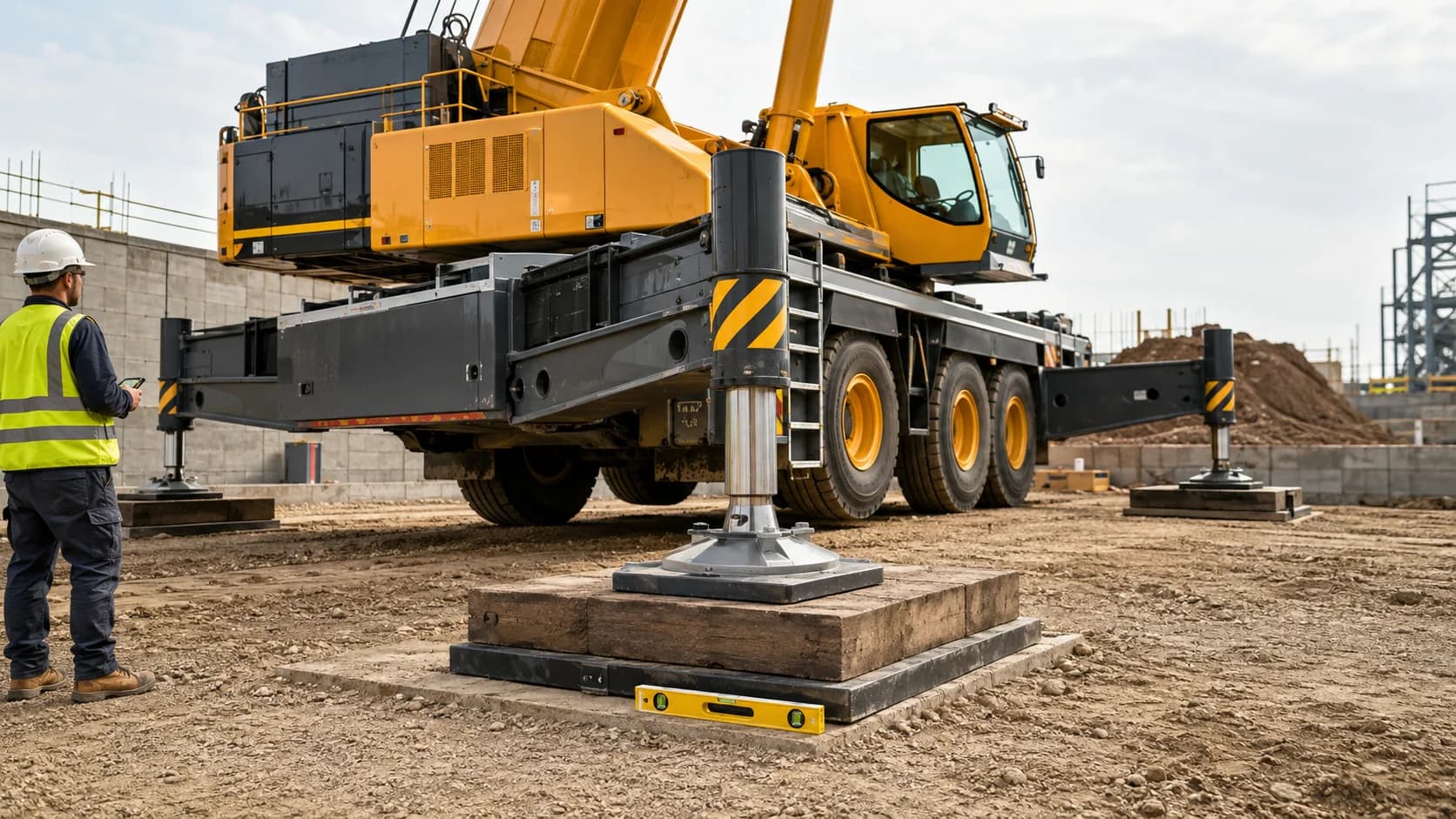
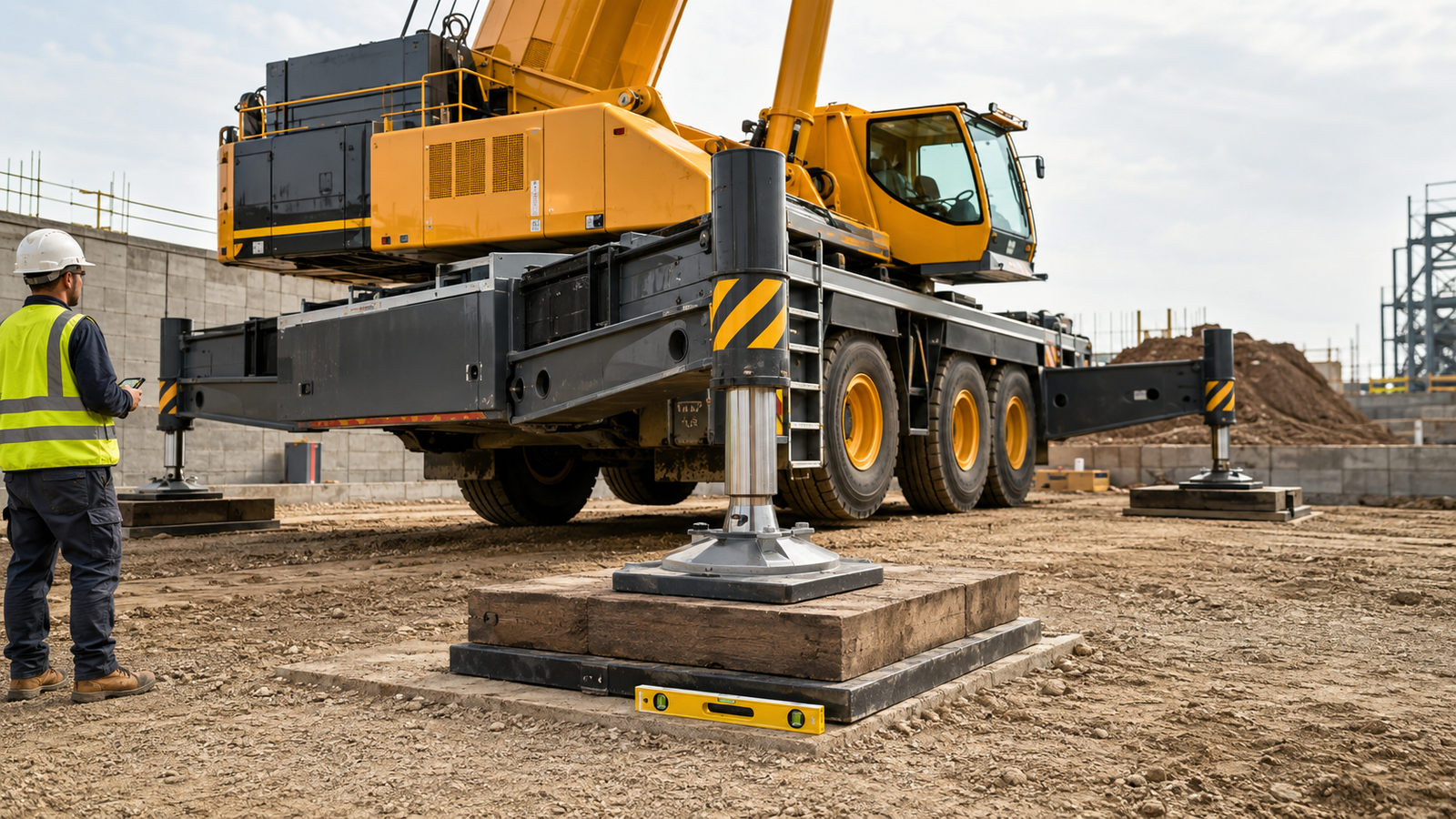
Outriggers turn a mobile crane carrier into a supported lifting platform by transferring large forces from the crane into the ground. Because those reactions can be extremely concentrated, correct outrigger setup is as important as selecting the right load-chart value. A crane can be well within chart capacity and still become unstable if an outrigger sinks, a pad bridges over a void, the crane is out of level, or a support is placed too close to an excavation. Good setup begins with a site assessment and continues through pad or mat selection, full extension or an approved partial configuration, leveling, pre-lift verification, and monitoring during the work. This guide explains the practical reasoning behind outrigger loads, ground bearing, cribbing, pads, mats, slope, underground hazards, and the checks that should be repeated whenever the crane is relocated or conditions change.
Use this guide with the exact manufacturer documentation. Capacities, configuration limits, inspection criteria, and operating procedures vary by crane model and jurisdiction.
Why Outriggers Matter to Crane Stability
Outriggers widen the effective support base of the crane and transfer overturning and vertical loads into the ground at points designed by the manufacturer. Confirm this point against the exact crane data and the actual field condition before proceeding.
Reactions are not equal at every outrigger during a lift; the support nearest the load can carry a much larger force while another support may be lightly loaded. Confirm this point against the exact crane data and the actual field condition before proceeding.
As the crane slews, booms down, or changes load radius, the highest reaction can move from one outrigger to another, so the entire setup area must be suitable rather than only the initial lift side. Confirm this point against the exact crane data and the actual field condition before proceeding.
Outrigger beams, jacks, floats, pins, sensors, and interlocks must be in the required position because an incomplete extension or improperly seated component changes the assumed geometry. Confirm this point against the exact crane data and the actual field condition before proceeding.
Stability depends on both crane configuration and ground support, so the load chart and the outrigger plan should be treated as two parts of one lifting system. Confirm this point against the exact crane data and the actual field condition before proceeding.
A short handover record of configuration, key dimensions, support assumptions, rigging, and restrictions helps prevent the next shift from using an outdated plan.
Assessing Ground Conditions Before Setup
A visual surface inspection is not enough to confirm bearing capacity because strong-looking pavement can cover weak fill, basements, utility trenches, vaults, culverts, or recently disturbed soil. Confirm this point against the exact crane data and the actual field condition before proceeding.
Project records, utility drawings, geotechnical information, and local knowledge should be reviewed when the crane will impose high reactions or work near underground features. Confirm this point against the exact crane data and the actual field condition before proceeding.
The setup should keep adequate distance from excavations, retaining edges, slopes, and unsupported trenches because the pressure bulb beneath an outrigger can influence soil beyond the pad footprint. Confirm this point against the exact crane data and the actual field condition before proceeding.
Water changes soil behavior, so rain, flooding, poor drainage, thawing, or broken utilities can reduce support after the crane has already been set up. Confirm this point against the exact crane data and the actual field condition before proceeding.
When ground capacity is uncertain, a qualified person or engineer should determine the required working platform, pad area, or alternative crane position rather than relying on guesswork. Confirm this point against the exact crane data and the actual field condition before proceeding.
For example, a lift can change when the crane must be positioned farther away than planned. Recalculate the working condition rather than treating the extra radius as insignificant.
Pads, Mats, Cribbing, and Load Distribution
The purpose of a pad or mat is to spread outrigger reaction over enough area that the resulting ground pressure remains within the allowable bearing capacity of the support surface. Confirm this point against the exact crane data and the actual field condition before proceeding.
Pad size should be based on expected outrigger reaction and allowable ground pressure, with additional engineering consideration for bending strength and how the pad distributes load. Confirm this point against the exact crane data and the actual field condition before proceeding.
A large but weak board can fail by bending or crushing, so material strength, condition, thickness, orientation, and full contact are as important as plan dimensions. Confirm this point against the exact crane data and the actual field condition before proceeding.
Cribbing should be built from suitable material in a stable, tightly stacked arrangement that avoids unstable towers, point contact, split timber, loose blocks, or unsupported gaps. Confirm this point against the exact crane data and the actual field condition before proceeding.
The outrigger float should be centered on the pad whenever possible, and the pad should rest on a level surface so the reaction is transferred uniformly rather than through one edge. Confirm this point against the exact crane data and the actual field condition before proceeding.
On a congested project, the limiting condition may occur later in the swing or at the set point, so check the complete lift envelope before mobilization.
Leveling the Crane Correctly
Mobile crane load charts assume the crane is level within the manufacturer tolerance, and even a small slope can shift the effective center of gravity and change the load carried by individual supports. Confirm this point against the exact crane data and the actual field condition before proceeding.
Level should be checked with the crane system or an appropriate independent method after the outriggers are loaded and before the lift begins. Confirm this point against the exact crane data and the actual field condition before proceeding.
Trying to correct a sloped site by building excessively tall improvised cribbing can create new instability; proper grading or engineered support is often the better solution. Confirm this point against the exact crane data and the actual field condition before proceeding.
After a heavy lift, rain event, long operating period, or visible settlement, the crane should be rechecked for level and pad condition because support can change during the shift. Confirm this point against the exact crane data and the actual field condition before proceeding.
If an outrigger begins to sink or the crane moves out of level, operations should stop and the setup should be corrected rather than attempting to compensate through crane movement. Confirm this point against the exact crane data and the actual field condition before proceeding.
Marking the crane center, support locations, load path, and landing area before setup makes the assumptions visible to the entire lifting team.
Full and Partial Outrigger Configurations
Many cranes achieve their best capacities with outriggers fully extended, but modern cranes may provide manufacturer-approved charts for intermediate or asymmetric positions. Confirm this point against the exact crane data and the actual field condition before proceeding.
A partial extension is not simply a smaller version of full extension; capacity can change substantially and may vary with the direction of the boom over the different support quadrants. Confirm this point against the exact crane data and the actual field condition before proceeding.
The crane control system may require accurate outrigger position sensing or manual configuration input, and incorrect input can cause the displayed capacity to be wrong. Confirm this point against the exact crane data and the actual field condition before proceeding.
Physical site restrictions should be identified before crane selection because a crane that cannot fully deploy may need a different chart, a different setup point, or a different machine. Confirm this point against the exact crane data and the actual field condition before proceeding.
Never assume an outrigger can be short-set because the lift appears light; use only configurations explicitly permitted by the manufacturer and reflected in the applicable load chart. Confirm this point against the exact crane data and the actual field condition before proceeding.
When uncertainty remains, conservative planning is more reliable than using every unit of theoretical capacity. Keep usable margin for normal variation in weight, radius, and positioning.
Monitoring the Setup During Lifting
The setup should be inspected throughout the shift for pad movement, soil cracking, cribbing damage, hydraulic leakage, outrigger beam movement, and changes in crane level. Confirm this point against the exact crane data and the actual field condition before proceeding.
A spotter or designated person can help observe supports that are not visible to the operator, especially when the lift is heavy or ground conditions are marginal. Confirm this point against the exact crane data and the actual field condition before proceeding.
Traffic, excavation, dewatering, nearby compaction, and other construction activities can alter the support environment after the initial setup, so crane operations should be coordinated with the wider site. Confirm this point against the exact crane data and the actual field condition before proceeding.
When the crane is relocated even a short distance, the new position should be treated as a new setup because underground features and bearing conditions can change across a site. Confirm this point against the exact crane data and the actual field condition before proceeding.
Good documentation of crane position, pad size, ground assumptions, outrigger configuration, and pre-lift checks helps the team repeat safe setups and identify changes before they become problems. Confirm this point against the exact crane data and the actual field condition before proceeding.
After weather changes, relocation, or a configuration change, reconfirm the condition that controls the lift instead of assuming the earlier setup is still valid.
Field Planning Checklist
Before the lift begins, convert the planning discussion into a short field checklist. A checklist does not replace judgment; it makes sure the agreed assumptions are visible and repeatable. The following items should be adapted to the exact crane, manufacturer instructions, project lift plan, and local requirements:
- Review underground utilities and structures.
- Confirm allowable ground bearing pressure.
- Obtain maximum outrigger reactions where needed.
- Size pads or mats for pressure and strength.
- Prepare a flat, fully supported surface.
- Extend outriggers to the approved chart position.
- Center floats on pads.
- Level the crane within manufacturer tolerance.
- Barricade and protect the setup area.
- Reinspect supports whenever conditions change.
A useful completion rule is that every unchecked item must have an owner and a reason. If the crew cannot confirm a load weight, support condition, configuration setting, or communication method, that uncertainty should be resolved before the lift proceeds. This is particularly important when a change appears small, because crane capacity and stability can be sensitive to geometry and support conditions.
Common Planning Mistakes to Avoid
- Using a crane’s advertised maximum capacity as though it applies at every radius and boom length. The better practice is to identify the assumption during planning, assign a clear verification method, and stop when the field condition no longer matches the basis of the lift.
- Assuming site ground is adequate because trucks or smaller equipment have already driven over it. The better practice is to identify the assumption during planning, assign a clear verification method, and stop when the field condition no longer matches the basis of the lift.
- Leaving rigging, hook, attachment, counterweight, support, or configuration details until the crane is already set up. The better practice is to identify the assumption during planning, assign a clear verification method, and stop when the field condition no longer matches the basis of the lift.
- Treating alarms, limiters, or electronic displays as replacements for a planned load chart and physical inspection. The better practice is to identify the assumption during planning, assign a clear verification method, and stop when the field condition no longer matches the basis of the lift.
- Continuing after site conditions, weather, crane level, access, or load geometry changes from the approved plan. The better practice is to identify the assumption during planning, assign a clear verification method, and stop when the field condition no longer matches the basis of the lift.
Frequently Asked Questions
How do I know what size outrigger pad to use?
Pad sizing depends on expected outrigger reaction, allowable ground bearing pressure, and pad strength. For significant lifts, use manufacturer reaction data and a competent ground assessment rather than choosing a pad by appearance. Always confirm model-specific limits in the crane manual and project plan.
Can I put an outrigger on asphalt?
Only after evaluating what is beneath the asphalt and whether the pavement and subgrade can carry the reaction. Asphalt alone does not prove adequate bearing capacity, especially in hot weather or over poorly compacted fill. Always confirm model-specific limits in the crane manual and project plan.
Why must the crane be level?
Load charts assume a defined level condition. Out-of-level setup changes geometry and can shift load toward one side, reducing stability and increasing support reactions. Always confirm model-specific limits in the crane manual and project plan.
Can partial outriggers be used in tight spaces?
Only if the exact crane provides an approved load chart or operating mode for that outrigger position. The permitted capacity may be much lower or direction-dependent. Always confirm model-specific limits in the crane manual and project plan.
What should I do if a pad starts to sink?
Stop lifting, secure the load if possible, and correct the ground support under a qualified plan. Do not continue simply because the crane has not yet triggered an alarm or reached a chart limit. Always confirm model-specific limits in the crane manual and project plan.
Conclusion
Good crane work is built on disciplined preparation. The most useful habit is to keep connecting the planned lift back to measurable facts: actual load, actual radius, actual configuration, actual support condition, and actual clearance. When those facts remain inside the manufacturer limits and the crew understands the plan, the crane can be used efficiently without relying on guesswork. When one of those facts changes, the plan should change with it. Treat the load chart, setup information, rigging data, safety systems, and site conditions as one connected system, and involve qualified personnel whenever the lift is unusual, close to a limit, or affected by uncertain ground or structural conditions.
Get More Expert Guides & Updates
Subscribe for Machinery.org guide updates and product learning content.