
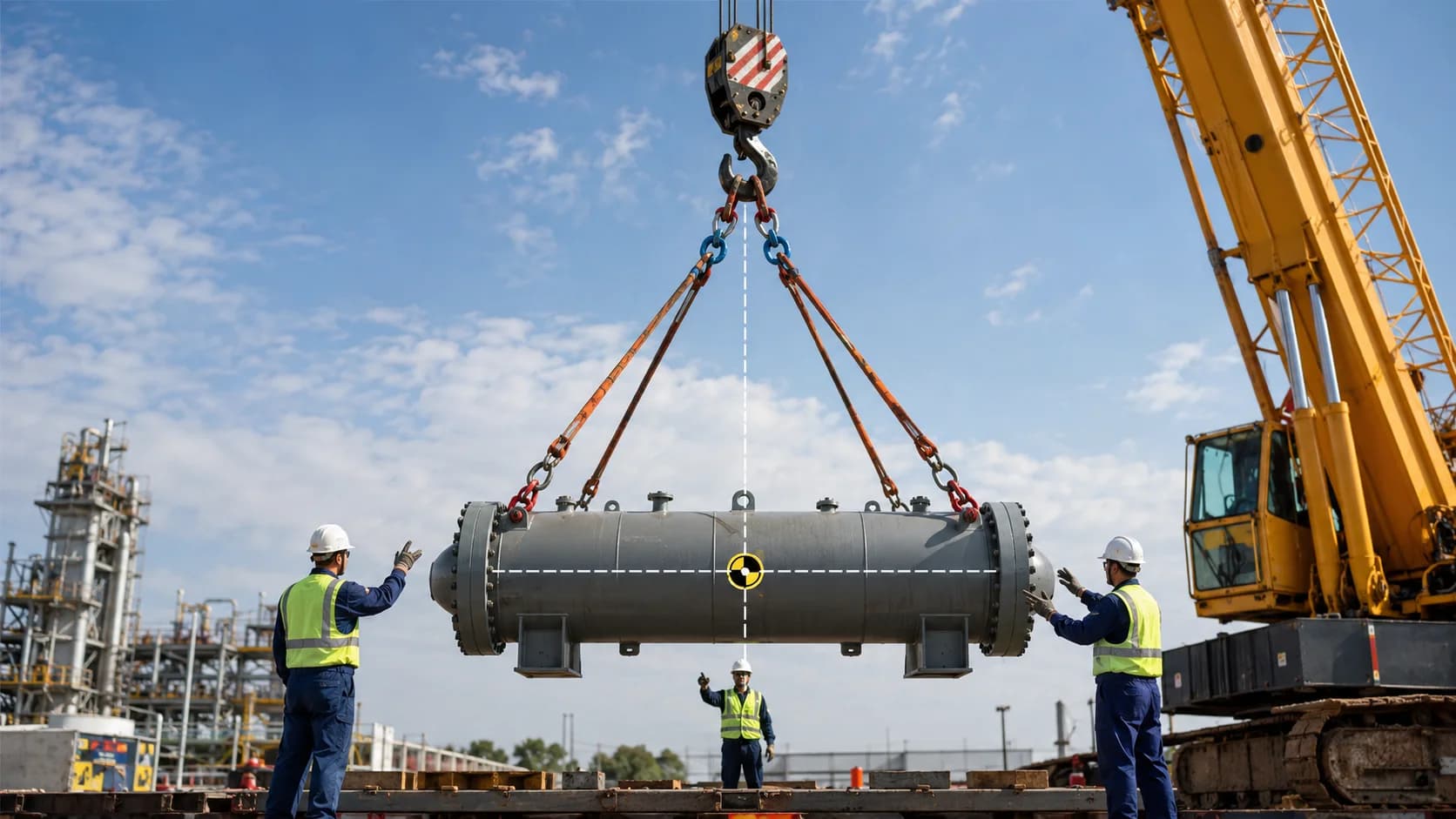
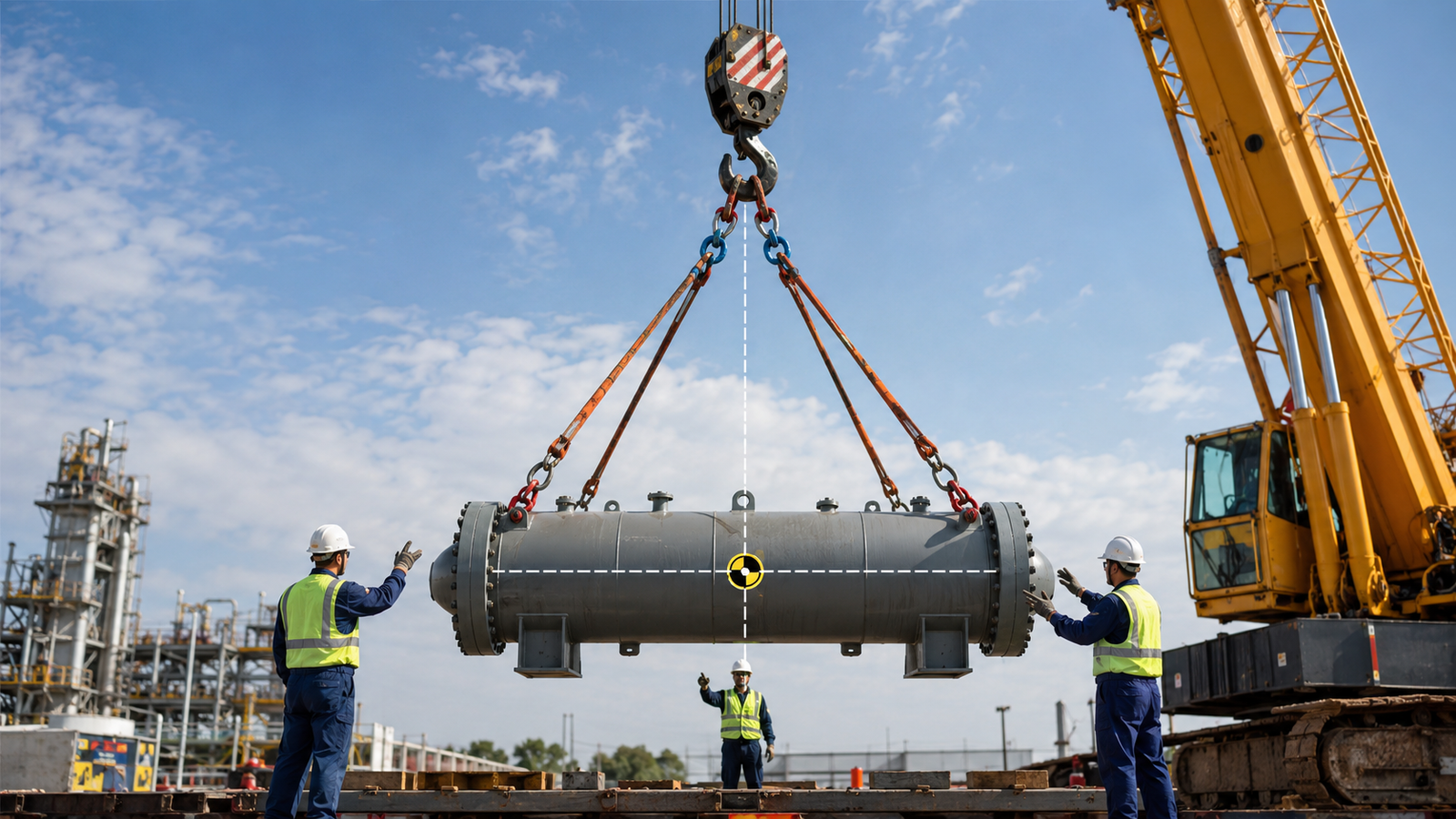
Rigging is the connection between the crane hook and the load, and it determines whether lifting force is transferred into the object in a controlled, balanced, and predictable way. The basic components—slings, shackles, hooks, lifting points, spreader beams, and other below-the-hook devices—may look simple, but their capacities depend on configuration, angle, loading direction, condition, and correct connection. A load can be well below the crane’s capacity and still be unsafe if the rigging is overloaded, the center of gravity is misunderstood, the sling legs are at poor angles, or the attachment points cannot carry the imposed forces. This guide introduces the practical fundamentals of rigging, including sling types, shackle and hook use, center of gravity, load balance, sling angle, load control, inspection, and communication. It is written as an educational guide, not a replacement for qualified rigger training or manufacturer instructions.
Use this guide with the exact manufacturer documentation. Capacities, configuration limits, inspection criteria, and operating procedures vary by crane model and jurisdiction.
Slings: The Main Load-Carrying Connections
Wire-rope slings offer durability and resistance to abrasion for many industrial lifts, but they require inspection for broken wires, crushing, kinks, corrosion, heat damage, and damaged end fittings. Confirm this point against the exact crane data and the actual field condition before proceeding.
Synthetic web and round slings are lighter and can protect finished surfaces, but they are vulnerable to cuts, sharp edges, heat, chemicals, and abrasion and therefore often require suitable edge protection. Confirm this point against the exact crane data and the actual field condition before proceeding.
Chain slings tolerate high temperatures and rugged service in many applications, but only approved lifting chain and components should be used, with links inspected for stretch, wear, deformation, or damage. Confirm this point against the exact crane data and the actual field condition before proceeding.
Every sling has a rated capacity that depends on hitch type and geometry, so the tag, certificate, or manufacturer data must be legible and matched to the actual configuration. Confirm this point against the exact crane data and the actual field condition before proceeding.
The safest sling is not simply the strongest one available; it must also suit the load surface, attachment points, environment, required length, angle, and method of controlling the object. Confirm this point against the exact crane data and the actual field condition before proceeding.
For example, a lift can change when the crane must be positioned farther away than planned. Recalculate the working condition rather than treating the extra radius as insignificant.
Shackles, Hooks, and Connection Hardware
Shackles are designed to carry load through specific parts of the body and pin, and side loading or forcing multiple sling eyes into a poorly fitting connection can reduce reliability. Confirm this point against the exact crane data and the actual field condition before proceeding.
The shackle size, working load limit, pin type, condition, and compatibility with the hook, sling eye, or lifting lug should be checked before use. Confirm this point against the exact crane data and the actual field condition before proceeding.
Hooks should have adequate throat size and load-seat geometry so the load bears in the bowl rather than on the tip, latch, or other unintended surface. Confirm this point against the exact crane data and the actual field condition before proceeding.
A hook latch can help retain loose rigging but is not a load-bearing device and should never be treated as a substitute for correct seating and connection. Confirm this point against the exact crane data and the actual field condition before proceeding.
Mixing components of uncertain grade, using makeshift bolts in place of shackle pins, or loading hardware in a direction not intended by the manufacturer are common rigging errors that should be eliminated during pre-lift inspection. Confirm this point against the exact crane data and the actual field condition before proceeding.
On a congested project, the limiting condition may occur later in the swing or at the set point, so check the complete lift envelope before mobilization.
Sling Angle and Load in Each Leg
When two or more sling legs support a load, the tension in each leg depends on the angle, and flatter sling angles create greater leg tension for the same suspended weight. Confirm this point against the exact crane data and the actual field condition before proceeding.
A sling that has enough vertical capacity can be overloaded when used at a low horizontal angle because each leg must produce a larger force to support the vertical component of the load. Confirm this point against the exact crane data and the actual field condition before proceeding.
Angle should be measured and calculated using the method specified by the rigging standard or manufacturer, and the selected sling capacity should match that angle and hitch type. Confirm this point against the exact crane data and the actual field condition before proceeding.
Spreader beams or lifting beams can improve geometry by maintaining more favorable sling angles, controlling compression on the load, or relocating connection points. Confirm this point against the exact crane data and the actual field condition before proceeding.
The rigging plan should account for unequal leg loading caused by an off-center center of gravity, unequal sling lengths, flexible loads, or connection points at different elevations. Confirm this point against the exact crane data and the actual field condition before proceeding.
Marking the crane center, support locations, load path, and landing area before setup makes the assumptions visible to the entire lifting team.
Center of Gravity and Load Balance
A suspended load will seek a position where its center of gravity lies vertically beneath the hook, which means an incorrect pick point can cause the object to tilt or rotate unexpectedly as it leaves support. Confirm this point against the exact crane data and the actual field condition before proceeding.
The center of gravity may not be at the geometric center, especially for machines, tanks with internal components, fabricated assemblies, or loads containing uneven materials. Confirm this point against the exact crane data and the actual field condition before proceeding.
Rigging attachment points and sling lengths should be arranged so the hook is above the estimated center of gravity and the load can rise in the intended attitude. Confirm this point against the exact crane data and the actual field condition before proceeding.
A controlled trial lift just clear of the support can reveal imbalance before the load is raised to full height, provided the lift plan allows a safe adjustment procedure. Confirm this point against the exact crane data and the actual field condition before proceeding.
Workers should never try to correct severe imbalance by standing under or pushing against a suspended load; the load should be lowered and the rigging configuration corrected. Confirm this point against the exact crane data and the actual field condition before proceeding.
When uncertainty remains, conservative planning is more reliable than using every unit of theoretical capacity. Keep usable margin for normal variation in weight, radius, and positioning.
Inspecting Rigging Before and During Use
Rigging should be inspected before use for identification, wear, deformation, cuts, broken wires, stretched links, damaged stitching, heat effects, corrosion, cracks, and damaged fittings. Confirm this point against the exact crane data and the actual field condition before proceeding.
Inspection criteria differ by sling and hardware type, so removal-from-service decisions should follow the applicable manufacturer instructions and governing standard rather than personal judgment. Confirm this point against the exact crane data and the actual field condition before proceeding.
Edge protection should stay in place through the lift because a sling can be damaged after initial tension when the load shifts or rotates against a sharp corner. Confirm this point against the exact crane data and the actual field condition before proceeding.
Rigging should be protected from welding current, hot surfaces, chemicals, moving equipment, and traffic while it is staged and after the load is landed. Confirm this point against the exact crane data and the actual field condition before proceeding.
Good rigging storage—dry, organized, off the ground, and separated from damaged equipment—makes inspection easier and reduces accidental reuse of items that have been removed from service. Confirm this point against the exact crane data and the actual field condition before proceeding.
After weather changes, relocation, or a configuration change, reconfirm the condition that controls the lift instead of assuming the earlier setup is still valid.
Planning the Lift and Controlling the Load
The rigging plan should identify load weight, center of gravity, approved lifting points, sling arrangement, hardware, hook position, expected angles, and the landing method before the crane takes weight. Confirm this point against the exact crane data and the actual field condition before proceeding.
Signal responsibilities and radio communication should be agreed in advance so the operator receives one clear set of instructions and everyone understands the stop signal. Confirm this point against the exact crane data and the actual field condition before proceeding.
Tag lines can help control rotation or orientation when appropriate, but they should not create a new entanglement, pinch, electrical, or line-of-fire hazard. Confirm this point against the exact crane data and the actual field condition before proceeding.
Personnel should stay clear of the fall zone and avoid placing hands, feet, or bodies where they could be trapped as the load comes into position. Confirm this point against the exact crane data and the actual field condition before proceeding.
Complex, unusual, high-value, or critical lifts may require engineered lifting points, designed spreader systems, proof information, or a written lift plan beyond basic field rigging practice. Confirm this point against the exact crane data and the actual field condition before proceeding.
A short handover record of configuration, key dimensions, support assumptions, rigging, and restrictions helps prevent the next shift from using an outdated plan.
Field Planning Checklist
Before the lift begins, convert the planning discussion into a short field checklist. A checklist does not replace judgment; it makes sure the agreed assumptions are visible and repeatable. The following items should be adapted to the exact crane, manufacturer instructions, project lift plan, and local requirements:
- Verify load weight and center of gravity.
- Use approved lifting points.
- Select sling type for the environment and load surface.
- Check sling tag and rated capacity.
- Calculate or verify sling angles.
- Inspect shackles, hooks, and fittings.
- Use edge protection where needed.
- Confirm hook is above the intended center of gravity.
- Perform a controlled trial lift when appropriate.
- Keep personnel clear of the suspended-load zone.
A useful completion rule is that every unchecked item must have an owner and a reason. If the crew cannot confirm a load weight, support condition, configuration setting, or communication method, that uncertainty should be resolved before the lift proceeds. This is particularly important when a change appears small, because crane capacity and stability can be sensitive to geometry and support conditions.
Common Planning Mistakes to Avoid
- Using a crane’s advertised maximum capacity as though it applies at every radius and boom length. The better practice is to identify the assumption during planning, assign a clear verification method, and stop when the field condition no longer matches the basis of the lift.
- Assuming site ground is adequate because trucks or smaller equipment have already driven over it. The better practice is to identify the assumption during planning, assign a clear verification method, and stop when the field condition no longer matches the basis of the lift.
- Leaving rigging, hook, attachment, counterweight, support, or configuration details until the crane is already set up. The better practice is to identify the assumption during planning, assign a clear verification method, and stop when the field condition no longer matches the basis of the lift.
- Treating alarms, limiters, or electronic displays as replacements for a planned load chart and physical inspection. The better practice is to identify the assumption during planning, assign a clear verification method, and stop when the field condition no longer matches the basis of the lift.
- Continuing after site conditions, weather, crane level, access, or load geometry changes from the approved plan. The better practice is to identify the assumption during planning, assign a clear verification method, and stop when the field condition no longer matches the basis of the lift.
Frequently Asked Questions
Why do shallow sling angles increase tension?
A sling leg at a shallow angle provides less vertical lifting force for each unit of tension, so the total tension in the leg must increase to support the same load. This is why angle is a core part of sling selection. Always confirm model-specific limits in the crane manual and project plan.
Can I use a shackle pin as a substitute bolt?
No. Lifting shackles should be used with their correct manufacturer-approved pins and in the intended loading direction. Substituting ordinary hardware can create an unknown and unsafe connection. Always confirm model-specific limits in the crane manual and project plan.
How do I find the center of gravity?
Use drawings, manufacturer data, known component weights, or engineering calculations where possible. For appropriate loads, a carefully controlled low trial lift can help verify balance before the load is raised. Always confirm model-specific limits in the crane manual and project plan.
Are synthetic slings safe around sharp edges?
They can be, but suitable edge protection and manufacturer guidance are essential. Synthetic material can be cut quickly when loaded against a sharp corner. Always confirm model-specific limits in the crane manual and project plan.
Does stronger rigging make a lift automatically safer?
No. Capacity is only one factor. Geometry, attachment points, center of gravity, hardware compatibility, condition, environment, and load control all have to be correct. Always confirm model-specific limits in the crane manual and project plan.
Conclusion
Good crane work is built on disciplined preparation. The most useful habit is to keep connecting the planned lift back to measurable facts: actual load, actual radius, actual configuration, actual support condition, and actual clearance. When those facts remain inside the manufacturer limits and the crew understands the plan, the crane can be used efficiently without relying on guesswork. When one of those facts changes, the plan should change with it. Treat the load chart, setup information, rigging data, safety systems, and site conditions as one connected system, and involve qualified personnel whenever the lift is unusual, close to a limit, or affected by uncertain ground or structural conditions.
Get More Expert Guides & Updates
Subscribe for Machinery.org guide updates and product learning content.