

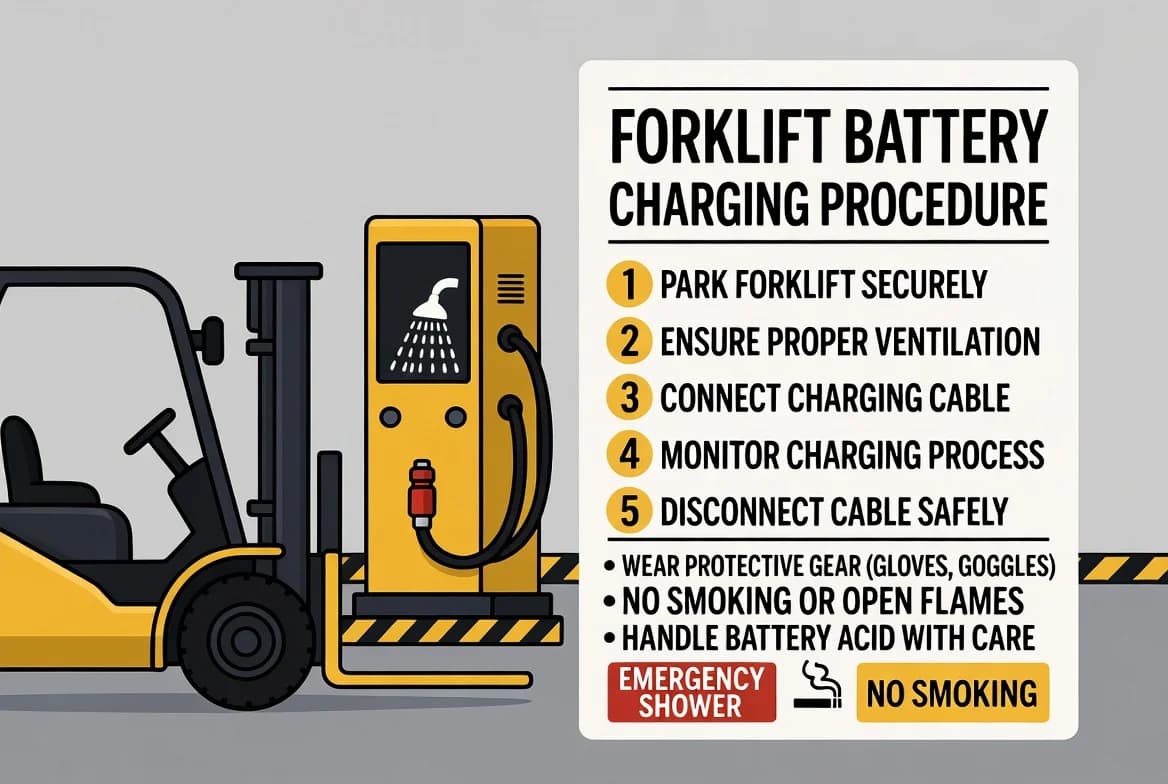

Battery charging for electric forklifts involves significant hazards: explosive hydrogen gas, corrosive electrolyte, high electrical current, and heavy batteries that can cause crushing injuries. A well-designed charging area and strict adherence to safe procedures eliminate most of these risks.
Charging should occur only in designated areas that are well ventilated, free of ignition sources, and equipped with emergency eyewash and shower facilities. Hydrogen gas is produced during charging, especially toward the end of the charge cycle; accumulation in poorly ventilated spaces creates an explosion hazard. No smoking, open flames, or spark-producing equipment is permitted in the charging area.
Personal protective equipment—chemical-resistant gloves, safety glasses or face shield, and protective clothing—must be worn when handling batteries or electrolyte. Acid spills should be neutralized with appropriate agents and cleaned promptly. Batteries must be charged with the correct charger matched to the battery voltage and capacity; using an incorrect charger can overheat the battery or produce excessive gassing.
Before connecting the charger, the truck should be parked on level ground, the parking brake applied, and the key switch turned off. Connect the charger to the battery before plugging the charger into the wall outlet (or follow the manufacturer’s sequence). Monitor the charge; do not leave charging batteries unattended for extended periods if the charger lacks automatic termination. After charging, disconnect in the reverse order and allow the battery to cool if it is hot before returning the truck to service.
Opportunity charging (short charges during breaks) is common with lithium-ion batteries and with some lead-acid systems designed for it. Conventional lead-acid batteries generally prefer a full charge cycle followed by a cool-down period. Equalization charges are required periodically for flooded lead-acid batteries to prevent stratification and sulfation.
Battery handling equipment—gantry cranes, battery carts, or change stands—must be rated for the battery weight and used according to safe lifting practices. Never attempt to lift a battery by hand. Keep the tops of batteries clean and dry; corrosion on terminals increases resistance and heat.
Training every person who charges or changes batteries, posting clear procedures, and maintaining the charging infrastructure are essential elements of a safe electric-forklift program.
Get More Expert Guides & Updates
Subscribe for Machinery.org guide updates and product learning content.