

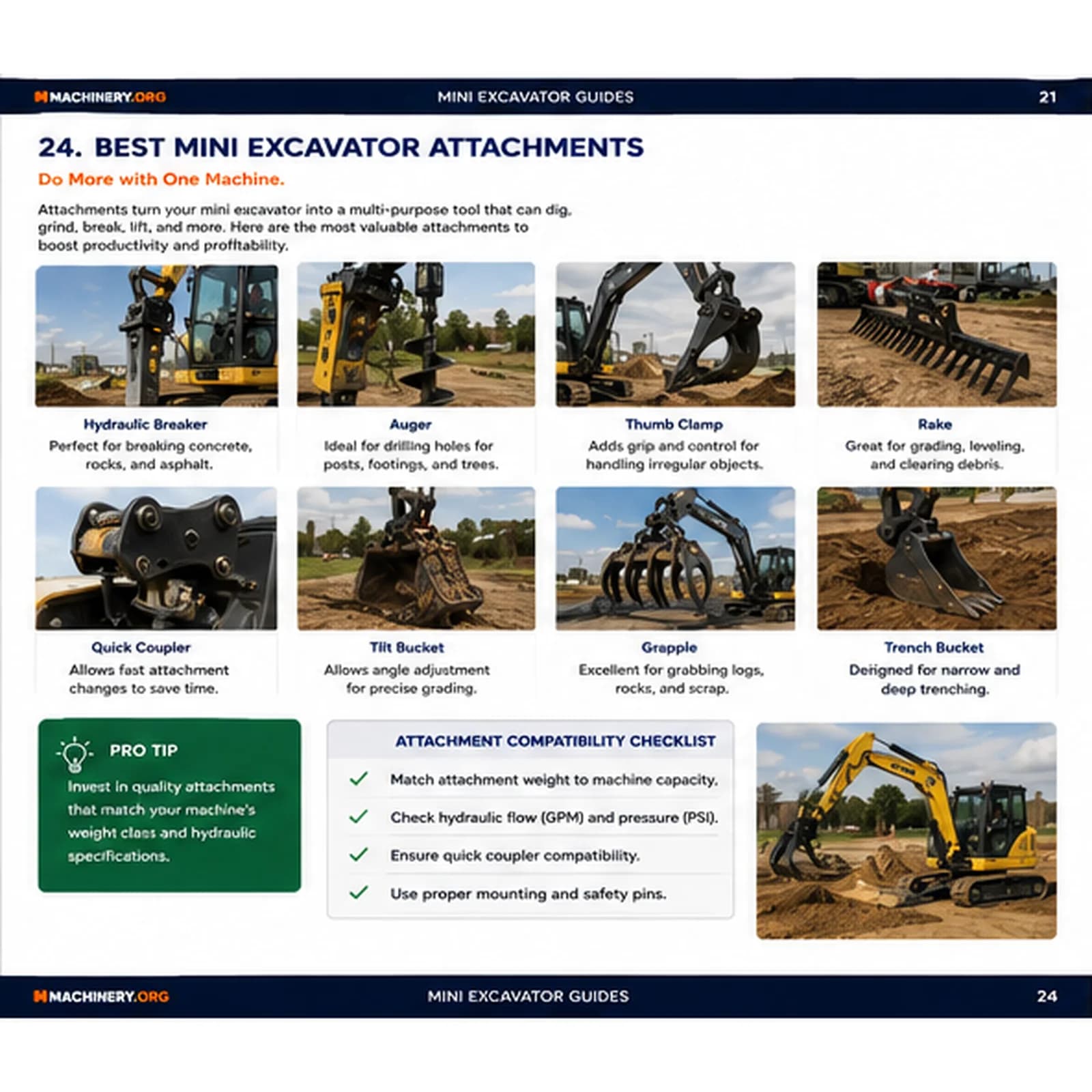
A mini excavator becomes far more valuable when it is treated as an attachment platform rather than a machine with only one bucket. With the correct tools, the same carrier can dig utilities, drill holes, break concrete, move logs, grade slopes, clear brush, compact trench backfill, and handle materials. Attachments can reduce the need for additional machines, create new services for a contractor, and improve utilization across the year.
The best attachment is not simply the most impressive tool in a catalog. It is the tool that matches the machine, the customer workload, and the business case. A hydraulic breaker may be essential for one contractor and rarely used by another. An auger may create steady revenue for fencing and landscaping companies, while a tilt bucket may save more time for drainage and finish-grading specialists. Compatibility, frequency of use, transport, maintenance, and operator skill should guide the purchase.
This guide reviews the highest-value mini excavator attachments and explains when each one makes sense.

Figure 24.1. Machinery.org attachment guide showing high-value mini excavator tools and their best applications.
Quick coupler
A quick coupler is often the first attachment-system investment because it makes every other tool easier to use. Manual couplers reduce change time without adding hydraulic complexity. Hydraulic couplers allow the operator to switch compatible tools from the cab on supported systems. The coupler must match pin diameter, spacing, bucket width, machine class, and locking procedure. Operators should perform the required visual or physical lock check every time.
Hydraulic breaker
Breakers are used for concrete, asphalt, rock, foundations, and demolition preparation. Correct sizing is critical. A breaker that is too large can overload the boom, pins, and hydraulic system. A tool that is too small may produce poor results and encourage excessive blank firing. Required flow, pressure, case drain, tool diameter, and carrier weight must all be confirmed. Proper lubrication and operating technique have a major effect on service life.
Auger
Augers create holes for fence posts, signs, footings, trees, poles, and soil sampling. Buyers should match drive torque, hydraulic flow, bit diameter, and soil conditions. Soft soil may allow larger bits, while dense clay, gravel, and rock require more torque and specialized teeth. Extensions increase depth but also increase bending loads and make the assembly more difficult to control.
Hydraulic thumb or grapple
A thumb works with the bucket to grip logs, rocks, brush, demolition debris, and irregular objects. Fixed thumbs are simple and affordable but have limited positions. Hydraulic thumbs provide better control and can fold away when not needed. Dedicated grapples may provide more capacity and rotation, but they add weight, cost, and hydraulic requirements. Guarding and load visibility are important because irregular objects can shift unexpectedly.
Tilt bucket and tiltrotator
Tilt buckets improve slope shaping, ditch cleaning, and grading around structures. Tiltrotators add rotation as well as tilt, allowing the bucket or tool to work at many angles without repositioning the excavator. They can transform productivity in precision work, but they also add weight, height, hydraulic complexity, and training needs. The machine’s lifting capacity and coupler system should be reviewed before installation.
Rake and grading attachments
Landscape rakes, grading beams, and wide cleanout buckets help prepare seed beds, spread topsoil, remove roots, level aggregate, and finish surfaces. These attachments often create strong value because they reduce hand labor and eliminate repeated machine repositioning. They are most effective when the machine has smooth controls and the operator understands grade and material flow.
Trenching bucket and compaction wheel
A narrow trenching bucket reduces spoil volume for utilities. After installation, a compaction wheel can consolidate backfill in layers without moving a separate compactor into the trench area. The wheel must match trench width and soil type. Compaction quality should be verified according to project requirements rather than assumed from appearance.
Ripper tooth
A ripper concentrates force at a single point to break frost, roots, compacted soil, shale, and hard ground before excavation. It is simple, low-maintenance, and often more effective than forcing a wide bucket into resistant material. A ripper can also reduce stress on bucket teeth and cutting edges.
Mulching and brush-clearing tools
Specialized cutters and mulchers allow compact excavators to manage vegetation along slopes, ditches, and confined areas. These tools require careful hydraulic matching, guarding, debris control, and exclusion zones. They may need case drains or high-flow circuits that are not available on every mini excavator. Operators must follow the attachment manufacturer’s safety requirements because thrown-object hazards can be severe.
How to prioritize purchases
List the jobs performed most frequently and the tasks currently completed by hand, rental machine, or subcontractor.
Estimate annual attachment use and realistic revenue or labor savings.
Confirm machine compatibility, hydraulic flow, pressure, coupler type, and net lifting capacity.
Calculate transport weight, storage needs, maintenance cost, and required spare wear parts.
Test or rent the attachment before buying when the application is unfamiliar or highly specialized.
Train operators and create an inspection routine for each hydraulic or rotating tool.
A strong starter attachment package
For many owners, a practical starter package includes a general-purpose bucket, narrow trenching bucket, grading bucket, hydraulic thumb, and quick coupler. An auger or breaker can be added when customer demand supports it. This package covers digging, utilities, cleanup, grading, and material handling without adding excessive hydraulic complexity.
Compatibility checklist
Machine operating weight and approved attachment class
Pin or coupler dimensions and locking method
Hydraulic flow, pressure, case drain, and electrical connections
Attachment weight and effect on lift capacity
Hose routing through the full boom and arm range
Guarding, visibility, transport, storage, and operator training requirements
Attachments produce value when they are used frequently, changed efficiently, and maintained correctly. Buying too many low-use tools can tie up capital and create storage problems. Buying the right few tools can turn a compact excavator into the most utilized machine in the fleet.

Figure 24.2. Machinery.org attachment-selection chart covering compatibility, productivity, and common jobsite uses.
Frequently Asked Questions
What is the most useful mini excavator attachment?
For many owners, a hydraulic thumb or quick coupler provides the broadest everyday benefit, but the best choice depends on the workload.
Can a mini excavator run a brush cutter?
Some can, but hydraulic flow, pressure, case drain, carrier weight, guarding, and manufacturer approval must be confirmed.
Should I buy or rent specialized attachments?
Renting is often sensible for low-frequency or uncertain work. Buying makes more sense when use, revenue, or labor savings are predictable.
Key Takeaway
Start with attachments that solve frequent jobs, verify compatibility carefully, and measure real labor or revenue benefit. A focused attachment package is usually more profitable than a large collection of rarely used tools.
Get More Expert Guides & Updates
Subscribe for Machinery.org guide updates and product learning content.