
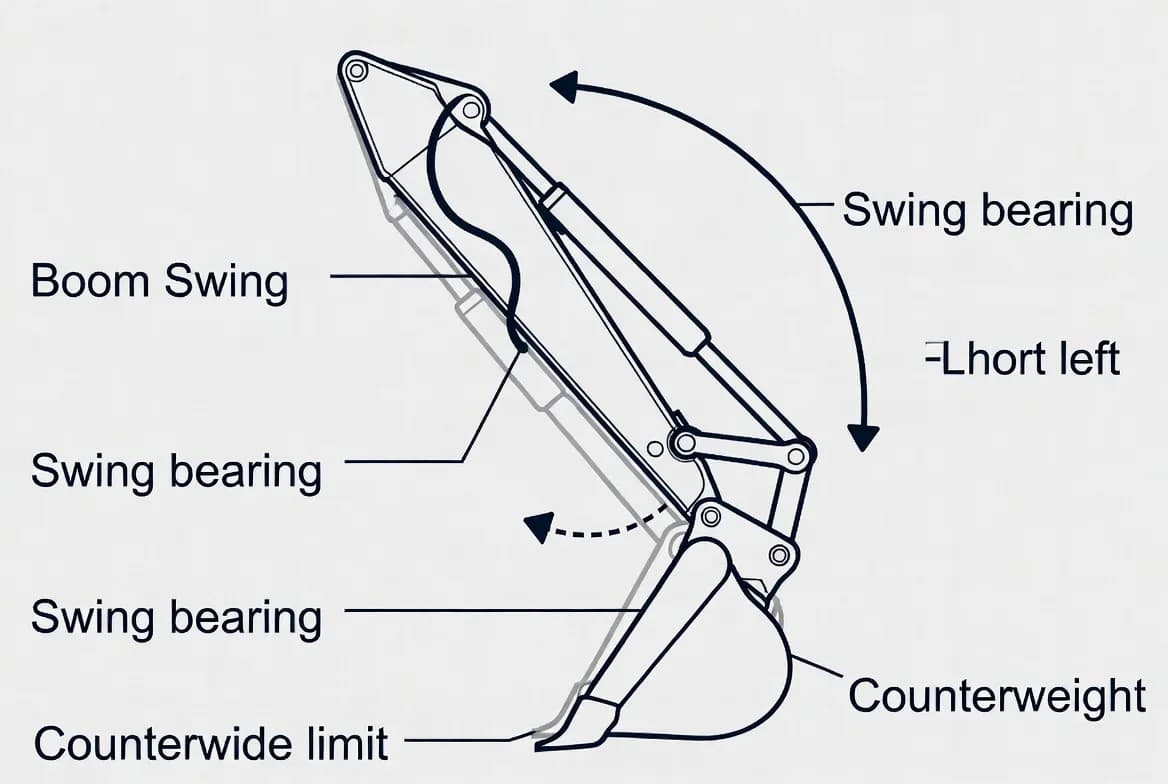
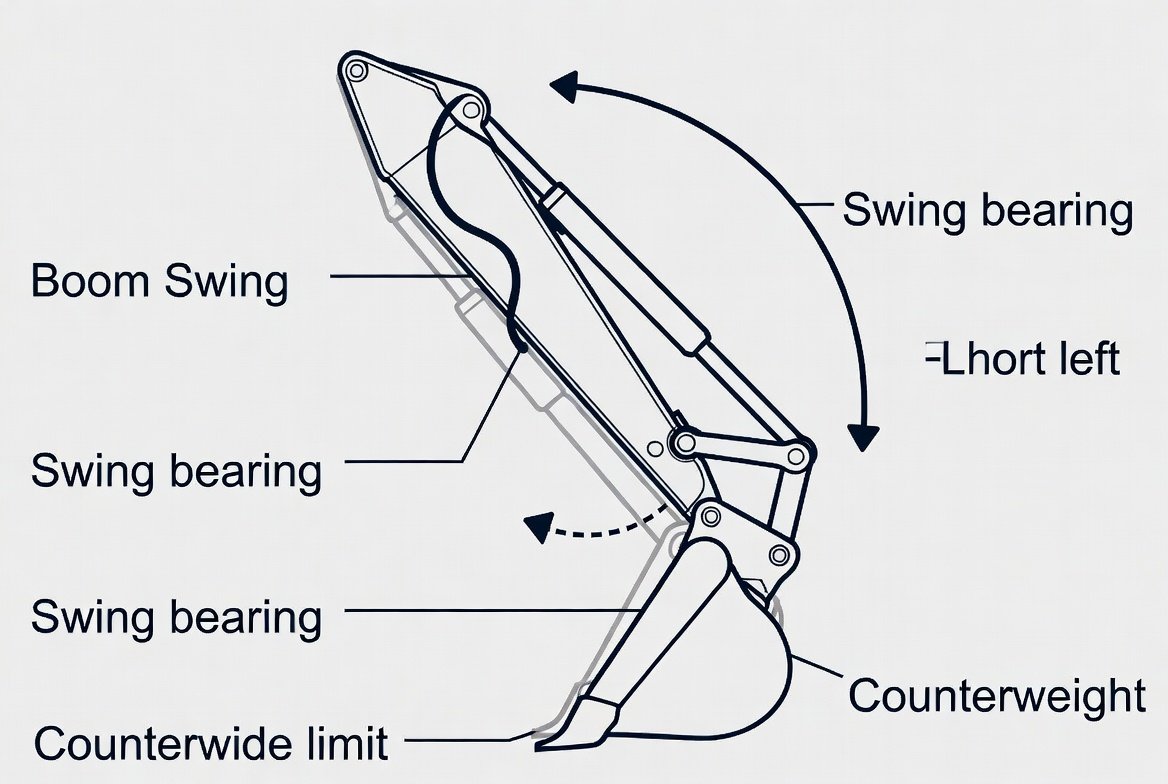
Boom swing (also called boom offset or side shift) is a feature found on many mini and midi excavators that allows the boom to pivot left or right relative to the upper structure. This capability is distinct from the full 360-degree rotation of the house on the swing bearing. Boom swing enables the operator to dig or place material to the side of the machine without having to reposition the tracks—an invaluable ability when working parallel to a wall, a trench, or a roadway.
How Boom Swing Works
On machines equipped with boom swing, the boom is mounted on a secondary pivot that is controlled by one or more hydraulic cylinders. The operator can offset the boom by a significant angle—often 50 to 90 degrees or more to each side—while the upper structure remains stationary relative to the tracks. The result is that the bucket can work outside the track envelope on either side of the machine.
There are two common mechanical arrangements. In the first, the entire boom swings on a vertical pin located near the front of the upper structure. In the second, a more complex linkage allows the boom to offset while maintaining a more favourable geometry for digging force. Both systems are controlled by a dedicated hydraulic circuit and are usually operated by a switch or proportional control on the joystick.
Practical Advantages
The most obvious advantage is the ability to dig a trench or foundation wall parallel to an existing structure while keeping the tracks a safe distance away. Without boom swing the operator would have to angle the entire machine, reducing stability and often requiring multiple repositioning moves. With boom swing the machine can sit parallel to the work and still reach the required line.
Boom swing is also useful when loading trucks from one side only, when working in a narrow easement, or when avoiding overhead obstacles that would interfere with a full house swing. In landscaping applications it allows precise placement of material against a wall or fence without the rear of the machine swinging into landscaping or structures on the opposite side.
Limitations and Considerations
When the boom is offset, the dig depth, reach, and breakout force change because the geometry of the linkage relative to the machine centreline is altered. Manufacturers publish dig-depth and lift-capacity charts for both the centred and the fully offset positions. Operators must be aware that maximum performance is usually achieved with the boom centred; offset operation trades some capacity for the ability to work to the side.
Stability is also affected. Digging or lifting with the boom fully offset places greater overturning moment on the side of the undercarriage. On soft ground or when working near a slope, the operator must exercise additional caution. Some machines automatically reduce hydraulic pressure or display a warning when the boom is offset beyond a certain angle.
Not all excavators offer boom swing. It is most common on mini and compact models where the feature adds the greatest practical value. On larger machines the same capability is sometimes provided by a tiltrotator or by the operator simply rotating the house, because the greater reach and the larger working area make pure side-offset less critical.
Operating Techniques
Effective use of boom swing requires practice. The operator must learn to coordinate house swing, boom offset, and stick/bucket movement so that the bucket follows a smooth path. When trenching parallel to a wall, the usual technique is to set the boom offset so that the bucket centreline is on the desired trench line, then use a combination of stick-in and house swing to advance along the trench. Periodic recentering of the boom helps maintain maximum force when penetrating hard material.
When finishing a vertical wall or cleaning a trench bottom, the ability to offset the boom allows the operator to keep the bucket face parallel to the wall without having the tracks angled awkwardly. This improves both the quality of the finished surface and the safety of the operation.
In summary, boom swing is a powerful feature that greatly expands the working envelope of compact excavators in confined spaces. By allowing the boom to offset independently of house rotation, it enables efficient parallel digging, safer operation close to obstacles, and more precise material placement. Operators who master the coordination of boom swing with the other machine functions gain a significant productivity and safety advantage on many types of work.
Get More Expert Guides & Updates
Subscribe for Machinery.org guide updates and product learning content.