

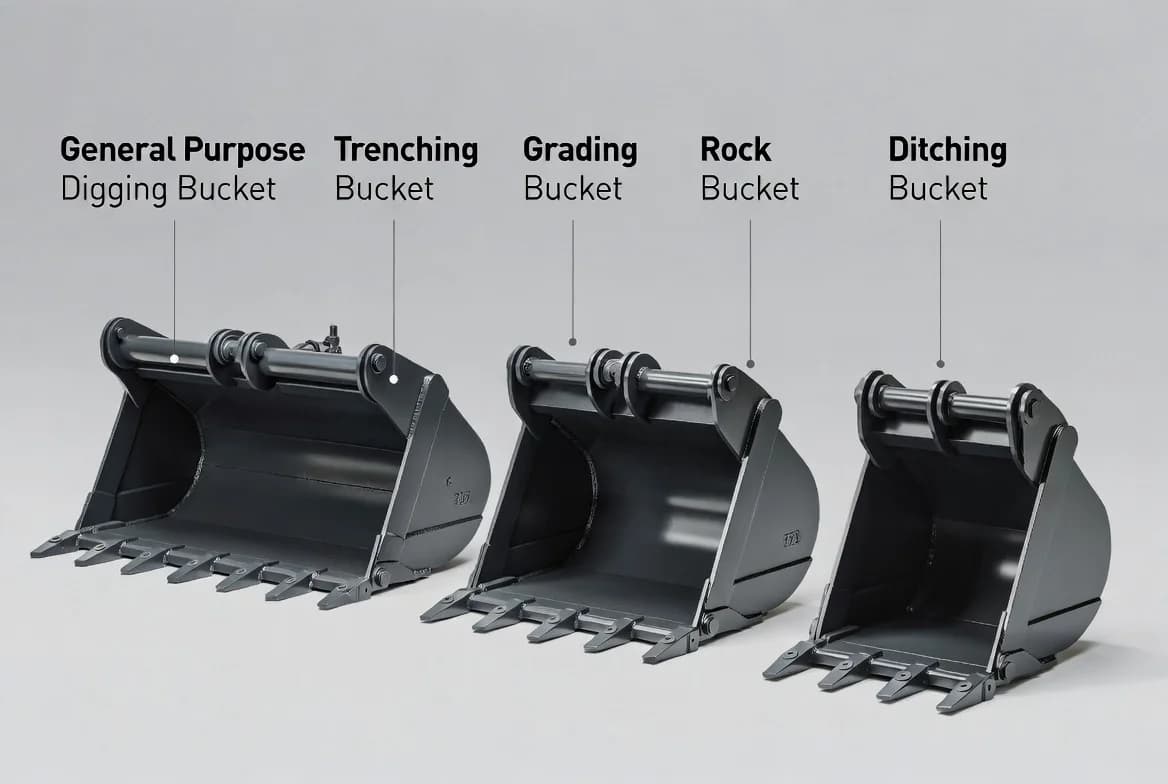

The bucket is the primary working tool of an excavator and has a greater influence on productivity and the quality of the finished excavation than almost any other component. Selecting the correct bucket for the material, the machine, and the task is therefore a critical decision. A well-chosen bucket fills quickly, dumps cleanly, penetrates efficiently, and wears at a predictable rate. A poorly chosen bucket reduces production, increases fuel consumption, and accelerates wear on both the bucket and the machine.
General-Purpose Digging Buckets
The standard digging bucket is the most common attachment. It is designed for a balance of capacity, penetration, and strength in a wide range of soils. Typical features include a curved side profile that aids in filling, a reinforced cutting edge, and provision for bolt-on teeth or a continuous edge. Capacity is usually stated in heaped (ISO or SAE) cubic metres or cubic yards. For a given machine the largest general-purpose bucket that can be filled efficiently in the expected material is usually the most productive choice for bulk excavation.
Trenching Buckets
Trenching buckets are narrower and often deeper than general-purpose buckets. They are optimised for digging narrow, straight-sided trenches for utilities. The narrow width concentrates breakout force, improving penetration in hard ground, and the shape helps maintain vertical trench walls. Many trenching buckets are available in a range of widths so that the trench can be sized exactly to the pipe or cable being installed, minimising the volume of material that must be excavated and backfilled.
Grading and Ditching Buckets
Grading buckets (also called ditching or clean-up buckets) are wide, shallow, and usually have a smooth, continuous cutting edge rather than teeth. They are used for finishing slopes, cleaning ditch bottoms, and grading surfaces to a precise elevation. The wide cutting edge produces a smooth finish and allows the operator to spread material evenly. Because they lack teeth, grading buckets are not intended for hard digging; they are finishing tools.
Heavy-Duty and Rock Buckets
When the material is abrasive, rocky, or heavily compacted, a heavy-duty or rock bucket is required. These buckets feature thicker plate, additional wear protection (such as wear plates, heel shrouds, and reinforced side cutters), and often a more aggressive tooth system. The added weight and strength reduce capacity slightly compared with a general-purpose bucket of the same width, but the increased durability and penetration capability more than compensate in tough conditions.
Specialised Buckets
Many other specialised designs exist. Skeleton or grizzly buckets allow fine material to sift through while retaining larger rock or debris. Clamshell buckets are used for precise placement or for digging in vertical shafts. Tilt buckets incorporate a hydraulic tilt mechanism that allows the cutting edge to be angled relative to the stick, greatly improving the ability to grade slopes and to work against vertical faces. Frost buckets or V-buckets are shaped for cutting through frozen ground or for creating V-shaped ditches.
Matching Bucket to Machine and Material
The first rule is never to exceed the machine’s rated lifting capacity or the structural limits of the linkage. A bucket that is too large or too heavy will overload the machine, reduce cycle speed, and may cause structural damage. Manufacturers publish recommended bucket-size ranges for each model.
Material density is the next consideration. A bucket that fills completely with light topsoil may be only partially filled with dense clay or rock before the machine reaches its lifting limit. In dense materials a smaller bucket often produces higher overall productivity because it can be filled and dumped more quickly and with less strain on the machine.
Tooth selection also matters. Twin tiger teeth or other aggressive profiles improve penetration in hard ground but wear faster and leave a more irregular trench bottom. Standard teeth or a continuous edge are better for general digging and for producing a smooth finish.
Wear Parts and Maintenance
The cutting edge, side cutters, and teeth are sacrificial wear parts. Replacing them before they are completely worn protects the more expensive bucket structure. Many contractors keep a spare set of teeth and a spare cutting edge on the service truck so that replacement can be performed in the field with minimal downtime.
In summary, the correct excavator bucket is the one that balances capacity, penetration, durability, and finish quality for the specific combination of machine, material, and task. Investing time in selecting and maintaining the right bucket yields continuous returns in higher productivity, lower fuel use, and longer component life.
Get More Expert Guides & Updates
Subscribe for Machinery.org guide updates and product learning content.