

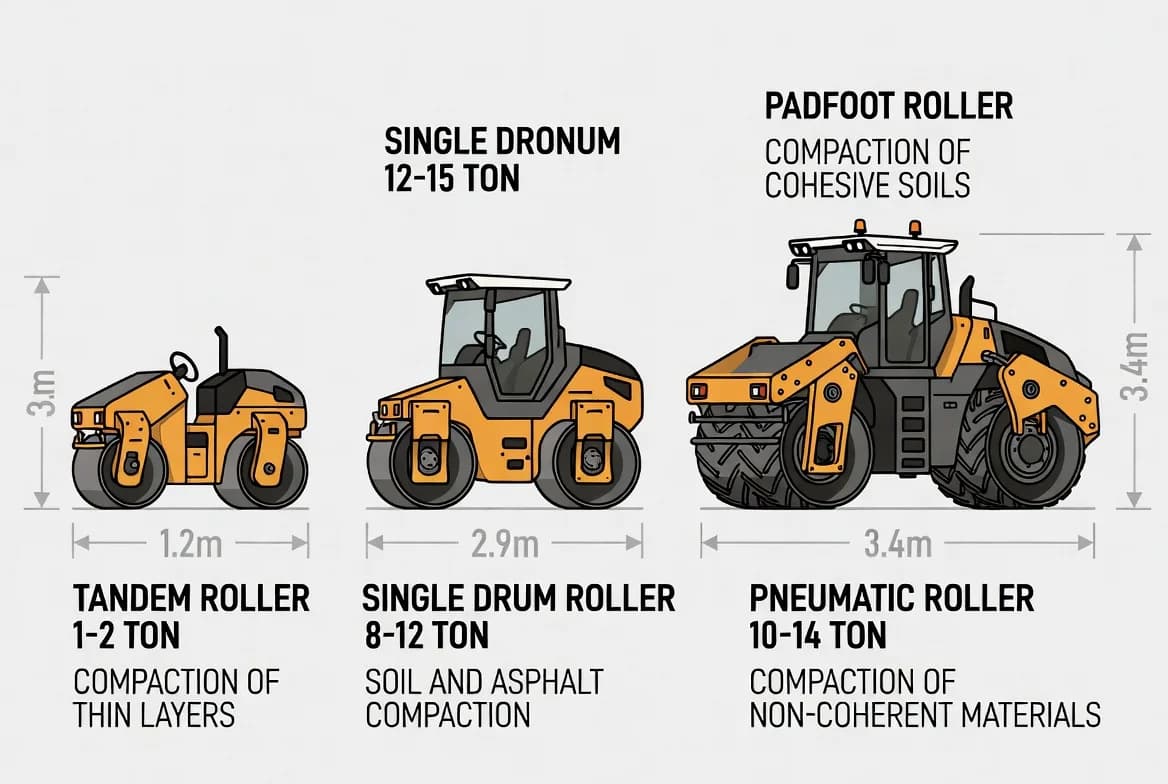

Selecting the correct roller size balances production capacity, material characteristics, site constraints, and total cost. A roller that is too small will require an excessive number of passes and may never achieve the specified density in thick lifts. A roller that is too large may be difficult to transport, may over-compact thin layers, or may be uneconomical for the volume of work. Systematic evaluation of the key variables leads to an appropriate choice.
Roller size is commonly expressed by operating weight in tonnes and by drum width. Light tandem rollers in the 1–3 tonne range are used for footpaths, patching, and thin asphalt layers. Medium tandem and single-drum rollers in the 7–13 tonne range handle most road-base and asphalt work on secondary roads and parking areas. Heavy single-drum and padfoot rollers of 15–25 tonnes and above are employed on major highway fills, embankments, and thick aggregate bases. Pneumatic-tired rollers of 10–25 tonnes provide a kneading action that is particularly effective on asphalt and on certain soils.
Granular materials and thick lifts benefit from heavier rollers with high centrifugal force. Cohesive soils often respond better to padfoot drums that knead the material; the required weight depends on plasticity and moisture content. Asphalt lift thickness is a primary constraint: a heavy vibratory roller on a thin lift can punch into the mix or create a wavy surface. Manufacturers publish recommended minimum and maximum lift thicknesses for each model; these guidelines should be observed.
Site access and geometry also influence size selection. Narrow urban streets, residential developments, and confined industrial sites may limit the use of wide or long rollers. Transport restrictions—bridge load limits, trailer capacity, and local permit requirements—can make a slightly smaller roller more practical even if a larger machine would be more productive on an open site. Productivity is a function of drum width, operating speed, number of passes required, and overall efficiency. A wider, heavier roller can cover more area per hour only if the material and lift thickness allow it to achieve density in a reasonable number of passes.
Owning and operating costs rise with size. Fuel consumption, drum or tyre wear, and transport cost all increase. A detailed cost-per-cubic-metre or cost-per-square-metre comparison that includes the number of rollers required to keep pace with the paver or the earthmoving fleet often reveals the most economical choice. When in doubt, consult the manufacturer’s application engineers or conduct a short field trial with candidate machines. In summary, roller size should be matched to the material, lift thickness, production requirements, and practical site and transport constraints.
Get More Expert Guides & Updates
Subscribe for Machinery.org guide updates and product learning content.