
Machinery is the backbone of modern construction, mining, agriculture, roadwork, material handling, demolition, landscaping, and industrial development. Whether someone is a beginner learning about heavy equipment for the first time, a contractor comparing models, an educator preparing technical lessons, or a buyer researching machines before making a purchase, understanding the main categories of machinery is essential. Each type of machine is designed for a specific purpose, and choosing the wrong equipment can lead to wasted money, poor productivity, safety risks, and unnecessary maintenance problems.
This guide explains the most important machinery categories, how they are used, what buyers should compare, and how equipment, attachments, brands, guides, news, and marketplace information should work together on a serious machinery platform like Machinery.org.
1. Earthmoving Equipment
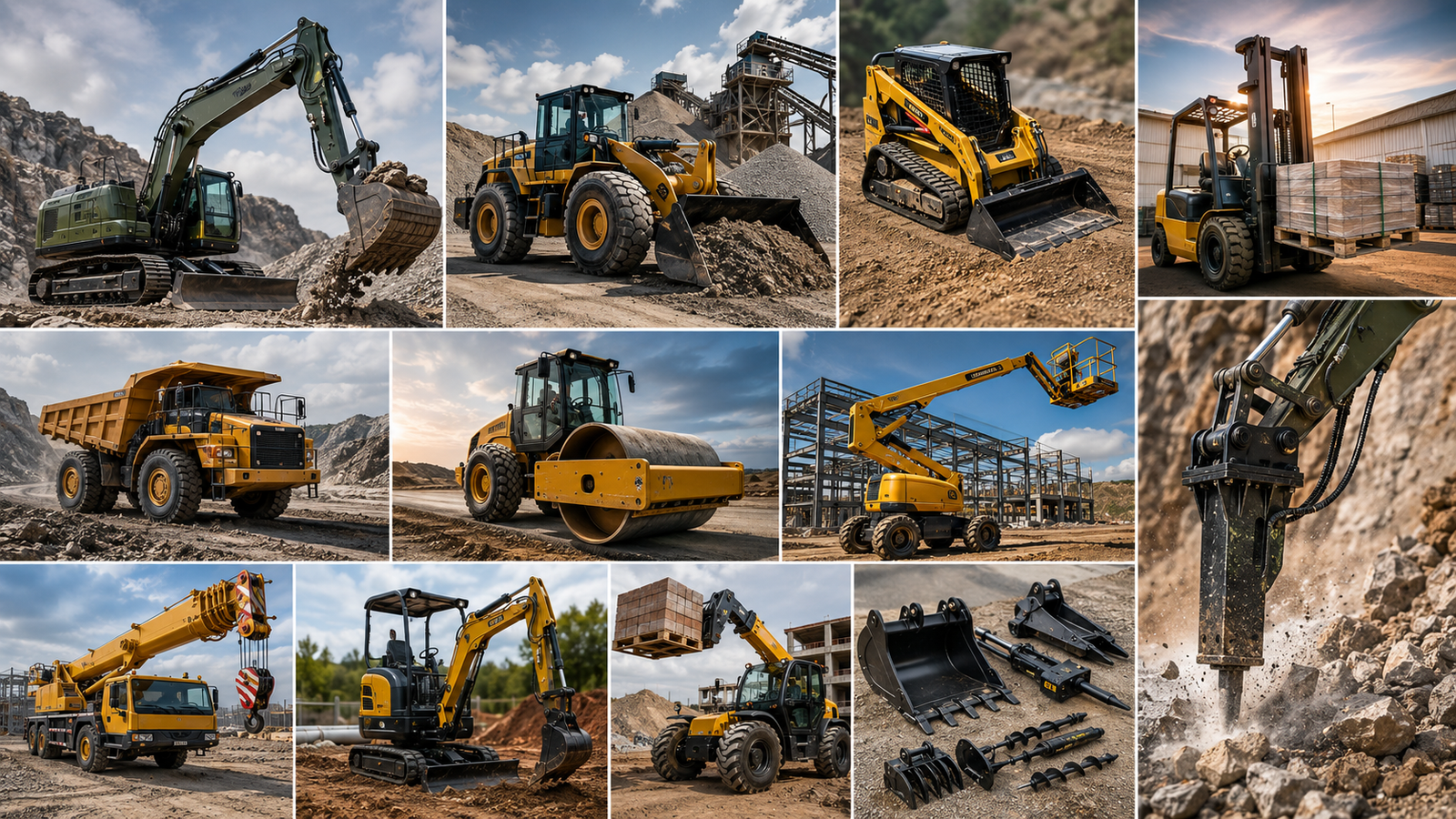
Earthmoving equipment is one of the most important machinery categories in construction and infrastructure work. These machines are built to dig, push, lift, grade, move, and shape soil, rock, gravel, sand, and other ground materials. Earthmoving machines are commonly used in building foundations, road construction, trenching, drainage work, mining preparation, landscaping, land clearing, and site development.
The most recognized earthmoving machine is the excavator. Excavators use a boom, arm, and bucket to dig and load material. They are available in many sizes, from mini excavators used in gardens and tight urban spaces to large crawler excavators used in mining and heavy construction. Excavators can also work with attachments such as hydraulic breakers, thumbs, grapples, augers, rippers, and grading buckets.
Mini excavators are especially popular with small contractors, landscapers, farmers, utility companies, and rental users. They are easier to transport than larger machines and can work in narrow spaces where full-size excavators cannot operate. A beginner may choose a mini excavator for trenching, drainage, small foundations, fence installation, stump removal, and light demolition. Professionals compare mini excavators by operating weight, digging depth, engine power, hydraulic flow, attachment compatibility, tail swing, cab comfort, and maintenance access.
Bulldozers are another major earthmoving machine. They use a large front blade to push soil, rock, sand, debris, and construction material. Dozers are useful for land clearing, road building, grading, mining work, and heavy pushing tasks. Track-type dozers provide strong traction on soft or uneven ground. Wheel dozers are faster and useful on larger sites where mobility matters.
Wheel loaders are used to scoop, lift, carry, and load materials. They are commonly seen in construction yards, quarries, farms, recycling centers, and material depots. Wheel loaders can load trucks, move aggregate, handle snow, carry pallets with forks, and support many site operations. Buyers usually compare bucket capacity, engine power, lifting height, breakout force, operating weight, fuel consumption, and visibility.
Backhoe loaders combine a front loader bucket with a rear digging arm. They are versatile machines for small construction companies, municipal work, farms, and utility projects. A backhoe loader can dig trenches, move soil, load material, break concrete, and perform general site tasks. For users who need one machine to do many jobs, a backhoe loader can be very practical.
Motor graders are used for precision grading and road finishing. They have a long blade mounted under the machine, allowing operators to create smooth road surfaces, maintain gravel roads, shape drainage slopes, and prepare sites before paving. Motor graders require skilled operators because small blade adjustments can significantly affect final surface quality.
2. Compact Equipment
Compact equipment is designed for tight spaces, smaller jobs, and easier transport. These machines are popular with landscapers, rental companies, small builders, property owners, farms, and contractors who need flexible machines that can work in restricted areas.
Skid steer loaders are compact machines with wheels and lift arms. They can turn in a very tight radius, making them useful in yards, warehouses, barns, demolition areas, and small construction sites. A skid steer loader can use many attachments, including buckets, pallet forks, sweepers, trenchers, augers, grapples, snow blades, and brush cutters.
Compact track loaders are similar to skid steer loaders but use rubber tracks instead of wheels. Tracks provide better traction and lower ground pressure, which helps on mud, sand, slopes, and soft ground. Compact track loaders are often preferred for landscaping, grading, forestry work, and construction sites with rough terrain. However, tracks can cost more to replace than tires, so buyers should compare maintenance costs before choosing.
Mini loaders and compact wheel loaders are smaller lifting machines used for landscaping, agriculture, material handling, and light construction. They are easier to operate than larger machines and are useful for users who need simple loading and carrying capability without the cost or size of a full wheel loader.
3. Lifting Equipment
Lifting equipment is used to raise people, pallets, tools, materials, and structures. This category includes forklifts, telehandlers, scissor lifts, boom lifts, cranes, and material lifts. Lifting equipment must be chosen carefully because overloading or using the wrong machine can create serious safety risks.
Forklifts are used in warehouses, factories, logistics centers, yards, farms, and construction material storage areas. They lift pallets, containers, pipes, blocks, machinery parts, and packaged goods. Buyers should compare lift capacity, lift height, power type, tire type, turning radius, mast type, and workplace conditions. Electric forklifts are common indoors because they produce no exhaust at the point of use, while diesel or LPG forklifts are often used outdoors.
Telehandlers combine forklift-style lifting with a telescopic boom. They are common on construction sites and farms because they can lift materials forward and upward. Telehandlers are useful for placing pallets on upper floors, loading trucks, handling hay bales, moving building materials, and supporting roofing or framing work. Buyers must check lift charts carefully because capacity changes depending on boom angle and reach.
Scissor lifts are work platforms that raise vertically using crossed support arms. They are used for indoor maintenance, installation, warehouse work, electrical tasks, painting, and construction finishing. Scissor lifts can be electric for indoor use or rough-terrain models for outdoor sites. Important comparison points include platform height, working height, platform size, weight capacity, drive type, and safety features.
Boom lifts provide elevated access with horizontal reach. They are used when workers need to reach over obstacles or access high areas that are not directly above the machine. Articulating boom lifts can bend around obstacles, while telescopic boom lifts provide long straight reach.
4. Road Construction and Compaction Equipment
Road construction equipment is used to build, repair, and maintain roads, highways, parking lots, airport surfaces, and industrial yards. This category includes asphalt pavers, road rollers, milling machines, motor graders, concrete finishers, compactors, and asphalt plants.
Road rollers are used to compact soil, gravel, asphalt, and other materials. Proper compaction improves road strength, reduces settlement, and increases surface durability. Single-drum rollers are often used for soil and base material, while double-drum rollers are common in asphalt compaction. Pneumatic rollers use rubber tires and are useful for certain asphalt and surface finishing tasks.
Plate compactors and rammer compactors are smaller machines used for trenches, sidewalks, landscaping, and small repair jobs. Plate compactors are good for flat surfaces, while rammers are useful for narrow trenches and cohesive soils.
Asphalt pavers lay asphalt evenly across a prepared surface. They work with rollers to create smooth roads and parking areas. Milling machines remove old asphalt or concrete surfaces before resurfacing. Concrete equipment includes mixers, screeds, power trowels, curb machines, and finishers.
5. Material Handling Equipment
Material handling equipment helps move goods, tools, pallets, boxes, containers, raw materials, and industrial supplies. This category overlaps with forklifts, loaders, pallet jacks, reach trucks, warehouse trucks, container handlers, and compact loaders.
In warehouses, material handling equipment improves efficiency by reducing manual lifting and speeding up movement. In construction, it helps move bricks, blocks, cement bags, pipes, steel, timber, attachments, and spare parts. In agriculture, loaders and forklifts move feed, fertilizer, pallets, bales, and equipment.
When choosing material handling equipment, users should consider the surface type, load weight, travel distance, lift height, indoor or outdoor use, operator visibility, turning space, and fuel or battery requirements. Safety is very important because loads can fall, machines can tip, and workers may be close to operating areas.
6. Mining and Quarry Equipment
Mining and quarry equipment is designed for demanding environments where machines handle rock, ore, aggregate, sand, gravel, and heavy production cycles. These machines are usually larger and stronger than general construction equipment.
Common mining and quarry machines include large excavators, wheel loaders, rigid dump trucks, articulated dump trucks, crushers, screeners, drilling rigs, rock breakers, conveyors, and dozers. Excavators load trucks, remove overburden, and dig blasted material. Wheel loaders handle aggregate stockpiles and load crushers or trucks. Dump trucks transport material across the site.
Crushers reduce large rock into smaller sizes. Screeners separate material by size. Hydraulic breakers break oversized rocks and support demolition or quarry operations. Buyers in this category must focus on durability, productivity, fuel cost, service support, parts availability, safety systems, and total cost of ownership.
7. Agriculture Machinery
Agriculture machinery supports farming, land management, livestock operations, irrigation, drainage, and property maintenance. While tractors are the most common farm machines, compact loaders, mini excavators, telehandlers, utility vehicles, trenchers, and attachments are also important.
Mini excavators can be useful on farms for digging drainage channels, cleaning ditches, installing water lines, removing stumps, building small ponds, repairing tracks, and preparing foundations for sheds or fences. Compact loaders can move soil, feed, hay, pallets, manure, gravel, and tools. Telehandlers are useful for lifting bales and handling materials across larger farm areas.
Farm machinery must be reliable and easy to maintain because downtime can affect seasonal work. Buyers should consider service access, parts support, fuel use, attachment compatibility, transport width, and operator comfort.
8. Demolition Equipment
Demolition equipment is used to tear down structures, break concrete, remove debris, and prepare sites for rebuilding. Excavators are commonly used for demolition because they can carry hydraulic breakers, shears, crushers, grapples, thumbs, and sorting attachments.
Hydraulic breakers are used to break concrete, rock, and pavement. Grapples help sort and move debris. Shears cut steel and metal structures. Crushers reduce concrete into smaller pieces. High-reach excavators are used for tall structures, while compact demolition robots are used indoors or in dangerous spaces.
Safety is extremely important in demolition. Operators must understand falling material risks, dust control, structural stability, underground utilities, attachment limits, and exclusion zones. The correct attachment should match the carrier machine’s weight, hydraulic flow, pressure, and mounting system.
9. Attachments
Attachments make machines more versatile. A single compact loader, skid steer, excavator, or wheel loader can perform many jobs if paired with the right attachment. Common attachments include buckets, hydraulic breakers, augers, grapples, thumbs, pallet forks, trenchers, rippers, brush cutters, brooms, snow blades, and compactors.
Attachment compatibility must never be guessed only by machine size. The machine and attachment must match by carrier weight, hydraulic flow, hydraulic pressure, mounting system, attachment weight, and working application. A hydraulic breaker that is too large can damage a small excavator. An attachment that requires more flow than the machine can provide will perform poorly. A heavy attachment can reduce stability and lifting capacity.
For serious equipment websites, every attachment page should clearly show compatible machine categories, compatible brands and models, hydraulic requirements, mounting system, adapter needs, weight, price, marketplace link, and last verified date.
10. Brands and Model Comparison
Machinery brands matter because dealer support, parts availability, resale value, warranty service, and product quality can vary by region. Major machinery brands include Caterpillar, Komatsu, Kubota, Bobcat, Yanmar, TYPHON, Volvo Construction Equipment, JCB, John Deere, Hitachi, CASE, New Holland, Takeuchi, Liebherr, SANY, XCMG, LiuGong, Manitou, Genie, JLG, Toyota Material Handling, Hyster, Yale, and others.
A good brand page should not only show a logo. It should explain the brand overview, country and headquarters, machinery categories, popular models, engine technologies, support network, parts availability, available equipment, attachments, news, comparisons, and official sources. If information has not been verified, the page should say “verification required” instead of inventing facts.
Model comparison pages should help users compare equipment side by side. Useful comparison fields include operating weight, engine power, digging depth, lifting capacity, hydraulic flow, dimensions, fuel type, price, availability, attachments, warranty, emissions compliance, and last verified date.
11. Buying Machinery
Buying machinery is a serious decision. New machines usually offer warranty coverage, the latest technology, cleaner emissions, and predictable condition. Used machines can cost less, but buyers must inspect them carefully. A used machine may need repairs, new tracks, hydraulic service, undercarriage work, tires, filters, or electronic diagnostics.
Before buying, users should check the machine’s serial number, ownership documents, service records, hour meter, physical condition, hydraulic leaks, engine behavior, structural cracks, tire or track wear, attachment condition, and seller reputation. They should ask why the machine is being sold, whether there are known problems, what attachments are included, whether finance is owed, and whether inspection is allowed.
Buyers should also calculate total cost, not just purchase price. Total cost includes transport, taxes, import duties, financing, insurance, repair, maintenance, attachments, fuel, training, downtime, and resale value.
Conclusion
Machinery is not just about large machines; it is about choosing the right tool for the right job. A beginner needs simple explanations, clear categories, and safe buying advice. A professional needs specifications, comparisons, compatibility data, technical details, verified sources, and marketplace information. Educators need structured content that explains how machines work and where they are used.
A strong machinery platform should connect equipment pages, brand pages, attachment pages, guides, news, comparison tools, and marketplace listings into one clear system. Every machine should have verified data. Every attachment should show real compatibility requirements. Every guide should help users make safer and smarter decisions. When built correctly, Machinery.org can serve contractors, farmers, operators, students, buyers, sellers, and industry professionals with reliable information that supports better equipment choices.
```Get More Expert Guides & Updates
Subscribe for Machinery.org guide updates and product learning content.