

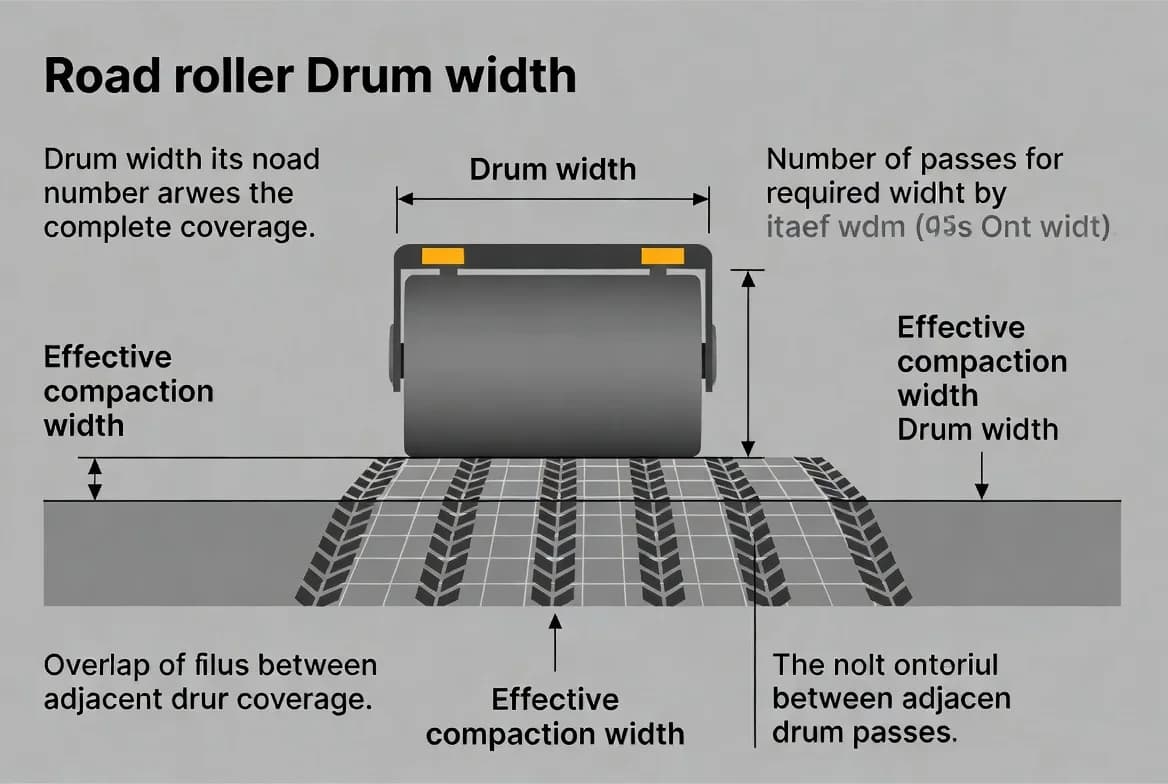

Drum width is a primary determinant of a roller’s productive capacity and of the number of passes required to cover a given area. Understanding how drum width interacts with overlap requirements, edge effects, and the geometry of the work area allows planners and operators to estimate production rates accurately and to select equipment that matches the job.
The nominal drum width is the physical width of the cylindrical surface that contacts the material. Effective compaction width is slightly less because the edges of the drum produce lower contact pressure and because successive passes must overlap to ensure uniform density. A typical overlap of 150–300 mm is recommended; the exact value depends on the material and the roller type. Consequently, the net advance width per pass is the drum width minus the overlap. On a wide embankment or roadway the number of side-by-side passes required is the total width divided by the net advance width, rounded upward. On narrow features such as shoulders or trench backfill a single drum width may be sufficient, but the operator must still ensure that the edges receive adequate coverage.
Articulated or dual-drum rollers that can offset the drums increase the effective coverage and improve edge compaction. Production rate in square metres per hour can be estimated from drum width, average operating speed, number of passes required for density, and an efficiency factor that accounts for turning, waiting, and non-productive time. Wider drums increase the theoretical production rate, but only if the roller can maintain the required number of passes without becoming the bottleneck in the construction sequence. Matching roller width to paver width on asphalt projects is a common practice that simplifies the rolling pattern and reduces the risk of uneven density.
Drum width also affects the roller’s ability to work close to obstacles, kerbs, and structures. Narrow drums or rollers with offset capability are preferred for detailed work; wide drums are preferred for open, high-production areas. Some modern rollers offer interchangeable drums or modular designs that allow the width to be adjusted for different phases of the project. In summary, drum width is a key variable in production planning, rolling-pattern design, and edge-quality control. Selecting and operating the roller with a clear understanding of effective width and required overlap produces uniform density and efficient coverage.
Get More Expert Guides & Updates
Subscribe for Machinery.org guide updates and product learning content.