Introduction
Equipment Financing Guide is an important subject for owners, operators, contractors and first-time buyers who need practical answers rather than marketing claims. The correct decision depends on the work being performed, the site, the operator, the machine configuration and the support available after purchase. In this guide, equipment financing guide is explained in a way that connects specifications with real jobsite results. The discussion covers planning, technical fundamentals, operating considerations, inspection points, ownership cost and common mistakes. Because machine designs vary, the operator’s manual, capacity chart, safety labels and local regulations must always take priority over general advice. Use this article as a framework for asking better questions, comparing options consistently and documenting the reasons behind a final decision.
Why this topic matters
Decisions about equipment financing guide affect productivity, safety and long-term cost at the same time. A machine that appears suitable on paper can still be a poor fit when access is tight, the ground is weak, the attachment is too heavy or the service network cannot supply parts quickly. For construction equipment, the most useful evaluation starts with the actual job cycle: what material is handled, how far it must move, how often the cycle repeats and what accuracy is required. The main risks include buying too much machine, buying too little capacity, hidden wear and weak support. A disciplined process makes those risks visible before money is committed or work begins. It also helps different team members—owner, operator, mechanic and supervisor—use the same criteria instead of relying on personal preference alone.
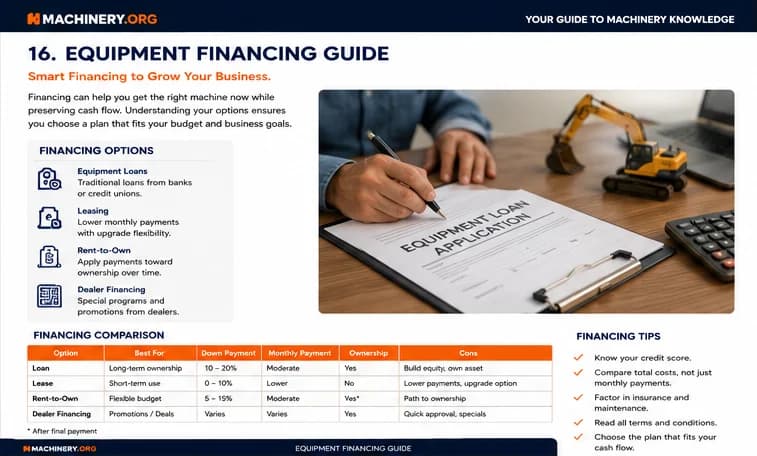
Financing choices, repayment structures, and business-fit factors for machinery acquisition.
Technical foundation
The technical foundation begins with the relationship between the machine’s power source, engine, hydraulics, drivetrain, structure, controls and attachments. These systems do not operate independently. More hydraulic flow may improve an attachment only when pressure, cooling and hose size are also adequate. More operating weight may improve stability but can increase transport cost and ground damage. Greater lift height or reach can reduce capacity at the edge of the working envelope. The most relevant measurements for this topic include capacity, reach, operating weight, hydraulic performance, dimensions, fuel use and service access. Read each specification together with its test condition and limitation. Rated values are not promises for every situation; they are reference points produced under defined conditions.
Manufacturer charts and manuals should therefore be reviewed before comparing brands or planning a lift, slope, trench or transport move.
Define the work before selecting equipment
Start by writing a job profile. List the heaviest expected load, normal and maximum working radius, required depth or height, travel distance, surface condition, access width, overhead restrictions and daily production target. Identify whether the work is continuous, seasonal or occasional. Then list the attachments and support tools required. This job profile protects the buyer from selecting a machine because it is popular or discounted. For construction equipment, the correct size is usually the smallest configuration that can safely complete the hardest regular task with a reasonable margin, while still fitting transport and access limits. Rare extreme tasks may be cheaper to rent or subcontract than to oversize the machine used every day.
Read specifications as a system
Compare specifications only after confirming that manufacturers use similar definitions. Focus on deposit, term length, interest cost, cash-flow effect and the conditions attached to each rating. Check whether published capacity includes a standard attachment, full fuel, operator weight or counterweight. Verify dimensions in the transport and working positions. Review hydraulic flow and pressure together, because either value alone can be misleading. For lifting equipment, study the full capacity chart rather than the maximum number. For digging or loading machines, consider geometry, breakout force, dump clearance and cycle time together. Specifications should narrow the shortlist, but a demonstration in representative conditions should make the final decision.
Ownership and support questions
The purchase decision continues after delivery. Ask who will perform scheduled service, how quickly common filters and wear parts can be supplied, whether diagnostic support is available and what the warranty requires. Estimate transport, insurance, financing, fuel or charging, planned maintenance, wear parts, downtime and resale value. Review inspection records, maintenance history, parts availability and dealer support. A machine with a strong local support network can be more profitable than a cheaper alternative that waits weeks for a hose, sensor or control module. Request written quotations that separate the base machine, attachments, freight, setup, taxes, training and warranty so the true comparison is clear.
Common mistakes to avoid
The most common mistake is choosing a solution from one impressive number or one successful demonstration. Other mistakes include ignoring attachment weight, assuming all couplers are interchangeable, using maximum capacity as a routine target, overlooking transport dimensions and delaying maintenance until a warning appears. Operators may also compensate for a poor machine match by working faster, carrying loads too high or using excessive hydraulic pressure. Buyers sometimes focus on purchase price while ignoring downtime, wear parts and resale. A better approach is to compare complete job cycles, document limits and leave a safety and production margin. When information conflicts, the manufacturer’s current manual and qualified technical support should decide the issue.
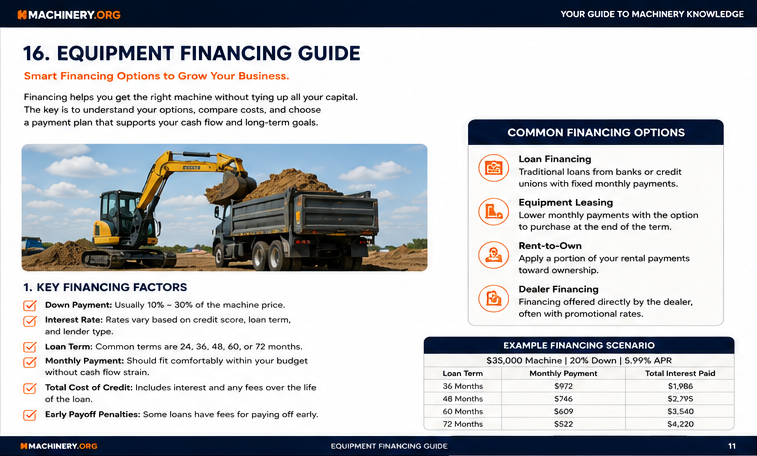
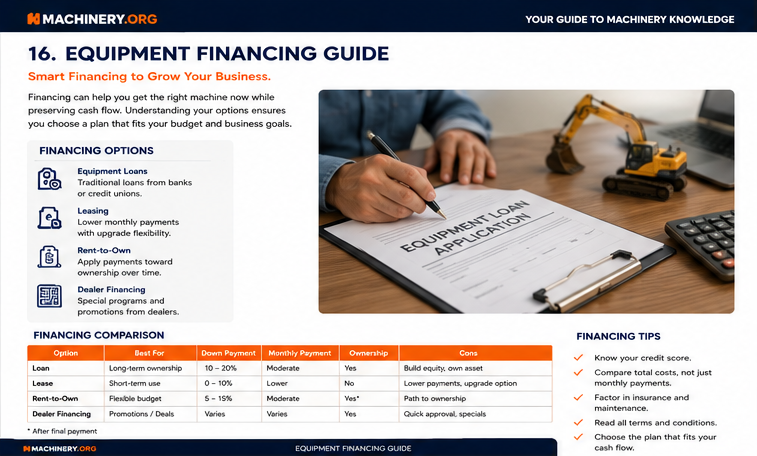
Equipment financing factors and an example payment comparison for planning cash flow.
Practical checklist
Use this checklist before purchasing, assigning or operating equipment for this topic: 1) Write the exact task, material and desired finished result. 2) Confirm access, surface, slope, overhead and transport limits. 3) Review capacity, reach, operating weight, hydraulic performance, dimensions, fuel use and service access. 4) Check the machine, attachment and support-equipment combination. 5) Inspect safety devices, structure, wear points and service records. 6) Test the equipment in representative conditions when practical. 7) Estimate fuel or energy, maintenance, transport, labor and downtime. 8) Document the final limits, settings and reasons for the decision. The checklist is intentionally broad so it can be adapted to a small owner-operated machine or a larger fleet. Add model-specific values from the manual and keep the completed version with the job plan or equipment record.
Cost, productivity and ownership impact
The best technical choice must also work financially. Estimate ownership cost per month and operating cost per productive hour. Include finance or depreciation, insurance, storage, transport, energy, routine service, wear parts and expected repairs. Then estimate realistic utilization and production, allowing for setup, attachment changes, breaks, weather and waiting time. For construction equipment, improved versatility may reduce the need for another machine, but a complex attachment can add maintenance and training. Low ground damage, better access or a cleaner finished surface may create value that is not visible in cycle time alone. Review the estimate after several jobs and replace assumptions with actual records.
Frequently asked questions
What is the first thing to check? Start with the job requirement and the manufacturer’s limitations, then confirm the machine configuration. Is a larger machine always more productive? No. A larger machine can be slower or more expensive when access, transport, surface damage or attachment changes control the job. Can published specifications be compared directly? Only when definitions and test conditions are equivalent. Should an operator rely on experience instead of the manual? Experience is valuable for planning and smooth control, but it does not replace capacity charts, safety instructions or maintenance procedures. When should professional help be used? Use qualified dealers, engineers, inspectors or technicians whenever the decision involves structural damage, critical lifting, complex diagnostics, legal compliance or a condition that cannot be verified safely.
Conclusion
A reliable approach to equipment financing guide combines technical information with observation, testing and disciplined documentation. Define the work, understand how the relevant systems interact, compare complete configurations and verify limits before operation. Protect the decision with inspection, training, maintenance and a clear stop-work rule. The objective is not to find the machine with the most impressive specification; it is to choose and operate equipment that produces the required result safely, consistently and profitably. Keep this guide with model-specific manuals, service records and jobsite procedures so the advice becomes part of a repeatable management system rather than a one-time reading exercise.
Get More Expert Guides & Updates
Subscribe for Machinery.org guide updates and product learning content.