
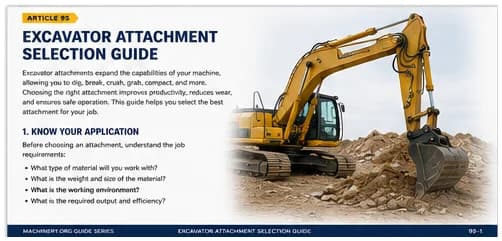
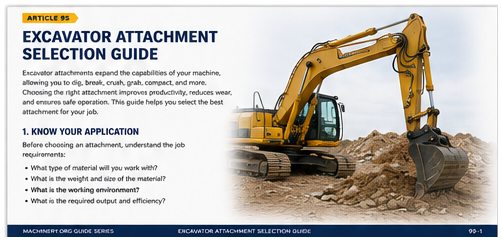
Figure 95.1 - Excavator attachment selection overview.
Image Description: A standalone guide image showing an excavator and the importance of matching attachments to the job.
Introduction
Excavator attachments can transform one machine into a digging tool, demolition tool, lifting support machine, grading tool, compaction platform, vegetation handler, or material sorting system. Choosing the right attachment improves production, reduces wear, and helps the operator do cleaner work. Choosing the wrong attachment wastes fuel, stresses hydraulic systems, damages components, and often creates poor results. Because attachments are so central to excavator productivity, selection should be treated as a planning decision rather than a last-minute purchase.
This Machinery.org guide explains how owners, buyers, and operators should select excavator attachments. The focus is on understanding the application first, then matching size, weight, hydraulic requirements, coupler compatibility, ground conditions, and service support. A powerful excavator is not automatically productive with every tool. The attachment must fit the machine and the job.
Excavators are used across construction, utilities, landscaping, mining support, demolition, forestry, agriculture, drainage, and roadwork. Each sector has different attachment needs. A narrow trenching bucket that works well for utility lines may be poor for bulk excavation. A hydraulic breaker that is too large can damage the carrier. A grapple that lacks enough opening or closing force may slow material handling. Attachment selection determines whether the machine feels efficient or frustrating.
Start With the Application
The first question is not “what attachment can this excavator run?” but “what job must be completed?” Define the material, depth, reach, precision, production target, and environment. Are you digging loose soil, clay, rock, roots, asphalt, concrete, trench spoil, demolition debris, logs, or scrap? Are you working near buildings, utilities, slopes, traffic, or water? Do you need speed, accuracy, sorting ability, impact force, reach, or finish quality?
Once the application is clear, the attachment field narrows quickly. Digging and trenching may require standard, heavy-duty, rock, or grading buckets. Demolition may require breakers, crushers, shears, thumbs, grapples, or sorting buckets. Land clearing may require rakes, grapples, mulchers, or thumbs. Utility work may require narrow buckets, compactors, augers, or quick couplers for frequent changes. Matching begins with the work, not the sales brochure.
Bucket Selection
Buckets are the most common excavator attachments, but bucket choice is more detailed than many buyers realize. Width, capacity, tooth style, shell strength, side cutters, cutting edge, and profile all affect performance. A wider bucket moves more material but may reduce digging force in hard ground. A narrow bucket may dig trenches efficiently but slow bulk loading. A grading bucket may produce a cleaner finish but is not ideal for aggressive penetration.
Soil and material density matter. Lightweight material allows larger bucket volume. Dense clay, rock, or demolition debris may require a stronger and sometimes smaller bucket to protect the machine and maintain digging force. Buyers should also match bucket pin size or coupler style, because an otherwise suitable bucket is useless if it does not connect correctly.
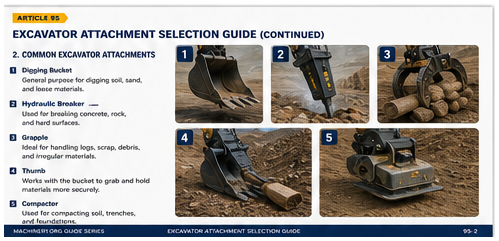
Figure 95.2 - Common excavator attachments and application guide.
Image Description: A standalone checklist guide image showing buckets, breakers, grapples, thumbs, and compactors as common excavator attachments.
Hydraulic Attachments and Machine Compatibility
Hydraulic attachments such as breakers, compactors, augers, thumbs, grapples, mulchers, and crushers require special attention. Flow, pressure, return-line requirements, case drain needs, and control circuits must match the carrier. Incorrect hydraulic setup can cause overheating, poor performance, seal failure, or damage to both attachment and excavator. Before purchase, the owner should confirm hydraulic compatibility in writing from the dealer or manufacturer.
Attachment weight is another major factor. A tool that is too heavy changes stability and reduces useful lifting or digging performance. This is especially important on compact and mid-size excavators where margin may be limited. Reach also changes the equation. A heavy tool at full extension places much more demand on stability than the same tool tucked close to the machine.
Common Attachment Types and Use Cases
Hydraulic breakers are used for concrete, rock, and demolition work. They should be matched carefully to carrier size and hydraulic output. Grapples help sort logs, scrap, demolition debris, and irregular material. Thumbs work with buckets to grip rocks, pipe, brush, and broken concrete. Compactors help compact trench backfill or small pads. Rippers break hard ground before digging. Augers drill holes for posts, foundations, and planting. Tilt buckets and tiltrotators improve precision grading and placement, especially in utility and landscaping applications.
Each attachment adds capability, but also adds maintenance and training needs. A breaker requires tool inspection, lubrication, and correct operating angle. A grapple needs pins, bushings, hoses, and cylinder checks. A compactor requires mounting and vibration system care. If an owner buys an attachment without planning maintenance, the tool may become a source of downtime instead of production.
Quick Couplers and Attachment Change Strategy
Quick couplers make attachment changes faster, but they introduce a critical safety responsibility. The operator must verify full locking every time. A dropped bucket or tool can cause severe damage or injury. Couplers should be compatible with the attachments being used and should be inspected for wear, cracks, damaged locks, and proper operation. Manual, hydraulic, and tilt couplers each have advantages, but every system requires disciplined use.
Attachment strategy should also consider workflow. If the excavator changes tools several times per day, a reliable quick coupler may pay for itself quickly. If the machine rarely changes tools, a direct pin-on setup may be simpler and lighter. The best choice depends on how the machine is actually used.
Buying and Ownership Advice
Before buying an attachment, compare application fit, machine compatibility, dealer support, parts availability, expected wear cost, and operator training requirements. The cheapest tool is not always the lowest-cost tool over time. Poor fit can reduce production and increase repairs. A well-matched attachment may cost more upfront but finish jobs faster and last longer.
Owners should also consider whether to buy, rent, or subcontract specialty attachments. A bucket, thumb, or coupler may justify ownership because it is used frequently. A rare-use breaker, compactor, or specialty demolition tool may be better rented until utilization is proven. Good attachment planning helps owners avoid tying money up in tools that sit unused.
Sizing, Weight, and Balance
An excavator attachment must be sized for the carrier. A tool that is too small may be inefficient and wear quickly; a tool that is too large may reduce stability, overload the boom and arm, or strain the hydraulic system. Weight matters most when the attachment is used at reach. A heavy attachment close to the machine may feel manageable, but that same attachment at full extension can reduce stability and lifting margin. Buyers should review machine charts, manufacturer recommendations, and dealer guidance before making a final decision.
Balance is also affected by the work method. A grading bucket, breaker, compactor, thumb, or grapple changes how the operator positions the machine and uses the boom. Operators should practice with new attachments in controlled conditions before working near people, structures, utilities, or traffic. Productivity improves when the attachment feels predictable.
Parts Support and Long-Term Value
Attachment ownership does not end at purchase. Teeth, pins, bushings, hoses, seals, breaker tools, compactor plates, wear edges, and coupler parts all need service over time. Before buying, owners should ask how easily parts can be obtained, who can service the tool, and what the common wear items cost. A low-cost attachment with poor support may become more expensive than a better supported tool after the first repair.
Resale value should also be considered. Common, well-maintained attachments with clear compatibility information are easier to sell or trade. Specialty tools can be valuable, but only when the next buyer has the right carrier and application. Keeping records, manuals, parts receipts, and maintenance notes improves confidence when the attachment is later sold.
Operator Training and Program Review
Attachment selection should be revisited whenever the excavator changes projects. A tool that was perfect for one job may be inefficient or unsafe on another. Before each major project, owners should compare material type, production target, reach, hydraulic requirements, coupler fit, and expected wear. This habit keeps the excavator working as a planned system rather than a carrier for whatever attachment happens to be available.
Final Field Review
This final review should include attachment storage, coupler inspection, hydraulic cleanliness, operator familiarization, and whether the selected tool supports the project schedule.
Detailed Ownership Note
A strong ownership program turns this topic into a repeatable procedure rather than a one-time reminder. Managers should define who performs the check, how findings are recorded, how urgent problems are escalated, and when the machine is removed from work. Operators should be encouraged to report small issues without fear of blame because small issues are often the first signs of larger failures. When inspection, training, maintenance, and communication are connected, the machine becomes easier to manage and safer to use. This article should therefore be treated as a practical field guide and a training reference that supports better judgment on real jobsites. It should also be reviewed during toolbox talks, new-hire orientation, incident reviews, and seasonal maintenance planning, especially when equipment is shared by multiple operators across different shifts.
FAQ
What is the most important factor when selecting an excavator attachment? Application fit comes first, followed closely by machine compatibility, hydraulic requirements, and attachment weight.
Can any excavator run any hydraulic attachment if the pins fit? No. Pin fit is not enough. Flow, pressure, return lines, case drain needs, weight, and control circuits must also match.
Is a quick coupler worth it? A quick coupler is often worthwhile when the machine changes tools frequently, but it must be inspected and locked correctly every time.
Key Takeaway
Excavator attachment selection should begin with the job and end with confirmed compatibility. The right tool improves production, precision, and machine life. The wrong tool creates stress, downtime, and poor results, even when the excavator itself is capable.
Get More Expert Guides & Updates
Subscribe for Machinery.org guide updates and product learning content.