

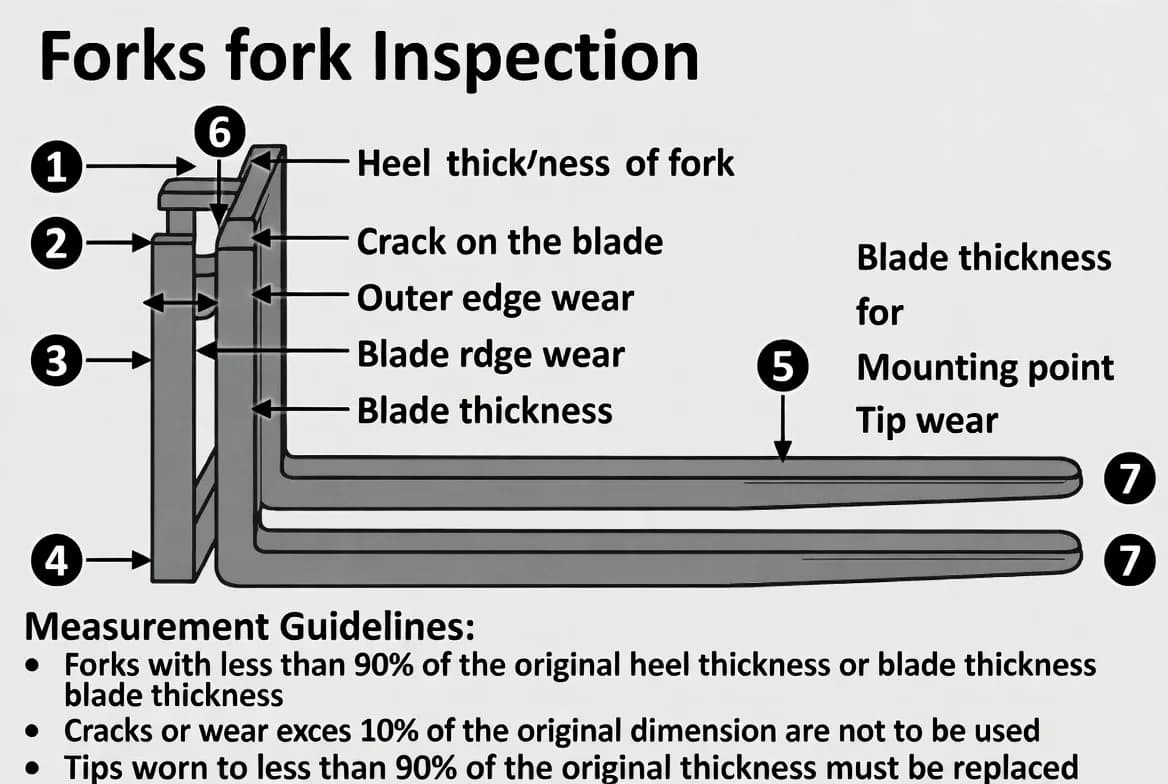

Forks are safety-critical components. A cracked, excessively worn, or bent fork can fail under load, dropping the load and potentially causing serious injury or death. Systematic inspection and adherence to wear limits are mandatory under most national safety regulations and manufacturer recommendations.
Daily visual inspection should look for obvious cracks (especially at the heel and at the top of the blade), bends, twists, and uneven wear. Any crack is cause for immediate removal from service. Forks that show permanent deformation (bending or twisting) must also be removed; they cannot be safely straightened in the field.
Dimensional wear is measured at specific locations. The heel thickness (the vertical section at the rear of the fork) and the blade thickness are the primary wear indicators. Industry practice and many standards require that forks be removed from service when either dimension has worn to 90 percent of the original thickness. Tip wear is also monitored; excessive tip wear can reduce load support and increase the risk of load slippage.
Measurement is performed with calipers or a specialized fork-wear gauge. Original dimensions are usually stamped on the fork or available from the manufacturer. Because wear is often greatest on the top surface of the blade and on the inner face of the heel, measurements must be taken at the thinnest points. Both forks of a pair should be measured; mismatched wear can indicate uneven loading or carriage problems.
Mounting hardware—the hooks or shaft that retain the forks on the carriage—must also be inspected for cracks, wear, and proper engagement. Locking pins or clips must be present and functional. Forks that are not properly locked can slide off the carriage during tilting or travel.
Forks should be inspected more thoroughly at regular service intervals and after any incident that may have overloaded or impacted them. Recordkeeping of measurements allows trending of wear rates and prediction of replacement timing. Never attempt to repair a cracked fork by welding unless the repair is performed by a qualified facility following the manufacturer’s approved procedure; improper welding can introduce residual stresses that lead to sudden failure.
In summary, fork inspection is a simple but non-negotiable safety practice. Daily visual checks combined with periodic dimensional measurement keep worn or damaged forks out of service and protect both loads and people.
Get More Expert Guides & Updates
Subscribe for Machinery.org guide updates and product learning content.