
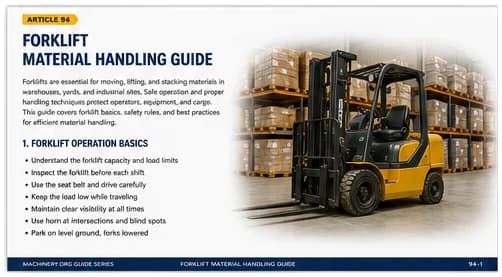
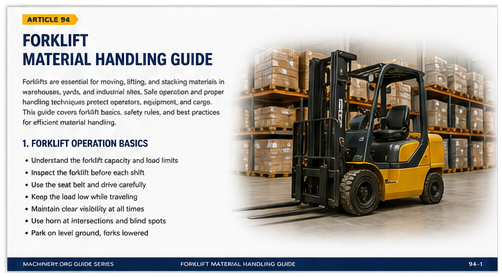
Figure 94.1 - Forklift material handling overview.
Image Description: A standalone guide image showing a forklift in a warehouse and the core principles of material handling.
Introduction
Forklifts are everyday machines in warehouses, factories, lumberyards, construction supply yards, farms, ports, and retail distribution centers. Because they are common, people sometimes underestimate the risks. A forklift can weigh several tons, carry heavy loads at height, turn sharply, and operate near pedestrians and stacked materials. Poor handling can damage products, collapse pallets, tip the machine, strike workers, or cause costly downtime. Safe material handling is therefore not optional; it is the core skill of forklift operation.
This Machinery.org guide explains how forklift operators should approach loads, understand stability, position forks, carry materials, stack safely, and work around people. It also explains why capacity ratings and load centers matter. A forklift is not simply rated for any load that fits on the forks. The weight, shape, balance, height, and distance from the mast all affect whether the lift is safe.
Good forklift operation combines mechanical understanding with disciplined habits. Operators must inspect the machine, read the load, plan the route, communicate with others, and keep the load under control from pickup to placement. The work may be repetitive, but the consequences of distraction can be severe.
Understanding Load Center and Capacity
Forklift capacity is based on a rated load center, which is the horizontal distance from the fork face to the center of gravity of the load. If the load is longer, unevenly packed, liquid-filled, loosely stacked, or carried away from the mast, the effective capacity decreases. This is why a forklift may be able to lift one pallet safely but become unstable with another pallet of the same weight if the load center is farther forward.
Operators must read the data plate and understand attachment effects. Fork extensions, clamps, side shifters, rotators, and other attachments can change capacity and load behavior. If the data plate does not reflect the installed attachment, operation may be unsafe. Never guess based only on whether the forklift can raise the load. Raising is not the same as safely carrying, turning, and stacking.
Approaching and Lifting the Load
The operator should approach the load slowly and squarely. Forks should be set wide enough to support the pallet or material evenly. The forks should enter fully under the load whenever possible, and the mast may be tilted slightly back after lifting to help stabilize the load. Lifting should be smooth. Jerky motion can shift material, damage pallets, or destabilize the forklift.
Before lifting, inspect the load. Is the pallet damaged? Is the weight evenly distributed? Is the material strapped or shrink-wrapped? Are loose items likely to fall? Does the load block forward visibility? A safe operator does not simply pick up whatever is placed in front of the machine. The operator evaluates whether it can be moved safely and asks for help or repacking when needed.
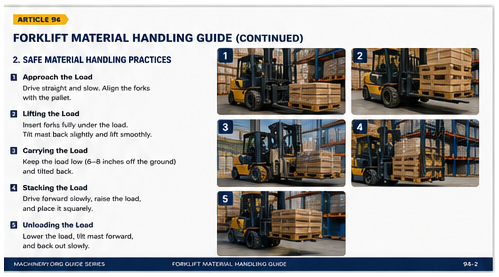
Figure 94.2 - Forklift safe material handling sequence.
Image Description: A standalone checklist guide image showing approach, fork insertion, lifting, carrying, stacking, and unloading steps.
Traveling With a Load
Loads should usually be carried low, only high enough to clear the floor or travel surface. The mast should be tilted back slightly according to safe practice, and the operator should drive at a controlled speed. Sharp turns, sudden braking, and rapid acceleration can shift the load or tip the machine. If the load blocks forward visibility, the operator may need to travel in reverse while looking in the direction of travel, except when moving up a ramp or where site rules require a different method.
Pedestrian awareness is critical. Forklifts work in shared spaces where people may step from aisles, docks, racks, or trailers. Horn use, eye contact, mirrors, blue lights, speed limits, and traffic lanes all help, but the operator remains responsible for maintaining control and stopping when visibility is poor. A forklift should never be driven faster than the conditions allow.
Stacking and Unloading
Stacking requires patience and accurate alignment. The operator should square the forklift to the rack, raise the load to the correct height only when close to the placement point, move slowly, level the forks, place the load gently, and back away only after the forks are clear. Rushing the final placement can damage racks, shift pallets, or knock material from height. Rack capacity and pallet condition must also be considered.
When unloading trucks or trailers, the operator should confirm dock plate condition, trailer restraint, trailer floor strength, and lighting. A trailer can move, settle, or fail if not prepared correctly. Dock work is one of the areas where forklift incidents can become severe, so communication and pre-checks matter.
Special Loads and Difficult Environments
Not all loads behave like standard pallets. Long pipe, lumber, liquid containers, bagged material, irregular crates, and loose bundles may shift or flex. Some loads require attachments, spotters, lower speeds, or different handling methods. Operators should never improvise with unstable loads simply to save time. If a load is not safe to lift, it should be secured, repacked, or moved with more suitable equipment.
Outdoor forklift operation introduces additional factors: gravel, slopes, mud, potholes, weather, and uneven surfaces. These conditions reduce stability and traction. The operator should slow down, keep loads low, avoid sharp turns, and verify that the forklift type is appropriate for the environment. Warehouse forklifts are not automatically suitable for rough-yard work.
Inspection and Operator Responsibility
Pre-shift forklift inspection should cover forks, mast, chains, hydraulic leaks, tires, brakes, steering, horn, lights, backup alarm, seat belt, data plate, and controls. Forks should be checked for cracks, excessive wear, bent tips, and missing locking pins. A damaged fork is a serious safety issue because it directly supports the load.
Operators should report defects immediately. A culture that pressures operators to continue using unsafe machines creates risk for everyone in the facility. Good forklift programs include training, refresher instruction, traffic management, supervisor accountability, and maintenance documentation.
Warehouse Traffic Management
Forklift safety depends heavily on the layout of the work area. Clear travel lanes, marked pedestrian crossings, speed limits, mirrors at blind corners, rack protection, and controlled loading zones reduce the number of decisions operators must make under pressure. A well-designed warehouse does not rely only on operator skill; it creates predictable movement patterns. When forklifts, pedestrians, pallet jacks, delivery trucks, and storage racks share the same space, traffic management becomes a core safety system.
Supervisors should review near misses, product damage, and congested areas to improve the layout over time. If operators frequently back up blindly, squeeze through narrow aisles, or stop suddenly because pedestrians cross unexpectedly, the traffic plan needs improvement. Material handling is safest when the route is planned before the load is lifted.
Ramp, Dock, and Trailer Awareness
Docks and ramps add special risk because the forklift may move between surfaces with different traction, strength, and slope. Before entering a trailer, operators should confirm that the trailer is secured, the dock plate or bridge is rated and positioned correctly, and the floor can support the forklift plus the load. Trailer floors can be damaged, wet, oily, or weak, and a failure under load can be catastrophic.
On ramps, the operator should follow the correct load orientation for the situation and keep movements slow and straight. Turning on a ramp with a load is a common stability hazard. If the route feels unsafe, the operator should stop and ask for the condition to be corrected rather than attempting to force the move.
Operator Training and Program Review
Forklift material handling should be measured by accuracy and control, not only by speed. A facility that rewards rushing often creates pallet damage, rack impacts, unstable stacking, and near misses with pedestrians. Better programs train operators to slow down before corners, square up before lifting, set loads down cleanly, and report poor pallets or damaged racks before they become larger hazards.
Final Field Review
This final review should include pedestrian control, rack condition, dock restraint, trailer inspection, and how poor pallets are removed from service before lifting.
Detailed Ownership Note
A strong ownership program turns this topic into a repeatable procedure rather than a one-time reminder. Managers should define who performs the check, how findings are recorded, how urgent problems are escalated, and when the machine is removed from work. Operators should be encouraged to report small issues without fear of blame because small issues are often the first signs of larger failures. When inspection, training, maintenance, and communication are connected, the machine becomes easier to manage and safer to use. This article should therefore be treated as a practical field guide and a training reference that supports better judgment on real jobsites. It should also be reviewed during toolbox talks, new-hire orientation, incident reviews, and seasonal maintenance planning, especially when equipment is shared by multiple operators across different shifts.
FAQ
Why is load center important? Load center affects stability and real lifting capacity. A long or forward-heavy load may reduce safe capacity even if the weight appears within the rating.
How high should a load be carried during travel? Carry loads low, only high enough to clear the travel surface, unless a specific operating condition requires otherwise.
What should an operator do if a load blocks visibility? Travel in the direction that allows clear visibility when safe and permitted, use a spotter if needed, and follow site procedures.
Key Takeaway
Forklift material handling depends on load understanding, smooth control, visibility, and respect for capacity. The safest operators are not the fastest; they are the ones who move every load with balance, planning, and awareness.
Get More Expert Guides & Updates
Subscribe for Machinery.org guide updates and product learning content.