
Chapter objective: Grapples are designed to grip, sort, carry and place irregular material. The correct design depends on what must be retained: logs, brush, roots, rock, scrap, demolition debris, waste, pipe or loose bulk material. A root grapple with widely spaced tines is efficient for brush and soil separation but may not retain small debris. A clamshell encloses material better but is heavier and may hold soil or water. A demolition grapple provides strong jaws and wear protection for mixed...
Match the grapple to the material
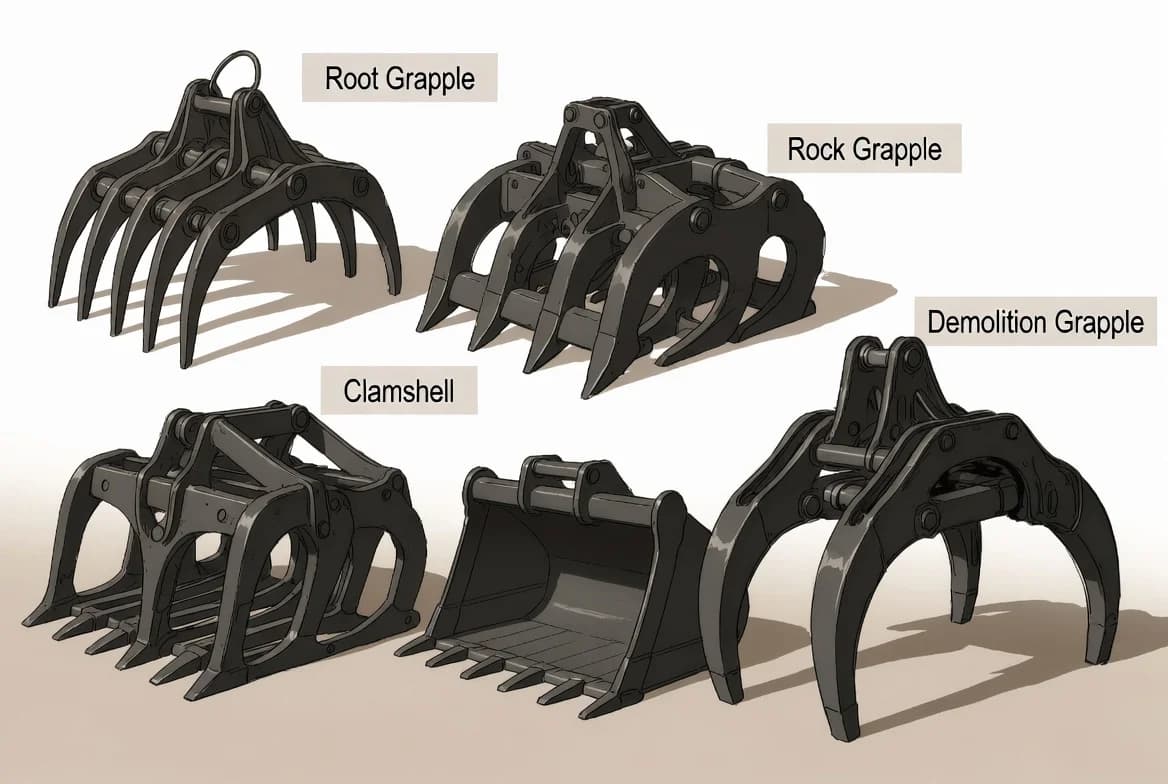
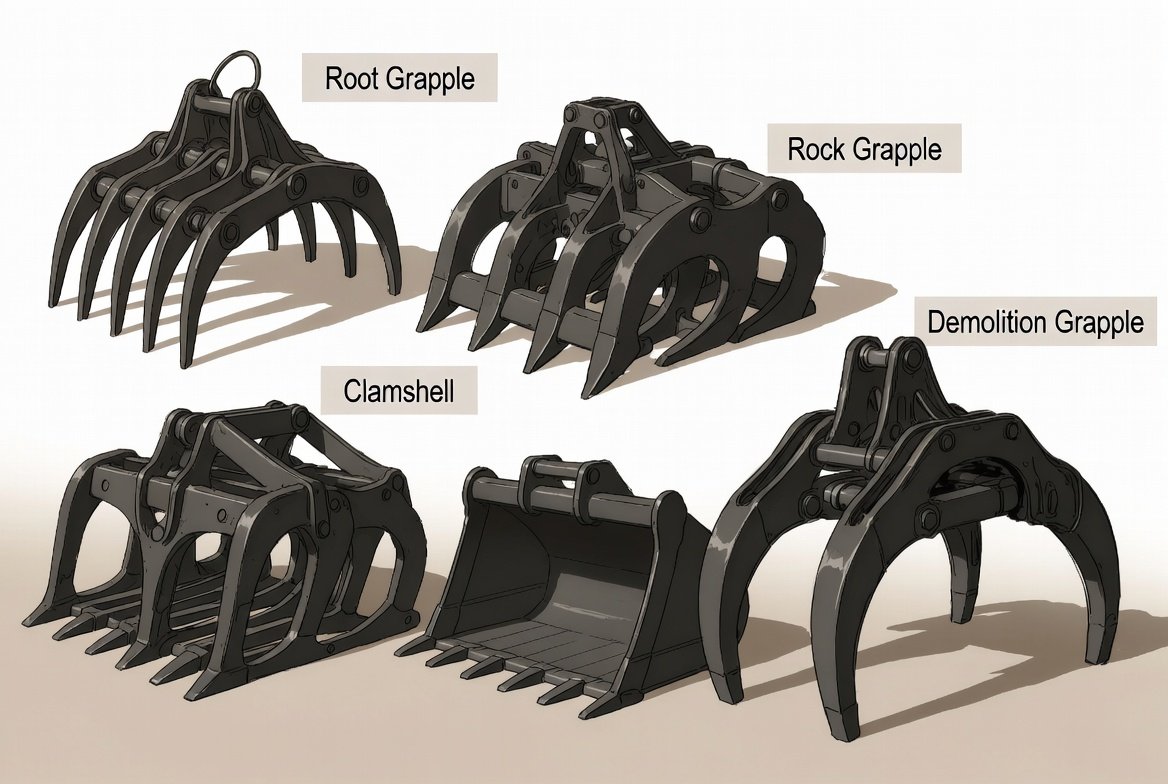
Grapples are designed to grip, sort, carry and place irregular material. The correct design depends on what must be retained: logs, brush, roots, rock, scrap, demolition debris, waste, pipe or loose bulk material. A root grapple with widely spaced tines is efficient for brush and soil separation but may not retain small debris. A clamshell encloses material better but is heavier and may hold soil or water. A demolition grapple provides strong jaws and wear protection for mixed debris.
Begin by defining material size, density, shape, abrasiveness and contamination. Consider whether the task is loading, sorting, feeding a processor, demolition, landscaping or precise placement. Choose a jaw and tine geometry that controls the material without requiring excessive crushing force.
Major grapple families
Root and brush grapples use open tines to retain larger material while allowing soil to fall through. Rock grapples use heavier structures and closer spacing. Clamshell or bucket grapples enclose material for bulk handling. Demolition and sorting grapples often rotate and use curved jaws for precise handling. Log grapples are shaped to centre round timber. Scrap grapples may use multiple tines or orange-peel configurations. Fork grapples combine pallet-fork style support with a top clamp.
Each family creates a different load centre and visibility profile. Rotators, extra cylinders and heavy-duty frames add weight. Select the simplest design that safely controls the material and supports the production target.
Carrier capacity and working radius
The combined weight of grapple, coupler, rotator, adapter and payload must remain within the carrier's capacity at the actual radius and height. Loads such as logs and beams may extend far beyond the grapple, increasing moment and swing hazard. For excavators, use the lifting chart and consider side lifting. For loaders and skid steers, use rated operating capacity and maintain the load low. For telehandlers, use the correct attachment-specific load chart.
Do not estimate payload by volume alone. Wet timber, concrete and scrap can be much heavier than they appear. Begin with smaller loads and verify machine stability. If the rear of the machine lifts, steering becomes light or the hydraulic system struggles, lower the load and reassess.
Jaw geometry, tine spacing and retention
Jaw opening must accommodate the largest expected object, while the closed gap must retain the smallest. Tine spacing controls sorting performance. Narrow spacing retains more material but increases weight and traps soil. Curved jaws centre round objects. Intermeshing tines improve retention of irregular debris. Replaceable tips and wear plates are valuable in abrasive work.
Retention force should be enough to secure the load without crushing pipe, timber or reusable material. Excessive clamping can damage the object and overload the attachment. Hydraulic pressure settings and cylinder size determine available force. Use the manufacturer's limits and avoid increasing pressure to compensate for poor jaw geometry.
Hydraulics and rotation
A basic grapple may require one auxiliary function for open and close. A rotating grapple may need a second circuit, diverter valve, control system or proportional function. Confirm flow, pressure, case-drain requirements and hose routing. Rotation can improve productivity and placement but adds weight, complexity and maintenance.
Check that the carrier controls allow smooth modulation. Jerky jaws can drop material. Hoses must be protected through full rotation and articulation. Use the approved swivel and connections. If rotation stops or becomes erratic, inspect hydraulics and controls rather than forcing the attachment.
Visibility and control
The operator must see the load, grapple tips and surrounding people. Large frames, top clamps and high loads can obstruct the view. Use cameras or a trained spotter where required, but maintain clear communication and exclusion zones. Never rely on a person standing close to the load to guide every movement.
Keep loads low during travel and orient long material to reduce swing and collision risk. Avoid sudden starts, stops and turns. On slopes, travel according to carrier guidance and do not carry unstable loads across the slope. Account for overhead obstacles and utilities.
Handling technique
Approach the material squarely and open the jaws only as much as needed. Centre the load, close smoothly and test retention before lifting high. Do not grab only the end of a long object when a more balanced position is available. Avoid side pulling, twisting and using one tine as a pry bar.
For demolition sorting, separate materials in controlled bites. Do not crush unknown containers or pressurised objects. For logs, prevent rolling and secure bundles according to the work method. For rock, avoid gripping a smooth boulder where it can eject unexpectedly. Lower the load before repositioning the carrier.
Inspection and wear
Inspect tines, jaw pivots, pins, bushes, cylinder mounts, hoses, rotator, welds and cutting edges. Look for bent tines, cracks and unequal jaw movement. Grease pivots and rotators according to schedule. Replace wear parts before the base structure is damaged.
Check hydraulic holding ability. A load that slowly slips may indicate internal leakage, valve problems or worn components. Do not work beneath a suspended load while diagnosing. Support the attachment safely and isolate pressure before maintenance.
Selection checklist
Record the material, maximum object dimensions, estimated payload, required sorting accuracy and cycle target. Identify the carrier's capacity and hydraulic functions. Choose grapple family, opening, closed gap, tine spacing, rotation and wear package. Calculate total mounted weight and load centre. Confirm mounting and controls. Review visibility, transport and site hazards. Conduct a low-level test with representative material.
Document any limits, such as maximum log diameter, permitted rotation mode, restricted lifting radius or required pressure setting. A clear selection record prevents a versatile-looking grapple from being used outside its intended purpose.
Key takeaways
Choose a grapple according to material, retention needs, jaw geometry, payload, working radius, hydraulics and visibility. Include rotator, coupler and adapter weight in capacity calculations. Use smooth, centred lifts and keep loads low during travel. Never pry with individual tines or handle unknown hazardous objects without a plan. Inspect pivots, tines, cylinders and hoses regularly and follow manufacturer ratings.
Classify the load before handling
Loads should be classified as rigid, flexible, loose, sharp, round, contaminated or potentially hazardous. Flexible bundles can shift through the jaws; smooth pipe can slide; containers may hold unknown pressure or liquid; tangled scrap can spring when released. The selection and work method should address these behaviours. If the grapple cannot create a predictable, balanced hold, use a purpose-designed clamp, lifting device or alternative handling method.
Demolition and sorting hazards
Demolition debris may contain sharp reinforcement, trapped energy, glass, nails, cables and unstable pieces. Approach from a position that keeps the cab protected and avoid pulling members that support other material. Sort in small controlled bites. Do not crush sealed drums, gas cylinders, batteries or unidentified containers. Establish a process for hazardous or suspect items before work begins.
Rotation, swivel and stored energy
Rotating grapples use hydraulic motors, swivels and valves that can retain pressure after shutdown. Before service, lower and support the attachment, isolate the carrier and relieve all circuits according to the manual. A rotator that drifts or jerks may indicate internal leakage or control problems. Do not hold or guide the attachment by hand while another person operates the controls. Test rotation at low speed after maintenance.
Transport and storage
Close the jaws or support them in the recommended position for transport and storage. Secure the grapple so it cannot roll, rotate or open. Protect hose ends and the mounting bracket. Long tines and sharp edges should be guarded or positioned away from walkways. During machine travel, keep the grapple low and compact; do not carry a loose load merely to save a separate trip.
Procurement and optional features
Options such as rotation, interchangeable shells, bolt-on edges, check valves, pressure relief, load-holding valves and different tine packages affect weight and function. Specify the expected material and carrier rather than ordering the most versatile configuration. Ask for load charts, hydraulic requirements, attachment weight, closed gap and service limits. Confirm parts support for pins, bushes, tips and seals.
Performance review
A suitable grapple captures the material with minimal repositioning, holds it securely through travel and releases cleanly. Poor selection appears as repeated slipping, excessive crushed material, low payload, obstructed visibility, constant relief operation or rapid tine wear. Review actual material and operator technique after the first work period. Adjust pressure only within approved limits and change the grapple design when geometry—not force—is the problem.
Handling long and suspended objects
Long logs, beams and pipe can rotate around the grapple and extend into blind areas. Centre the grip near the true balance point and control both ends through the travel path. Use a tag line only under an approved plan that keeps the person outside pinch and swing zones. Never allow workers to steady a suspended object by hand. If the load cannot be prevented from rotating or sliding, use a purpose-designed handling frame, additional control point or different lifting method.
Load release and placement
Plan where and how the material will be released before lifting. Place loads on stable supports and open the jaws gradually. Avoid dropping heavy objects because impact can damage the grapple, ground, structures and nearby equipment. In sorting work, maintain separate stable piles and do not build stacks that can collapse back toward the machine. Confirm the load is fully supported before withdrawing the grapple.
Emergency response
If a load begins to slip, do not attempt to catch or guide it with people on the ground. Lower it to the nearest safe location using smooth controls and stop the operation. If hydraulic failure prevents normal control, follow the carrier and attachment emergency procedure and isolate the area. Investigate leakage, valve function, pressure setting, jaw geometry and load condition before resuming.
Manufacturer authority: Use the current carrier and attachment manuals, approved fitment charts and service limits as the final source for ratings, settings, inspection criteria and operating procedures.
Get More Expert Guides & Updates
Subscribe for Machinery.org guide updates and product learning content.