

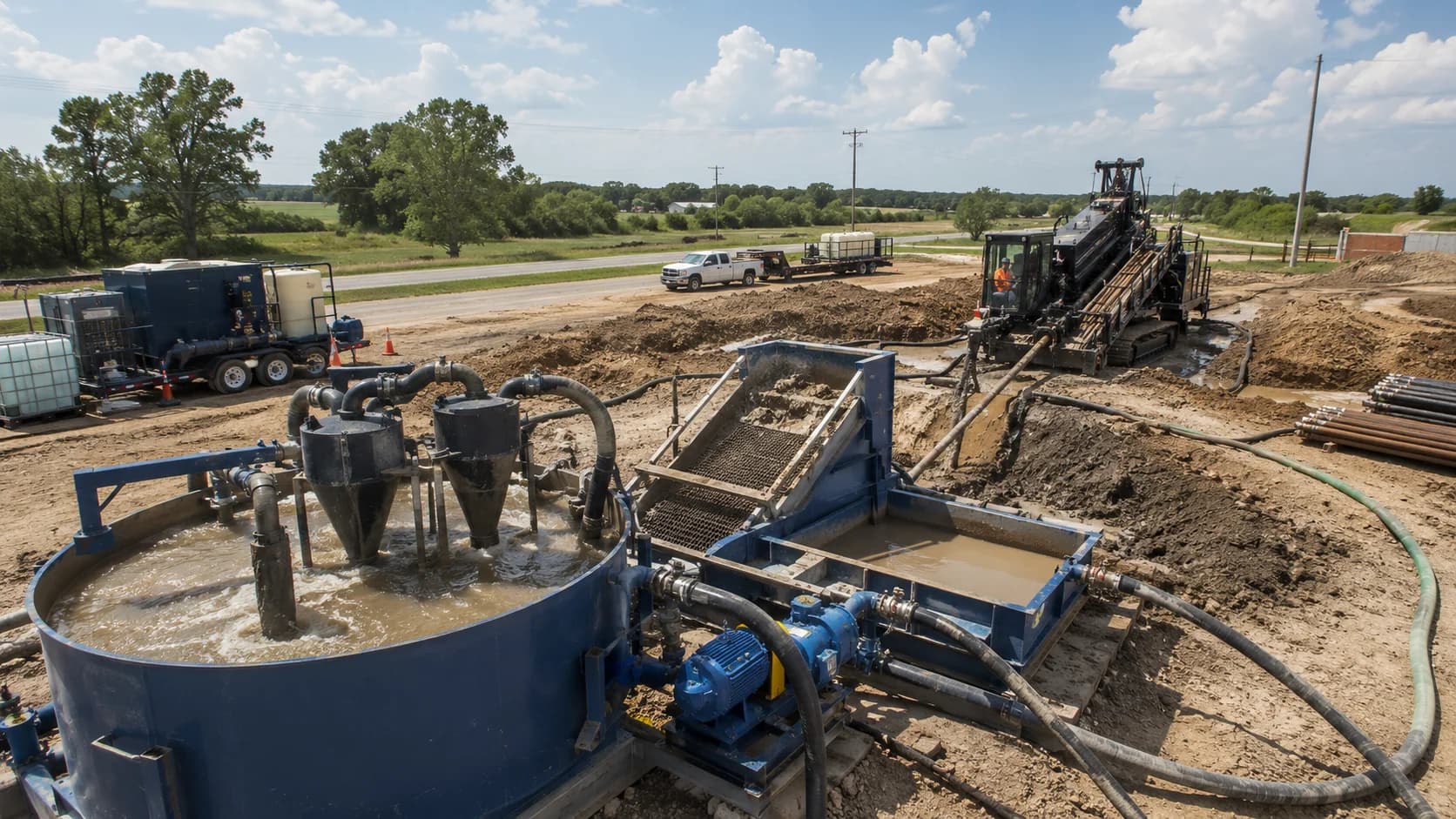
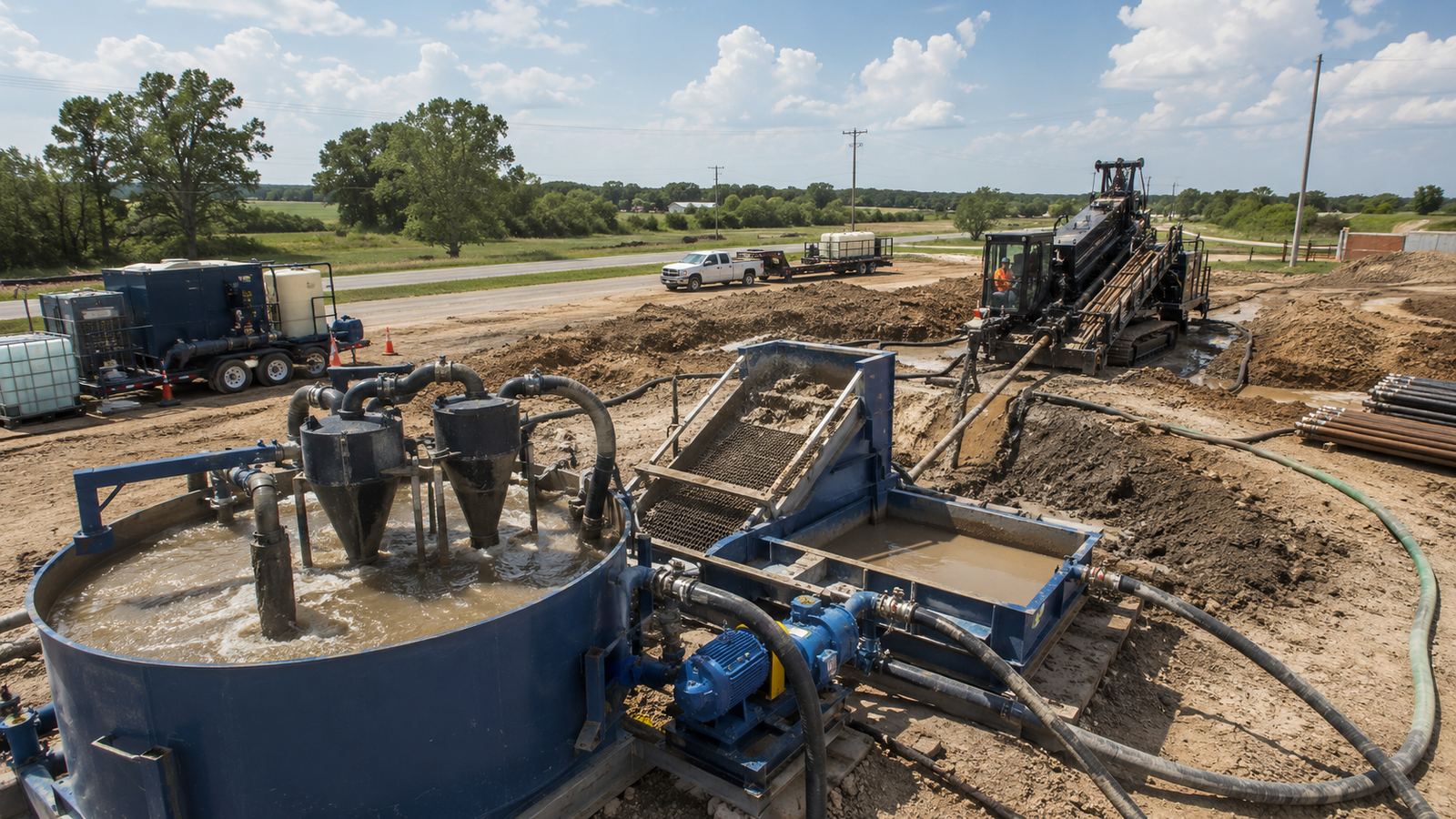
Drilling fluid is one of the most important working systems in horizontal directional drilling. It is not simply water used to wash soil away. A properly designed fluid supports the bore, transports cuttings, lubricates drill rods and product pipe, cools the cutting tool, reduces friction, and helps control pressure around the hole. The mud system that mixes, pumps, circulates, cleans, stores, and recycles this fluid must be sized to the bore diameter, formation, drilling rate, and reaming program. Poor fluid management can turn adequate rig and tooling capacity into slow penetration, high torque, stuck pipe, unstable bore conditions, or uncontrolled fluid losses.
Functions of HDD drilling fluid
Cuttings transport
The fluid must suspend and move excavated solids away from the cutting face and through the annulus. If cuttings settle around the drill string or reamer, torque and pull force increase and the hole can become packed even though plenty of liquid is being pumped. In practice, this point matters because cuttings transport affects more than the immediate machine action. It influences crew timing, equipment loading, material behavior, and the amount of room available to recover if conditions begin to drift. A useful field procedure is to define the expected condition before production, assign who will monitor it, and establish what change will trigger a slowdown, inspection, adjustment, or stop. That approach reduces last-minute decisions and makes the process more repeatable from one shift or pour to the next.
Bore stability
Bentonite-based systems can create a thin filter cake that reduces fluid loss and helps support soil at the bore wall. In unstable sand or gravel, this function can be as important as lubrication because the hole must remain open long enough for reaming and pullback. From a production standpoint, bore stability affects more than the immediate machine action. It influences crew timing, equipment loading, material behavior, and the amount of room available to recover if conditions begin to drift. A useful field procedure is to define the expected condition before production, assign who will monitor it, and establish what change will trigger a slowdown, inspection, adjustment, or stop. The crew should therefore verify the condition before work begins and continue watching it as equipment, weather, and material conditions change.
Cooling and lubrication
Drill heads, reamers, rods, and product pipe experience friction. Fluid removes heat and reduces contact friction, which can lower torque and pullback load. Lubricity is especially important on long bores and during product installation. On an active jobsite, cooling and lubrication affects more than the immediate machine action. It influences crew timing, equipment loading, material behavior, and the amount of room available to recover if conditions begin to drift. A useful field procedure is to define the expected condition before production, assign who will monitor it, and establish what change will trigger a slowdown, inspection, adjustment, or stop. This is also useful for troubleshooting because changes in pressure, torque, output, or surface behavior can be tied to a specific operating condition.
Basic fluid components
Water quality
Water is the base of most HDD fluids, but pH, hardness, dissolved minerals, salt, and contamination can affect how bentonite and polymers hydrate. Treating the makeup water when necessary helps the additives produce the intended properties. For planning purposes, water quality affects more than the immediate machine action. It influences crew timing, equipment loading, material behavior, and the amount of room available to recover if conditions begin to drift. A useful field procedure is to define the expected condition before production, assign who will monitor it, and establish what change will trigger a slowdown, inspection, adjustment, or stop. That approach reduces last-minute decisions and makes the process more repeatable from one shift or pour to the next.
Bentonite
Bentonite is a swelling clay used to build viscosity, gel strength, filtration control, and bore-wall support. Proper mixing requires enough shear and hydration time. Dumping product into a tank without effective mixing can leave unhydrated lumps and poor performance. Operationally, bentonite affects more than the immediate machine action. It influences crew timing, equipment loading, material behavior, and the amount of room available to recover if conditions begin to drift. A useful field procedure is to define the expected condition before production, assign who will monitor it, and establish what change will trigger a slowdown, inspection, adjustment, or stop. The crew should therefore verify the condition before work begins and continue watching it as equipment, weather, and material conditions change.
Polymers and specialty additives
Polymers can improve encapsulation, inhibition, filtration, viscosity, or lubrication depending on chemistry. They should be chosen for a defined purpose and used according to technical guidance because incompatible or excessive additives can produce difficult fluid behavior. The practical consequence is that polymers and specialty additives affects more than the immediate machine action. It influences crew timing, equipment loading, material behavior, and the amount of room available to recover if conditions begin to drift. A useful field procedure is to define the expected condition before production, assign who will monitor it, and establish what change will trigger a slowdown, inspection, adjustment, or stop. This is also useful for troubleshooting because changes in pressure, torque, output, or surface behavior can be tied to a specific operating condition.
Mixing system design
Tank capacity
The active system should hold enough fluid to support pumping, mixing, and circulation without constantly running nearly empty. Reaming a large hole can consume fluid quickly, so tank volume should be compared with planned flow rate and available water supply. In practice, this point matters because tank capacity affects more than the immediate machine action. It influences crew timing, equipment loading, material behavior, and the amount of room available to recover if conditions begin to drift. A useful field procedure is to define the expected condition before production, assign who will monitor it, and establish what change will trigger a slowdown, inspection, adjustment, or stop. That approach reduces last-minute decisions and makes the process more repeatable from one shift or pour to the next.
Venturi and high-shear mixing
Many systems use a hopper and venturi to draw dry products into a high-velocity fluid stream. Good recirculation allows additives to disperse instead of floating, clumping, or settling. The mixing pump must provide sufficient flow and pressure for the chosen equipment. From a production standpoint, venturi and high-shear mixing affects more than the immediate machine action. It influences crew timing, equipment loading, material behavior, and the amount of room available to recover if conditions begin to drift. A useful field procedure is to define the expected condition before production, assign who will monitor it, and establish what change will trigger a slowdown, inspection, adjustment, or stop. The crew should therefore verify the condition before work begins and continue watching it as equipment, weather, and material conditions change.
Add materials in a controlled sequence
Water treatment, bentonite, and polymers often have preferred addition orders. Following the supplier's procedure prevents one additive from interfering with the hydration or function of another and improves repeatability from tank to tank. On an active jobsite, add materials in a controlled sequence affects more than the immediate machine action. It influences crew timing, equipment loading, material behavior, and the amount of room available to recover if conditions begin to drift. A useful field procedure is to define the expected condition before production, assign who will monitor it, and establish what change will trigger a slowdown, inspection, adjustment, or stop. This is also useful for troubleshooting because changes in pressure, torque, output, or surface behavior can be tied to a specific operating condition.
Properties to monitor
Viscosity
Field viscosity tests provide a quick indication of how readily fluid flows and carries solids. A higher number is not always better; overly thick fluid can be difficult to pump and may increase pressure, while fluid that is too thin may not transport cuttings. For planning purposes, viscosity affects more than the immediate machine action. It influences crew timing, equipment loading, material behavior, and the amount of room available to recover if conditions begin to drift. A useful field procedure is to define the expected condition before production, assign who will monitor it, and establish what change will trigger a slowdown, inspection, adjustment, or stop. That approach reduces last-minute decisions and makes the process more repeatable from one shift or pour to the next.
Density and solids loading
As cuttings accumulate, fluid density and sand content rise. High solids reduce useful carrying capacity, increase abrasion, and can make the system difficult to pump. Monitoring helps determine when dilution, cleaning, or disposal is needed. Operationally, density and solids loading affects more than the immediate machine action. It influences crew timing, equipment loading, material behavior, and the amount of room available to recover if conditions begin to drift. A useful field procedure is to define the expected condition before production, assign who will monitor it, and establish what change will trigger a slowdown, inspection, adjustment, or stop. The crew should therefore verify the condition before work begins and continue watching it as equipment, weather, and material conditions change.
Filtration and gel behavior
Filtration characteristics influence how fluid seals permeable ground, while gel strength affects suspension when circulation stops. These properties are especially relevant on long bores, pauses, and unstable formations. The practical consequence is that filtration and gel behavior affects more than the immediate machine action. It influences crew timing, equipment loading, material behavior, and the amount of room available to recover if conditions begin to drift. A useful field procedure is to define the expected condition before production, assign who will monitor it, and establish what change will trigger a slowdown, inspection, adjustment, or stop. This is also useful for troubleshooting because changes in pressure, torque, output, or surface behavior can be tied to a specific operating condition.
Pumps, hoses, and drill-string delivery
Mud pump capacity
The pump must deliver the required flow at the pressure needed to overcome hoses, drill rods, nozzles, and depth. Rated maximum values are less useful than the flow available at the actual working pressure and fluid viscosity. In practice, this point matters because mud pump capacity affects more than the immediate machine action. It influences crew timing, equipment loading, material behavior, and the amount of room available to recover if conditions begin to drift. A useful field procedure is to define the expected condition before production, assign who will monitor it, and establish what change will trigger a slowdown, inspection, adjustment, or stop. That approach reduces last-minute decisions and makes the process more repeatable from one shift or pour to the next.
Protect the suction side
Restricted suction, air leaks, poor tank level, or clogged strainers can cause cavitation and unstable output. The suction arrangement should be short, sealed, and sized for the pump so the system does not lose performance when fluid thickens. From a production standpoint, protect the suction side affects more than the immediate machine action. It influences crew timing, equipment loading, material behavior, and the amount of room available to recover if conditions begin to drift. A useful field procedure is to define the expected condition before production, assign who will monitor it, and establish what change will trigger a slowdown, inspection, adjustment, or stop. The crew should therefore verify the condition before work begins and continue watching it as equipment, weather, and material conditions change.
Nozzles convert hydraulic energy
Jet size and placement influence pressure and cleaning at the tool. Oversized openings may reduce useful jet action, while undersized or blocked nozzles can create excessive pressure and poor distribution. Tool and pump should be configured together. On an active jobsite, nozzles convert hydraulic energy affects more than the immediate machine action. It influences crew timing, equipment loading, material behavior, and the amount of room available to recover if conditions begin to drift. A useful field procedure is to define the expected condition before production, assign who will monitor it, and establish what change will trigger a slowdown, inspection, adjustment, or stop. This is also useful for troubleshooting because changes in pressure, torque, output, or surface behavior can be tied to a specific operating condition.
Recycling and solids control
Why reclaim fluid
Large bores can require substantial fluid volume. A reclaimer separates cuttings so usable liquid can be returned to the active system, reducing water consumption, bentonite cost, trucking, and disposal volume. For planning purposes, why reclaim fluid affects more than the immediate machine action. It influences crew timing, equipment loading, material behavior, and the amount of room available to recover if conditions begin to drift. A useful field procedure is to define the expected condition before production, assign who will monitor it, and establish what change will trigger a slowdown, inspection, adjustment, or stop. That approach reduces last-minute decisions and makes the process more repeatable from one shift or pour to the next.
Separation stages
Shaker screens remove larger solids, while desanders and desilters use hydrocyclones or similar processes for finer material. The system works best when flow is balanced so solids are removed without overwhelming screens or bypassing treatment. Operationally, separation stages affects more than the immediate machine action. It influences crew timing, equipment loading, material behavior, and the amount of room available to recover if conditions begin to drift. A useful field procedure is to define the expected condition before production, assign who will monitor it, and establish what change will trigger a slowdown, inspection, adjustment, or stop. The crew should therefore verify the condition before work begins and continue watching it as equipment, weather, and material conditions change.
Do not recycle bad chemistry indefinitely
Mechanical solids removal does not correct every fluid problem. Excess salts, cement contamination, incompatible soil chemistry, or degraded polymers may require dilution or disposal even if the fluid looks clean after screening. The practical consequence is that do not recycle bad chemistry indefinitely affects more than the immediate machine action. It influences crew timing, equipment loading, material behavior, and the amount of room available to recover if conditions begin to drift. A useful field procedure is to define the expected condition before production, assign who will monitor it, and establish what change will trigger a slowdown, inspection, adjustment, or stop. This is also useful for troubleshooting because changes in pressure, torque, output, or surface behavior can be tied to a specific operating condition.
Formation-specific fluid strategy
Clay and reactive soil
Some clays become sticky, swell, or disperse when exposed to water. Inhibitive polymers, appropriate viscosity, and controlled fluid volume can help keep cuttings from adhering to the tool and forming a thick paste around the drill string. In practice, this point matters because clay and reactive soil affects more than the immediate machine action. It influences crew timing, equipment loading, material behavior, and the amount of room available to recover if conditions begin to drift. A useful field procedure is to define the expected condition before production, assign who will monitor it, and establish what change will trigger a slowdown, inspection, adjustment, or stop. That approach reduces last-minute decisions and makes the process more repeatable from one shift or pour to the next.
Sand and gravel
Loose formations often need fluid capable of building wall support and carrying high solids. Adequate flow is important because granular cuttings can settle quickly, especially in enlarged reamed holes. From a production standpoint, sand and gravel affects more than the immediate machine action. It influences crew timing, equipment loading, material behavior, and the amount of room available to recover if conditions begin to drift. A useful field procedure is to define the expected condition before production, assign who will monitor it, and establish what change will trigger a slowdown, inspection, adjustment, or stop. The crew should therefore verify the condition before work begins and continue watching it as equipment, weather, and material conditions change.
Rock
Competent rock may need less bore-wall support but still requires cooling, cuttings removal, and lubrication. The fluid system must carry dense rock fragments without allowing them to settle around the reamer or product. On an active jobsite, rock affects more than the immediate machine action. It influences crew timing, equipment loading, material behavior, and the amount of room available to recover if conditions begin to drift. A useful field procedure is to define the expected condition before production, assign who will monitor it, and establish what change will trigger a slowdown, inspection, adjustment, or stop. This is also useful for troubleshooting because changes in pressure, torque, output, or surface behavior can be tied to a specific operating condition.
Containment, monitoring, and disposal
Plan entry and exit pits
Pits provide collection points for returns and allow vacuum equipment or pumps to recover fluid. Their capacity and location should account for peak reaming flows and prevent overflow into roads, drains, waterways, or neighboring property. For planning purposes, plan entry and exit pits affects more than the immediate machine action. It influences crew timing, equipment loading, material behavior, and the amount of room available to recover if conditions begin to drift. A useful field procedure is to define the expected condition before production, assign who will monitor it, and establish what change will trigger a slowdown, inspection, adjustment, or stop. That approach reduces last-minute decisions and makes the process more repeatable from one shift or pour to the next.
Watch for inadvertent returns
Fluid can migrate through fractures, loose fill, old utility trenches, or weak ground and appear at the surface away from the entry or exit. The project should have monitoring responsibilities, stop-work criteria, containment materials, and a response plan. Operationally, watch for inadvertent returns affects more than the immediate machine action. It influences crew timing, equipment loading, material behavior, and the amount of room available to recover if conditions begin to drift. A useful field procedure is to define the expected condition before production, assign who will monitor it, and establish what change will trigger a slowdown, inspection, adjustment, or stop. The crew should therefore verify the condition before work begins and continue watching it as equipment, weather, and material conditions change.
Dispose according to project and local requirements
Used mud contains soil and potentially other site contaminants. Disposal, drying, reuse, transport, and discharge requirements should be established before drilling so the crew is not forced into improvised decisions when tanks become full. The practical consequence is that dispose according to project and local requirements affects more than the immediate machine action. It influences crew timing, equipment loading, material behavior, and the amount of room available to recover if conditions begin to drift. A useful field procedure is to define the expected condition before production, assign who will monitor it, and establish what change will trigger a slowdown, inspection, adjustment, or stop. This is also useful for troubleshooting because changes in pressure, torque, output, or surface behavior can be tied to a specific operating condition.
Practical planning checklist
Before the work starts, convert the main technical ideas into a short field plan. Review the equipment manual and project requirements, confirm site access and support conditions, verify the material or drilling program, identify the people authorized to control the operation, and agree on communication signals. Confirm that inspection, maintenance, cleanup, environmental controls, and emergency access are not being left until the end of the shift. A checklist is most useful when it is specific to the actual machine, ground, mix, crew, and layout rather than copied without adaptation from a different project.
- Verify equipment configuration, wear condition, required tooling or delivery components, and all manufacturer limitations that apply to the planned work.
- Confirm that the work area, access route, traffic plan, supporting ground, and exclusion zones are ready before production equipment is committed.
- Review material properties or ground conditions and confirm that the selected operating method matches what the crew expects to encounter.
- Establish a realistic production rate that downstream operations can accept without creating long stops, uncontrolled queues, or rushed workmanship.
- Assign one clear communication chain for start, stop, speed changes, abnormal conditions, and emergency action.
- Prepare the cleanup, waste, washout, drilling-fluid, spoil, or residual-material plan before the operation begins.
- Record unusual pressure, torque, output, wear, delays, or quality observations so the next similar job can be planned with better information.
Final guidance
A strong HDD mud program connects chemistry, mixing, pump capacity, tool nozzles, bore volume, solids control, containment, and disposal. The objective is not to pump the most fluid or the thickest fluid; it is to maintain a stable, lubricated, well-cleaned bore with predictable pressure and returns. Contractors that test the fluid, track solids loading, match the recipe to the formation, and size the recycling system for reaming volume usually achieve lower torque, cleaner pullbacks, and fewer interruptions.
Get More Expert Guides & Updates
Subscribe for Machinery.org guide updates and product learning content.