

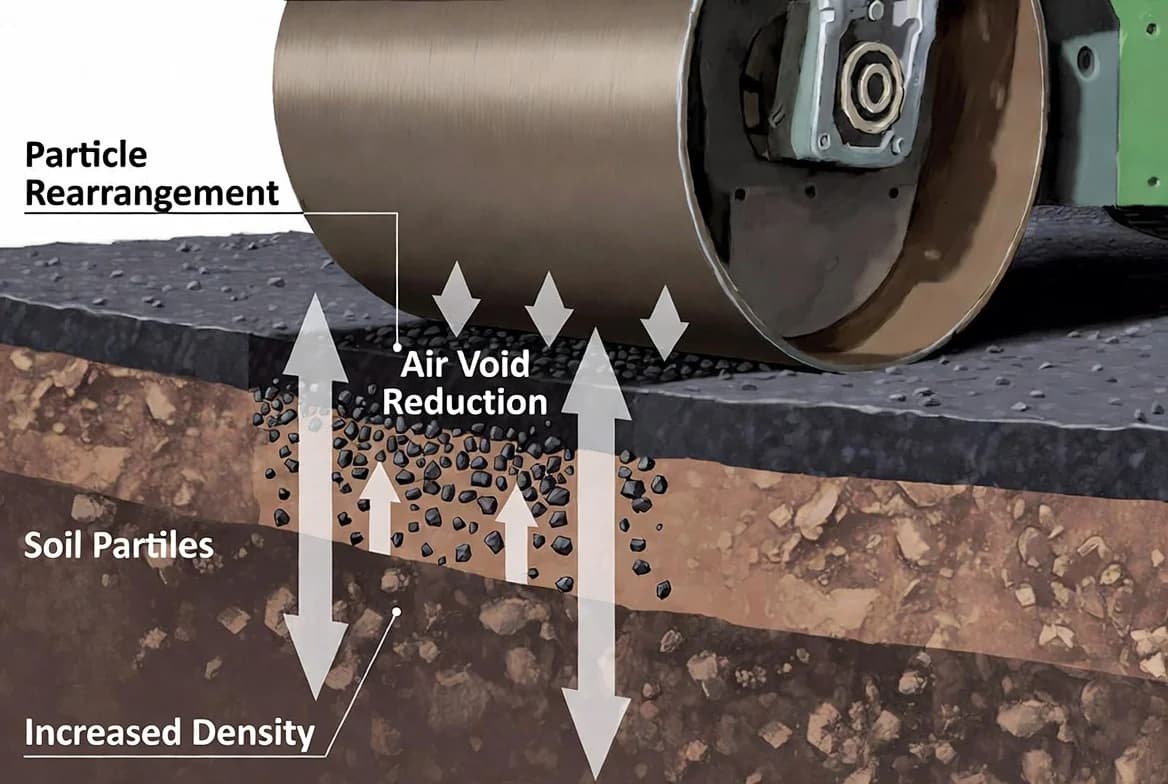

Compaction is the fundamental process by which the density of soil, aggregate, or asphalt is increased through the application of mechanical energy. The objective is to reduce the volume of air voids between solid particles so that the material becomes stronger, less permeable, and more resistant to deformation under traffic or structural loads. In road construction, earthworks, and foundation engineering, achieving the specified degree of compaction is one of the most important quality-control requirements. Inadequate compaction leads to settlement, rutting, cracking, and premature failure of the pavement or structure. A thorough understanding of the physical mechanisms involved allows engineers and operators to select appropriate equipment, control moisture, limit lift thickness, and verify results with confidence.
At the microscopic level, compaction rearranges particles into a denser packing arrangement. When a roller applies pressure, particles slide, rotate, and settle into positions that minimise the void space. Air that previously occupied the interstices is expelled. The resulting material has higher dry density, improved shear strength, and reduced compressibility. The amount of densification that can be achieved depends on several interrelated factors: the particle-size distribution and shape, the surface texture of the particles, the moisture content, the magnitude and type of applied energy (static or dynamic), and the thickness of the layer being compacted.
Moisture content plays a decisive role, especially in soil compaction. Water acts as a lubricant that reduces inter-particle friction and allows particles to move more freely under load. Laboratory Proctor tests establish the relationship between moisture content and dry density for a given compactive effort. The curve typically shows a clear peak—the maximum dry density—at an optimum moisture content. Below that optimum the soil is too stiff; above it the soil becomes saturated and the applied energy is absorbed by pore water rather than by particle rearrangement. Field operations must therefore keep the material close to optimum moisture. Too-dry material may require water addition and mixing; too-wet material may require aeration or waiting for drainage.
Static pressure is generated by the dead weight of the roller acting through the contact area of the drum or tyres. Contact pressure is simply the weight divided by the contact area; heavier machines and narrower drums produce higher pressures. Static pressure is effective for many materials when the lift is not too thick and when sustained load can rearrange particles. Vibratory rollers add a dynamic component by oscillating the drum at high frequency. The vibration reduces internal friction, allowing particles to settle more readily under the combined static and dynamic forces. The dynamic force is produced by rotating eccentric weights; its magnitude is proportional to the eccentric moment and the square of rotational speed. Vibration is particularly effective in granular soils and in hot asphalt mixtures.
Energy from the roller dissipates with depth. A surface that appears well compacted may conceal under-compacted material at the bottom of a thick lift. Consequently, specifications limit lift thickness—commonly 150–300 mm for soil and 40–80 mm for asphalt—depending on the roller type and the material. Each lift is compacted to the required density before the next is placed. Uniform coverage is equally important. Successive passes must overlap by 150–300 mm so that no strip receives fewer passes than its neighbours. Operators must also avoid stopping or turning on freshly placed asphalt, because concentrated loads create depressions that are difficult to remove.
Field density is measured with nuclear density gauges, sand-cone apparatus, or other approved methods and is compared with the laboratory maximum dry density. Typical requirements are 95–98 percent of maximum dry density for structural fills and 92–96 percent for asphalt concrete, depending on the mix and the traffic classification. Continuous compaction control systems that measure drum response in real time are increasingly used to give the operator immediate feedback and to document uniformity across the entire area. In summary, compaction succeeds when particle rearrangement and air expulsion are achieved under controlled moisture, appropriate energy, limited lift thickness, and verified density. Mastery of these principles produces durable, specification-compliant construction.
Get More Expert Guides & Updates
Subscribe for Machinery.org guide updates and product learning content.