
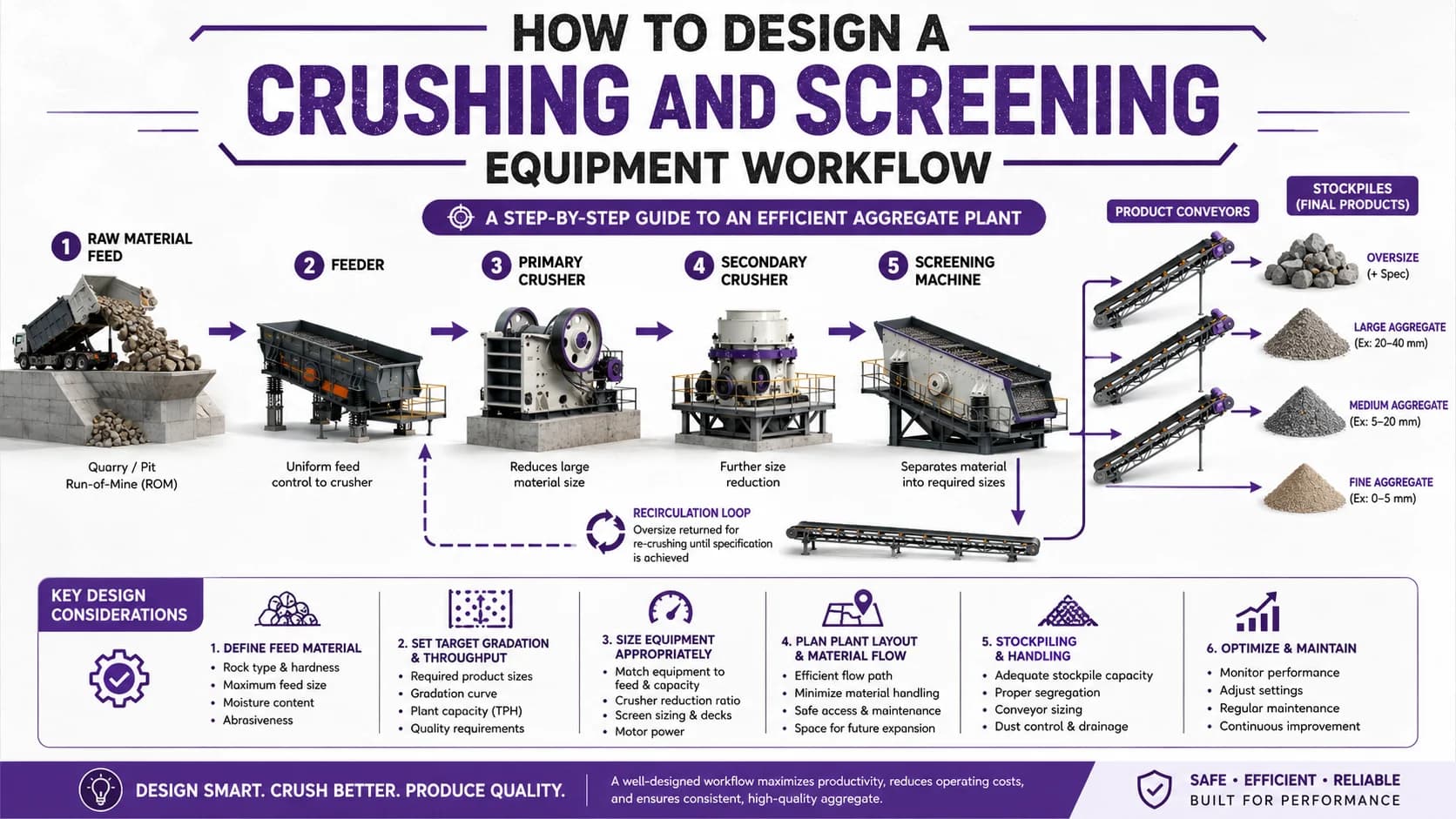
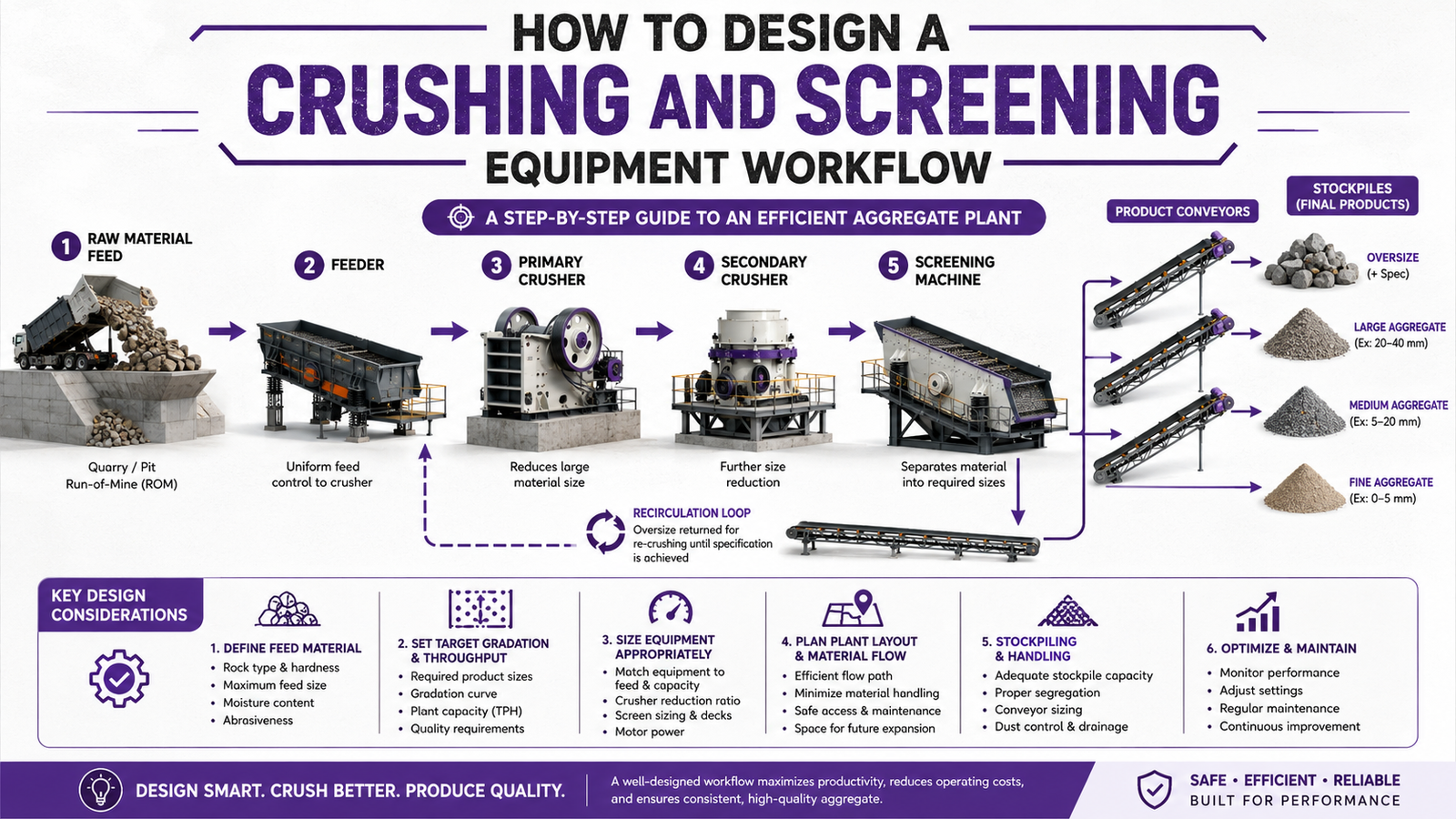
A crushing and screening plant is a connected process rather than a collection of individual machines. Feed preparation influences the primary crusher; crusher discharge controls screen loading; the screen determines what becomes product and what returns for more crushing; conveyors, bins, chutes, controls, and stockpiles determine whether the theoretical production can be sustained. A good workflow begins with the raw material and finished-product requirements, then works backward through every stage. This guide provides a practical framework for designing that workflow from feed hopper to final stockpile.
1. Characterize the Raw Material
Plant design should begin with representative information about the real feed. This is an important part of how to design a crushing and screening equipment workflow because the setting, component, or process does not operate in isolation. It changes the load seen by the next machine, the condition of the material, and the amount of useful product that can be produced. Important inputs include maximum lump size, full gradation, bulk density, compressive strength, abrasiveness, moisture, clay, and seasonal variation. Operators therefore need to understand both the mechanical function and the process consequence before they make adjustments.
From a process standpoint, Recycling plants should also identify steel, wood, soil, and other contaminants. The practical result should be checked with measurements rather than appearance alone. Useful observations can include feed rate, product gradation, machine power or pressure, vibration, temperature, wear condition, recirculating load, moisture, and downtime, depending on the equipment involved. The loading method and expected average and peak feed rates influence hopper and feeder selection. When these observations are recorded consistently, normal variation becomes easier to separate from a developing fault.
In day-to-day operation, stability is usually more valuable than a short peak in output. A machine that alternates between starvation and overload may briefly show high production, yet it normally creates more wear, more product variation, and more operator intervention. Clear feed assumptions provide the foundation for every downstream equipment calculation. The best operating point is the one that can be repeated safely for the expected feed and product requirement, with enough reserve for normal changes in material condition.
For troubleshooting, make one controlled change at a time whenever production conditions allow. First document the symptom and current setup, then inspect the simplest causes before changing a major setting or replacing a component. Check the equipment immediately upstream and downstream as well, because many apparent machine problems are actually caused by unstable feeding, restricted discharge, poor separation, blocked chutes, incorrect line routing, or insufficient surge capacity. After a change, compare the result under similar operating conditions and keep the data for future reference.
Maintenance and safety requirements must be built into the operating method. Wear parts, guards, access doors, hydraulic systems, electrical drives, rotating components, and stored energy should be inspected and serviced using the manufacturer procedure and the site's isolation rules. Machine-specific capacities, allowable settings, pressures, speeds, wear limits, and inspection intervals vary by model, so general guidance should never replace the applicable manual. A clear inspection routine and accurate service history help prevent small defects from becoming production failures.
2. Define Finished Products and Market Requirements
The number and size of saleable products determine the screening and crushing arrangement. This is an important part of how to design a crushing and screening equipment workflow because the setting, component, or process does not operate in isolation. It changes the load seen by the next machine, the condition of the material, and the amount of useful product that can be produced. Each product should have a target gradation, shape requirement, cleanliness requirement, and expected percentage of total production. Operators therefore need to understand both the mechanical function and the process consequence before they make adjustments.
From a process standpoint, Products may require washing, blending, or classification in addition to dry screening. The practical result should be checked with measurements rather than appearance alone. Useful observations can include feed rate, product gradation, machine power or pressure, vibration, temperature, wear condition, recirculating load, moisture, and downtime, depending on the equipment involved. Oversize must have a defined destination such as recirculation, sale, or waste. When these observations are recorded consistently, normal variation becomes easier to separate from a developing fault.
In day-to-day operation, stability is usually more valuable than a short peak in output. A machine that alternates between starvation and overload may briefly show high production, yet it normally creates more wear, more product variation, and more operator intervention. Future products can be considered without creating unnecessary complexity in the initial plant. The best operating point is the one that can be repeated safely for the expected feed and product requirement, with enough reserve for normal changes in material condition.
For troubleshooting, make one controlled change at a time whenever production conditions allow. First document the symptom and current setup, then inspect the simplest causes before changing a major setting or replacing a component. Check the equipment immediately upstream and downstream as well, because many apparent machine problems are actually caused by unstable feeding, restricted discharge, poor separation, blocked chutes, incorrect line routing, or insufficient surge capacity. After a change, compare the result under similar operating conditions and keep the data for future reference.
Maintenance and safety requirements must be built into the operating method. Wear parts, guards, access doors, hydraulic systems, electrical drives, rotating components, and stored energy should be inspected and serviced using the manufacturer procedure and the site's isolation rules. Machine-specific capacities, allowable settings, pressures, speeds, wear limits, and inspection intervals vary by model, so general guidance should never replace the applicable manual. A clear inspection routine and accurate service history help prevent small defects from becoming production failures.
3. Select Primary Crushing and Pre-Screening
The primary crusher must accept the largest credible feed and produce a manageable downstream size. This is an important part of how to design a crushing and screening equipment workflow because the setting, component, or process does not operate in isolation. It changes the load seen by the next machine, the condition of the material, and the amount of useful product that can be produced. Jaw crushers are common in hard rock while primary impactors can provide high reduction in suitable lower-abrasion material. Operators therefore need to understand both the mechanical function and the process consequence before they make adjustments.
From a process standpoint, A grizzly or scalping screen can remove natural fines before the crusher and reduce unnecessary wear. The practical result should be checked with measurements rather than appearance alone. Useful observations can include feed rate, product gradation, machine power or pressure, vibration, temperature, wear condition, recirculating load, moisture, and downtime, depending on the equipment involved. Oversize management may require a rock breaker or controlled rejection method. When these observations are recorded consistently, normal variation becomes easier to separate from a developing fault.
In day-to-day operation, stability is usually more valuable than a short peak in output. A machine that alternates between starvation and overload may briefly show high production, yet it normally creates more wear, more product variation, and more operator intervention. Maintenance access for primary crusher wear parts should be planned before structures and chutes are finalized. The best operating point is the one that can be repeated safely for the expected feed and product requirement, with enough reserve for normal changes in material condition.
For troubleshooting, make one controlled change at a time whenever production conditions allow. First document the symptom and current setup, then inspect the simplest causes before changing a major setting or replacing a component. Check the equipment immediately upstream and downstream as well, because many apparent machine problems are actually caused by unstable feeding, restricted discharge, poor separation, blocked chutes, incorrect line routing, or insufficient surge capacity. After a change, compare the result under similar operating conditions and keep the data for future reference.
Maintenance and safety requirements must be built into the operating method. Wear parts, guards, access doors, hydraulic systems, electrical drives, rotating components, and stored energy should be inspected and serviced using the manufacturer procedure and the site's isolation rules. Machine-specific capacities, allowable settings, pressures, speeds, wear limits, and inspection intervals vary by model, so general guidance should never replace the applicable manual. A clear inspection routine and accurate service history help prevent small defects from becoming production failures.
4. Design Secondary and Tertiary Reduction
Secondary and tertiary stages should each have a clear purpose in the overall reduction strategy. This is an important part of how to design a crushing and screening equipment workflow because the setting, component, or process does not operate in isolation. It changes the load seen by the next machine, the condition of the material, and the amount of useful product that can be produced. Cone crushers are common for hard abrasive rock while impact crushers can improve shape in suitable materials. Operators therefore need to understand both the mechanical function and the process consequence before they make adjustments.
From a process standpoint, Interstage screening can remove finished material before it passes through another high-wear crushing stage. The practical result should be checked with measurements rather than appearance alone. Useful observations can include feed rate, product gradation, machine power or pressure, vibration, temperature, wear condition, recirculating load, moisture, and downtime, depending on the equipment involved. A tertiary stage may be justified for tight gradation, manufactured sand, or higher-quality cubical products. When these observations are recorded consistently, normal variation becomes easier to separate from a developing fault.
In day-to-day operation, stability is usually more valuable than a short peak in output. A machine that alternates between starvation and overload may briefly show high production, yet it normally creates more wear, more product variation, and more operator intervention. The goal is to avoid crushing particles more times than necessary to meet the specification. The best operating point is the one that can be repeated safely for the expected feed and product requirement, with enough reserve for normal changes in material condition.
For troubleshooting, make one controlled change at a time whenever production conditions allow. First document the symptom and current setup, then inspect the simplest causes before changing a major setting or replacing a component. Check the equipment immediately upstream and downstream as well, because many apparent machine problems are actually caused by unstable feeding, restricted discharge, poor separation, blocked chutes, incorrect line routing, or insufficient surge capacity. After a change, compare the result under similar operating conditions and keep the data for future reference.
Maintenance and safety requirements must be built into the operating method. Wear parts, guards, access doors, hydraulic systems, electrical drives, rotating components, and stored energy should be inspected and serviced using the manufacturer procedure and the site's isolation rules. Machine-specific capacities, allowable settings, pressures, speeds, wear limits, and inspection intervals vary by model, so general guidance should never replace the applicable manual. A clear inspection routine and accurate service history help prevent small defects from becoming production failures.
5. Position Screens and Control Recirculation
Screens create finished products and govern the amount of oversize returned to a crusher. This is an important part of how to design a crushing and screening equipment workflow because the setting, component, or process does not operate in isolation. It changes the load seen by the next machine, the condition of the material, and the amount of useful product that can be produced. Screen capacity must include circulating load as well as fresh feed. Operators therefore need to understand both the mechanical function and the process consequence before they make adjustments.
From a process standpoint, Near-size material can consume more deck area than a simple tonnage calculation suggests. The practical result should be checked with measurements rather than appearance alone. Useful observations can include feed rate, product gradation, machine power or pressure, vibration, temperature, wear condition, recirculating load, moisture, and downtime, depending on the equipment involved. Changing crusher settings changes the screen feed distribution and therefore the return load. When these observations are recorded consistently, normal variation becomes easier to separate from a developing fault.
In day-to-day operation, stability is usually more valuable than a short peak in output. A machine that alternates between starvation and overload may briefly show high production, yet it normally creates more wear, more product variation, and more operator intervention. Sampling points and belt scales can help quantify how efficiently the closed circuit is operating. The best operating point is the one that can be repeated safely for the expected feed and product requirement, with enough reserve for normal changes in material condition.
For troubleshooting, make one controlled change at a time whenever production conditions allow. First document the symptom and current setup, then inspect the simplest causes before changing a major setting or replacing a component. Check the equipment immediately upstream and downstream as well, because many apparent machine problems are actually caused by unstable feeding, restricted discharge, poor separation, blocked chutes, incorrect line routing, or insufficient surge capacity. After a change, compare the result under similar operating conditions and keep the data for future reference.
Maintenance and safety requirements must be built into the operating method. Wear parts, guards, access doors, hydraulic systems, electrical drives, rotating components, and stored energy should be inspected and serviced using the manufacturer procedure and the site's isolation rules. Machine-specific capacities, allowable settings, pressures, speeds, wear limits, and inspection intervals vary by model, so general guidance should never replace the applicable manual. A clear inspection routine and accurate service history help prevent small defects from becoming production failures.
6. Size Conveyors, Chutes, and Surge Capacity
Conveyors must handle the highest realistic instantaneous flow, not just average plant production. This is an important part of how to design a crushing and screening equipment workflow because the setting, component, or process does not operate in isolation. It changes the load seen by the next machine, the condition of the material, and the amount of useful product that can be produced. Transfer chutes should load receiving belts centrally and control drop height, dust, spillage, and wear. Operators therefore need to understand both the mechanical function and the process consequence before they make adjustments.
From a process standpoint, Surge bins decouple machines so short interruptions do not stop the entire circuit. The practical result should be checked with measurements rather than appearance alone. Useful observations can include feed rate, product gradation, machine power or pressure, vibration, temperature, wear condition, recirculating load, moisture, and downtime, depending on the equipment involved. Level sensors and controlled feeders help keep downstream crushers and screens stable. When these observations are recorded consistently, normal variation becomes easier to separate from a developing fault.
In day-to-day operation, stability is usually more valuable than a short peak in output. A machine that alternates between starvation and overload may briefly show high production, yet it normally creates more wear, more product variation, and more operator intervention. The layout should include safe access to clean spills, replace chute liners, and maintain conveyor components. The best operating point is the one that can be repeated safely for the expected feed and product requirement, with enough reserve for normal changes in material condition.
For troubleshooting, make one controlled change at a time whenever production conditions allow. First document the symptom and current setup, then inspect the simplest causes before changing a major setting or replacing a component. Check the equipment immediately upstream and downstream as well, because many apparent machine problems are actually caused by unstable feeding, restricted discharge, poor separation, blocked chutes, incorrect line routing, or insufficient surge capacity. After a change, compare the result under similar operating conditions and keep the data for future reference.
Maintenance and safety requirements must be built into the operating method. Wear parts, guards, access doors, hydraulic systems, electrical drives, rotating components, and stored energy should be inspected and serviced using the manufacturer procedure and the site's isolation rules. Machine-specific capacities, allowable settings, pressures, speeds, wear limits, and inspection intervals vary by model, so general guidance should never replace the applicable manual. A clear inspection routine and accurate service history help prevent small defects from becoming production failures.
7. Automation, Interlocks, and Upset Strategy
A well-designed control system starts downstream equipment before upstream feed begins and stops feed before discharge paths are lost. This is an important part of how to design a crushing and screening equipment workflow because the setting, component, or process does not operate in isolation. It changes the load seen by the next machine, the condition of the material, and the amount of useful product that can be produced. Interlocks protect crushers and conveyors when a downstream machine trips. Operators therefore need to understand both the mechanical function and the process consequence before they make adjustments.
From a process standpoint, Feeder speed can be regulated using level sensors, crusher power, motor load, belt scales, and screen status. The practical result should be checked with measurements rather than appearance alone. Useful observations can include feed rate, product gradation, machine power or pressure, vibration, temperature, wear condition, recirculating load, moisture, and downtime, depending on the equipment involved. The plant should have a defined response for full stockpiles, blocked chutes, screen trips, and return-conveyor failures. When these observations are recorded consistently, normal variation becomes easier to separate from a developing fault.
In day-to-day operation, stability is usually more valuable than a short peak in output. A machine that alternates between starvation and overload may briefly show high production, yet it normally creates more wear, more product variation, and more operator intervention. Operators need to understand the reason for an interlock rather than bypassing it to maintain short-term production. The best operating point is the one that can be repeated safely for the expected feed and product requirement, with enough reserve for normal changes in material condition.
For troubleshooting, make one controlled change at a time whenever production conditions allow. First document the symptom and current setup, then inspect the simplest causes before changing a major setting or replacing a component. Check the equipment immediately upstream and downstream as well, because many apparent machine problems are actually caused by unstable feeding, restricted discharge, poor separation, blocked chutes, incorrect line routing, or insufficient surge capacity. After a change, compare the result under similar operating conditions and keep the data for future reference.
Maintenance and safety requirements must be built into the operating method. Wear parts, guards, access doors, hydraulic systems, electrical drives, rotating components, and stored energy should be inspected and serviced using the manufacturer procedure and the site's isolation rules. Machine-specific capacities, allowable settings, pressures, speeds, wear limits, and inspection intervals vary by model, so general guidance should never replace the applicable manual. A clear inspection routine and accurate service history help prevent small defects from becoming production failures.
8. Maintenance Access, Commissioning, and Optimization
Platforms, stairs, handrails, lifting beams, isolation points, and component removal paths should be part of the plant design. This is an important part of how to design a crushing and screening equipment workflow because the setting, component, or process does not operate in isolation. It changes the load seen by the next machine, the condition of the material, and the amount of useful product that can be produced. Commissioning should begin at reduced feed while belt tracking, chute flow, crusher settings, screen motion, and interlocks are verified. Operators therefore need to understand both the mechanical function and the process consequence before they make adjustments.
From a process standpoint, Feed can then be increased gradually while power, throughput, product gradation, and return load are recorded. The practical result should be checked with measurements rather than appearance alone. Useful observations can include feed rate, product gradation, machine power or pressure, vibration, temperature, wear condition, recirculating load, moisture, and downtime, depending on the equipment involved. One variable should be tuned at a time so the effect can be identified. When these observations are recorded consistently, normal variation becomes easier to separate from a developing fault.
In day-to-day operation, stability is usually more valuable than a short peak in output. A machine that alternates between starvation and overload may briefly show high production, yet it normally creates more wear, more product variation, and more operator intervention. The final result should be a documented best-known operating setup for each common product campaign. The best operating point is the one that can be repeated safely for the expected feed and product requirement, with enough reserve for normal changes in material condition.
For troubleshooting, make one controlled change at a time whenever production conditions allow. First document the symptom and current setup, then inspect the simplest causes before changing a major setting or replacing a component. Check the equipment immediately upstream and downstream as well, because many apparent machine problems are actually caused by unstable feeding, restricted discharge, poor separation, blocked chutes, incorrect line routing, or insufficient surge capacity. After a change, compare the result under similar operating conditions and keep the data for future reference.
Maintenance and safety requirements must be built into the operating method. Wear parts, guards, access doors, hydraulic systems, electrical drives, rotating components, and stored energy should be inspected and serviced using the manufacturer procedure and the site's isolation rules. Machine-specific capacities, allowable settings, pressures, speeds, wear limits, and inspection intervals vary by model, so general guidance should never replace the applicable manual. A clear inspection routine and accurate service history help prevent small defects from becoming production failures.
Quick Reference
Workflow Stage
Main Purpose
Key Question
Feed/surge
Stabilize incoming flow
How variable is raw feed?
Primary crushing
Reduce top size
Can it accept worst-case lumps?
Secondary/tertiary
Shape and final reduction
What route is economical?
Screening
Create products/control return
What is near-size load?
Conveying
Move material reliably
What is peak internal flow?
Final Takeaway
Successful equipment operation comes from matching the machine to the actual material or placement requirement, then controlling the whole workflow rather than one component in isolation. Stable feed or supply, correct settings, adequate downstream capacity, planned maintenance, and consistent records create reliable production. When performance changes, identify the symptom, verify the operating condition, inspect connected equipment, and use the manufacturer limits before making a major adjustment. This disciplined approach improves quality, controls wear and operating cost, and reduces avoidable downtime.
Get More Expert Guides & Updates
Subscribe for Machinery.org guide updates and product learning content.