
Safe and legal transport of a mini excavator is a fundamental part of equipment ownership. Improper loading, inadequate securement, or failure to comply with highway regulations can result in equipment damage, traffic accidents, fines, or liability claims. A systematic approach to transport planning, loading, securing, and unloading protects both the machine and everyone sharing the road.
Selecting the Right Trailer
The trailer must have a rated capacity that exceeds the operating weight of the excavator plus any residual fuel, attachments, and the weight of the trailer itself. A common recommendation is to keep the excavator weight at or below 80 % of the trailer’s payload capacity. Tandem-axle trailers are preferred for stability; triple-axle trailers are used for heavier mini excavators. Deck length must accommodate the machine with the boom and stick folded or positioned for the lowest overall height and the most favourable weight distribution.
Trailer features that improve safety and convenience include loading ramps with an appropriate angle (ideally 15 degrees or less), a tilt-deck or hydraulic beaver-tail design for low-angle loading, and a sufficient number of D-rings or stake pockets for chain or strap attachment. Electric or hydraulic brakes are essential for trailers that will carry significant weight.
Preparing the Excavator for Transport
Before loading, clean the tracks of mud and debris that could fall onto the roadway. Retract any variable-width undercarriage to its narrowest setting. Position the boom and stick so that the overall height is minimised and the centre of gravity is as low and as far forward as practical. Many operators fold the boom back and rest the bucket on the deck or on a wooden block. Engage the swing lock or house lock if the machine is equipped with one. Turn off the battery disconnect switch if long-distance transport is planned.
Loading Procedure
Position the trailer on firm, level ground. Chock the trailer wheels. Align the excavator with the ramps and drive or track slowly onto the deck. Keep the machine centred. Once fully on the trailer, lower the blade (if equipped) or the bucket to the deck to increase stability. Some operators prefer to leave a small amount of hydraulic pressure in the cylinders so that the machine is not completely “dead,” but local regulations and company policy should be followed.
Securement
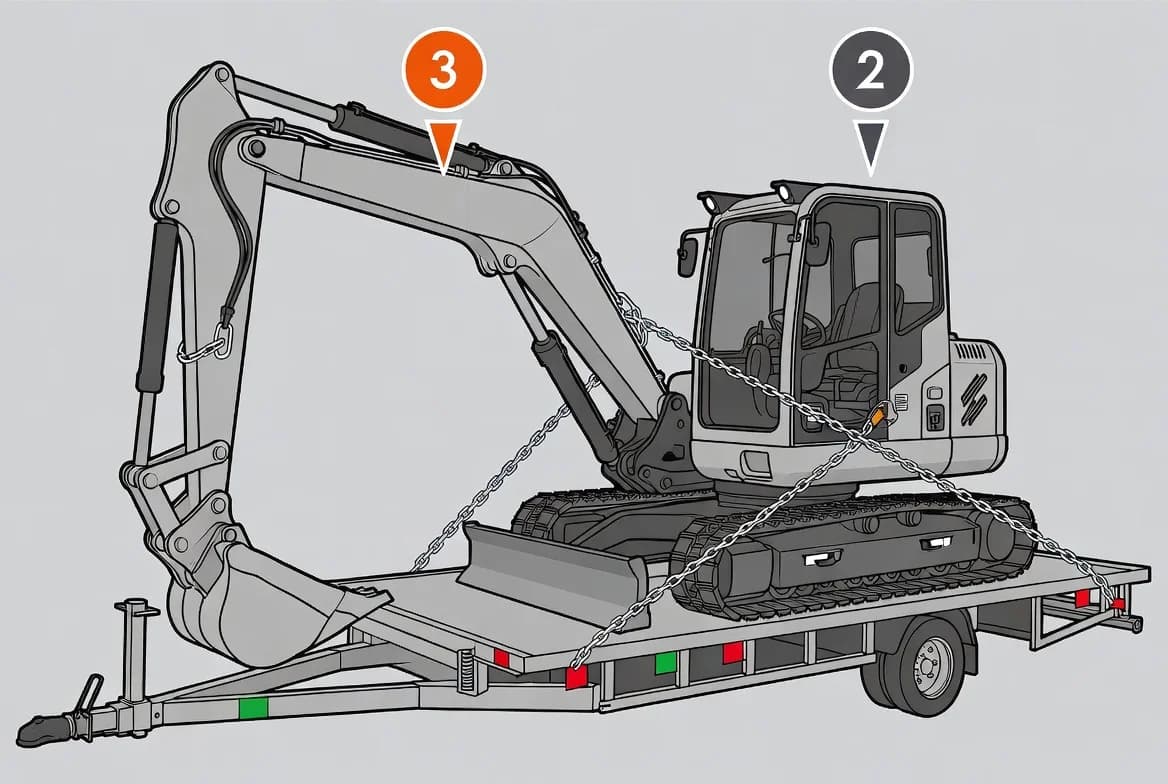
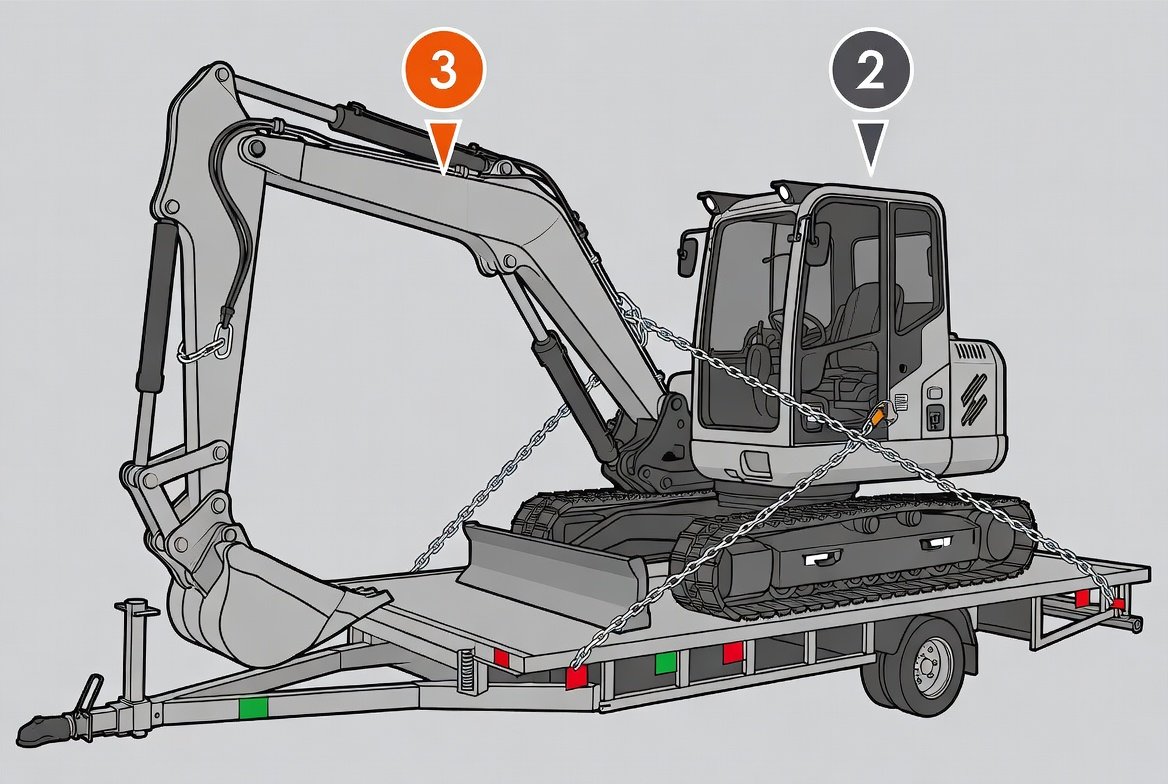
Use at least four tie-down points—typically two at the front of the undercarriage and two at the rear. Grade 70 or Grade 80 transport chains with appropriate binders, or heavy-duty ratchet straps rated for the load, are required. Attach the chains to the structural points of the undercarriage or to the manufacturer’s designated tie-down locations; never attach to hydraulic cylinders, track rollers, or sheet-metal components. Tighten the chains evenly so that the machine cannot shift in any direction. After a few kilometres of travel, stop and re-check the tension, because chains can settle.
In addition to the undercarriage tie-downs, many operators secure the boom and stick with an additional chain or strap to prevent any residual hydraulic movement. Reflective flags or oversize signs may be required depending on the overall width and height of the loaded combination and on local regulations.
Legal and Safety Considerations
Know the legal weight limits, axle-load limits, and oversize-permit requirements for every jurisdiction through which the load will travel. A commercial driver’s licence (or equivalent) may be required once the combined weight exceeds a certain threshold. Lighting, braking systems, and safety chains between the tow vehicle and trailer must be in full working order. Never exceed the tow vehicle’s rated towing capacity or the trailer’s rated capacity.
During transport, avoid sudden braking or sharp turns that could shift the load. Plan the route to avoid low bridges, weight-restricted roads, and areas with height restrictions. If the overall height exceeds local limits, an alternative route or a different boom position may be necessary.
Unloading
Unloading is essentially the reverse of loading. Position the trailer on firm level ground, chock the wheels, remove the tie-downs, and carefully track the machine off the ramps. Be especially cautious if the ground at the destination is soft or sloping; the machine’s centre of gravity changes as it moves down the ramps.
In summary, safe transport of a mini excavator requires a properly rated trailer, careful preparation of the machine, methodical loading, robust securement with chains or straps at designated points, compliance with all highway regulations, and cautious unloading. Following these practices protects the equipment investment and keeps everyone on the road safe.
Get More Expert Guides & Updates
Subscribe for Machinery.org guide updates and product learning content.