
Verified guide word count: 3,352 words
Introduction
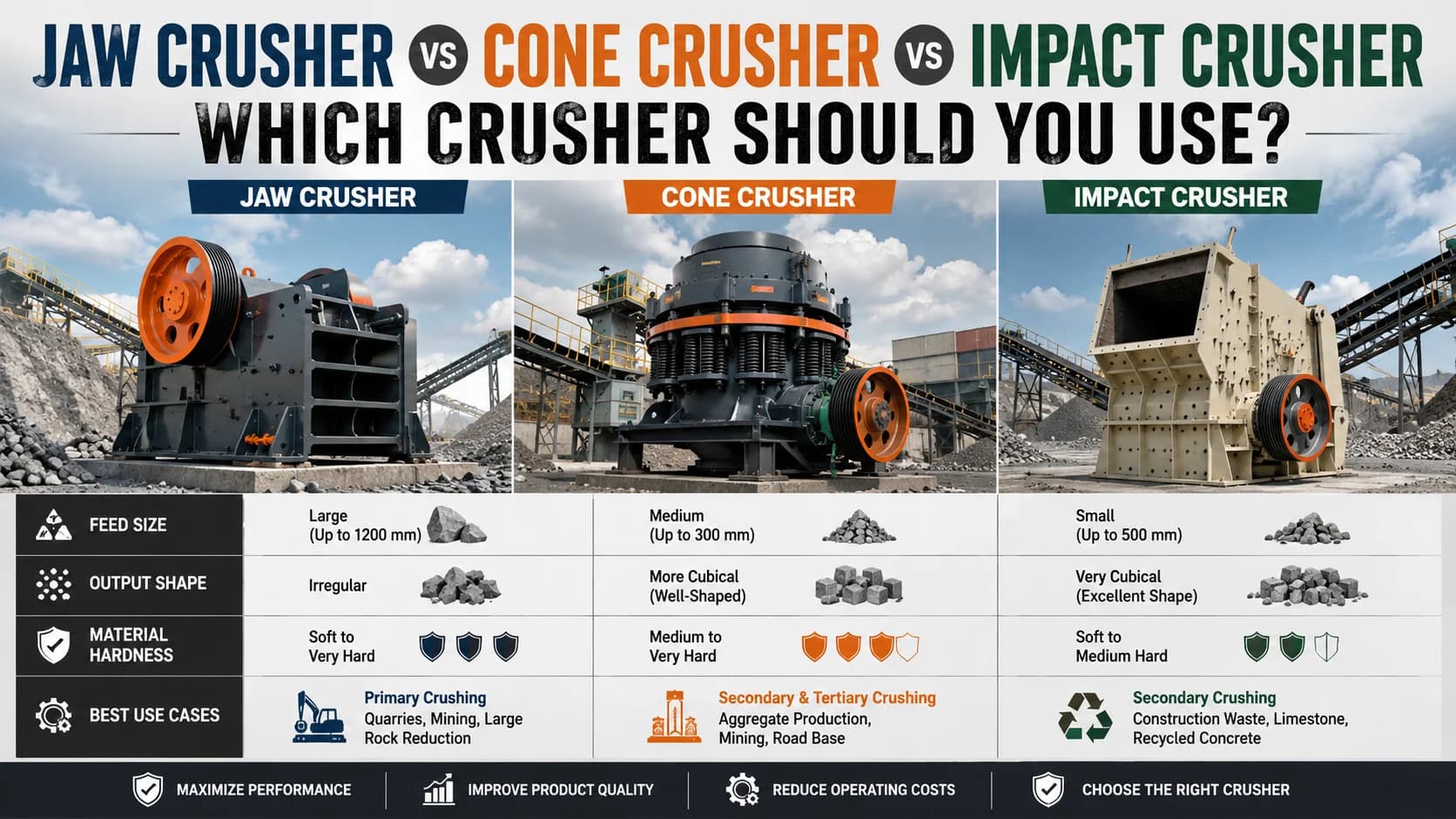
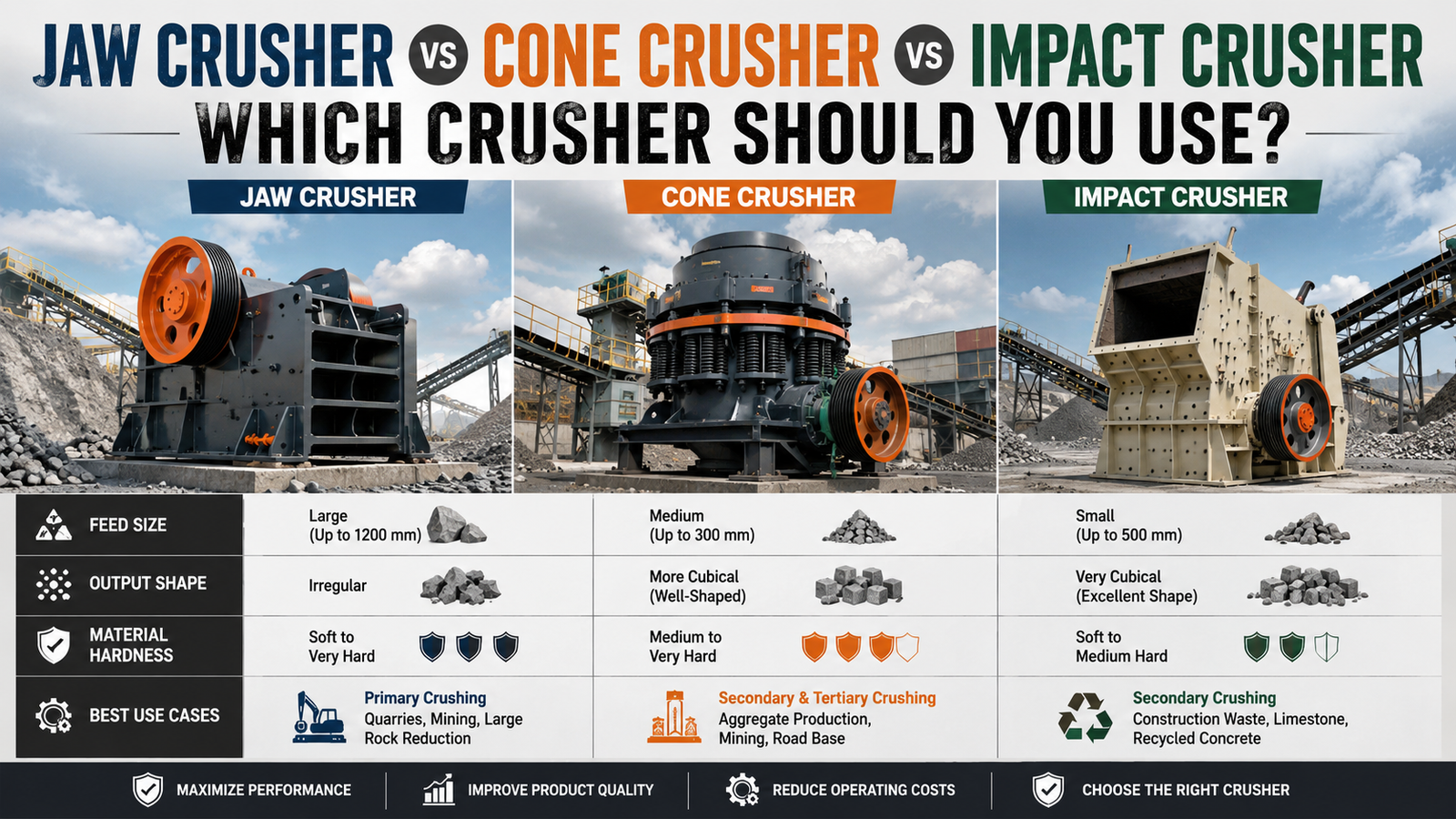
Jaw, cone, and impact crushers all reduce rock and recycled materials, but they use different crushing mechanisms and therefore excel in different stages and feed conditions.
A jaw crusher uses compression between fixed and moving jaws, a cone crusher uses repeated compression between a mantle and concave, and an impact crusher uses high-speed impact against blow bars and breaker surfaces.
The correct machine depends on feed size, material hardness and abrasiveness, moisture, desired reduction ratio, product shape, required capacity, wear cost, and the role of the crusher in the circuit.
This guide compares the three types from a practical production and buying perspective.
Jaw Crusher Strengths and Limitations
Jaw crushers accept large feed and are widely used as primary machines for blasted quarry rock, demolition concrete, and other hard materials. In practice, crews should verify this condition under the actual job environment rather than relying only on a display or a previous setting. Small changes in material, temperature, wear, or machine position can change the result, so measured checks and consistent observation are important.
The V-shaped chamber repeatedly compresses the feed until pieces are small enough to pass through the discharge opening. This point also affects productivity because the machine works best when the surrounding process is stable. When the condition begins to drift, the operator should identify the source, make one logical correction, and allow enough operating time to judge whether the correction worked.
Jaw crushers are mechanically straightforward and can tolerate variable feed better than many secondary crushing machines. From a quality-control perspective, the result should be checked repeatedly at planned intervals instead of only after a visible defect appears. A sequence of measurements reveals trends early and gives supervisors time to correct the process before a long section or a large volume of material is affected.
The primary product is often more angular or elongated than the product from a well-set cone or impact crusher, so additional shaping may be required. Maintenance and operation are connected here. Wear, looseness, buildup, damaged sensors, or restricted flow can force the operator to compensate with controls, but compensation rarely produces the same consistency as restoring the component to proper condition.
Jaw performance depends strongly on feed distribution, jaw-plate profile, closed-side setting, and prevention of bridging at the feed opening. The safest and most efficient approach is to include this item in the pre-shift plan and to define who is responsible for checking it during production. Clear communication between the main machine operator, ground crew, trucks, quality personnel, and support equipment reduces delays and prevents conflicting adjustments.
For a crusher selection crew, the practical objective in this area is repeatability. Record the starting condition, observe how the machine and material respond, and use measured results to decide whether another adjustment is necessary. This disciplined method reduces rework, makes troubleshooting faster, and produces a process that can be repeated by the next shift.
Cone Crusher Strengths and Limitations
Cone crushers are commonly used in secondary and tertiary stages after a primary crusher has reduced the maximum feed size. Experienced crews treat this as one variable in a larger system rather than an isolated setting. If performance changes, they compare material condition, machine speed, mechanical condition, and downstream capacity before assuming that one control must be adjusted.
The eccentric mantle compresses material repeatedly against the concave and can process hard, abrasive rock efficiently when the chamber is correctly fed. In practice, crews should verify this condition under the actual job environment rather than relying only on a display or a previous setting. Small changes in material, temperature, wear, or machine position can change the result, so measured checks and consistent observation are important.
Stable choke feeding helps maintain inter-particle crushing, product gradation, and even liner wear in many cone-crusher applications. This point also affects productivity because the machine works best when the surrounding process is stable. When the condition begins to drift, the operator should identify the source, make one logical correction, and allow enough operating time to judge whether the correction worked.
Cones generally prefer a controlled feed size and even distribution around the chamber rather than large irregular run-of-mine rock. From a quality-control perspective, the result should be checked repeatedly at planned intervals instead of only after a visible defect appears. A sequence of measurements reveals trends early and gives supervisors time to correct the process before a long section or a large volume of material is affected.
Product shape can be very good when chamber profile, reduction ratio, speed, throw, liner condition, and feed distribution are properly matched. Maintenance and operation are connected here. Wear, looseness, buildup, damaged sensors, or restricted flow can force the operator to compensate with controls, but compensation rarely produces the same consistency as restoring the component to proper condition.
For a crusher selection crew, the practical objective in this area is repeatability. Record the starting condition, observe how the machine and material respond, and use measured results to decide whether another adjustment is necessary. This disciplined method reduces rework, makes troubleshooting faster, and produces a process that can be repeated by the next shift.
Impact Crusher Strengths and Limitations
Horizontal-shaft impact crushers use a high-speed rotor and blow bars to accelerate material into breaker plates and create repeated impact fracture. The safest and most efficient approach is to include this item in the pre-shift plan and to define who is responsible for checking it during production. Clear communication between the main machine operator, ground crew, trucks, quality personnel, and support equipment reduces delays and prevents conflicting adjustments.
Impact crushing can achieve a high reduction ratio and often produces an excellent cubical product with fewer stages in suitable materials. Experienced crews treat this as one variable in a larger system rather than an isolated setting. If performance changes, they compare material condition, machine speed, mechanical condition, and downstream capacity before assuming that one control must be adjusted.
Limestone, recycled concrete, asphalt, and many soft to medium-hard materials are common impact-crusher applications. In practice, crews should verify this condition under the actual job environment rather than relying only on a display or a previous setting. Small changes in material, temperature, wear, or machine position can change the result, so measured checks and consistent observation are important.
Very hard abrasive rock can create high blow-bar and liner consumption, so wear cost per tonne should be estimated before selecting an impactor. This point also affects productivity because the machine works best when the surrounding process is stable. When the condition begins to drift, the operator should identify the source, make one logical correction, and allow enough operating time to judge whether the correction worked.
Large metal, uncrushable objects, sticky feed, and excessive fines can reduce performance and require careful feed preparation and protection systems. From a quality-control perspective, the result should be checked repeatedly at planned intervals instead of only after a visible defect appears. A sequence of measurements reveals trends early and gives supervisors time to correct the process before a long section or a large volume of material is affected.
For a crusher selection crew, the practical objective in this area is repeatability. Record the starting condition, observe how the machine and material respond, and use measured results to decide whether another adjustment is necessary. This disciplined method reduces rework, makes troubleshooting faster, and produces a process that can be repeated by the next shift.
Feed Size and Primary Stage Choice
Large run-of-mine rock generally favors a jaw or suitable primary impactor because both can be built with substantial feed openings. Maintenance and operation are connected here. Wear, looseness, buildup, damaged sensors, or restricted flow can force the operator to compensate with controls, but compensation rarely produces the same consistency as restoring the component to proper condition.
A cone crusher is normally placed after primary reduction and should receive feed that fits its chamber without repeated bridging or overload. The safest and most efficient approach is to include this item in the pre-shift plan and to define who is responsible for checking it during production. Clear communication between the main machine operator, ground crew, trucks, quality personnel, and support equipment reduces delays and prevents conflicting adjustments.
Feeders and grizzly screens can scalp natural fines so the primary crusher spends more energy on material that actually requires reduction. Experienced crews treat this as one variable in a larger system rather than an isolated setting. If performance changes, they compare material condition, machine speed, mechanical condition, and downstream capacity before assuming that one control must be adjusted.
Slabby or elongated feed should be evaluated carefully because nominal dimension alone does not predict whether a piece will orient and enter the opening. In practice, crews should verify this condition under the actual job environment rather than relying only on a display or a previous setting. Small changes in material, temperature, wear, or machine position can change the result, so measured checks and consistent observation are important.
Crusher selection should begin with the largest realistic feed and the required product, then build the circuit between those two conditions. This point also affects productivity because the machine works best when the surrounding process is stable. When the condition begins to drift, the operator should identify the source, make one logical correction, and allow enough operating time to judge whether the correction worked.
For a crusher selection crew, the practical objective in this area is repeatability. Record the starting condition, observe how the machine and material respond, and use measured results to decide whether another adjustment is necessary. This disciplined method reduces rework, makes troubleshooting faster, and produces a process that can be repeated by the next shift.
Hardness, Abrasiveness, and Wear
Hardness describes resistance to fracture, while abrasiveness describes how rapidly the material wears liners, plates, blow bars, and other metal surfaces. From a quality-control perspective, the result should be checked repeatedly at planned intervals instead of only after a visible defect appears. A sequence of measurements reveals trends early and gives supervisors time to correct the process before a long section or a large volume of material is affected.
Compression crushers such as jaws and cones are often economical on hard abrasive stone because wear is produced by pressure and sliding rather than repeated high-speed impact. Maintenance and operation are connected here. Wear, looseness, buildup, damaged sensors, or restricted flow can force the operator to compensate with controls, but compensation rarely produces the same consistency as restoring the component to proper condition.
Impact crushers may be highly productive in softer rock while becoming expensive in very abrasive granite or quartz-rich material. The safest and most efficient approach is to include this item in the pre-shift plan and to define who is responsible for checking it during production. Clear communication between the main machine operator, ground crew, trucks, quality personnel, and support equipment reduces delays and prevents conflicting adjustments.
Representative material testing and real wear data from similar applications are more useful than choosing a crusher from a hardness description alone. Experienced crews treat this as one variable in a larger system rather than an isolated setting. If performance changes, they compare material condition, machine speed, mechanical condition, and downstream capacity before assuming that one control must be adjusted.
Wear should be evaluated as cost per saleable tonne and should include the labor and downtime needed to change plates, liners, or blow bars. In practice, crews should verify this condition under the actual job environment rather than relying only on a display or a previous setting. Small changes in material, temperature, wear, or machine position can change the result, so measured checks and consistent observation are important.
For a crusher selection crew, the practical objective in this area is repeatability. Record the starting condition, observe how the machine and material respond, and use measured results to decide whether another adjustment is necessary. This disciplined method reduces rework, makes troubleshooting faster, and produces a process that can be repeated by the next shift.
Product Shape, Gradation, and Reduction Ratio
Impact crushers are widely selected when cubical particle shape is a high priority because impact breaks material at multiple orientations. This point also affects productivity because the machine works best when the surrounding process is stable. When the condition begins to drift, the operator should identify the source, make one logical correction, and allow enough operating time to judge whether the correction worked.
Cone crushers can also produce well-shaped aggregate when operated in an efficient reduction range with a full, evenly fed chamber. From a quality-control perspective, the result should be checked repeatedly at planned intervals instead of only after a visible defect appears. A sequence of measurements reveals trends early and gives supervisors time to correct the process before a long section or a large volume of material is affected.
Jaw crushers are excellent primary reducers but usually do not provide the final shape required for premium aggregate on their own. Maintenance and operation are connected here. Wear, looseness, buildup, damaged sensors, or restricted flow can force the operator to compensate with controls, but compensation rarely produces the same consistency as restoring the component to proper condition.
Very high reduction in one crusher can increase wear and reduce product control, so multi-stage circuits often divide the work across machines. The safest and most efficient approach is to include this item in the pre-shift plan and to define who is responsible for checking it during production. Clear communication between the main machine operator, ground crew, trucks, quality personnel, and support equipment reduces delays and prevents conflicting adjustments.
Screens and recirculating conveyors are essential because they determine which particles are finished products and which return for another crushing pass. Experienced crews treat this as one variable in a larger system rather than an isolated setting. If performance changes, they compare material condition, machine speed, mechanical condition, and downstream capacity before assuming that one control must be adjusted.
For a crusher selection crew, the practical objective in this area is repeatability. Record the starting condition, observe how the machine and material respond, and use measured results to decide whether another adjustment is necessary. This disciplined method reduces rework, makes troubleshooting faster, and produces a process that can be repeated by the next shift.
Capacity, Circuit Design, and Mobility
Published crusher capacity assumes defined feed conditions, and actual production changes with feed gradation, moisture, hardness, CSS, chamber fill, and downstream restrictions. In practice, crews should verify this condition under the actual job environment rather than relying only on a display or a previous setting. Small changes in material, temperature, wear, or machine position can change the result, so measured checks and consistent observation are important.
A crusher should be sized for realistic peak feed without being so oversized that it runs chronically underloaded and inefficiently. This point also affects productivity because the machine works best when the surrounding process is stable. When the condition begins to drift, the operator should identify the source, make one logical correction, and allow enough operating time to judge whether the correction worked.
Mobile jaw, cone, and impact crushers are useful for contract crushing, demolition, and quarries where the operating face moves frequently. From a quality-control perspective, the result should be checked repeatedly at planned intervals instead of only after a visible defect appears. A sequence of measurements reveals trends early and gives supervisors time to correct the process before a long section or a large volume of material is affected.
Stationary plants can use larger surge bins, controlled feeders, multiple screens, and optimized conveyors to support long-term high-volume production. Maintenance and operation are connected here. Wear, looseness, buildup, damaged sensors, or restricted flow can force the operator to compensate with controls, but compensation rarely produces the same consistency as restoring the component to proper condition.
The complete plant should be judged by saleable output rather than the instantaneous tonnes passing through one crusher. The safest and most efficient approach is to include this item in the pre-shift plan and to define who is responsible for checking it during production. Clear communication between the main machine operator, ground crew, trucks, quality personnel, and support equipment reduces delays and prevents conflicting adjustments.
For a crusher selection crew, the practical objective in this area is repeatability. Record the starting condition, observe how the machine and material respond, and use measured results to decide whether another adjustment is necessary. This disciplined method reduces rework, makes troubleshooting faster, and produces a process that can be repeated by the next shift.
Which Crusher Should You Use?
Choose a jaw crusher when the priority is accepting large hard feed and performing robust primary reduction with a relatively simple machine. Experienced crews treat this as one variable in a larger system rather than an isolated setting. If performance changes, they compare material condition, machine speed, mechanical condition, and downstream capacity before assuming that one control must be adjusted.
Choose a cone crusher when the job is secondary or tertiary crushing of hard abrasive aggregate and feed size can be controlled. In practice, crews should verify this condition under the actual job environment rather than relying only on a display or a previous setting. Small changes in material, temperature, wear, or machine position can change the result, so measured checks and consistent observation are important.
Choose an impact crusher when high reduction and cubical shape are important and the material is suitable for economically acceptable blow-bar wear. This point also affects productivity because the machine works best when the surrounding process is stable. When the condition begins to drift, the operator should identify the source, make one logical correction, and allow enough operating time to judge whether the correction worked.
Recycled concrete and asphalt often suit impactors, while hard quarry circuits commonly combine a jaw primary with one or more cones. From a quality-control perspective, the result should be checked repeatedly at planned intervals instead of only after a visible defect appears. A sequence of measurements reveals trends early and gives supervisors time to correct the process before a long section or a large volume of material is affected.
Before buying, compare feed testing, product specification, expected wear, parts support, power cost, screen recirculation, mobility needs, and total cost per saleable tonne. Maintenance and operation are connected here. Wear, looseness, buildup, damaged sensors, or restricted flow can force the operator to compensate with controls, but compensation rarely produces the same consistency as restoring the component to proper condition.
For a crusher selection crew, the practical objective in this area is repeatability. Record the starting condition, observe how the machine and material respond, and use measured results to decide whether another adjustment is necessary. This disciplined method reduces rework, makes troubleshooting faster, and produces a process that can be repeated by the next shift.
Field Operating Checklist
Before work begins, review the job objective, material condition, planned production rate, machine configuration, inspection requirements, traffic or site movement, and the conditions that require the crusher selection to stop. Confirm that high-wear components, sensors, guards, warning systems, fluid levels, and support equipment are ready. During production, watch for changes in sound, vibration, material flow, machine load, surface condition, and the distance between the main machine and support equipment. Measure quality early enough to identify trends. Record major setting changes, delays, unusual material, weather changes, and maintenance issues. At the end of the shift, clean and inspect the machine according to the manufacturer’s procedure, report defects while they are fresh in memory, and compare planned production with actual production. A short end-of-shift review helps the next crew begin from known conditions rather than repeating the same troubleshooting process.
Conclusion
The crusher selection performs best when operators understand the physical process rather than treating the controls as isolated switches. Good production comes from correct setup, stable material flow, reasonable machine speed, mechanical condition, frequent measurement, and coordinated support equipment. The machine should be operated within the manufacturer’s requirements and the project specification, with changes made deliberately and verified from the result. When these habits become routine, quality becomes more consistent, wear is easier to manage, and the crew spends less time correcting preventable defects.
Get More Expert Guides & Updates
Subscribe for Machinery.org guide updates and product learning content.