
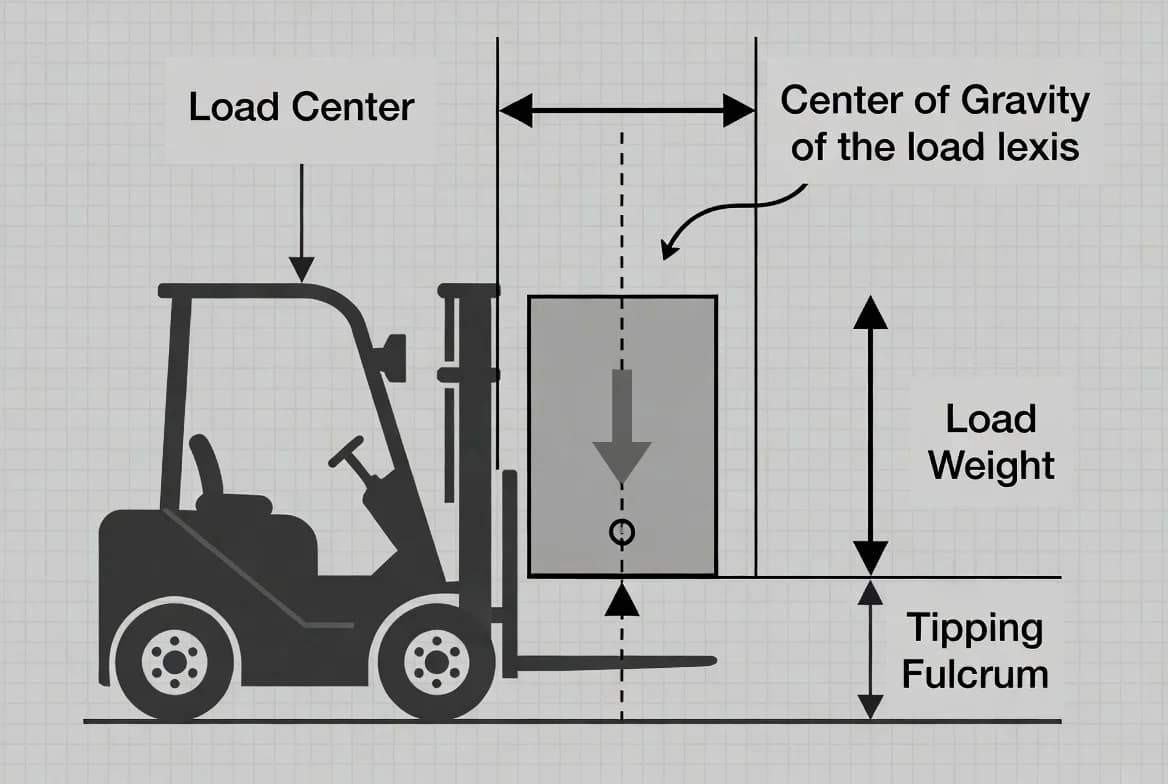
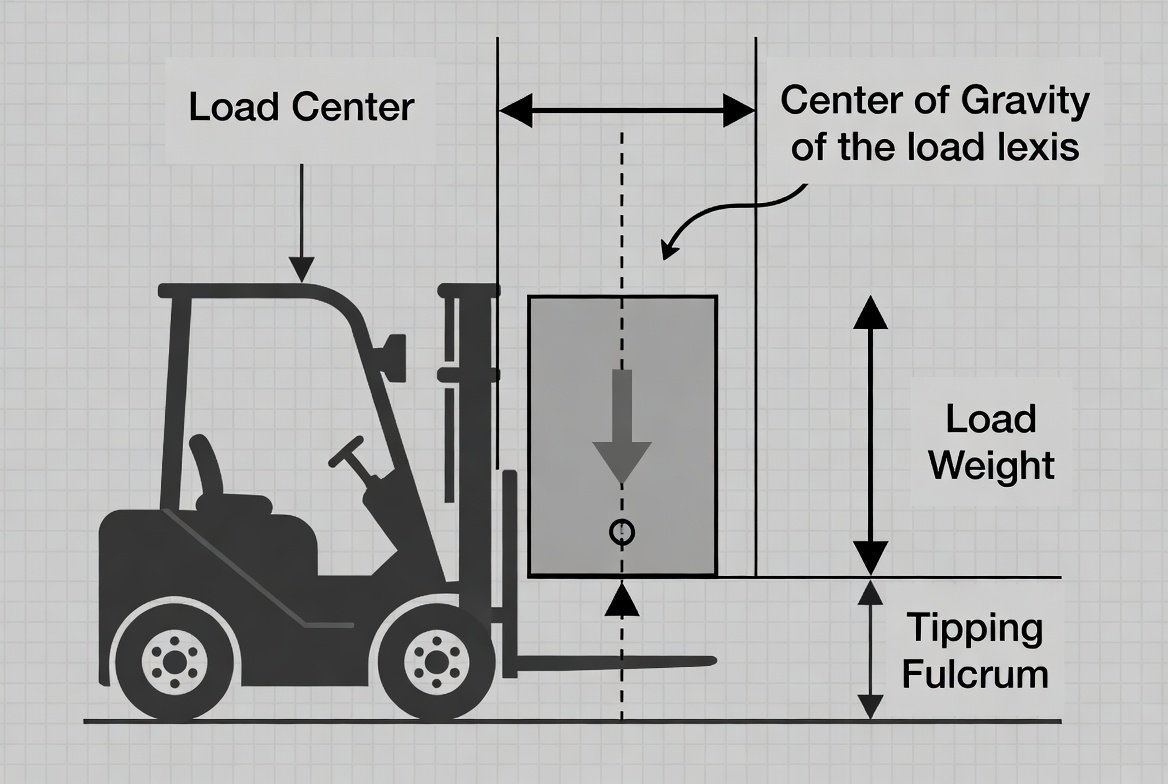
The load center is one of the most critical yet frequently misunderstood concepts in forklift operation and specification. It is the horizontal distance from the vertical face of the forks (or the front face of the fork carriage) to the center of gravity of the load. Standard rated capacities are almost always stated at a 24-inch (600 mm) or 500 mm load center. When the actual load center is greater than the rated value, the truck’s safe lifting capacity decreases, sometimes dramatically.
Imagine the forklift as a seesaw pivoting about the front axle (the tipping fulcrum). The weight of the truck and its counterweight act on one side; the load acts on the other. The farther the load’s center of gravity is from the fulcrum, the greater the tipping moment it produces. Therefore a 2,000 kg load whose center is 600 mm from the fork face produces less tipping moment than the same 2,000 kg load whose center is 900 mm from the fork face. To keep the truck stable, the allowable load weight must be reduced as the load center increases.
Manufacturers publish capacity charts that show how rated capacity declines with increasing load center and with increasing lift height. These charts are derived from stability tests conducted according to national and international standards (ISO, ANSI/ITSDF, etc.). Operators and supervisors must consult the specific chart for the truck and attachment combination in use.
Common situations that increase the effective load center include long or irregularly shaped loads, loads that cannot be placed fully against the fork carriage, the use of fork extensions, side-shift or other attachments that move the load forward, and suspended loads. In each case the operator must either reduce the load weight or verify that the truck’s capacity at the new load center is still adequate.
Measuring the load center in the field is straightforward: locate the approximate center of gravity of the load (often the geometric center for uniform loads) and measure horizontally from the vertical face of the forks to that point. When in doubt, treat the load center as larger rather than smaller. Never assume that the published capacity applies to every load shape or attachment configuration.
Understanding load center protects against tip-overs, the most common serious forklift accident. It also prevents structural overload of the mast, carriage, and forks. Training every operator to recognize and calculate load center is one of the highest-value safety investments a warehouse or yard can make.
Get More Expert Guides & Updates
Subscribe for Machinery.org guide updates and product learning content.