
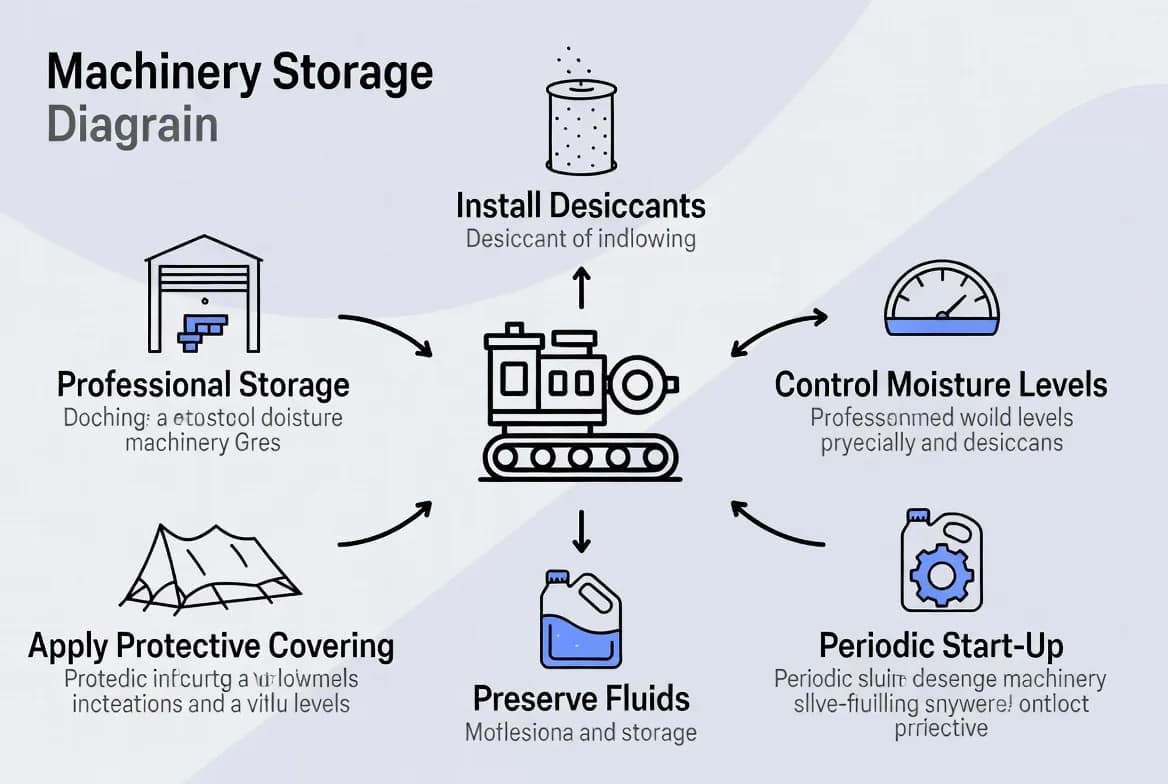
Storage for several months or years requires preservation of fluids, cylinders, bearings, electronics, seals, tires, tracks, fuel, and internal engine surfaces, followed by planned inspections and recommissioning.
CHAPTER FOCUS
engine internal surfaces, fuel system, cooling system, hydraulics, driveline, battery and electronics, and tires or tracks
Why This Topic Matters
Long-Term Machinery Storage is a core part of reliable heavy-equipment ownership because small changes in condition can develop into safety incidents, component damage, lost production, or expensive secondary failures. Storage for several months or years requires preservation of fluids, cylinders, bearings, electronics, seals, tires, tracks, fuel, and internal engine surfaces, followed by planned inspections and recommissioning. A disciplined program does more than satisfy a service schedule: it creates evidence about how the machine is aging and gives operators and technicians time to intervene before a defect becomes urgent.
The objective is to stop corrosion and degradation without creating new risks through incompatible preservatives, blocked vents, trapped moisture, unsafe support, or incomplete return-to-service procedures. The strongest maintenance programs connect the operator's daily observations with technician measurements, service history, parts usage, and manufacturer guidance. Decisions should be based on the exact model, serial range, configuration, environment, and duty cycle. Generic intervals and values are useful only as orientation; the operator's manual and service information remain the controlling references for capacities, limits, approved materials, and safety procedures.
System Fundamentals
The relevant system includes engine internal surfaces, fuel system, cooling system, hydraulics, driveline, battery and electronics, tires or tracks, cylinders and seals, cab, and air and exhaust paths. These parts should not be considered independently. A restriction, leak, incorrect adjustment, electrical command, contaminated fluid, or damaged mechanical interface in one area can create symptoms elsewhere. Understanding the flow of energy and material through the system helps prevent the common mistake of replacing the most visible component rather than finding the originating cause.
Build a simple mental model before performing work. Identify what enters the system, what controls it, what work it performs, how heat and contamination leave, and which measurements prove correct operation. For long-term machinery storage, the technician should know the normal operating state, the expected sequence of events, and the safeguards that prevent uncontrolled movement, pressure release, fire, chemical exposure, or mechanical injury.
Safety and Preparation
Prepare the machine on firm, stable ground and follow site isolation rules. Lower implements, neutralize stored energy, apply the parking brake, stop the engine, remove the key, and use lockout or tagout where the task requires it. Chock, block, or support components only with devices rated for the load. Never work beneath an unsupported attachment or rely on hydraulic pressure to hold a raised structure.
Use the personal protective equipment specified for the task and chemical. Typical preparation may include gloves, eye or face protection, protective footwear, suitable clothing, spill-control materials, and adequate ventilation. High-pressure hydraulic fluid, hot coolant, batteries, rotating fans, pressurized grease adjusters, fuel systems, and exhaust aftertreatment can cause severe injury. If the procedure requires specialized testing or exposure to stored pressure, stop and use qualified personnel.
Tools, Materials, and Technical References
Prepare the required information and equipment before opening the machine. Useful items include manufacturer preservation procedure, approved preservatives, desiccants and humidity indicators, battery maintenance equipment, fluid sampling supplies, covers and plugs, lifting or support equipment rated for storage, and inspection log. Tools must be clean, correctly rated, calibrated where measurement accuracy matters, and suitable for the machine's pressure, voltage, temperature, or load. Improvised adapters and unverified instruments can create both bad data and unsafe conditions.
Confirm the exact model and serial number, then obtain the current operator's manual, maintenance chart, service procedure, fluid or lubricant specification, torque information, and safety bulletins that apply. Record model-specific values on the work order instead of relying on memory. If a document conflicts with a decal or later manufacturer instruction, resolve the difference before continuing.
Step-by-Step Professional Procedure
Use a fixed sequence so that each step creates information for the next. The first half of the process is: 1) Develop a written preservation and recommissioning plan based on storage duration, climate, machine type, warranty, and manufacturer instructions. 2) Complete repairs and baseline testing so the machine is stored in known condition rather than with hidden faults. 3) Clean and dry thoroughly, service fluids as directed, protect fuel, coolant, engine internals, hydraulic rods, and exposed metal with approved products. 4) Remove, maintain, or isolate batteries and preserve electronic modules according to manufacturer guidance.
Continue with the remaining process: 5) Relieve loads, position cylinders, support tires or tracks safely, rotate or move components only on an approved schedule. 6) Control humidity and pests, protect openings while preserving required ventilation, and label every plug, drain, disconnect, and preservative. 7) Inspect at planned intervals for leaks, corrosion, moisture, pests, pressure loss, battery state, and support stability. 8) Before return to service, remove preservation materials, sample or replace fluids, inspect internally as required, restore all connections, and function-test progressively. Complete the work with a final visual inspection, removal of tools and rags, restoration of guards, and a controlled functional test. Any step that cannot be verified should be marked incomplete rather than assumed satisfactory.
What Normal Condition Looks Like
Normal condition is established through repeatable observation rather than a single impression. Expected indicators include stable preservation condition, humidity controlled, no leaks, no pest evidence, battery maintained or safely stored, supports stable, labels intact, periodic inspection completed, and fluid samples acceptable. A normal result should agree with the machine's history and operating environment. For example, an acceptable temperature or pressure at idle may not prove that the machine can control heat or deliver performance under rated load.
Create a baseline after purchase, major repair, or recommissioning. Record measurements, photographs, fluid condition, component clearances, cycle times, voltage, pressure, temperature, or other relevant values while the machine is known to be healthy. Future checks then compare against both manufacturer limits and the machine's own trend. A change within the published limit can still deserve attention when it is rapid or unexplained.
Warning Signs and Failure Clues
Conditions that require investigation include condensation, preservative incompatibility, collapsed tire, track corrosion, blocked breather, rod pitting, fuel varnish or microbial growth, missing plugs, forgotten disconnected control, and settlement of supports. Observe when the symptom occurs and what changes it. Note whether it appears only when cold, hot, loaded, traveling, turning, using a particular attachment, operating on a slope, or after a service action. Timing and operating context often separate several possible causes that otherwise look similar.
Do not erase evidence before documenting it. Photograph leaks, residue, damaged parts, warning displays, smoke, wear patterns, or contaminated filters before cleaning. Record odors, sounds, vibration, temperature, and operator comments using precise language. 'Weak,' 'hot,' or 'noisy' is less useful than a description of which function changed, by how much, and under what conditions.
Common Maintenance and Diagnostic Mistakes
Frequent errors include using generic fogging oil without approval, assuming winter storage steps are enough for years, failing to label disconnected systems, starting periodically without a complete warm-up plan, leaving stale coolant or fuel, ignoring software batteries and memory requirements, and returning directly to full load. These mistakes usually occur because the task appears routine or production pressure encourages shortcuts. A checklist is valuable precisely because experienced people can overlook familiar details, especially when working at night, in bad weather, or after an interruption.
Avoid changing several variables at once during diagnosis. Replacing filters, adjusting valves, adding fluid, clearing codes, and changing operating settings simultaneously can hide the real cause. Make one controlled change, record it, and repeat the test. Parts should be replaced because evidence identifies them as failed or because an approved preventive interval requires replacement, not because they are convenient suspects.
Severe-Duty and Environmental Adjustments
Maintenance frequency and acceptance criteria may need adjustment for multi-year storage, humid tropics, desert dust, coastal atmosphere, freezing climate, warehouse storage, remote site, and equipment held for resale. Severe duty can increase contamination, heat, condensation, corrosion, vibration, impact loading, and service consumption. Short calendar intervals may be necessary even when hour accumulation is low, while continuous high-load operation may justify closer temperature and fluid monitoring.
Environmental controls are part of maintenance. Clean fueling and lubrication equipment, protected storage, suitable covers, drainage, dust control, wash procedures, and correct warm-up or cool-down practices reduce the contaminant load entering the machine. Record the actual environment so interval changes are supported by evidence rather than habit.
Measurement, Testing, and Interpretation
Use measurements to confirm observations. Select the test condition specified by the manufacturer, including fluid temperature, engine speed, machine posture, attachment, load, and control mode. Compare results with the correct units and configuration. A value taken under the wrong condition can appear precise while being technically meaningless.
Interpret trends and relationships, not only pass-or-fail limits. Rising temperature with stable load, increasing filter restriction, changing fluid-consumption rate, greater voltage drop, longer cycle time, or repeated need for adjustment may signal deterioration before a hard limit is exceeded. When results are ambiguous, repeat the test with verified equipment or involve a technician familiar with the system.
Record-Keeping and Trend Analysis
A useful maintenance record includes preservation plan, baseline condition, fluids and preservatives, battery disposition, sealed openings, support points, inspection schedule, inspection findings, sample results, and recommissioning checklist. Records should identify who performed the work, the machine hours, the exact products and parts used, measurements before and after service, and any remaining condition. Attach photographs, laboratory reports, fault-code printouts, invoices, and calibration information where relevant.
Good records support warranty claims, planned downtime, parts forecasting, resale value, and root-cause analysis. They also reveal repeat failures that individual work orders hide. Review recurring leaks, filter changes, battery replacements, overheating events, adjustments, and fluid additions by machine and by site. Repetition usually indicates an unresolved cause, unsuitable operating practice, or a maintenance-process weakness.
When to Stop and Escalate
Stop work and escalate when there is evidence of internal corrosion indication, water in fluids, unstable supports, severe rod pitting, fuel degradation, pest damage to harnesses, unknown preservation chemical, and engine unable to rotate as expected. The machine should remain out of service when a defect affects steering, braking, load holding, structural integrity, fire protection, operator protection, uncontrolled movement, or a manufacturer prohibition. Production urgency does not change the energy stored in the machine or the consequence of failure.
Escalation should be specific. State the symptom, measurements, operating condition, actions already taken, and the reason the machine is unsafe or requires specialist testing. Protect the evidence, isolate the machine, and identify the person authorized to approve return to service. A clear handover prevents the next person from unknowingly restarting an incomplete diagnosis.
Practical Field Example
A standby generator is stored for eighteen months. The owner follows the manufacturer's preservation procedure, records coolant and oil condition, protects the fuel system, maintains the starting batteries, controls humidity, and performs documented inspections. Recommissioning includes fluid sampling, removal of intake protection, cable checks, no-load testing, and gradual load application.
The important lesson is the method rather than the specific component. The operator recognized a change, preserved evidence, avoided an unsafe shortcut, and connected the symptom to the wider system. The maintenance response confirmed the cause, corrected it, and verified normal operation. That sequence is the foundation of professional long-term machinery storage.
Integrating the Task Into a Maintenance Program
Long-Term Machinery Storage should be linked to daily inspections, planned service, condition monitoring, defect management, and parts planning. Define who performs each level of work, what training is required, which measurements are recorded, and what result triggers a work order. Ensure the required consumables, filters, seals, test equipment, and reference documents are available before the interval arrives.
Review the effectiveness of the program through downtime, repeat failures, service compliance, fluid-analysis trends, wear cost, and operator reports. A task is not successful merely because a box was checked. It is successful when the machine remains safe, available, and within expected condition while maintenance effort is focused where it produces real risk reduction.
Operator and Technician Coordination
Operators often detect the first signs of change because they experience the machine under load. Technicians provide measurement, disassembly, testing, and repair knowledge. The maintenance system should make it easy for both groups to communicate. Reports should identify the function, condition, and timing rather than use vague statements, and technicians should explain what was found and what operators should continue to monitor.
After service, brief the operator on any changed settings, new parts, running-in requirements, follow-up checks, or temporary limitations. Confirm that guards and safety devices are restored and that the machine is clean enough for leaks to be detected. A short handover prevents misinterpretation and improves the quality of the next inspection.
Final Checklist
Before closing the task, verify the following: the correct machine and procedure were used; energy was controlled; tools and materials were suitable; all required steps were completed; normal indicators were confirmed; warning signs were resolved or documented; guards and access panels were restored; spills and waste were managed; and the record contains preservation plan, baseline condition, fluids and preservatives, battery disposition, sealed openings, and support points.
Mark each item as verified, conditionally accepted with an assigned action, unknown pending investigation, or unacceptable. Unknown and unacceptable items require a named owner and deadline. Do not use a signature to turn incomplete work into completed work. The close-out should make the machine's condition clear to the next operator and the maintenance planner.
Key Takeaways
Professional long-term machinery storage depends on consistency, cleanliness, correct technical information, controlled energy, and evidence. The most useful habits are to follow the same sequence, compare with a healthy baseline, record exact findings, and stop when the procedure or result is uncertain.
Manufacturer instructions remain the primary authority for model-specific values and procedures. The guidance in this chapter supports those instructions by explaining how to organize the work, interpret condition, and connect individual observations to a wider maintenance strategy. Careful routine work protects people first, then components, production, and the long-term value of the machine.
Chapter Maintenance Record
Review Item
Status
Evidence / Action
Manufacturer procedure confirmed
☐ Verified ☐ Conditional ☐ Unknown
Machine safely isolated
☐ Verified ☐ Conditional ☐ Unknown
Required measurements recorded
☐ Verified ☐ Conditional ☐ Unknown
Normal condition verified
☐ Verified ☐ Conditional ☐ Unknown
Warning signs investigated
☐ Verified ☐ Conditional ☐ Unknown
Corrective actions completed
☐ Verified ☐ Conditional ☐ Unknown
Guards and safety systems restored
☐ Verified ☐ Conditional ☐ Unknown
Operator handover completed
☐ Verified ☐ Conditional ☐ Unknown
Get More Expert Guides & Updates
Subscribe for Machinery.org guide updates and product learning content.