
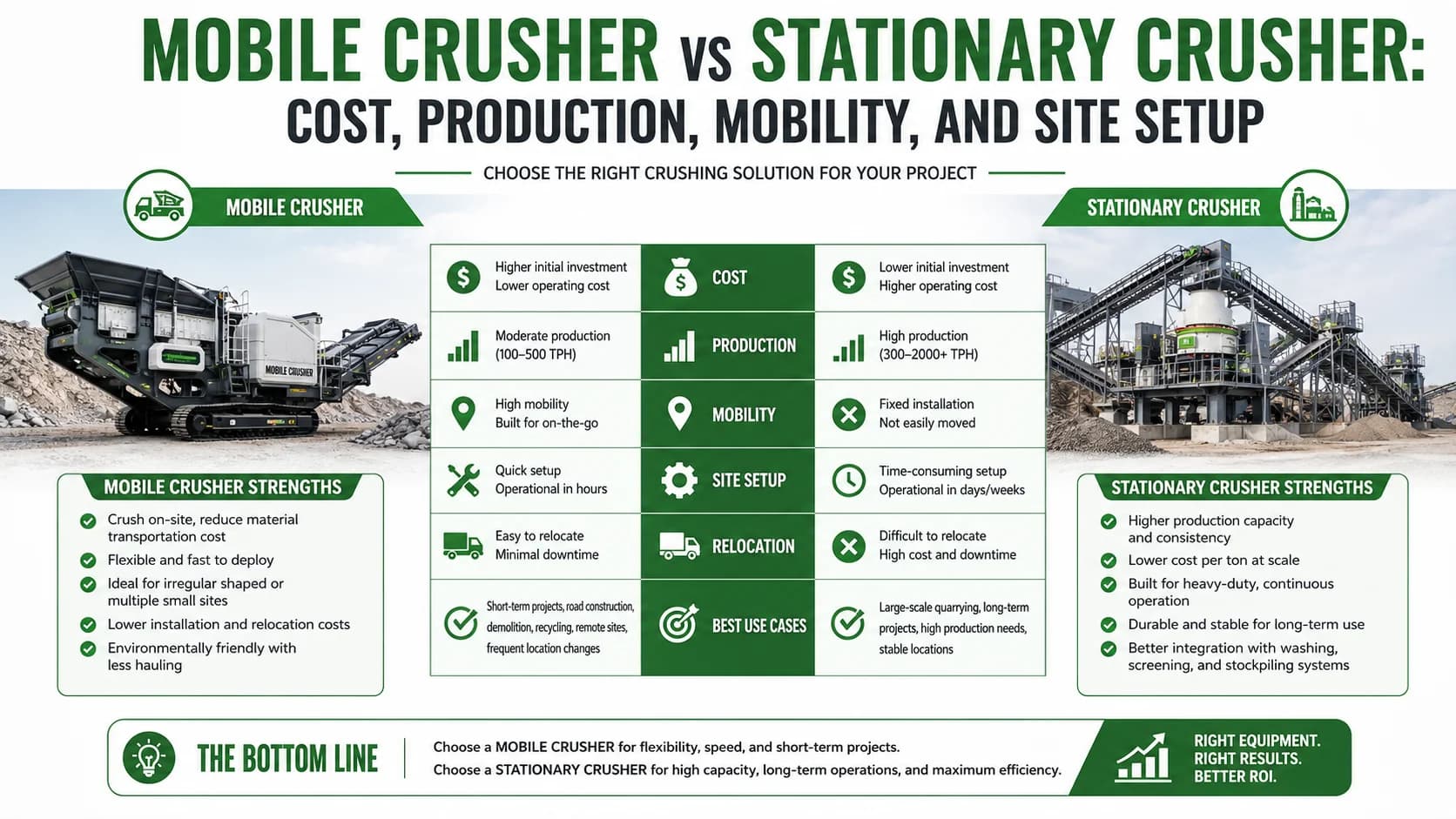
Choosing between a mobile crusher and a stationary crushing plant requires more than comparing crusher size or purchase price. The economic answer depends on project duration, annual tonnage, material haul distance, relocation frequency, product range, site infrastructure, energy source, labor, and the value of flexibility. Mobile crushers can move closer to the material source and often reduce civil work, while stationary plants can be optimized for high continuous production and complex multi-stage circuits. This guide compares the two approaches from a whole-project perspective.
1. What Mobile and Stationary Systems Mean
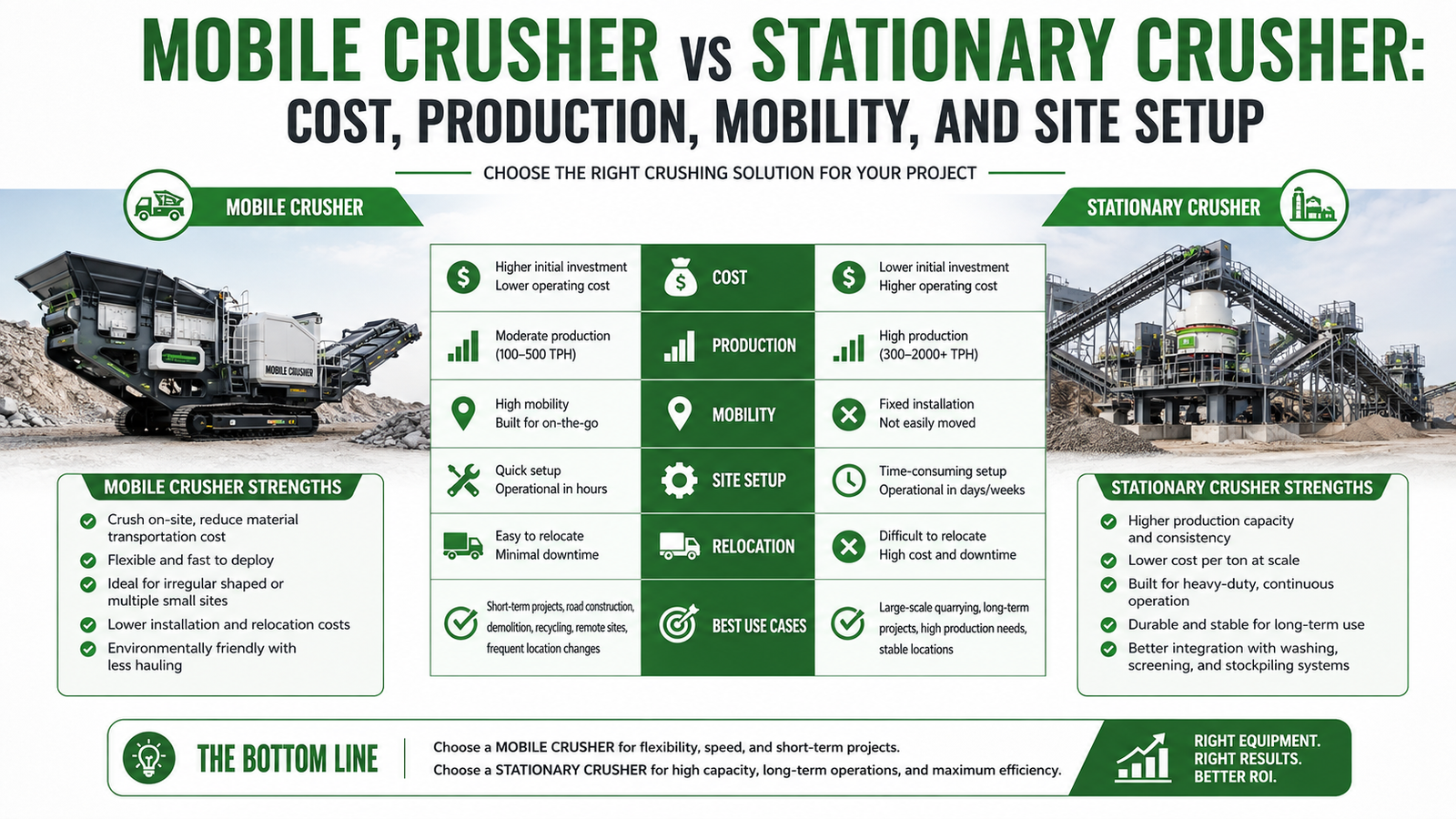
Track-mounted mobile crushers combine feeder, crusher, conveyors, power, and controls on a movable chassis. This is an important part of mobile crusher vs stationary crusher: cost, production, mobility, and site setup because the setting, component, or process does not operate in isolation. It changes the load seen by the next machine, the condition of the material, and the amount of useful product that can be produced. Wheel-mounted portable plants can relocate by road but usually require more setup than tracked units. Operators therefore need to understand both the mechanical function and the process consequence before they make adjustments.
From a process standpoint, Stationary plants are installed on foundations and connected by permanent conveyors, bins, electrical systems, and structures. The practical result should be checked with measurements rather than appearance alone. Useful observations can include feed rate, product gradation, machine power or pressure, vibration, temperature, wear condition, recirculating load, moisture, and downtime, depending on the equipment involved. Some operations use hybrid layouts that combine mobile primary crushing with stationary secondary or screening stages. When these observations are recorded consistently, normal variation becomes easier to separate from a developing fault.
In day-to-day operation, stability is usually more valuable than a short peak in output. A machine that alternates between starvation and overload may briefly show high production, yet it normally creates more wear, more product variation, and more operator intervention. The best classification depends on how often equipment must move and how permanent the surrounding infrastructure is. The best operating point is the one that can be repeated safely for the expected feed and product requirement, with enough reserve for normal changes in material condition.
For troubleshooting, make one controlled change at a time whenever production conditions allow. First document the symptom and current setup, then inspect the simplest causes before changing a major setting or replacing a component. Check the equipment immediately upstream and downstream as well, because many apparent machine problems are actually caused by unstable feeding, restricted discharge, poor separation, blocked chutes, incorrect line routing, or insufficient surge capacity. After a change, compare the result under similar operating conditions and keep the data for future reference.
Maintenance and safety requirements must be built into the operating method. Wear parts, guards, access doors, hydraulic systems, electrical drives, rotating components, and stored energy should be inspected and serviced using the manufacturer procedure and the site's isolation rules. Machine-specific capacities, allowable settings, pressures, speeds, wear limits, and inspection intervals vary by model, so general guidance should never replace the applicable manual. A clear inspection routine and accurate service history help prevent small defects from becoming production failures.
2. Capital and Installation Cost
Mobile plants often package several process functions into one purchase and require less permanent civil work. This is an important part of mobile crusher vs stationary crusher: cost, production, mobility, and site setup because the setting, component, or process does not operate in isolation. It changes the load seen by the next machine, the condition of the material, and the amount of useful product that can be produced. Stationary plants may need foundations, steelwork, electrical rooms, conveyors, buildings, dust systems, and drainage. Operators therefore need to understand both the mechanical function and the process consequence before they make adjustments.
From a process standpoint, A stationary crusher can offer favorable cost per installed tonne when high capacity is required for many years. The practical result should be checked with measurements rather than appearance alone. Useful observations can include feed rate, product gradation, machine power or pressure, vibration, temperature, wear condition, recirculating load, moisture, and downtime, depending on the equipment involved. Mobile equipment may carry a higher cost per unit of installed capacity but can avoid large fixed infrastructure. When these observations are recorded consistently, normal variation becomes easier to separate from a developing fault.
In day-to-day operation, stability is usually more valuable than a short peak in output. A machine that alternates between starvation and overload may briefly show high production, yet it normally creates more wear, more product variation, and more operator intervention. Total installed cost should include transport, erection, power connection, permitting, and commissioning. The best operating point is the one that can be repeated safely for the expected feed and product requirement, with enough reserve for normal changes in material condition.
For troubleshooting, make one controlled change at a time whenever production conditions allow. First document the symptom and current setup, then inspect the simplest causes before changing a major setting or replacing a component. Check the equipment immediately upstream and downstream as well, because many apparent machine problems are actually caused by unstable feeding, restricted discharge, poor separation, blocked chutes, incorrect line routing, or insufficient surge capacity. After a change, compare the result under similar operating conditions and keep the data for future reference.
Maintenance and safety requirements must be built into the operating method. Wear parts, guards, access doors, hydraulic systems, electrical drives, rotating components, and stored energy should be inspected and serviced using the manufacturer procedure and the site's isolation rules. Machine-specific capacities, allowable settings, pressures, speeds, wear limits, and inspection intervals vary by model, so general guidance should never replace the applicable manual. A clear inspection routine and accurate service history help prevent small defects from becoming production failures.
3. Operating Cost and Cost per Tonne
Operating cost includes fuel or electricity, wear parts, maintenance, labor, hauling, and utilization. This is an important part of mobile crusher vs stationary crusher: cost, production, mobility, and site setup because the setting, component, or process does not operate in isolation. It changes the load seen by the next machine, the condition of the material, and the amount of useful product that can be produced. A mobile crusher can reduce truck haul distance by working nearer the quarry face or demolition source. Operators therefore need to understand both the mechanical function and the process consequence before they make adjustments.
From a process standpoint, Stationary plants can use efficient electric drives and optimized conveyors when grid power is available. The practical result should be checked with measurements rather than appearance alone. Useful observations can include feed rate, product gradation, machine power or pressure, vibration, temperature, wear condition, recirculating load, moisture, and downtime, depending on the equipment involved. Track wear, diesel consumption, and repeated mobilization add cost to mobile operations. When these observations are recorded consistently, normal variation becomes easier to separate from a developing fault.
In day-to-day operation, stability is usually more valuable than a short peak in output. A machine that alternates between starvation and overload may briefly show high production, yet it normally creates more wear, more product variation, and more operator intervention. The best comparison uses cost per saleable tonne over the expected project life. The best operating point is the one that can be repeated safely for the expected feed and product requirement, with enough reserve for normal changes in material condition.
For troubleshooting, make one controlled change at a time whenever production conditions allow. First document the symptom and current setup, then inspect the simplest causes before changing a major setting or replacing a component. Check the equipment immediately upstream and downstream as well, because many apparent machine problems are actually caused by unstable feeding, restricted discharge, poor separation, blocked chutes, incorrect line routing, or insufficient surge capacity. After a change, compare the result under similar operating conditions and keep the data for future reference.
Maintenance and safety requirements must be built into the operating method. Wear parts, guards, access doors, hydraulic systems, electrical drives, rotating components, and stored energy should be inspected and serviced using the manufacturer procedure and the site's isolation rules. Machine-specific capacities, allowable settings, pressures, speeds, wear limits, and inspection intervals vary by model, so general guidance should never replace the applicable manual. A clear inspection routine and accurate service history help prevent small defects from becoming production failures.
4. Production Capacity and Product Range
Stationary plants are well suited to very high, continuous output with multiple crushing and screening stages. This is an important part of mobile crusher vs stationary crusher: cost, production, mobility, and site setup because the setting, component, or process does not operate in isolation. It changes the load seen by the next machine, the condition of the material, and the amount of useful product that can be produced. Large surge bins, high-capacity screens, recirculating loops, washing systems, and large stockpiles are easier to integrate permanently. Operators therefore need to understand both the mechanical function and the process consequence before they make adjustments.
From a process standpoint, Mobile trains can also make several products but transport dimensions and onboard conveyor size create constraints. The practical result should be checked with measurements rather than appearance alone. Useful observations can include feed rate, product gradation, machine power or pressure, vibration, temperature, wear condition, recirculating load, moisture, and downtime, depending on the equipment involved. Peak crusher capacity means little if the screen or return conveyor cannot handle the internal load. When these observations are recorded consistently, normal variation becomes easier to separate from a developing fault.
In day-to-day operation, stability is usually more valuable than a short peak in output. A machine that alternates between starvation and overload may briefly show high production, yet it normally creates more wear, more product variation, and more operator intervention. Required annual production and product mix should be modeled before selecting plant type. The best operating point is the one that can be repeated safely for the expected feed and product requirement, with enough reserve for normal changes in material condition.
For troubleshooting, make one controlled change at a time whenever production conditions allow. First document the symptom and current setup, then inspect the simplest causes before changing a major setting or replacing a component. Check the equipment immediately upstream and downstream as well, because many apparent machine problems are actually caused by unstable feeding, restricted discharge, poor separation, blocked chutes, incorrect line routing, or insufficient surge capacity. After a change, compare the result under similar operating conditions and keep the data for future reference.
Maintenance and safety requirements must be built into the operating method. Wear parts, guards, access doors, hydraulic systems, electrical drives, rotating components, and stored energy should be inspected and serviced using the manufacturer procedure and the site's isolation rules. Machine-specific capacities, allowable settings, pressures, speeds, wear limits, and inspection intervals vary by model, so general guidance should never replace the applicable manual. A clear inspection routine and accurate service history help prevent small defects from becoming production failures.
5. Mobility and Haulage Advantage
Mobility creates the greatest value when the raw material source changes location. This is an important part of mobile crusher vs stationary crusher: cost, production, mobility, and site setup because the setting, component, or process does not operate in isolation. It changes the load seen by the next machine, the condition of the material, and the amount of useful product that can be produced. A tracked primary crusher can follow the working face and shorten truck cycles. Operators therefore need to understand both the mechanical function and the process consequence before they make adjustments.
From a process standpoint, On demolition projects, processing material on site can reduce disposal and imported aggregate transport. The practical result should be checked with measurements rather than appearance alone. Useful observations can include feed rate, product gradation, machine power or pressure, vibration, temperature, wear condition, recirculating load, moisture, and downtime, depending on the equipment involved. A stationary plant requires raw feed to travel to a fixed location even as extraction moves farther away. When these observations are recorded consistently, normal variation becomes easier to separate from a developing fault.
In day-to-day operation, stability is usually more valuable than a short peak in output. A machine that alternates between starvation and overload may briefly show high production, yet it normally creates more wear, more product variation, and more operator intervention. Truck fuel, tires, road maintenance, loading equipment, and cycle time should be included in the mobility calculation. The best operating point is the one that can be repeated safely for the expected feed and product requirement, with enough reserve for normal changes in material condition.
For troubleshooting, make one controlled change at a time whenever production conditions allow. First document the symptom and current setup, then inspect the simplest causes before changing a major setting or replacing a component. Check the equipment immediately upstream and downstream as well, because many apparent machine problems are actually caused by unstable feeding, restricted discharge, poor separation, blocked chutes, incorrect line routing, or insufficient surge capacity. After a change, compare the result under similar operating conditions and keep the data for future reference.
Maintenance and safety requirements must be built into the operating method. Wear parts, guards, access doors, hydraulic systems, electrical drives, rotating components, and stored energy should be inspected and serviced using the manufacturer procedure and the site's isolation rules. Machine-specific capacities, allowable settings, pressures, speeds, wear limits, and inspection intervals vary by model, so general guidance should never replace the applicable manual. A clear inspection routine and accurate service history help prevent small defects from becoming production failures.
6. Site Setup, Power, and Environmental Controls
Mobile crushers normally reach production faster on a prepared, level site. This is an important part of mobile crusher vs stationary crusher: cost, production, mobility, and site setup because the setting, component, or process does not operate in isolation. It changes the load seen by the next machine, the condition of the material, and the amount of useful product that can be produced. They still require safe ground, stockpile clearance, water or dust suppression, lighting, drainage, and fuel or electrical supply. Operators therefore need to understand both the mechanical function and the process consequence before they make adjustments.
From a process standpoint, Stationary plants take longer to erect but can use permanent enclosures, paved access, centralized dust extraction, and engineered water systems. The practical result should be checked with measurements rather than appearance alone. Useful observations can include feed rate, product gradation, machine power or pressure, vibration, temperature, wear condition, recirculating load, moisture, and downtime, depending on the equipment involved. Mobile units may use diesel-hydraulic, diesel-electric, plug-in electric, or hybrid power. When these observations are recorded consistently, normal variation becomes easier to separate from a developing fault.
In day-to-day operation, stability is usually more valuable than a short peak in output. A machine that alternates between starvation and overload may briefly show high production, yet it normally creates more wear, more product variation, and more operator intervention. The local energy cost and environmental permit requirements can strongly influence the final choice. The best operating point is the one that can be repeated safely for the expected feed and product requirement, with enough reserve for normal changes in material condition.
For troubleshooting, make one controlled change at a time whenever production conditions allow. First document the symptom and current setup, then inspect the simplest causes before changing a major setting or replacing a component. Check the equipment immediately upstream and downstream as well, because many apparent machine problems are actually caused by unstable feeding, restricted discharge, poor separation, blocked chutes, incorrect line routing, or insufficient surge capacity. After a change, compare the result under similar operating conditions and keep the data for future reference.
Maintenance and safety requirements must be built into the operating method. Wear parts, guards, access doors, hydraulic systems, electrical drives, rotating components, and stored energy should be inspected and serviced using the manufacturer procedure and the site's isolation rules. Machine-specific capacities, allowable settings, pressures, speeds, wear limits, and inspection intervals vary by model, so general guidance should never replace the applicable manual. A clear inspection routine and accurate service history help prevent small defects from becoming production failures.
7. Maintenance, Flexibility, and Utilization
Mobile machines package many components in a compact chassis, which can make service access tighter. This is an important part of mobile crusher vs stationary crusher: cost, production, mobility, and site setup because the setting, component, or process does not operate in isolation. It changes the load seen by the next machine, the condition of the material, and the amount of useful product that can be produced. Stationary plants can be designed with permanent cranes, platforms, workshops, and lifting beams. Operators therefore need to understand both the mechanical function and the process consequence before they make adjustments.
From a process standpoint, Mobile contractors can redeploy equipment between projects and increase annual utilization. The practical result should be checked with measurements rather than appearance alone. Useful observations can include feed rate, product gradation, machine power or pressure, vibration, temperature, wear condition, recirculating load, moisture, and downtime, depending on the equipment involved. Stationary equipment achieves low unit cost when the deposit and market support high long-term utilization. When these observations are recorded consistently, normal variation becomes easier to separate from a developing fault.
In day-to-day operation, stability is usually more valuable than a short peak in output. A machine that alternates between starvation and overload may briefly show high production, yet it normally creates more wear, more product variation, and more operator intervention. Parts lead time, local service support, and safe wear-part access should be evaluated for both options. The best operating point is the one that can be repeated safely for the expected feed and product requirement, with enough reserve for normal changes in material condition.
For troubleshooting, make one controlled change at a time whenever production conditions allow. First document the symptom and current setup, then inspect the simplest causes before changing a major setting or replacing a component. Check the equipment immediately upstream and downstream as well, because many apparent machine problems are actually caused by unstable feeding, restricted discharge, poor separation, blocked chutes, incorrect line routing, or insufficient surge capacity. After a change, compare the result under similar operating conditions and keep the data for future reference.
Maintenance and safety requirements must be built into the operating method. Wear parts, guards, access doors, hydraulic systems, electrical drives, rotating components, and stored energy should be inspected and serviced using the manufacturer procedure and the site's isolation rules. Machine-specific capacities, allowable settings, pressures, speeds, wear limits, and inspection intervals vary by model, so general guidance should never replace the applicable manual. A clear inspection routine and accurate service history help prevent small defects from becoming production failures.
8. Decision Framework: Which One Fits Best?
Mobile crushing is usually strongest for temporary projects, moving faces, demolition, recycling, and remote contracts. This is an important part of mobile crusher vs stationary crusher: cost, production, mobility, and site setup because the setting, component, or process does not operate in isolation. It changes the load seen by the next machine, the condition of the material, and the amount of useful product that can be produced. Stationary crushing is usually strongest for long-life quarries, high annual tonnage, stable geology, and complex product requirements. Operators therefore need to understand both the mechanical function and the process consequence before they make adjustments.
From a process standpoint, A semi-mobile or hybrid plant can capture haulage savings without moving every process stage. The practical result should be checked with measurements rather than appearance alone. Useful observations can include feed rate, product gradation, machine power or pressure, vibration, temperature, wear condition, recirculating load, moisture, and downtime, depending on the equipment involved. The financial model should test several production and relocation scenarios rather than assuming one constant operating condition. When these observations are recorded consistently, normal variation becomes easier to separate from a developing fault.
In day-to-day operation, stability is usually more valuable than a short peak in output. A machine that alternates between starvation and overload may briefly show high production, yet it normally creates more wear, more product variation, and more operator intervention. The correct choice is the system with the lowest total project risk and cost per saleable tonne, not simply the lowest initial price. The best operating point is the one that can be repeated safely for the expected feed and product requirement, with enough reserve for normal changes in material condition.
For troubleshooting, make one controlled change at a time whenever production conditions allow. First document the symptom and current setup, then inspect the simplest causes before changing a major setting or replacing a component. Check the equipment immediately upstream and downstream as well, because many apparent machine problems are actually caused by unstable feeding, restricted discharge, poor separation, blocked chutes, incorrect line routing, or insufficient surge capacity. After a change, compare the result under similar operating conditions and keep the data for future reference.
Maintenance and safety requirements must be built into the operating method. Wear parts, guards, access doors, hydraulic systems, electrical drives, rotating components, and stored energy should be inspected and serviced using the manufacturer procedure and the site's isolation rules. Machine-specific capacities, allowable settings, pressures, speeds, wear limits, and inspection intervals vary by model, so general guidance should never replace the applicable manual. A clear inspection routine and accurate service history help prevent small defects from becoming production failures.
Quick Reference
Decision Factor
Mobile Crusher
Stationary Crusher
Relocation
Strong advantage
Limited
Civil infrastructure
Lower/modular
Higher/permanent
Very high continuous output
Possible but constrained
Strong advantage
Haul reduction
Strong advantage
Depends on fixed feed point
Service access
Compact packaging
Can be purpose-designed
Final Takeaway
Successful equipment operation comes from matching the machine to the actual material or placement requirement, then controlling the whole workflow rather than one component in isolation. Stable feed or supply, correct settings, adequate downstream capacity, planned maintenance, and consistent records create reliable production. When performance changes, identify the symptom, verify the operating condition, inspect connected equipment, and use the manufacturer limits before making a major adjustment. This disciplined approach improves quality, controls wear and operating cost, and reduces avoidable downtime.
Get More Expert Guides & Updates
Subscribe for Machinery.org guide updates and product learning content.