
Chapter objective: Pallet-fork capacity is governed by the weakest part of the complete system: forks, carriage, attachment frame, carrier, tyres or tracks, hydraulics and stability. A capacity stamped on the fork usually applies at a defined load centre and does not automatically represent what the machine can lift. The carrier's rated operating capacity or load chart may be lower. The attachment's weight also consumes...
Capacity is more than the number stamped on the fork
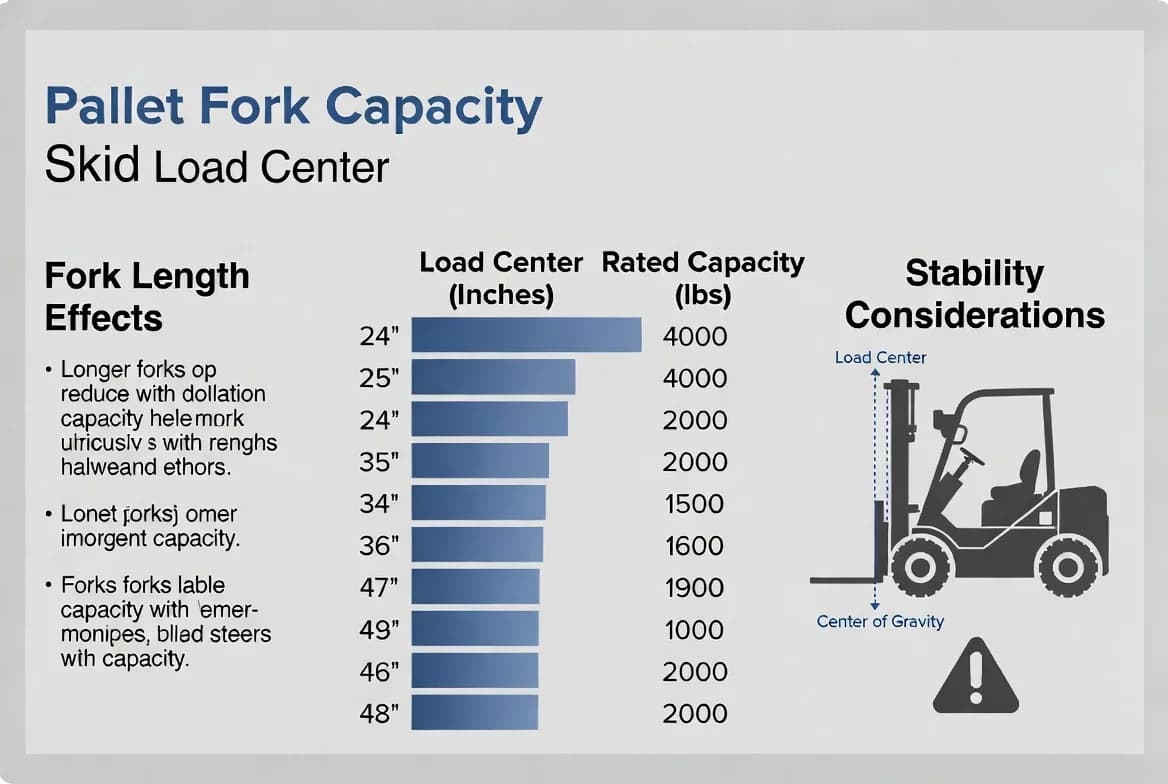
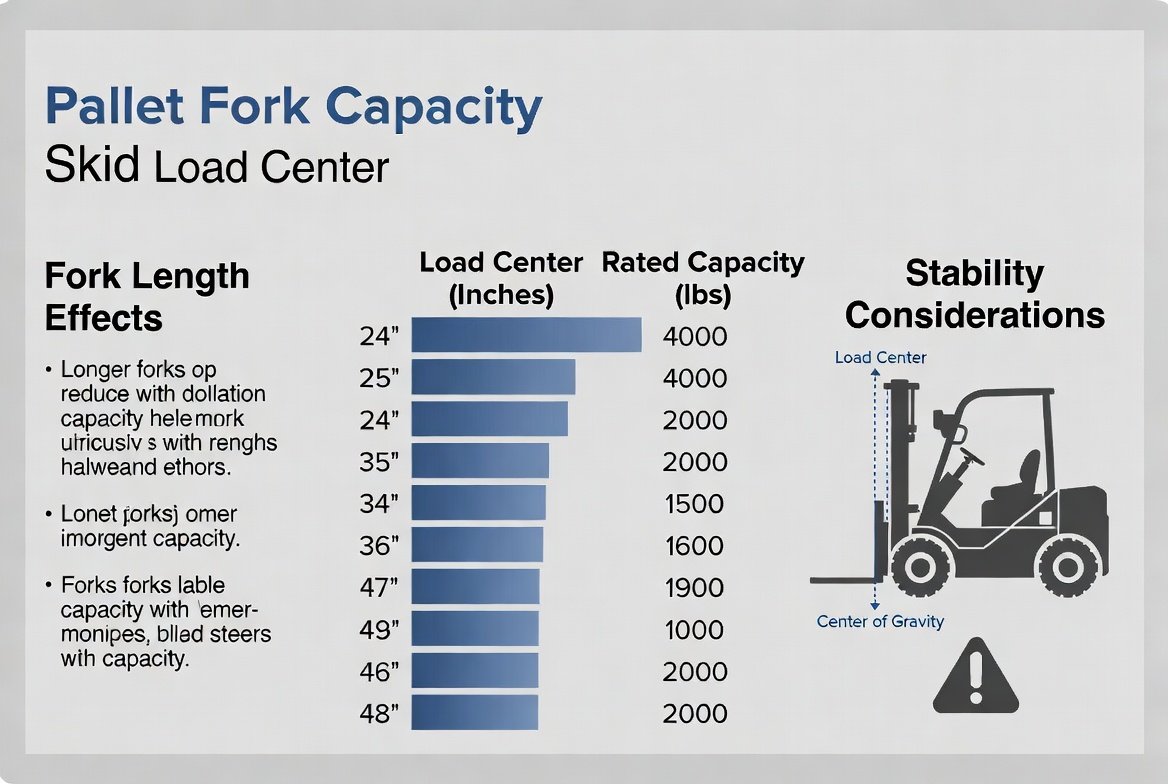
Pallet-fork capacity is governed by the weakest part of the complete system: forks, carriage, attachment frame, carrier, tyres or tracks, hydraulics and stability. A capacity stamped on the fork usually applies at a defined load centre and does not automatically represent what the machine can lift. The carrier's rated operating capacity or load chart may be lower. The attachment's weight also consumes capacity.
Every lift must consider total load, centre of gravity, lift height, forward reach, ground condition and machine configuration. A load that can be picked at ground level may not be safe at full height. The professional approach is to use the appropriate capacity chart for the actual attachment and configuration rather than relying on feel.
Understanding load centre
Load centre is the horizontal distance from the fork face or carriage reference point to the load's centre of gravity. Standard ratings often assume a particular distance, but real loads vary. A long crate, uneven pallet or machine component may place the centre far forward. As the centre moves forward, the overturning moment increases and allowable weight decreases.
Fork extensions also move the effective load centre outward and may reduce capacity. A load should be positioned fully against the fork backrest when possible. If it cannot be centred or supported evenly, use a different attachment or engineered lifting method. Do not estimate the centre only from the pallet dimensions; consider where the weight is actually concentrated.
Fork length, spacing and support
Forks should support most of the load length without projecting into hazards. Short forks can concentrate stress and allow a pallet to break. Excessively long forks increase forward reach, reduce manoeuvrability and may be difficult to see. Adjustable spacing should be set as wide as practical for stability while fitting the pallet openings. Both forks must be equally engaged and locked on the carriage.
Do not lift with one fork unless the equipment and load are specifically designed for it. Check that the fork heel, hook and locking pin are correctly seated. Forks should be a matched pair with the same rating, length and wear condition. Mixing forks can create uneven loading.
Carrier ratings and residual capacity
Skid steers and compact track loaders use rated operating capacity, often related to tipping load under defined conditions. Telehandlers and forklifts use load charts that change with height, reach, boom angle, stabiliser position and attachment. Wheel loaders have their own capacity and stability limits. The pallet-fork frame and carriage mass must be subtracted or included according to the chart method.
Use the chart for the exact machine, tyres, counterweight, boom, carriage and attachment. Generic charts are not acceptable. If an attachment changes the centre of gravity, the manufacturer may provide a reduced or residual capacity. Do not exceed the chart because the machine appears stable during a slow test.
Load assessment and securing
Inspect the pallet, packaging and load before lifting. Broken boards, loose bands, leaking containers and shifted contents create unpredictable centres of gravity. Confirm weight from documentation, scale or reliable calculation. Do not guess dense or unfamiliar loads. Secure unstable items and use an appropriate backrest or restraint where needed.
Insert forks fully, raise only enough to test the load and tilt back slightly if the machine design permits. Check that the load does not shift. Keep people clear. Loads that obscure forward vision may require reverse travel, a spotter or another route according to site rules.
Travel and positioning
Carry the load as low as practical and maintain a stable tilt. Avoid sudden steering, braking and acceleration. Slow down on rough ground and before turns. Do not travel across steep slopes with a raised load. Maintain tyre pressure and track condition because stability ratings assume serviceable equipment.
Approach trucks, racks and platforms squarely. Confirm floor and dock capacity. At height, make small smooth corrections. Never use the fork tips to push, pry or straighten loads. Do not allow riders on the forks or pallet unless an approved work platform and procedure are used.
Fork inspection
Inspect forks for cracks, bends, heel wear, tip damage, unequal height, worn hooks and damaged locking pins. The heel is a high-stress area and requires careful examination. Excessive wear reduces cross-section and capacity. Measure fork thickness and angle according to the manufacturer's criteria.
Do not straighten, weld or heat-treat forks without an approved repair process. Forks are safety-critical components. Replace damaged or mismatched pairs. Inspect the carriage and backrest for cracks and deformation. Keep adjustment surfaces clean and lubricated where specified.
Common capacity errors
Common errors include using the fork's stamped rating as the machine rating, ignoring attachment mass, carrying the load at the fork tips, using unapproved extensions, lifting with one fork, estimating weight, travelling with the load high, turning rapidly and operating on unsuitable ground. Another error is using a telehandler chart for a standard carriage when a different fork frame is installed.
If the rear wheels become light, the machine leans, alarms sound or steering changes, lower the load immediately. Do not add improvised counterweight. Reassess the load and use appropriate equipment.
A practical lift plan
Identify the load weight, dimensions and centre of gravity. Inspect the pallet and route. Confirm fork and carriage ratings. Select fork spacing and length. Find the carrier capacity at the required height and reach with the installed attachment. Account for ground slope, wind where relevant and visibility. Establish exclusion zones and communication. Test the load close to the ground before travelling or raising.
For unusual, high-value or near-capacity loads, document the plan and involve a competent person. A few minutes of planning prevents tip-over, dropped loads and damaged goods.
Key takeaways
Pallet-fork capacity is controlled by the complete machine, attachment and load geometry. Load centre, height and reach can reduce allowable weight dramatically. Use the exact capacity chart, fully engage matched forks, confirm weight and keep loads low during travel. Inspect forks and carriage regularly. Never guess near the limit or compensate with improvised counterweight.
Dynamic effects and uneven ground
Published ratings are established under defined conditions. Braking, turning, potholes, kerbs and slopes create dynamic forces that reduce stability. A suspended or flexible load can swing and shift the centre of gravity. Travel slowly, keep the load low and avoid abrupt steering. On rough ground, reduce load and speed further. Capacity charts do not authorise unsafe travel on a surface that cannot support the machine.
Off-centre and irregular loads
Loads are not always symmetrical. Engines, coils, stone slabs and machinery parts may carry most weight on one side. Determine the actual centre of gravity and position the forks to support it. If the load cannot be centred on the carriage, use an engineered lifting attachment or a different machine. Side shift improves placement but does not increase capacity; an extreme side-shifted load can reduce stability and stress the carriage.
Fork extensions and special accessories
Fork extensions, booms, carpet poles, drum handlers and clamps change the load centre and residual capacity. Use only approved accessories with a known rating. Extensions must be correctly retained and supported by forks of suitable length. Never use loose pipe or fabricated sleeves as extensions. Obtain the revised capacity information for the complete configuration and label the machine where required.
Ramps, docks and elevated surfaces
Before travelling onto a ramp, dock, floor or trailer, confirm its capacity, condition and edge protection. Keep a safe distance from unsupported edges. Follow the carrier guidance for direction of travel on grades with a load. Dock plates must be secured and rated. A load that is safe on level ground may become unstable on a slope because the combined centre of gravity shifts toward the downhill side.
Differences between carrier types
A skid steer, telehandler and counterbalance forklift may all use pallet forks, but their capacity systems are different. Skid steers rely on rated operating capacity and lift-path geometry. Telehandlers use charts that vary with boom extension and height. Forklifts use rated capacity at a defined load centre and mast configuration. Apply the rules and chart for the actual carrier; do not transfer a familiar limit from another machine type.
Communication and restricted visibility
Large loads can block the operator's view. Plan a route with separation from pedestrians and use a trained spotter when required. Agree on signals and stop if communication is lost. Do not carry the load higher simply to see beneath it. Reverse travel may be appropriate only when site rules, machine design and conditions permit. Cameras help but do not eliminate blind spots.
Load stability at height
As a load rises, the combined centre of gravity moves upward and the margin against tip-over becomes smaller. Wind, mast or boom movement and a shifting pallet become more important. Raise only at the final placement area, keep the machine level and use slow controls. Do not travel significant distances with a raised load. If the load begins to lean or the machine alarm activates, lower immediately rather than attempting a fast correction at height.
Receiving and placing pallets
Confirm the destination can accept the load and that rack beams, shelves, trailers or platforms are not damaged. Align squarely, stop before insertion and make small corrections. Do not use the forks to push a pallet sideways on a rack. Lower until the load is fully supported, remove fork pressure and withdraw straight. A pallet that remains caught on one fork can fall when the carrier reverses.
Work near pedestrians
Separate forklifting routes from pedestrian routes with barriers, marked crossings and clear right-of-way rules. Sound warnings as required, slow at blind corners and never assume eye contact has been made. A spotter must not stand between the load and a fixed object. When the machine is parked, lower forks to the ground and secure controls so the tips do not remain a trip or impalement hazard.
Manufacturer authority: Use the current carrier and attachment manuals, approved fitment charts and service limits as the final source for ratings, settings, inspection criteria and operating procedures.
Get More Expert Guides & Updates
Subscribe for Machinery.org guide updates and product learning content.