
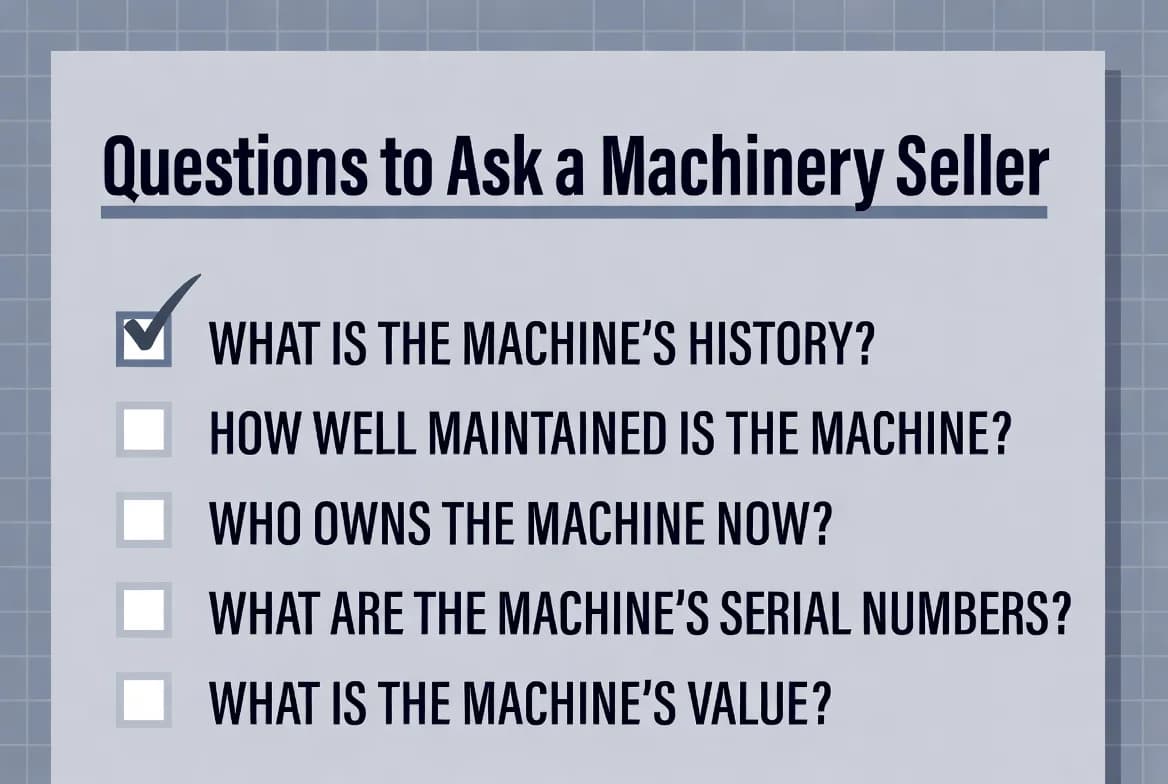
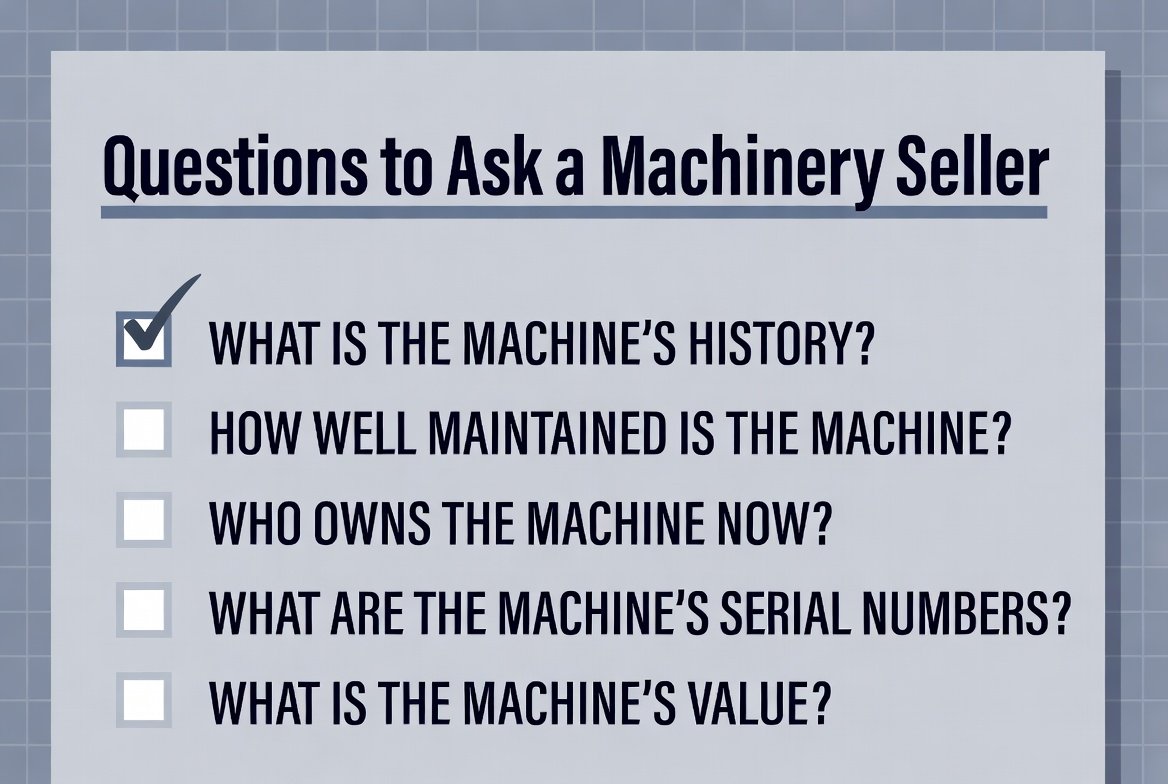
A complete interview framework for clarifying ownership, condition, history, specifications, price, logistics, and transaction terms.
CORE REVIEW AREAS
ownership, service history, reason for sale, known defects, included attachments, title or lien, delivery, and payment terms
Why This Topic Matters
Questions to Ask a Machinery Seller is not a narrow purchasing detail; it is a decision that affects safety, productivity, cash flow, maintenance workload, and the reliability of every job that follows. A complete interview framework for clarifying ownership, condition, history, specifications, price, logistics, and transaction terms. A machine that appears attractive in a listing can become expensive when its configuration, history, legal status, support arrangements, or real operating condition do not match the buyer's needs. Professional buyers therefore treat the purchase as a controlled verification process rather than a quick comparison of photographs and headline price.
The strongest decisions combine operational evidence with commercial discipline. Important themes include ownership, service history, reason for sale, known defects, included attachments, title or lien, delivery, and payment terms. None of these factors should be reviewed in isolation. A lower acquisition price may be offset by transport, repairs, finance charges, compliance work, lost production, or weak resale value. Conversely, a higher-priced machine may produce the better result when it reduces risk and is supported by accurate records, local parts, competent service, and a configuration that fits the intended work.
Start With the Intended Job
Before discussing a particular machine, define what the machine must accomplish. Record the normal job type, material, terrain, working radius, lift or digging requirement, travel distance, climate, access limitations, and expected annual usage. For this topic, the most influential planning factors are seller type, machine age, jurisdiction, transaction size, equipment location, inspection access, warranty status, and market demand. These should be converted into measurable requirements wherever possible. For example, replace 'needs to be powerful' with a required lift capacity at a stated radius, a hydraulic-flow range, a transport-width limit, or a target production rate.
The intended job also determines how conservative the purchase should be. A machine used occasionally on non-critical work may justify a different cost and risk profile from one that supports a production line, emergency service, or daily contracting revenue. Buyers should distinguish between minimum capability and comfortable working capacity. Selecting at the absolute limit can reduce productivity and accelerate wear, especially when attachments, steep ground, high ambient temperature, or dense material increase real demand.
Information to Collect Before Making a Decision
Build a written information pack before committing funds. At minimum it should include seller identity, exact manufacturer and model, serial number, model year, configuration, hours, location, ownership evidence, service records, photographs, videos, known defects, installed options, included attachments, price, taxes, transport terms, and payment conditions. For questions to ask a machinery seller, give special attention to ownership, service history, reason for sale, known defects, and included attachments. Information received verbally should be confirmed in writing, particularly when it influences price or expected performance.
Organize the evidence so that contradictions become visible. Dates on service invoices should align with hour readings. Photographs should match the listed serial number and configuration. The advertised operating weight should reflect attachments, counterweights, tires, tracks, cab type, and other options. When information is missing, mark it as unknown rather than assuming the most favorable value. An explicit unknown is easier to investigate and price than an untested assumption.
Technical and Condition Factors
Technical suitability must be evaluated at the level of the actual machine, not only the model name. Configuration differences can change capacity, stability, transport dimensions, hydraulic performance, emissions compliance, and attachment compatibility. Review seller type, machine age, jurisdiction, transaction size, equipment location, and inspection access. Check whether values are standard, optional, estimated, or measured. Where the machine is used, compare published specifications with physical condition and observed behavior.
Condition should be judged as a system. Engine performance, hydraulics, structure, undercarriage or tires, electrical controls, cooling, attachments, and safety devices interact. A clean cab does not compensate for structural cracking, and fresh paint does not prove sound maintenance. Wear patterns should be consistent with age, hours, and claimed use. A professional inspection records both defects and evidence of proper care, because strong maintenance history can be as important as a low hour reading.
Financial and Commercial Considerations
Calculate cost beyond the advertised price. Include taxes, finance charges, inspection, transport, permits, customs where applicable, immediate repairs, fluids, wear parts, attachments, insurance, registration, operator training, and expected downtime. Build at least three scenarios: expected, optimistic, and adverse. The adverse scenario should include a major early repair, delayed delivery, or lower-than-planned utilization. If the purchase only works under optimistic assumptions, the decision is fragile.
Commercial value is also affected by liquidity and exit options. Consider expected ownership period, local demand, brand support, parts availability, and likely resale condition. In the context of questions to ask a machinery seller, compare cash purchase, financing, leasing, and delayed purchase only where they are genuinely available. Do not judge an offer by monthly payment alone. Total repayment, fees, residual obligations, ownership status, and early termination terms can change the real cost substantially.
Documentation and Source Verification
Manufacturer documentation is the preferred source for technical ratings and required procedures. Useful records include the operator's manual, specification sheet, capacity chart, service manual references, warranty terms, serial-number information, and dealer build data. For this chapter, verification should focus on request written answers, verify identity, confirm ownership, obtain records, clarify inclusions, and document conditions of sale. Third-party listings can help locate machines, but copied specification tables should not be treated as authoritative without confirmation.
Keep an evidence file containing downloaded documents, dated screenshots, inspection photographs, seller statements, quotations, and correspondence. Record the source and date for every important figure. This is especially important for price, hours, capacity, compliance, warranty, and ownership. If a later dispute arises, the buyer should be able to show what was represented, what was checked, and which conditions were included in the final agreement.
A Step-by-Step Professional Method
Use a repeatable process. First, define the job and non-negotiable limits. Second, identify candidate machines. Third, collect serial numbers and documents. Fourth, screen out options that fail legal, technical, or support requirements. Fifth, inspect or arrange an independent inspection. Sixth, verify ownership and commercial terms. Seventh, calculate the full landed and ownership cost. Eighth, negotiate written conditions. Ninth, complete payment only through an approved method. Tenth, inspect again at collection or delivery.
For questions to ask a machinery seller, add explicit hold points before irreversible actions. Do not pay a non-refundable deposit until essential identity and ownership checks are complete. Do not authorize transport until dimensions, weight, loading method, destination access, and insurance are confirmed. Do not accept delivery without comparing the machine to the agreement and recording condition. These hold points prevent urgency from bypassing the checks that protect the buyer.
Common Warning Signs
Warning signs include evasive answers, inconsistent records, unclear ownership, pressure to pay quickly, missing serial numbers, and verbal promises. One warning sign does not automatically prove a bad transaction, but several combined should increase caution. Pressure to act immediately, refusal to provide a serial number, inconsistent explanations, restricted inspection access, and requests for unusual payment methods are especially serious. The appropriate response is not argument; it is independent verification or withdrawal.
Technical warning signs include values that do not match the machine configuration, unexplained welding, active fault codes, abnormal smoke, slow hydraulics, overheating, excessive play, mismatched tires or tracks, missing guards, and disabled safety systems. Commercial warning signs include unclear taxes, vague delivery responsibility, verbal-only warranty promises, and invoices issued by an entity different from the seller. Every concern should be resolved in writing before funds are released.
How to Compare Alternatives
Create a comparison table that uses the same fields and units for every candidate. Include technical suitability, condition, service history, support, purchase price, immediate work, annual operating cost, downtime risk, transport, finance, warranty, and expected resale. Score each field only after the underlying evidence is collected. A precise-looking score based on guesses is less useful than a simple comparison that clearly marks unknowns.
Separate disqualifying requirements from preferences. A machine that cannot meet a legal emissions requirement, transport limit, attachment interface, or essential capacity should not remain in the comparison simply because it is inexpensive. After removing unsuitable candidates, compare the remaining options using total value. The best alternative is the one that delivers the required work with acceptable risk and cost, not necessarily the newest, cheapest, or most powerful.
Negotiation and Contract Considerations
Negotiate from evidence. Inspection findings, missing records, worn components, outdated service, transport cost, and market comparisons provide stronger grounds than general statements that the price feels high. Decide before negotiation which items require repair, a price reduction, a warranty, or a condition of sale. Keep the negotiation focused on measurable issues and avoid allowing minor cosmetic defects to distract from expensive mechanical or legal risks.
The written agreement should identify the exact machine by serial number and describe included attachments, accessories, keys, manuals, software access, records, and spare parts. It should state price, taxes, deposit, payment timing, inspection rights, delivery responsibility, risk transfer, warranty, known defects, and remedies if the machine differs materially from the description. Local contract requirements vary, so obtain qualified advice for high-value or cross-border transactions.
Risk Control and Safety
No purchasing objective justifies an unsafe inspection or test. Inspections should be conducted on stable ground with authorization, competent operators, exclusion zones, and suitable personal protective equipment. Never work beneath unsupported equipment or attachments. Lockout, isolation, and manufacturer procedures must be followed before close inspection of moving, pressurized, elevated, or electrically energized components.
Commercial risk controls should be equally deliberate. Verify seller identity through independent channels, protect personal and financial data, and use payment methods appropriate to the transaction. For questions to ask a machinery seller, maintain separation between the seller's claims and the buyer's verification. A professional buyer is respectful but does not allow familiarity, urgency, or a polished presentation to replace evidence.
Practical Field Example
Consider a buyer interviewing a dealer about a late-model wheel loader. The buyer begins by defining annual hours, expected tasks, attachment requirements, transport limits, and downtime tolerance. Candidate information is collected in a standard form. The serial number is checked against documentation, and the configuration is compared with manufacturer literature. A cold-start inspection and operational test are arranged, while ownership, finance, warranty, and transport terms are reviewed separately.
The first option may offer the lowest price but require immediate undercarriage work and have incomplete records. The second may cost more but include verified service, a suitable attachment package, local support, and lower delivery risk. The buyer models both over the planned ownership period and places a value on expected downtime. The final decision is based on evidence and operational fit rather than the listing price alone. All representations and conditions are incorporated into the written agreement.
Mistakes Buyers Commonly Make
Common mistakes include beginning with a favorite brand or price before defining the job, relying on photographs, treating model-year specifications as identical across configurations, ignoring transport and taxes, accepting verbal promises, and failing to budget for immediate maintenance. Buyers also overvalue low hours while undervaluing service history, work severity, and condition. Another frequent error is comparing monthly payments rather than total cost and obligations.
In questions to ask a machinery seller, avoid confirmation bias. Once a buyer becomes emotionally committed to a machine, warning signs are often reinterpreted as minor. Use a written checklist and, for significant purchases, involve someone who is not invested in the transaction. A second set of eyes can identify inconsistencies and make it easier to walk away when essential evidence is missing.
Working With Dealers, Inspectors, and Advisers
Qualified dealers can add value through build information, parts access, service capacity, warranty support, financing, and trade-in options. Independent inspectors can provide a condition assessment, fluid sampling, diagnostic downloads, and measured wear. Transport specialists, customs brokers, insurers, accountants, and legal advisers may be necessary depending on transaction size and complexity. Their role should be clearly defined, and any conflicts of interest should be understood.
Professional assistance does not remove the buyer's responsibility to make a suitable decision. Ask for written scope, findings, assumptions, exclusions, and supporting evidence. An inspection that excludes internal components or does not verify ownership should not be treated as complete. Use specialists to reduce uncertainty in their area of competence, then combine their findings into the overall technical and commercial assessment.
Final Decision Checklist
Before approval, confirm that the machine fits the job, the exact identity is verified, ownership is clear, documents are consistent, specifications are sourced, condition is acceptable, known defects are priced, support is available, full cost is affordable, transport is planned, payment is secure, and the written agreement reflects the transaction. Specifically confirm that you have completed these actions: request written answers, verify identity, confirm ownership, obtain records, clarify inclusions, and document conditions of sale.
Assign every checklist item one of four states: verified, acceptable with condition, unknown, or unacceptable. Unknown items should have an owner and deadline for resolution. Unacceptable items should stop the purchase unless the underlying requirement changes. This simple discipline prevents incomplete investigations from being treated as complete merely because the buyer is ready to proceed.
Key Takeaways
Questions to Ask a Machinery Seller should be approached as a structured evidence-based process. The buyer must connect job requirements, technical condition, documentation, commercial terms, safety, and long-term ownership cost. The most important themes are ownership, service history, reason for sale, known defects, included attachments, title or lien, delivery, and payment terms. Good decisions are rarely created by a single clever question; they result from consistent verification across many small details.
When uncertainty remains, slow the transaction down. Obtain the missing document, repeat the test, consult the manufacturer or a qualified specialist, or select a more conservative alternative. A disciplined buyer is willing to lose a deal in order to avoid acquiring a machine that is unsafe, unsuitable, illegally imported, financially burdensome, or difficult to support. The goal is not simply to buy machinery; it is to acquire reliable productive capacity on terms the business can sustain.
Chapter Review Record
Item
Status
Evidence / Notes
Request written answers
☐ Verified ☐ Conditional ☐ Unknown
Verify identity
☐ Verified ☐ Conditional ☐ Unknown
Confirm ownership
☐ Verified ☐ Conditional ☐ Unknown
Obtain records
☐ Verified ☐ Conditional ☐ Unknown
Clarify inclusions
☐ Verified ☐ Conditional ☐ Unknown
Document conditions of sale
☐ Verified ☐ Conditional ☐ Unknown
Get More Expert Guides & Updates
Subscribe for Machinery.org guide updates and product learning content.