
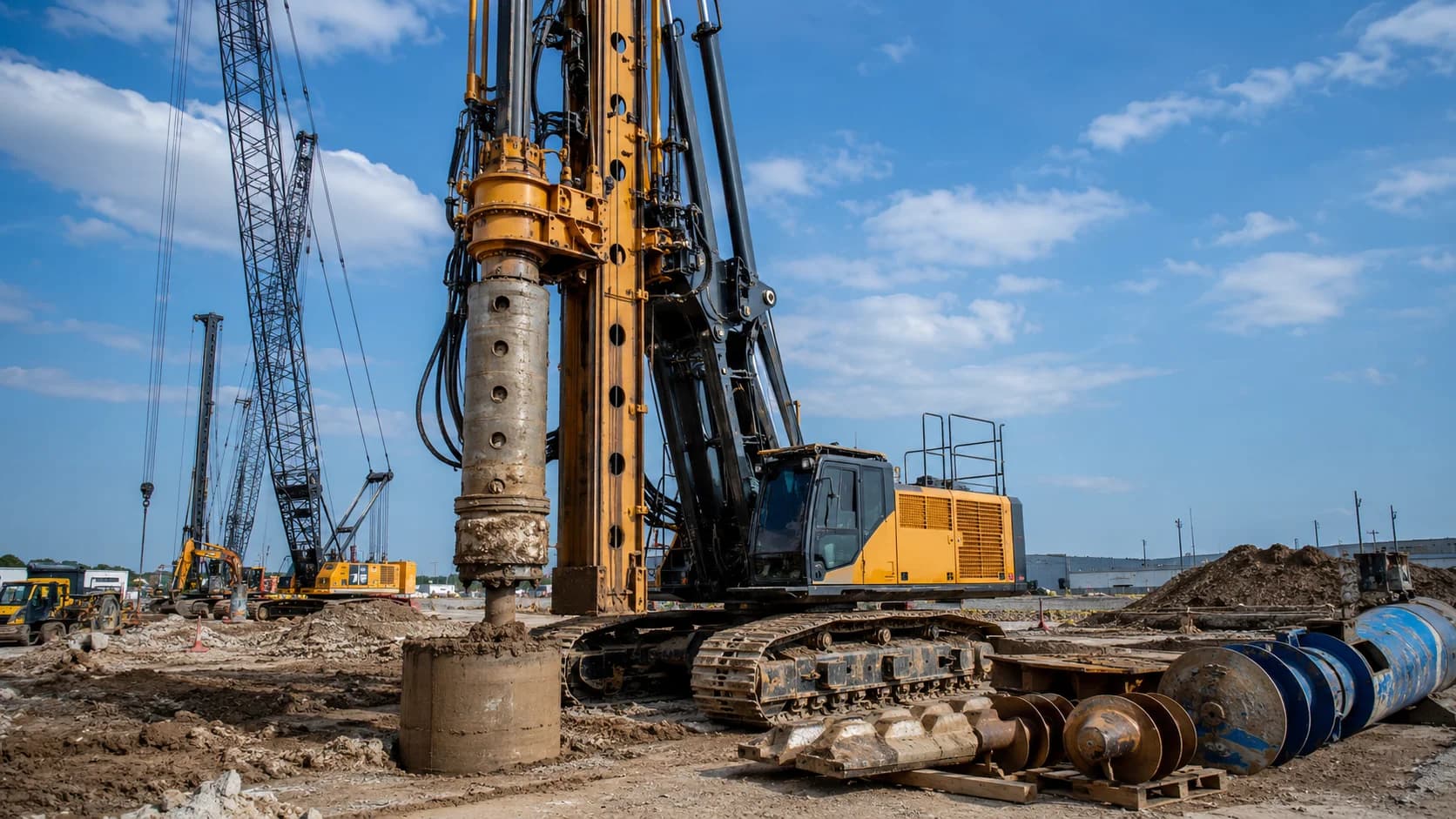
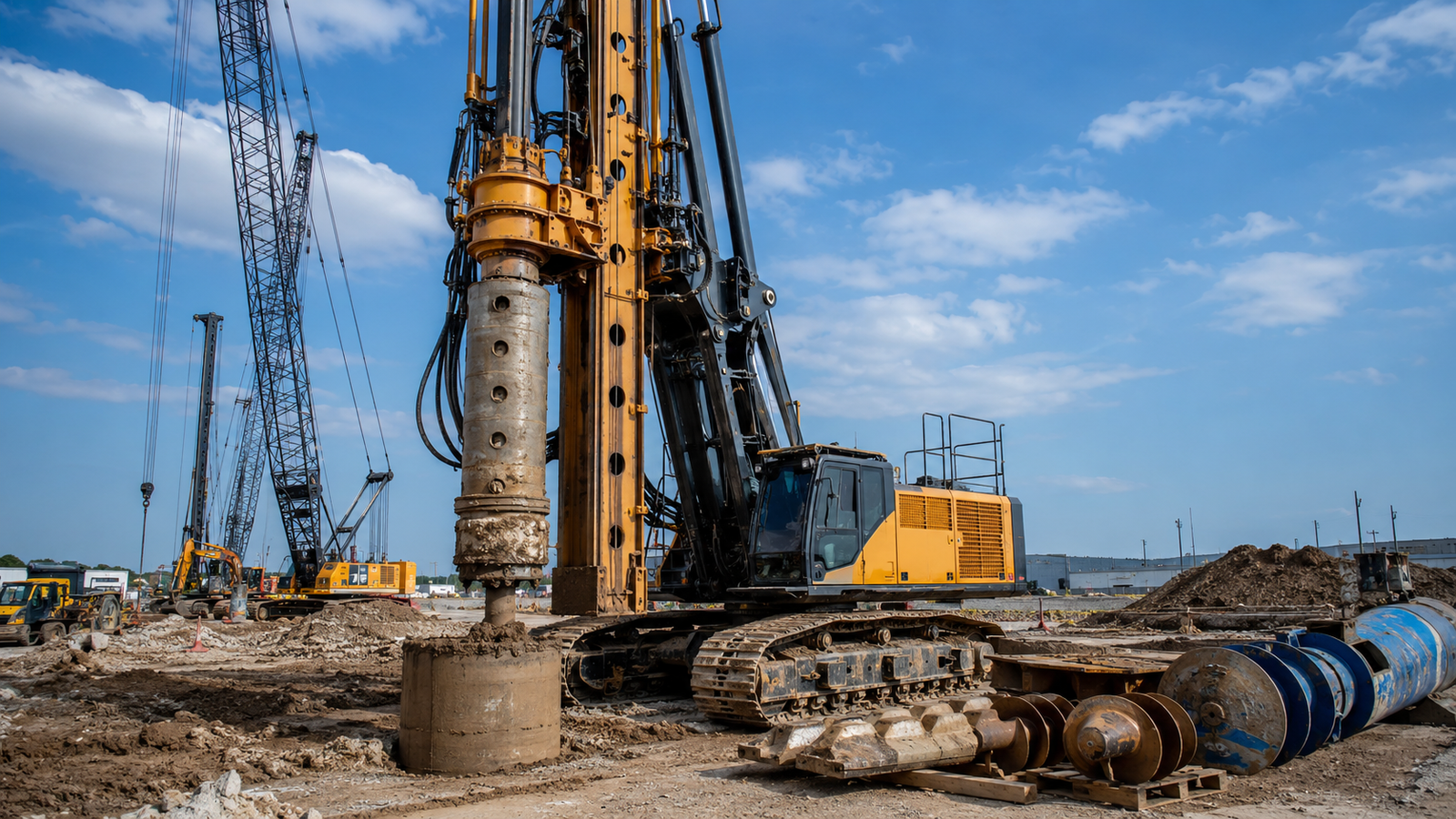
Rotary drilling rigs are widely used to construct bored piles, drilled shafts, foundation elements, retaining systems, and large-diameter holes in soil and rock. The rig combines a tracked base, mast, main winch, rotary drive, crowd system, kelly bar or drill string, and interchangeable tools that excavate material in repeated cycles. Productivity depends on more than engine power or maximum drilling diameter. The rig must provide the correct combination of torque, crowd force, extraction force, winch capacity, mast geometry, kelly depth, and tool design for the ground and foundation specification. This guide explains the major components and how they work together.
Main structure of a rotary drilling rig
Carrier and undercarriage
The tracked carrier supports the rig and provides mobility and stability. Track width, retractable undercarriage features, counterweight, ground bearing pressure, and chassis condition influence whether the machine can safely work on the prepared platform. In practice, this point matters because carrier and undercarriage affects more than the immediate machine action. It influences crew timing, equipment loading, material behavior, and the amount of room available to recover if conditions begin to drift. A useful field procedure is to define the expected condition before production, assign who will monitor it, and establish what change will trigger a slowdown, inspection, adjustment, or stop. That approach reduces last-minute decisions and makes the process more repeatable from one shift or pour to the next.
Mast and leader system
The mast guides the rotary drive and kelly bar while carrying drilling loads. It must remain within the specified vertical tolerance, and mast hinges, pins, cylinders, and locking systems require inspection because alignment affects pile position and tool behavior. From a production standpoint, mast and leader system affects more than the immediate machine action. It influences crew timing, equipment loading, material behavior, and the amount of room available to recover if conditions begin to drift. A useful field procedure is to define the expected condition before production, assign who will monitor it, and establish what change will trigger a slowdown, inspection, adjustment, or stop. The crew should therefore verify the condition before work begins and continue watching it as equipment, weather, and material conditions change.
Main and auxiliary winches
The main winch handles the kelly and tool during drilling cycles, while an auxiliary winch may handle casing, reinforcement, tools, or support items depending on rig configuration. Rope condition, reeving, brakes, and rated capacity are critical to safe lifting. On an active jobsite, main and auxiliary winches affects more than the immediate machine action. It influences crew timing, equipment loading, material behavior, and the amount of room available to recover if conditions begin to drift. A useful field procedure is to define the expected condition before production, assign who will monitor it, and establish what change will trigger a slowdown, inspection, adjustment, or stop. This is also useful for troubleshooting because changes in pressure, torque, output, or surface behavior can be tied to a specific operating condition.
Rotary head or rotary drive
Torque generation
The rotary drive turns the kelly bar and tool, converting hydraulic power into drilling torque. High torque is needed for large diameter, dense soil, and rock, but torque must be balanced with suitable rotation speed and tool geometry. For planning purposes, torque generation affects more than the immediate machine action. It influences crew timing, equipment loading, material behavior, and the amount of room available to recover if conditions begin to drift. A useful field procedure is to define the expected condition before production, assign who will monitor it, and establish what change will trigger a slowdown, inspection, adjustment, or stop. That approach reduces last-minute decisions and makes the process more repeatable from one shift or pour to the next.
Crowd force
Many rigs can push the rotary drive downward using hydraulic cylinders or a crowd winch. Crowd helps cutting teeth penetrate hard soil or rock. Excessive force, however, can overload tooling, stall rotation, or cause the rig to react against the working platform. Operationally, crowd force affects more than the immediate machine action. It influences crew timing, equipment loading, material behavior, and the amount of room available to recover if conditions begin to drift. A useful field procedure is to define the expected condition before production, assign who will monitor it, and establish what change will trigger a slowdown, inspection, adjustment, or stop. The crew should therefore verify the condition before work begins and continue watching it as equipment, weather, and material conditions change.
Speed ranges
Different formations and tools need different rotational speeds. Augers in soil may operate differently from rock buckets or core barrels. Modern rigs often provide multiple speed or torque modes so the operator can match the drive to the excavation task. The practical consequence is that speed ranges affects more than the immediate machine action. It influences crew timing, equipment loading, material behavior, and the amount of room available to recover if conditions begin to drift. A useful field procedure is to define the expected condition before production, assign who will monitor it, and establish what change will trigger a slowdown, inspection, adjustment, or stop. This is also useful for troubleshooting because changes in pressure, torque, output, or surface behavior can be tied to a specific operating condition.
Kelly bars
Telescopic structure
A kelly bar consists of nested telescoping sections that extend to reach drilling depth while transmitting torque from the rotary drive to the tool. The number and length of sections determine maximum depth but also affect weight and handling. In practice, this point matters because telescopic structure affects more than the immediate machine action. It influences crew timing, equipment loading, material behavior, and the amount of room available to recover if conditions begin to drift. A useful field procedure is to define the expected condition before production, assign who will monitor it, and establish what change will trigger a slowdown, inspection, adjustment, or stop. That approach reduces last-minute decisions and makes the process more repeatable from one shift or pour to the next.
Interlocking versus friction kelly
Interlocking kelly bars have mechanical drive keys that transmit crowd force more directly to lower sections and are commonly used in hard ground. Friction kelly bars rely more on frictional engagement and can offer efficient operation in suitable soil conditions. From a production standpoint, interlocking versus friction kelly affects more than the immediate machine action. It influences crew timing, equipment loading, material behavior, and the amount of room available to recover if conditions begin to drift. A useful field procedure is to define the expected condition before production, assign who will monitor it, and establish what change will trigger a slowdown, inspection, adjustment, or stop. The crew should therefore verify the condition before work begins and continue watching it as equipment, weather, and material conditions change.
Wear and lubrication
Kelly guides, drive keys, locking pockets, springs, and contact surfaces experience heavy sliding and impact. Correct lubrication and wear inspection are necessary because damaged keys can prevent proper extension or torque transfer and can create expensive failures. On an active jobsite, wear and lubrication affects more than the immediate machine action. It influences crew timing, equipment loading, material behavior, and the amount of room available to recover if conditions begin to drift. A useful field procedure is to define the expected condition before production, assign who will monitor it, and establish what change will trigger a slowdown, inspection, adjustment, or stop. This is also useful for troubleshooting because changes in pressure, torque, output, or surface behavior can be tied to a specific operating condition.
Common drilling tools
Drilling buckets
Buckets cut soil at the base and retain excavated material until lifted out and emptied. Bottom-door designs, cutting teeth, pilot points, and shell geometry vary for clay, sand, gravel, and weathered material. A bucket is often effective where clean removal of loose material is important. For planning purposes, drilling buckets affects more than the immediate machine action. It influences crew timing, equipment loading, material behavior, and the amount of room available to recover if conditions begin to drift. A useful field procedure is to define the expected condition before production, assign who will monitor it, and establish what change will trigger a slowdown, inspection, adjustment, or stop. That approach reduces last-minute decisions and makes the process more repeatable from one shift or pour to the next.
Augers
Continuous or short flight augers cut and carry soil on helical flights. They can drill quickly in many cohesive soils but may lose loose sand or gravel during lifting. Flight pitch, diameter, tooth pattern, and pilot design should match the formation. Operationally, augers affects more than the immediate machine action. It influences crew timing, equipment loading, material behavior, and the amount of room available to recover if conditions begin to drift. A useful field procedure is to define the expected condition before production, assign who will monitor it, and establish what change will trigger a slowdown, inspection, adjustment, or stop. The crew should therefore verify the condition before work begins and continue watching it as equipment, weather, and material conditions change.
Core barrels and rock tools
Core barrels cut an annular ring and help break competent rock or boulders. Roller-bit core barrels, bullet-tooth tools, rock augers, and cleanout buckets may be used in sequence depending on rock strength and the need to remove broken fragments. The practical consequence is that core barrels and rock tools affects more than the immediate machine action. It influences crew timing, equipment loading, material behavior, and the amount of room available to recover if conditions begin to drift. A useful field procedure is to define the expected condition before production, assign who will monitor it, and establish what change will trigger a slowdown, inspection, adjustment, or stop. This is also useful for troubleshooting because changes in pressure, torque, output, or surface behavior can be tied to a specific operating condition.
Casing and bore support
Why casing is used
Temporary or permanent casing can support unstable ground near the surface, control groundwater, protect the bore from collapse, and provide a clean guide for the pile. Casing diameter and wall strength must suit the drilling method and extraction forces. In practice, this point matters because why casing is used affects more than the immediate machine action. It influences crew timing, equipment loading, material behavior, and the amount of room available to recover if conditions begin to drift. A useful field procedure is to define the expected condition before production, assign who will monitor it, and establish what change will trigger a slowdown, inspection, adjustment, or stop. That approach reduces last-minute decisions and makes the process more repeatable from one shift or pour to the next.
Casing oscillator or rotator support
Large projects may use separate casing oscillators or rotators when the drilling rig alone cannot install or extract casing efficiently. This equipment applies torque and vertical force directly to the casing while the drilling rig excavates inside. From a production standpoint, casing oscillator or rotator support affects more than the immediate machine action. It influences crew timing, equipment loading, material behavior, and the amount of room available to recover if conditions begin to drift. A useful field procedure is to define the expected condition before production, assign who will monitor it, and establish what change will trigger a slowdown, inspection, adjustment, or stop. The crew should therefore verify the condition before work begins and continue watching it as equipment, weather, and material conditions change.
Drilling slurry alternatives
Bentonite or polymer support fluid may be used instead of full-length casing in some bored piles. The fluid must maintain sufficient level and properties to support the excavation until reinforcement and concrete are placed. On an active jobsite, drilling slurry alternatives affects more than the immediate machine action. It influences crew timing, equipment loading, material behavior, and the amount of room available to recover if conditions begin to drift. A useful field procedure is to define the expected condition before production, assign who will monitor it, and establish what change will trigger a slowdown, inspection, adjustment, or stop. This is also useful for troubleshooting because changes in pressure, torque, output, or surface behavior can be tied to a specific operating condition.
Working platform and rig stability
Platform quality is fundamental
Rotary rigs are heavy and generate changing loads as the mast, kelly, and tool move. The working platform needs adequate bearing capacity, drainage, level tolerance, and edge distance from excavations. A weak platform can lead to excessive settlement or overturning risk. For planning purposes, platform quality is fundamental affects more than the immediate machine action. It influences crew timing, equipment loading, material behavior, and the amount of room available to recover if conditions begin to drift. A useful field procedure is to define the expected condition before production, assign who will monitor it, and establish what change will trigger a slowdown, inspection, adjustment, or stop. That approach reduces last-minute decisions and makes the process more repeatable from one shift or pour to the next.
Track position affects stability
The operator should use the undercarriage and mast orientation specified for drilling. Working across slopes, near unsupported edges, or with tracks partially on different materials can reduce stability and drilling accuracy. Operationally, track position affects stability affects more than the immediate machine action. It influences crew timing, equipment loading, material behavior, and the amount of room available to recover if conditions begin to drift. A useful field procedure is to define the expected condition before production, assign who will monitor it, and establish what change will trigger a slowdown, inspection, adjustment, or stop. The crew should therefore verify the condition before work begins and continue watching it as equipment, weather, and material conditions change.
Ground improvement may be required
Crushed stone working mats, geogrid, engineered fill, timber or composite mats, and drainage may be used to create suitable access. Platform design should reflect the heaviest expected configuration and movement path, not only the drilling position. The practical consequence is that ground improvement may be required affects more than the immediate machine action. It influences crew timing, equipment loading, material behavior, and the amount of room available to recover if conditions begin to drift. A useful field procedure is to define the expected condition before production, assign who will monitor it, and establish what change will trigger a slowdown, inspection, adjustment, or stop. This is also useful for troubleshooting because changes in pressure, torque, output, or surface behavior can be tied to a specific operating condition.
Drilling cycle and production
Cut, fill, lift, empty
For bucket and short-auger drilling, production is cyclical. The tool drills until appropriately loaded, the kelly retracts, the tool is lifted clear, the rig slews or positions for discharge, the spoil is emptied, and the tool returns to the hole. In practice, this point matters because cut, fill, lift, empty affects more than the immediate machine action. It influences crew timing, equipment loading, material behavior, and the amount of room available to recover if conditions begin to drift. A useful field procedure is to define the expected condition before production, assign who will monitor it, and establish what change will trigger a slowdown, inspection, adjustment, or stop. That approach reduces last-minute decisions and makes the process more repeatable from one shift or pour to the next.
Avoid overfilling the tool
Trying to fill beyond efficient capacity can waste time because soil packs tightly, extraction force rises, and unloading becomes difficult. Skilled operators learn the number of rotations and penetration depth that produce a clean, repeatable cycle. From a production standpoint, avoid overfilling the tool affects more than the immediate machine action. It influences crew timing, equipment loading, material behavior, and the amount of room available to recover if conditions begin to drift. A useful field procedure is to define the expected condition before production, assign who will monitor it, and establish what change will trigger a slowdown, inspection, adjustment, or stop. The crew should therefore verify the condition before work begins and continue watching it as equipment, weather, and material conditions change.
Spoil handling affects drilling rate
Excavated material must be removed from the rig swing area quickly. Poor loader, excavator, or truck coordination can stop the drilling rig even when the machine itself is performing well. On an active jobsite, spoil handling affects drilling rate affects more than the immediate machine action. It influences crew timing, equipment loading, material behavior, and the amount of room available to recover if conditions begin to drift. A useful field procedure is to define the expected condition before production, assign who will monitor it, and establish what change will trigger a slowdown, inspection, adjustment, or stop. This is also useful for troubleshooting because changes in pressure, torque, output, or surface behavior can be tied to a specific operating condition.
Accuracy, inspection, and concreting interface
Control position and verticality
Pile center, casing location, mast plumb, and bore depth should be checked against the foundation layout. Small positional errors at the top can become important at depth, especially for large-diameter shafts or tight pile groups. For planning purposes, control position and verticality affects more than the immediate machine action. It influences crew timing, equipment loading, material behavior, and the amount of room available to recover if conditions begin to drift. A useful field procedure is to define the expected condition before production, assign who will monitor it, and establish what change will trigger a slowdown, inspection, adjustment, or stop. That approach reduces last-minute decisions and makes the process more repeatable from one shift or pour to the next.
Inspect the base
The project may require cleaning, sounding, camera inspection, or other verification that loose sediment has been removed and the design founding layer is reached. Tool selection and final cleanout method influence base quality. Operationally, inspect the base affects more than the immediate machine action. It influences crew timing, equipment loading, material behavior, and the amount of room available to recover if conditions begin to drift. A useful field procedure is to define the expected condition before production, assign who will monitor it, and establish what change will trigger a slowdown, inspection, adjustment, or stop. The crew should therefore verify the condition before work begins and continue watching it as equipment, weather, and material conditions change.
Coordinate reinforcement and concrete
Rebar cages, tremie pipes, concrete supply, casing extraction, and slurry management need to be ready when drilling reaches completion. A finished bore should not remain open unnecessarily while the crew searches for the next operation. The practical consequence is that coordinate reinforcement and concrete affects more than the immediate machine action. It influences crew timing, equipment loading, material behavior, and the amount of room available to recover if conditions begin to drift. A useful field procedure is to define the expected condition before production, assign who will monitor it, and establish what change will trigger a slowdown, inspection, adjustment, or stop. This is also useful for troubleshooting because changes in pressure, torque, output, or surface behavior can be tied to a specific operating condition.
Maintenance and tool management
Inspect teeth and holders
Worn teeth reduce penetration, increase torque, and can damage holders. Replacing cutting components at planned intervals protects tool bodies and keeps excavation predictable. In practice, this point matters because inspect teeth and holders affects more than the immediate machine action. It influences crew timing, equipment loading, material behavior, and the amount of room available to recover if conditions begin to drift. A useful field procedure is to define the expected condition before production, assign who will monitor it, and establish what change will trigger a slowdown, inspection, adjustment, or stop. That approach reduces last-minute decisions and makes the process more repeatable from one shift or pour to the next.
Monitor rotary and hydraulic systems
Leaks, unusual temperature, vibration, gear noise, and changing torque response can indicate drive problems. Preventive attention to filters, hoses, oils, bearings, and gear systems is less disruptive than a failure with a tool deep in the bore. From a production standpoint, monitor rotary and hydraulic systems affects more than the immediate machine action. It influences crew timing, equipment loading, material behavior, and the amount of room available to recover if conditions begin to drift. A useful field procedure is to define the expected condition before production, assign who will monitor it, and establish what change will trigger a slowdown, inspection, adjustment, or stop. The crew should therefore verify the condition before work begins and continue watching it as equipment, weather, and material conditions change.
Manage kelly and wire ropes carefully
Kelly damage and wire-rope deterioration can be hidden by dirt and daily production pressure. Cleaning, inspection, lubrication, and documented replacement criteria are essential because these components carry repeated high loads. On an active jobsite, manage kelly and wire ropes carefully affects more than the immediate machine action. It influences crew timing, equipment loading, material behavior, and the amount of room available to recover if conditions begin to drift. A useful field procedure is to define the expected condition before production, assign who will monitor it, and establish what change will trigger a slowdown, inspection, adjustment, or stop. This is also useful for troubleshooting because changes in pressure, torque, output, or surface behavior can be tied to a specific operating condition.
Practical planning checklist
Before the work starts, convert the main technical ideas into a short field plan. Review the equipment manual and project requirements, confirm site access and support conditions, verify the material or drilling program, identify the people authorized to control the operation, and agree on communication signals. Confirm that inspection, maintenance, cleanup, environmental controls, and emergency access are not being left until the end of the shift. A checklist is most useful when it is specific to the actual machine, ground, mix, crew, and layout rather than copied without adaptation from a different project.
- Verify equipment configuration, wear condition, required tooling or delivery components, and all manufacturer limitations that apply to the planned work.
- Confirm that the work area, access route, traffic plan, supporting ground, and exclusion zones are ready before production equipment is committed.
- Review material properties or ground conditions and confirm that the selected operating method matches what the crew expects to encounter.
- Establish a realistic production rate that downstream operations can accept without creating long stops, uncontrolled queues, or rushed workmanship.
- Assign one clear communication chain for start, stop, speed changes, abnormal conditions, and emergency action.
- Prepare the cleanup, waste, washout, drilling-fluid, spoil, or residual-material plan before the operation begins.
- Record unusual pressure, torque, output, wear, delays, or quality observations so the next similar job can be planned with better information.
Final guidance
A rotary drilling rig is a system of carrier, mast, rotary drive, kelly bar, winches, casing support, and interchangeable excavation tools. Rig selection should be based on required diameter and depth, expected geology, torque and crowd demand, casing method, working-platform capacity, and site logistics. The correct tool and operating cycle can improve production more than simply choosing a larger machine. Reliable drilled foundations come from matching equipment to the ground, maintaining alignment and bore support, controlling wear, and coordinating excavation with spoil removal, reinforcement, and concrete placement.
Get More Expert Guides & Updates
Subscribe for Machinery.org guide updates and product learning content.