
The undercarriage determines how a mini excavator contacts the ground, moves across a site, protects finished surfaces, and converts engine power into traction. Rubber tracks and steel tracks can both support productive excavation, but they are optimized for different environments. Choosing the wrong track type can increase ground damage, reduce grip, accelerate wear, and create higher ownership costs than expected.
Rubber tracks are common on compact excavators because they are quiet, versatile, transport-friendly, and gentle on pavement, concrete, lawns, and landscaped areas. Steel tracks are selected when durability, puncture resistance, rock performance, demolition work, or severe ground conditions matter more than surface protection. The choice should follow the machine’s real workload, not simply the track type that appears more rugged or more affordable at purchase.
This guide compares the two systems and explains how terrain, travel distance, operating technique, maintenance, and optional track pads influence the decision.

Figure 22.1. Machinery.org undercarriage comparison showing where rubber tracks and steel tracks perform best.
Rubber track strengths
Rubber tracks distribute machine weight over a broad contact area while providing a relatively soft interface with the ground. This makes them well suited to landscaping, residential construction, utility work, pavement repair, indoor demolition, and other jobs where surface damage must be controlled. They create less noise and vibration than bare steel, which can improve operator comfort and reduce disturbance near homes, schools, hospitals, and occupied facilities.
Rubber tracks also simplify movement across mixed sites. A machine may travel from soil to asphalt, cross a driveway, and work beside finished landscaping without changing pads. For contractors who serve many short-duration jobs, this flexibility is often more valuable than maximum durability in one severe application.
Steel track strengths
Steel tracks are built for abrasion, impact, sharp debris, and demanding ground conditions. Rocky excavation, demolition, scrap handling, forestry support, and rough earthwork can destroy rubber tracks quickly. Steel shoes resist cuts and punctures and often deliver longer life in those environments. They can also provide dependable traction where a more aggressive shoe profile bites into loose or uneven ground.
The trade-off is greater noise, vibration, weight, and potential damage to finished surfaces. Bare steel tracks can mark concrete, asphalt, curbs, pavers, and floors. Steel systems also contain more serviceable joints and wear points, so maintenance practices differ from those used with molded rubber tracks.
Traction and flotation
Traction is not determined only by material. Shoe design, tread pattern, ground pressure, machine balance, and soil condition all matter. Rubber tracks often perform very well in soft soil because their continuous tread creates broad contact and good flotation. Steel tracks can excel on rock, hard-packed ground, broken concrete, and severe grades where shoe edges provide mechanical bite. In deep mud, the best result depends on tread pattern, track width, and the machine’s ability to clear packed material from the undercarriage.
Ground protection
Ground protection is the clearest advantage of rubber. It does not mean rubber tracks are damage-free. Counter-rotation, sharp turning, heavy loads, and repeated travel can still tear turf, scuff pavement, or rut soft ground. Operators who use gradual turns and minimize unnecessary spinning will protect surfaces and extend track life. Steel tracks should be treated as a high-damage option on finished surfaces unless protective pads are installed.
Durability and common damage
Rubber track failures often begin with cuts, exposed steel cords, missing tread blocks, edge damage, or internal cable separation. Sharp rocks, rebar, demolition debris, and side loading are common causes. Steel-track wear appears at pins, bushings, links, rollers, sprockets, and shoe edges. Both systems suffer when track tension is incorrect or the undercarriage is packed with abrasive material.
Maintenance differences
Check track tension daily or at the interval specified in the manual, especially after cleaning or moving between soil conditions.
Clean mud, concrete, stone, roots, and debris from the undercarriage before material hardens around rollers and sprockets.
Inspect rubber tracks for deep cuts, exposed cords, missing lugs, and uneven edge wear.
Inspect steel tracks for loose shoes, cracked links, pin-and-bushing wear, and abnormal sprocket contact.
Avoid driving long distances at high speed when the task can be completed with better machine positioning or transport support.
Rotate travel direction and work patterns when practical to reduce one-sided wear.
Noise, vibration, and operator comfort
Rubber tracks generally provide a smoother and quieter ride, especially on pavement and compact ground. Lower vibration can reduce fatigue during repeated travel and grading tasks. Steel tracks transmit more shock through the machine, which may be acceptable on rough jobs where durability is the priority. Cab suspension, seat quality, travel speed, and undercarriage condition also affect comfort.
Transport and machine weight
Steel undercarriages are usually heavier. That additional weight may improve stability but can move the machine into a different trailer or towing requirement. Buyers should compare actual operating weight, including cab, blade, coupler, bucket, fuel, and track configuration. Rubber-track machines are often preferred by small contractors because they are easier to transport between many short jobs.
Steel tracks with rubber pads
Bolt-on or clip-on rubber pads can create a useful middle ground. The steel chain provides durability, while pads reduce surface damage and noise. However, pad systems add cost, weight, fasteners, and maintenance. They may not protect surfaces as gently as a full rubber track, and damaged pads must be replaced before exposed steel contacts the ground.
How to choose
List the surfaces the machine works on most often: turf, pavement, soil, rock, debris, or demolition material.
Estimate how much travel occurs on finished surfaces versus severe ground.
Compare track replacement cost with the cost of surface damage, downtime, and undercarriage service.
Check transport weight and trailer limits for each track configuration.
Consider whether rubber pads on steel tracks provide a practical compromise.
Choose the system that fits the dominant workload rather than the rarest extreme job.
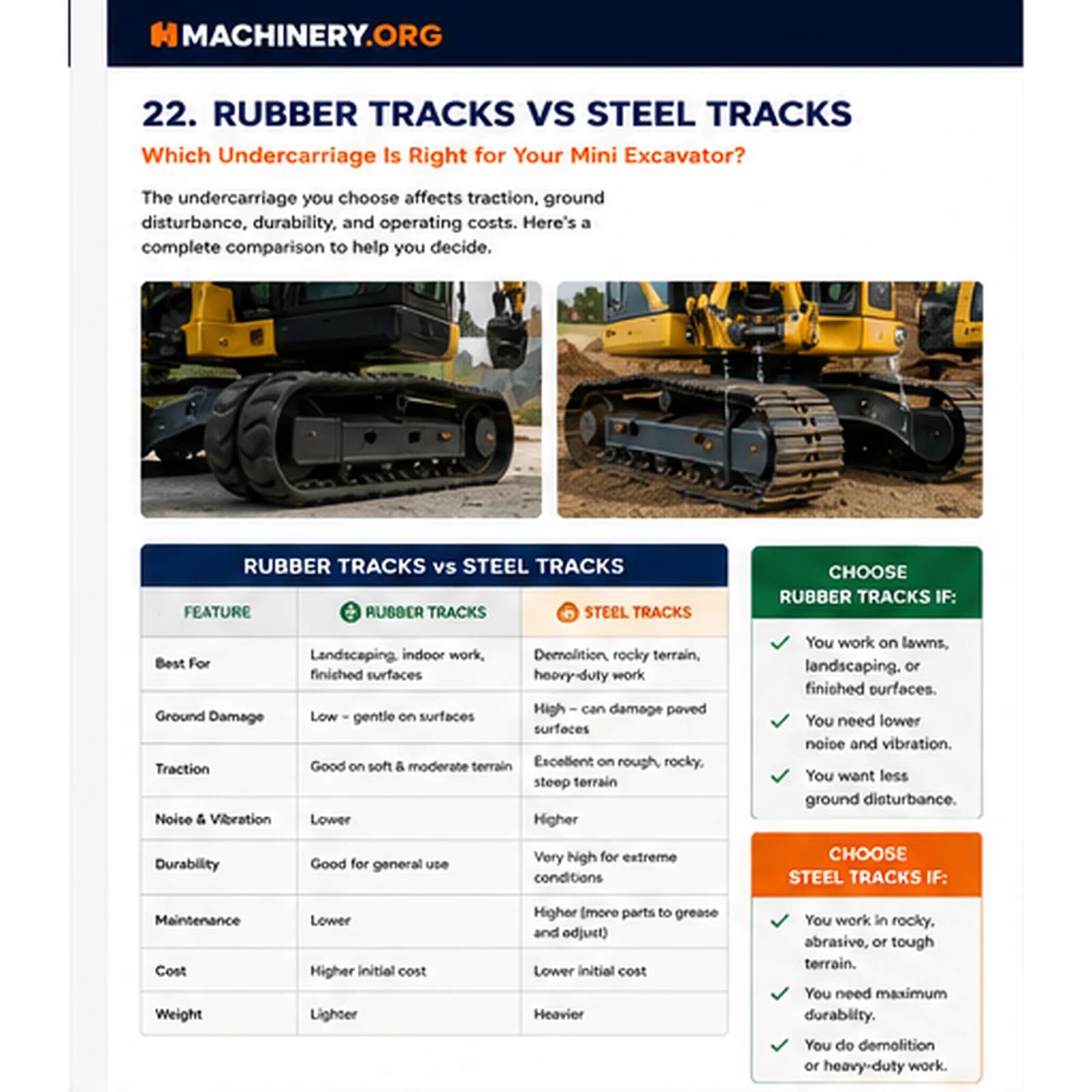
For landscaping, residential utility work, rental fleets, and mixed-surface jobs, rubber tracks are usually the stronger all-around choice. For demolition, rocky excavation, scrap, and sustained abrasive work, steel tracks often provide better durability and predictability.

Figure 22.2. Machinery.org track-selection guide comparing terrain, durability, noise, surface protection, maintenance, and cost.
Frequently Asked Questions
Do rubber tracks have less traction than steel tracks?
Not always. Rubber can provide excellent traction and flotation in soft soil, while steel often excels on rock, debris, and severe abrasive terrain.
Can steel tracks be used on asphalt?
They can, but bare steel may damage or mark the surface. Approved rubber pads may be needed.
Which track type costs less?
Rubber often has a lower initial undercarriage cost, while steel may last longer in severe applications. Total cost depends on terrain and operating technique.
Key Takeaway
Choose rubber tracks for versatility, low noise, smoother travel, and surface protection. Choose steel tracks for severe abrasion, demolition, sharp debris, and rocky ground where durability is the main requirement.
Get More Expert Guides & Updates
Subscribe for Machinery.org guide updates and product learning content.