

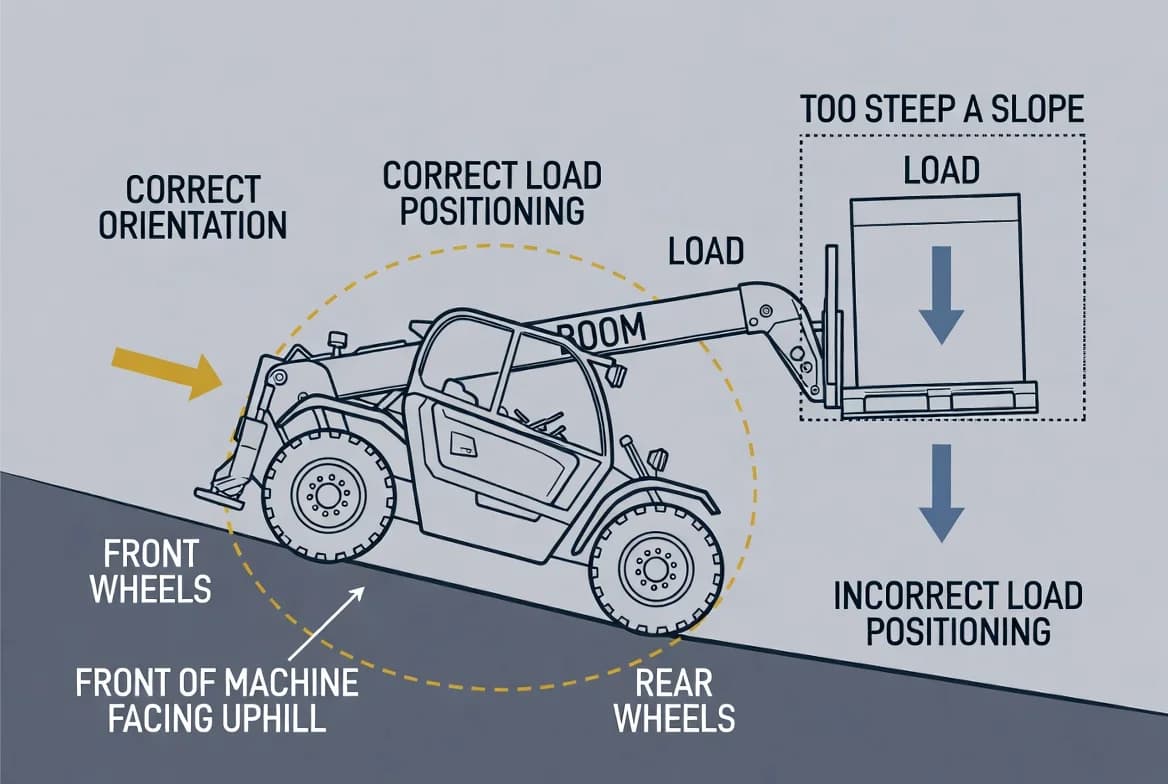

Operating a road roller on sloping ground introduces significant risks of tip-over, loss of control, and runaway. The high centre of gravity of many rollers, combined with the oscillating mass of a vibratory drum, makes them particularly sensitive to side slopes and to changes in grade. Strict adherence to safe operating practices and to the manufacturer’s slope limits is essential.
Manufacturers publish maximum recommended side-slope and grade angles for each model, often distinguishing between static and vibratory operation. These limits are based on the machine’s geometry, weight distribution, and the dynamic effects of vibration. Exceeding the published limits can result in a tip-over. Operators must assess the slope before beginning work and continuously monitor the machine’s attitude while rolling. When travelling up or down a slope, the roller should be oriented so that the drum is on the downhill side whenever possible; this keeps the centre of gravity in the most stable position. Speed must be kept low and constant; sudden braking or acceleration can shift the weight distribution and initiate a tip. Vibration should be turned off when travelling on significant slopes unless the manufacturer specifically permits it.
Articulated rollers can change their effective stability when the frame is steered on a slope. Steering toward the downhill side reduces the support base and increases tip risk. On very steep grades it may be necessary to use a winch or to select a different machine with a lower centre of gravity. Seat belts or restraint systems must be worn at all times; in a tip-over they keep the operator within the protective envelope of the ROPS. The ROPS itself must be in sound condition. Before working on slopes the operator should inspect the ground for soft spots, rocks, or drop-offs. Working near the edge of a fill requires extra caution. Training should include practical exercises on slopes under controlled conditions. Site supervisors must enforce the manufacturer’s slope restrictions. When the slope exceeds the safe limit, alternative compaction methods must be used. In summary, safe slope operation depends on knowing and respecting the machine’s limits, maintaining a stable orientation, controlling speed, using restraint systems, and exercising continuous situational awareness.
Get More Expert Guides & Updates
Subscribe for Machinery.org guide updates and product learning content.