
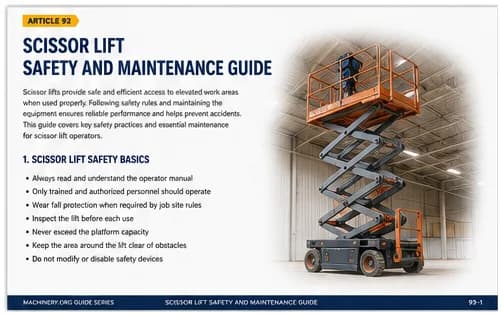
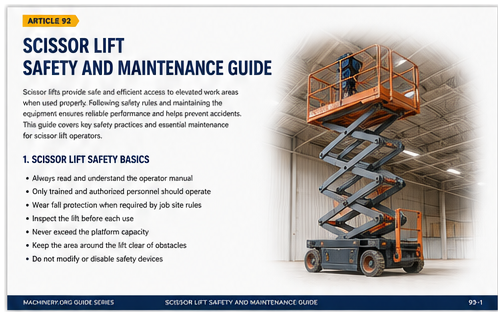
Figure 93.1 - Scissor lift safety and maintenance overview.
Image Description: A standalone guide image showing a scissor lift and the main safety and maintenance points for elevated work.
Introduction
Scissor lifts are essential access machines for construction, maintenance, warehousing, facility management, electrical work, painting, signage, and indoor installation projects. They provide a stable elevated platform when used correctly, but they also introduce hazards that must be managed carefully. Falls, tip-overs, crushing, electrocution, collisions, and mechanical failures are all possible when operators ignore inspection, terrain limits, load ratings, or safe work practices. Because workers are elevated above the ground, small mistakes can have serious outcomes.
This Machinery.org article is designed as a practical guide for safe scissor lift use and maintenance. It explains how to inspect the machine before use, how to manage platform safety, how batteries and hydraulic systems should be treated, how to understand ground conditions, and how to avoid the most common mistakes. The guide applies to electric indoor scissor lifts, rough-terrain lifts, and general access equipment concepts, although owners should always follow the specific manual for their machine.
The central idea is simple: a scissor lift should be treated as a controlled work platform, not as a shortcut for reaching high places. Operators must be trained, the work area must be evaluated, the machine must be inspected, and the platform must be used within its limits. Maintenance matters because a lift that raises people into the air has almost no tolerance for neglected safety systems.
Scissor Lift Safety Basics
Before operating a scissor lift, the operator must understand the machine’s platform capacity, maximum working height, indoor or outdoor rating, wind limitations, gradeability, control layout, emergency lowering system, and manufacturer restrictions. The machine should never be used as a crane, forklift, ladder support, or pushing device. The platform is intended to raise people, tools, and materials within the allowed load capacity, not to carry uncontrolled loads or force objects into place.
Only trained and authorized personnel should operate a lift. Training should include controls, inspections, emergency procedures, hazard recognition, fall protection requirements, battery charging, and the difference between driving in the lowered position and elevated movement. Many scissor lift incidents occur because users assume the machine is simple enough to operate without training. It is simple only when its limits are understood.
Pre-Use Inspection
A pre-use inspection should begin with the ground area and machine exterior. Look for leaks, damaged tires, worn wheels, missing labels, cracked welds, damaged guardrails, loose platform gates, bent scissor arms, damaged control cables, broken pothole protection devices, and anything that appears modified or missing. If the lift uses outriggers or stabilizers, those systems must be inspected according to the manual. The operator should also check the condition of the deck extension if equipped.
Controls should be tested from both the ground control station and the platform control station. Raise, lower, drive, steer, emergency stop, horn, alarms, tilt warning, and emergency lowering systems should be confirmed. If any safety system fails, the machine should be removed from service. Never bypass or tape down safety features to keep working. A disabled safety device is a warning that the lift is not ready for use.
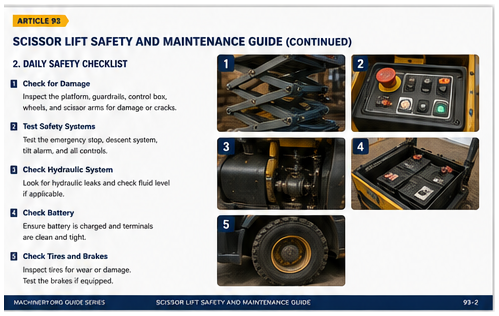
Figure 93.2 - Scissor lift daily safety checklist.
Image Description: A standalone checklist guide image showing platform checks, guardrails, controls, hydraulic components, batteries, tires, and brakes.
Work Area Evaluation
The best scissor lift inspection can still fail if the work area is unsafe. Operators should check for floor strength, holes, drop-offs, debris, slopes, curbs, overhead beams, power lines, doors, moving vehicles, forklifts, cranes, and other equipment. A scissor lift should be used on surfaces that match the machine’s design and rating. Many indoor lifts are intended for smooth, level surfaces and should not be driven on rough ground or outdoor slopes simply because the work is urgent.
Overhead hazards are especially important. A worker can be crushed between the platform and a beam, duct, pipe, ceiling, or structural member if the lift is raised carelessly. Slow, deliberate elevation and constant awareness are essential. Ground workers should also be kept clear of the lift path and work zone.
Platform Use and Load Management
Platform capacity includes people, tools, and materials. Operators should not overload the platform or stack material in a way that blocks the gate, guardrails, or controls. Tools should be secured, and loose items should be controlled to reduce falling-object hazards. Workers should stand on the platform floor, not on guardrails, boxes, buckets, or ladders. Climbing on guardrails is one of the most dangerous and preventable scissor lift mistakes.
Driving while elevated should be done only when allowed by the machine and conditions. If the lift is elevated, travel should be slow and smooth. The operator should avoid sudden stops, sharp steering, and rough surfaces. If the lift has a tilt alarm or warning, operation should stop and the platform should be lowered safely according to the manual. Ignoring an alarm is never acceptable.
Battery, Hydraulic, and Mechanical Maintenance
Maintenance is essential because scissor lifts depend on reliable power, hydraulic control, structural integrity, and safety interlocks. Battery-powered lifts require proper charging habits, clean terminals, adequate electrolyte management where applicable, and inspection for damaged cables. Charging should occur in approved areas with ventilation and fire safety practices. A weak battery can interrupt work at height and may also affect drive or lift performance.
Hydraulic systems should be checked for leaks, hose condition, cylinder performance, and fluid level where accessible and specified. Scissor arms, pins, pivot points, platform gates, guardrails, tires, brakes, and pothole protection should be inspected regularly. Maintenance records are especially important for rental fleets and shared equipment because many users may operate the same lift without knowing its history.
Common Mistakes and Prevention
Common mistakes include operating on slopes beyond the rating, driving into holes or debris, overloading the platform, bypassing safety devices, using the lift near energized power lines, climbing guardrails, ignoring alarms, and failing to inspect the emergency lowering system. Another frequent issue is using an indoor slab lift outdoors on unsuitable ground. The correct machine must be chosen for the environment. Rough-terrain work requires the right model, tires, and stabilization practices.
Prevention comes from training, site planning, inspection discipline, and supervisor enforcement. A scissor lift can be very safe when used correctly, but it cannot protect workers from deliberate misuse. The operator must have authority to stop work when conditions become unsafe.
Emergency Lowering and Rescue Planning
Every scissor lift user should understand emergency lowering before the platform is raised. The ground controls, manual lowering valve, emergency stop buttons, and rescue procedure should be known by the operator and by at least one person on the ground. If the platform operator becomes unable to lower the lift, a trained person must be able to bring the platform down safely. Waiting until an emergency to learn the system wastes valuable time and increases risk.
Rescue planning is especially important indoors where overhead structures, narrow aisles, mezzanines, doors, and production equipment may complicate recovery. The work area should have enough room for safe lowering, and workers should know who to call if the lift loses power, alarms, becomes stuck, or experiences a control failure. The rescue plan does not need to be complex, but it must be practical and understood before work starts.
Indoor Versus Outdoor Use
Indoor and outdoor scissor lift operation are not the same. Indoor slab lifts are usually designed for smooth, level floors and controlled environments. Outdoor work may introduce wind, uneven soil, slopes, wet surfaces, potholes, gravel, and weather exposure. A lift that is safe in a warehouse may be completely unsuitable for a rough outdoor site. Before choosing a lift, supervisors should confirm surface rating, tire type, platform height, wind rating, and whether outriggers or stabilizers are required.
Operators should also pay attention to floor loading. Some elevated floors, decorative surfaces, temporary covers, or access panels may not support the lift safely. When in doubt, verify the surface before driving onto it. A scissor lift accident often begins with an assumption that the floor or ground is stronger, flatter, or cleaner than it really is.
Operator Training and Program Review
A scissor lift program should be reviewed after every incident, near miss, or change in work environment. If the same hazards appear repeatedly, such as blocked aisles, uneven floors, weak charging habits, or damaged guardrails, the problem is not only operator behavior; it is a system issue. Strong companies make lift inspection, work-area review, rescue planning, and maintenance reporting part of the normal start-of-shift conversation. They also keep manuals accessible, confirm that emergency lowering is understood by ground personnel, and remove damaged equipment from service without debate.
Final Field Review
This final review should include battery charging areas, rescue access, floor capacity, platform gate condition, and the process for tagging out unsafe lifts before any worker enters the platform again.
FAQ
Can anyone operate a scissor lift? No. Operators should be trained and authorized, and they must understand the specific machine and worksite hazards.
Can a ladder be used inside the platform? No. Standing on ladders, boxes, buckets, or rails inside the platform creates serious fall and stability hazards.
What should happen if the tilt alarm sounds? Stop, avoid further unsafe movement, lower the platform safely according to the manual, and correct the condition before continuing.
Key Takeaway
Scissor lift safety depends on trained operators, careful inspections, sound work-area evaluation, load control, and respect for safety systems. Maintenance is not separate from safety; it is what keeps the platform dependable when people are elevated above the ground.
Get More Expert Guides & Updates
Subscribe for Machinery.org guide updates and product learning content.