
SEO Title
Skid Steer Fuel Efficiency Guide
URL Slug
/skid-steer-fuel-efficiency-guide/
Meta Description
Reduce skid steer fuel consumption with better maintenance, correct attachment matching, efficient job planning, and smooth operator habits.
Fuel is one of the most visible operating costs in skid steer ownership. Even when the price of diesel changes only slightly, the effect becomes noticeable across hundreds of operating hours. Fuel use also reveals more than cost: a machine that suddenly consumes more fuel may be overloaded, poorly maintained, equipped with the wrong attachment, or operated inefficiently. For this reason, fuel efficiency should be treated as a complete management issue rather than a single engine specification.
A fuel-efficient skid steer is not necessarily the smallest or least powerful model. The most efficient machine is the one that completes the required work without spending long periods overloaded, idling, traveling unnecessarily, or fighting an attachment it cannot power correctly. A larger machine working comfortably may sometimes use less fuel per completed task than a smaller unit operating at maximum load all day. Owners therefore need to evaluate efficiency by job output, not only by gallons or liters consumed per hour.
This guide explains the major factors that influence skid steer fuel consumption, the maintenance habits that protect efficiency, and the operating practices that help crews get more useful work from every tank. The percentages shown in visual examples are illustrative only; actual savings vary by model, site, attachment, material, weather, and operator technique.
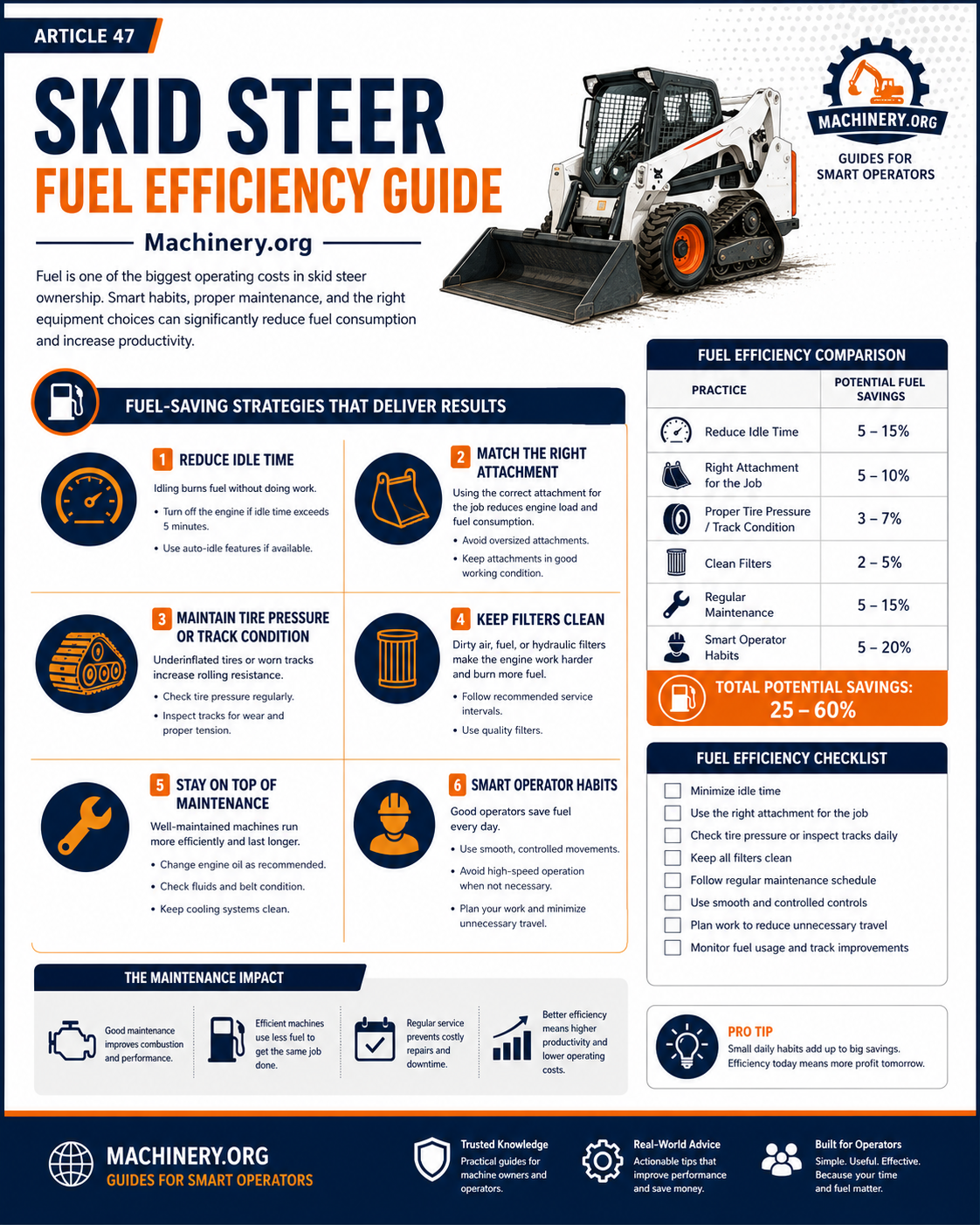
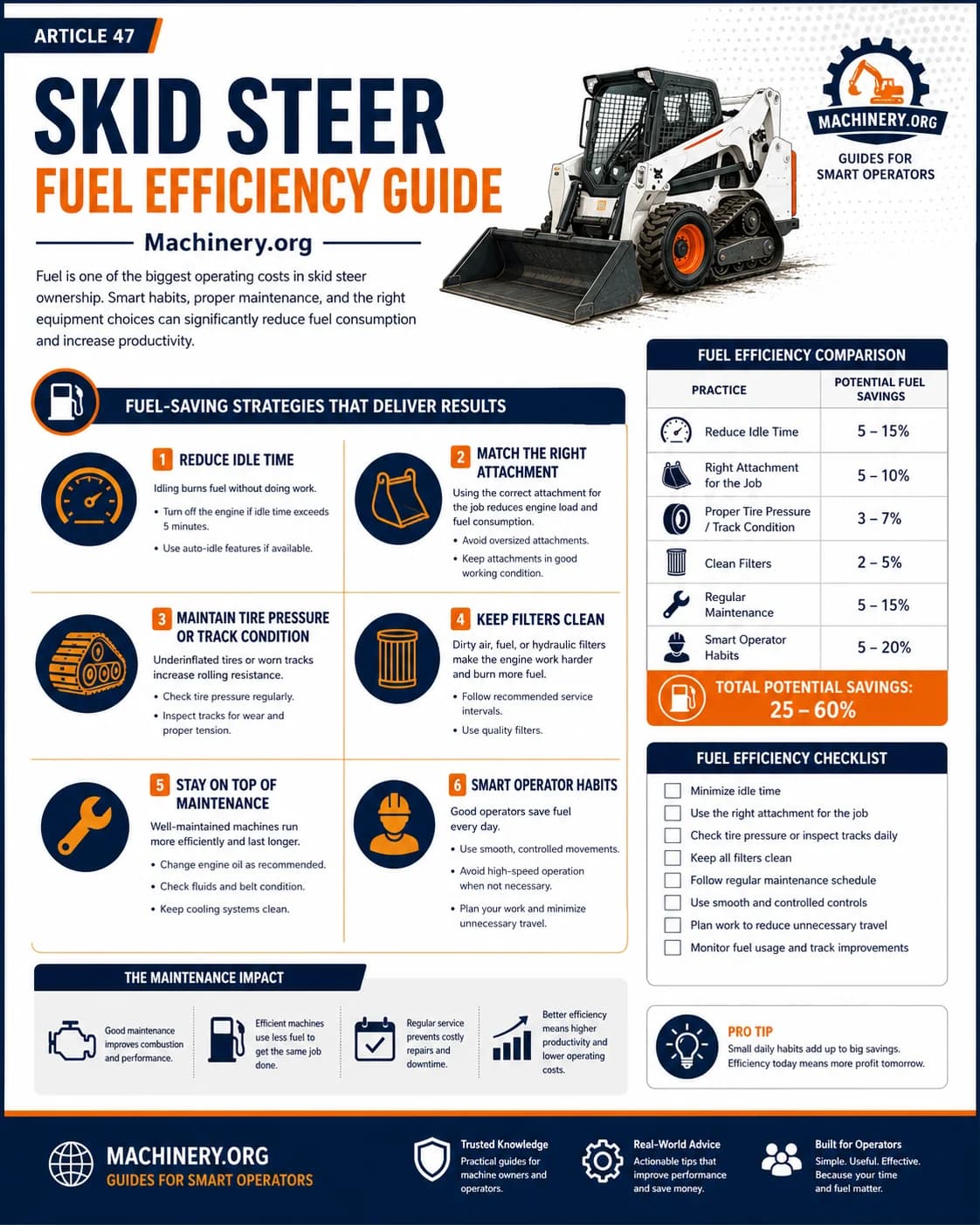
Figure 47.1. Machinery.org overview of fuel-saving strategies, daily checks, and operating habits that influence skid steer fuel consumption.
Start with the correct machine and attachment
Efficiency begins before the engine starts. A skid steer should be sized for its most common workload, lifting requirements, hydraulic attachments, and jobsite conditions. A machine that is too small may spend the day at high throttle, struggle through each cycle, and require more passes. A machine that is unnecessarily large may carry higher purchase, transport, and fuel costs without creating additional value. The objective is a balanced machine that performs its normal work with a reasonable power reserve.
Attachment matching is equally important. Oversized buckets, heavy grapples, high-demand cutters, and poorly matched hydraulic tools can force the engine and hydraulic system to work harder than necessary. The right attachment width, weight, hydraulic flow requirement, and material capacity improve cycle time and reduce wasted motion. Operators should confirm compatibility with the machine specification and attachment manual rather than assuming that any universal mounting plate means full performance compatibility.
Control idle time without creating new problems
Idling consumes fuel without producing useful work, but the solution is not to shut down the engine during every brief pause. Operators should follow the manufacturer’s guidance for warm-up, cool-down, turbocharger care, and regeneration systems. The practical goal is to avoid extended unnecessary idling while still protecting the engine. Auto-idle and automatic shutdown features can help when configured correctly.
Job planning reduces idling naturally. Materials, trucks, attachments, and crew instructions should be ready before the skid steer begins a work cycle. When an operator waits repeatedly for a truck to reposition, for another worker to clear an area, or for materials to arrive, fuel is being converted into heat and hours rather than productive output.
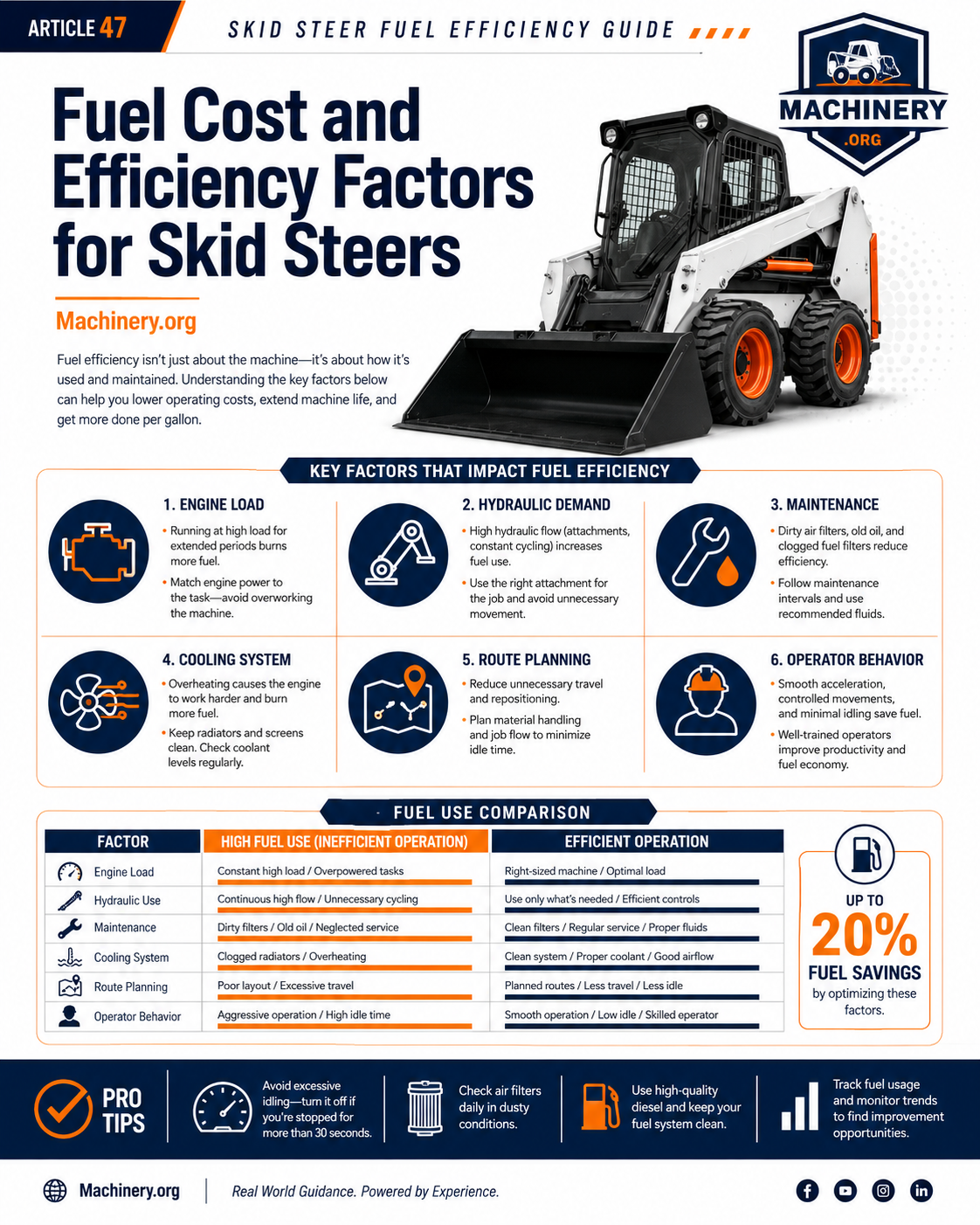
Figure 47.2. Factors that raise or lower skid steer fuel use, including engine load, hydraulic demand, cooling, route planning, and operator behavior.
Maintenance has a direct effect on fuel use
An engine cannot operate efficiently when air, fuel, lubrication, or cooling systems are restricted. Dirty air filters reduce airflow. Contaminated fuel filters can limit delivery and affect combustion. Incorrect oil or neglected oil changes increase friction and wear. Clogged radiators and coolers raise operating temperature, which may reduce performance and shorten component life. Tire pressure and track condition also matter because rolling resistance and undercarriage drag require additional engine power.
Preventive maintenance should follow the machine-specific operator and service manuals. Generic intervals are useful for planning, but dusty work, extreme temperatures, heavy hydraulic attachments, and long shifts may require more frequent inspections. A maintenance record helps owners compare fuel use with service events and recognize patterns such as rising consumption before a filter change or repeated overheating in a specific application.
Efficiency area
What to inspect
Why it matters
Air and fuel filters
Restriction indicator, contamination, service interval
Restricted flow can reduce performance and increase fuel use.
Cooling package
Radiator, oil cooler, screens, fan area
Clean airflow prevents overheating and protects full engine output.
Tires or tracks
Pressure, tension, wear, debris
Excess resistance wastes power and accelerates wear.
Hydraulics
Leaks, oil level, hose condition, attachment flow
Leaks and mismatched flow reduce useful work from engine power.
Operating records
Fuel added, hours, task completed
Tracking reveals trends and allows cost-per-job comparison.
Operator technique determines cycle efficiency
Smooth control input usually produces faster and more economical cycles than aggressive movement. Sudden starts, hard turns, unnecessary wheel spin, and repeated corrections consume fuel while increasing tire, track, and component wear. Skilled operators enter the pile correctly, fill the bucket efficiently, travel on a planned path, and position the machine so the lift and dump sequence requires minimal adjustment.
The operator should also use the lowest practical engine speed that completes the task productively. Some attachments require a specific throttle or hydraulic flow setting, so low engine speed is not always better. The goal is the correct setting for the work. Excess throttle that does not improve cycle time merely increases noise, heat, and fuel consumption.
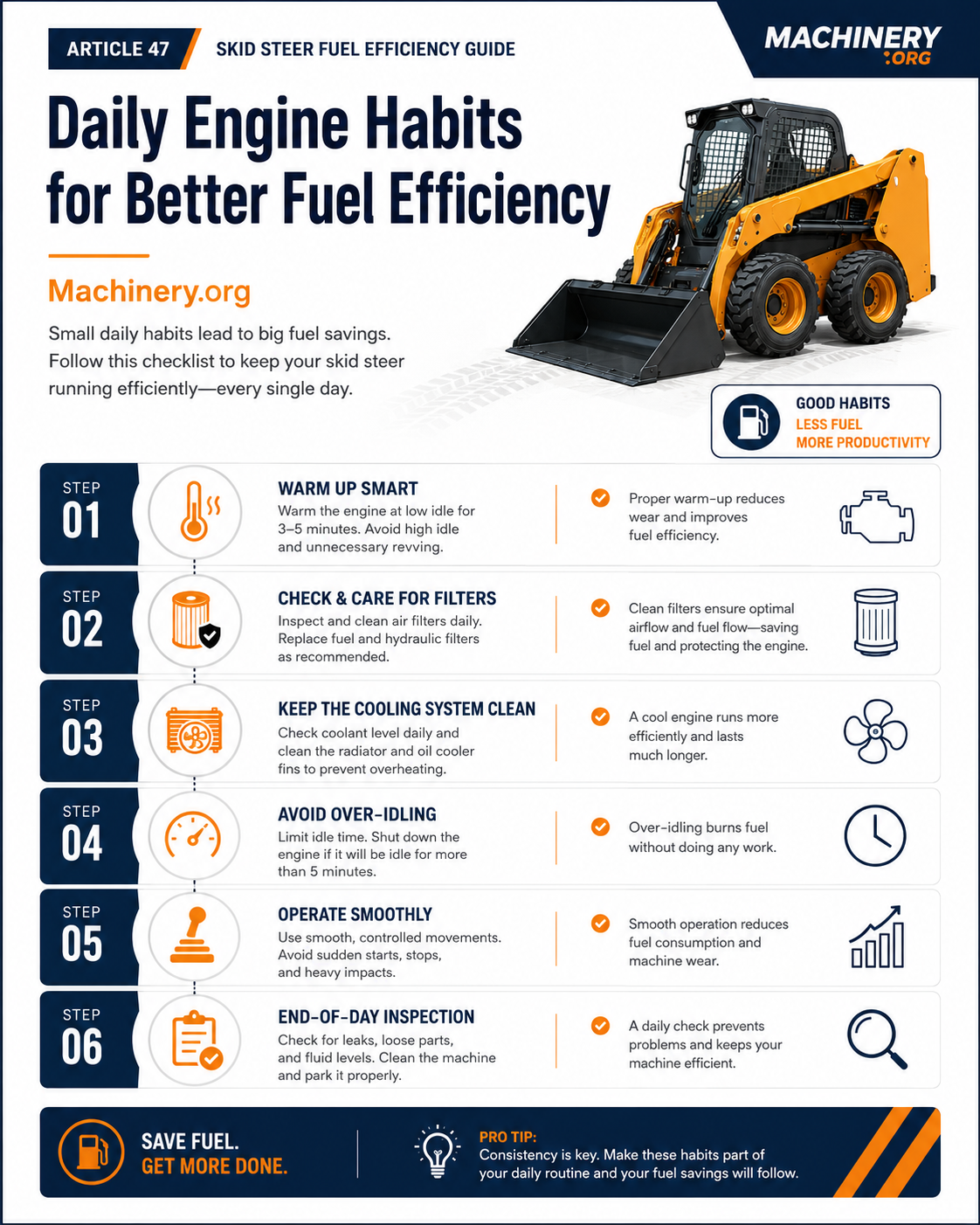
Figure 47.3. Daily engine and operating habits that support better fuel efficiency and reliable skid steer performance.
Plan the job, not only the machine
A well-organized site reduces travel distance, waiting, and repeated handling. Stockpiles should be positioned to support short cycles without creating unsafe traffic conflicts. Trucks should be staged where the skid steer can approach and dump without excessive reversing. Attachments should be stored securely but close enough to avoid long travel. Small improvements in layout can save more fuel than minor differences between similar machine models.
Owners should evaluate efficiency with a simple measure: fuel used per completed unit of work. That unit may be tons moved, pallets handled, acres cleared, stalls cleaned, or jobs completed. Hourly fuel use alone can be misleading because a highly productive machine may consume more per hour while completing the job in significantly fewer hours.
Fuel-efficiency checklist
Match the skid steer and attachment to the regular workload.
Limit unnecessary idle time while following warm-up and cool-down guidance.
Keep air, fuel, oil, hydraulic, and cooling systems properly maintained.
Maintain correct tire pressure or track tension and remove packed debris.
Use smooth controls, planned travel routes, and efficient loading positions.
Record operating hours, fuel added, task type, and unusual performance changes.
Investigate sudden increases in fuel consumption rather than treating them as normal.
Safety and accuracy: Never change engine, hydraulic, emissions, or idle settings outside the manufacturer’s approved procedures. Efficiency improvements must not reduce stability, visibility, safe travel speed, or required warm-up and cool-down practices.
Frequently Asked Questions
Does lower engine speed always save fuel?
No. The engine and hydraulic system must still operate in the correct range for the task and attachment. Too little power can lengthen cycles and increase total fuel used.
How should fuel efficiency be measured?
Track fuel per completed job or unit of work, not only fuel per hour. Include task type, material, attachment, and site conditions for a fair comparison.
Can poor track tension or tire pressure increase fuel consumption?
Yes. Incorrect pressure, excessive track tension, wear, and packed debris increase resistance and require more power to move the machine.
Why did fuel use increase suddenly?
Possible causes include filter restriction, hydraulic leaks, cooling problems, tire or track issues, attachment mismatch, heavier material, or a change in operator technique. Inspect the machine and work conditions.
Key Takeaway
Machinery.org takeaway: Fuel efficiency comes from correct equipment selection, disciplined maintenance, organized jobsites, and skilled operation. Measure useful work from each tank, investigate changes early, and never sacrifice safety or machine protection for a small fuel saving.
Get More Expert Guides & Updates
Subscribe for Machinery.org guide updates and product learning content.