
Tires are the primary interface between a wheeled skid steer and the ground. The choice of tire type affects traction, ride quality, puncture resistance, surface disturbance, and overall operating cost. Understanding the main categories and their ideal applications allows operators to optimize performance and minimize downtime.
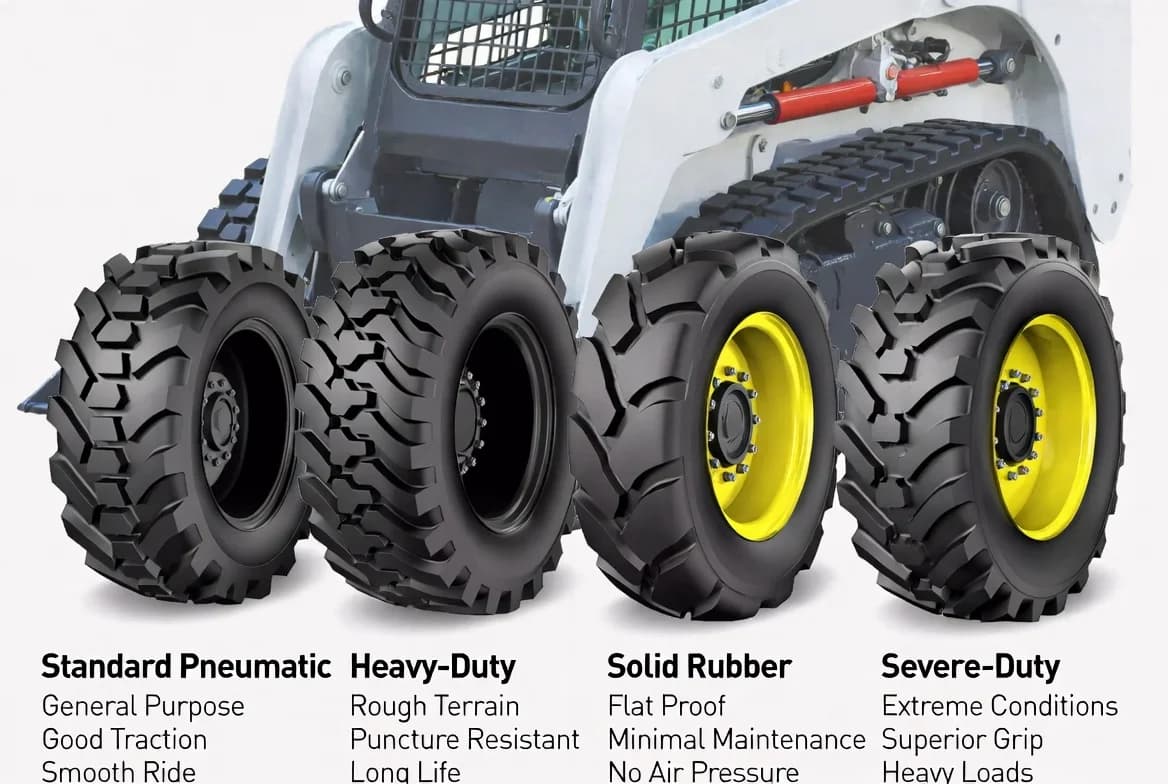
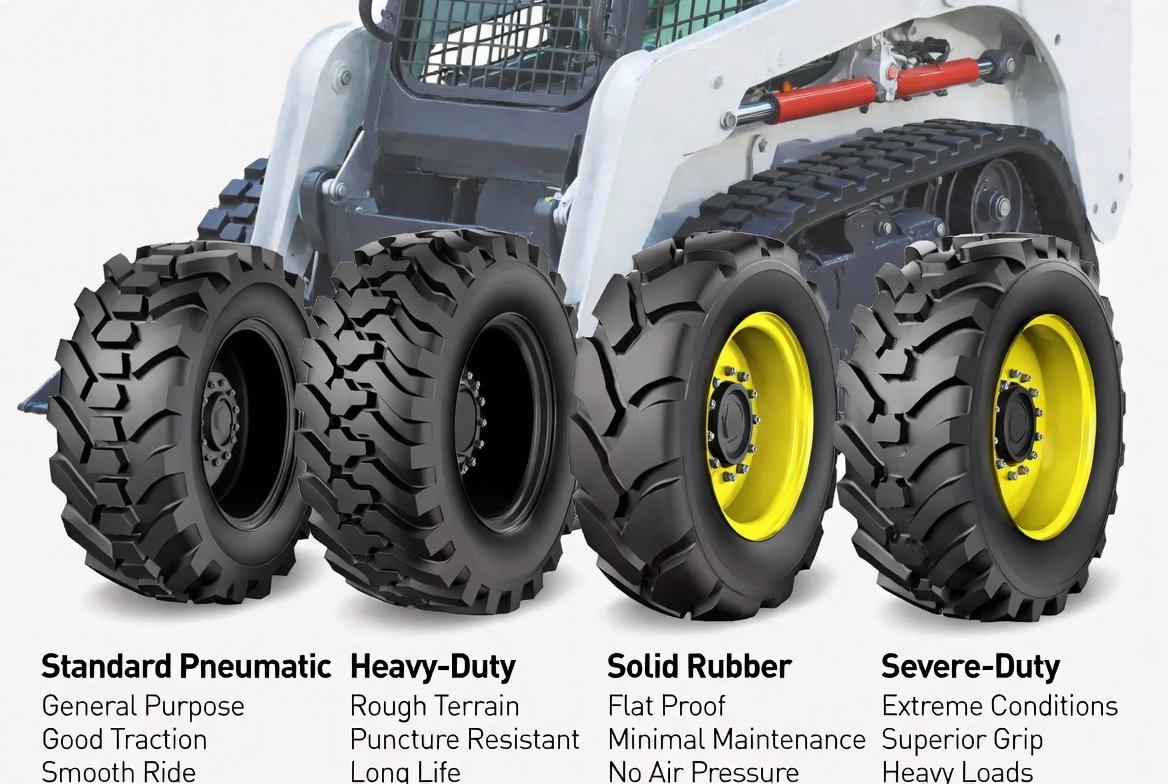
Standard pneumatic tires are air-filled and offer the smoothest ride and lowest rolling resistance on firm surfaces. They provide good flotation relative to solid tires and are the least expensive option. Their principal weakness is vulnerability to punctures from nails, rebar, sharp rocks, and demolition debris. In environments where punctures are frequent, the cost of repairs and downtime can quickly exceed the savings of pneumatic tires.
Heavy-duty or puncture-resistant pneumatic tires incorporate thicker sidewalls, reinforced treads, and sometimes internal liners or sealants. They retain much of the ride quality of standard pneumatics while offering improved resistance to common job-site hazards. They remain susceptible to large sidewall cuts and to the gradual loss of air pressure that can go unnoticed until the tire is seriously under-inflated.
Solid rubber tires eliminate the possibility of flats entirely. They are molded as a single piece of rubber or as a rubber compound bonded to a steel wheel. Solid tires excel in demolition, recycling, scrap yards, and any environment with extreme puncture risk. The trade-offs are a harsher ride, higher ground pressure, increased stress on axles and the operator, and typically higher purchase cost. Solid tires also generate more heat during high-speed travel and can be more difficult to mount and demount.
Foam-filled tires start as pneumatic tires that are injected with a polyurethane foam that cures into a solid core. They combine puncture-proof performance with a ride that is somewhat softer than true solid tires. Foam-filled tires are popular in mixed environments where flats are a concern but a completely solid tire would be too harsh. Once filled, the tire cannot be repaired by conventional means; when the outer rubber wears out, the entire unit is replaced.
Severe-duty or extra-deep-tread tires are designed for maximum traction and longevity in abrasive or soft conditions. They feature aggressive lug patterns and thick rubber compounds. They are commonly used in forestry, mining support, and heavy construction where traction and wear life take priority over ride comfort.
Selection Considerations
Evaluate the predominant surface, the frequency of sharp debris, the importance of ride quality, and the total cost of ownership including downtime. Many fleets keep a set of pneumatic tires for clean, hard-surface work and a set of solid or foam-filled tires for demolition or scrap work, changing them seasonally or by job type. Proper inflation pressure (for pneumatic and foam-filled tires) is critical; under-inflation accelerates wear and reduces stability, while over-inflation reduces flotation and traction.
In summary, tire selection is a balance among puncture risk, ride quality, traction, and cost. Matching the tire type to the work environment yields higher productivity, lower operating expense, and greater operator comfort.
Get More Expert Guides & Updates
Subscribe for Machinery.org guide updates and product learning content.