

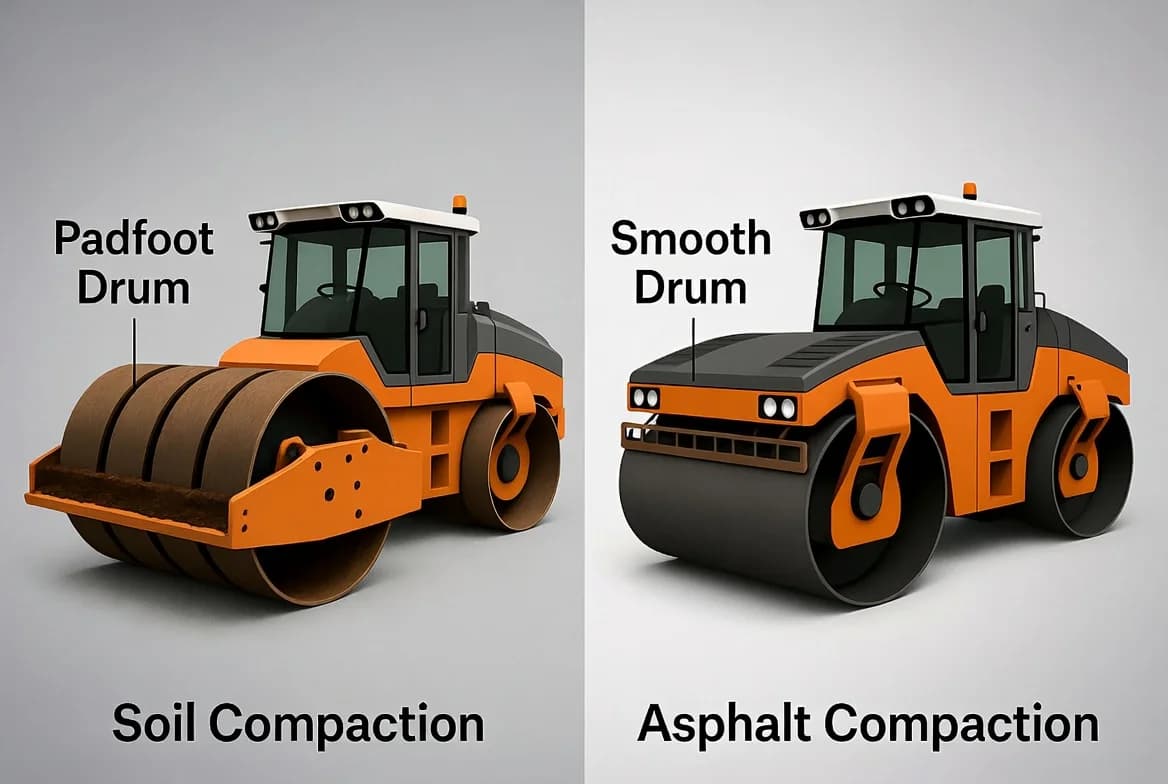

Although the fundamental goal of increasing density is the same, the materials, equipment, and techniques used for soil compaction differ significantly from those used for asphalt compaction. Treating the two processes as interchangeable leads to poor results and wasted effort. A clear understanding of the differences enables the correct selection of rollers, operating parameters, and quality-control methods.
Soil compaction deals with a wide range of particle sizes, plasticity characteristics, and moisture sensitivities. Cohesive soils (clays and silts) require kneading action and are often compacted with padfoot or sheepsfoot rollers that penetrate the lift and remould the material. Granular soils (sands and gravels) respond best to vibratory smooth-drum rollers that rearrange particles through vibration and static pressure. Moisture control is critical; the soil must be near optimum moisture content for the available compactive effort. Lift thickness is typically greater than for asphalt—often 150–300 mm—and density is verified by nuclear gauge or sand-cone testing against a laboratory Proctor maximum.
Asphalt compaction operates on a temperature-sensitive bituminous mixture. The mix must be compacted while it is still hot enough for the binder to allow particle movement—generally above 80–100 °C depending on the binder grade. Once the mix cools below a critical temperature, further rolling produces little additional density and can cause surface cracking. Breakdown rolling with a vibratory smooth-drum roller is performed immediately behind the paver; intermediate and finish rolling follow as the mat cools. Lift thickness is limited (typically 40–80 mm for dense-graded mixes) because heat is lost rapidly from thin layers and because the roller must achieve density before the mix stiffens.
Equipment differences are pronounced. Soil rollers frequently use padfoot drums, heavier operating weights, and higher centrifugal forces. Water-spray systems are less critical. Asphalt rollers use smooth drums, often with dual-drum drive, sophisticated vibration control, and well-maintained water-spray systems to prevent asphalt pickup. Pneumatic-tired rollers are widely used on asphalt for their kneading action and ability to seal the surface. Rolling patterns also differ: soil compaction often proceeds in systematic lanes across a large fill, while asphalt compaction follows the paver closely with coordinated breakdown, intermediate, and finish rollers. In summary, soil compaction emphasises moisture control and appropriate drum type; asphalt compaction emphasises temperature management and rapid coverage. Matching equipment and technique to the material is essential.
Get More Expert Guides & Updates
Subscribe for Machinery.org guide updates and product learning content.