

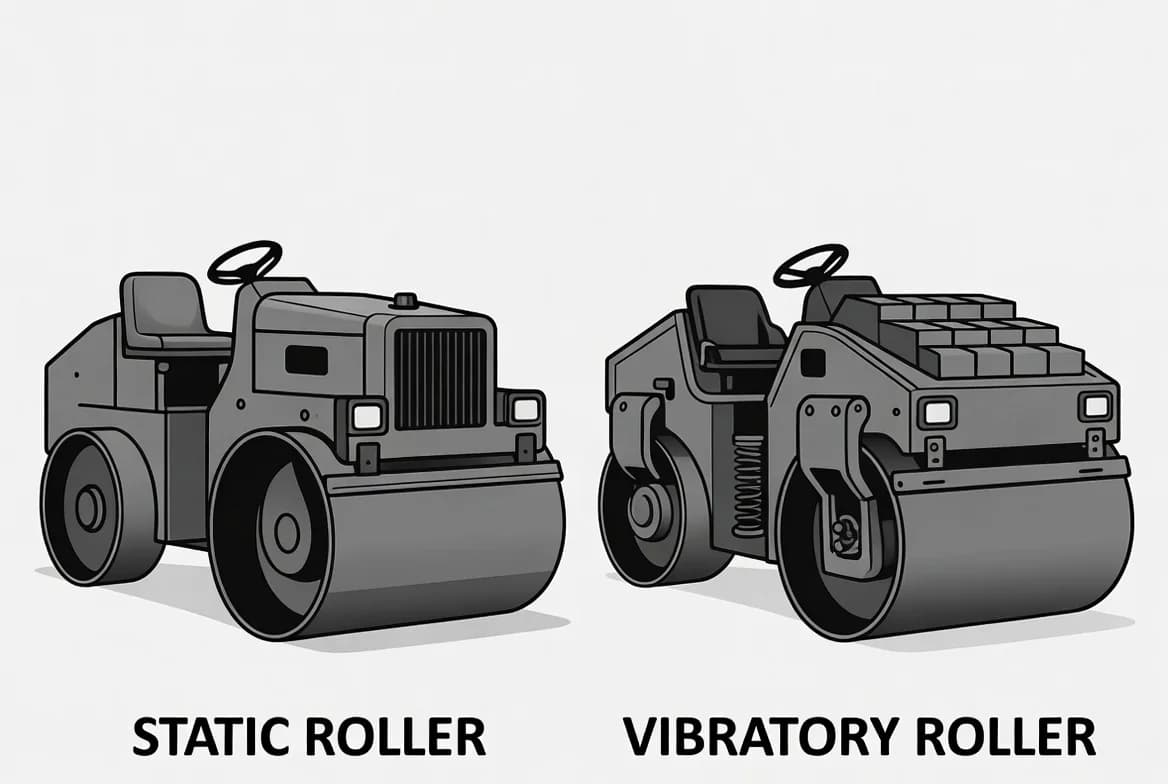

The choice between static and vibratory rollers is one of the most consequential decisions in a compaction plan. Static rollers apply only the gravitational weight of the machine; vibratory rollers superimpose high-frequency oscillation on that static load. Each method has distinct advantages, limitations, and preferred applications. Understanding the differences enables the correct selection for every stage of the work.
Static rollers have been the traditional workhorses of compaction. Their mechanical simplicity means fewer wearing parts, lower maintenance cost, and reliable performance across a wide range of conditions. Because they generate no dynamic forces, they are less likely to damage nearby structures, underground utilities, or freshly placed concrete. Static rollers remain the preferred choice for final finishing passes on asphalt, where vibration can sometimes over-compact the surface or produce a flushed, shiny appearance if the mix temperature is still high. They are also useful on certain cohesive soils that respond better to sustained pressure than to vibration.
Vibratory rollers have become the dominant technology for primary compaction of both soil and asphalt because they achieve higher densities in fewer passes and can handle thicker lifts. The vibration reduces inter-particle friction, allowing particles to rearrange more easily under the static load. In granular soils and crushed-stone base courses the improvement in efficiency is dramatic. In asphalt paving, vibratory breakdown rolling is the standard method for achieving the required density while the mix is still hot. Modern vibratory systems allow the operator to select amplitude and, on many machines, frequency, so that the energy can be matched to the material and the lift thickness.
Inside a vibratory drum, eccentric weights rotate at high speed. The centrifugal force they generate oscillates the drum. Amplitude is controlled by the size or position of the eccentric mass; frequency is controlled by the rotational speed of the drive motor. High amplitude is used for thick lifts and coarse materials; low amplitude is used for thin lifts and finishing. Isolation mounts between the drum and the frame protect the operator and the machine structure from the high-frequency energy. Worn isolators transmit excessive vibration into the chassis and must be replaced promptly.
Operators must recognise that vibration is not universally beneficial. On thin asphalt lifts, excessive vibration can cause the drum to bounce, producing a washboard surface. On very soft or saturated soils, vibration can pump water to the surface and create an unstable layer. In these situations the vibration should be switched off and static rolling used instead. Many projects therefore employ both types of roller: vibratory machines for breakdown and intermediate compaction, followed by static machines for finish rolling and surface sealing.
In summary, static rollers provide controlled, low-impact compaction and excellent finishing capability; vibratory rollers deliver high-energy densification for production work. Matching the roller type to the material, the lift thickness, and the stage of compaction produces the best combination of density, surface quality, and productivity.
Get More Expert Guides & Updates
Subscribe for Machinery.org guide updates and product learning content.