

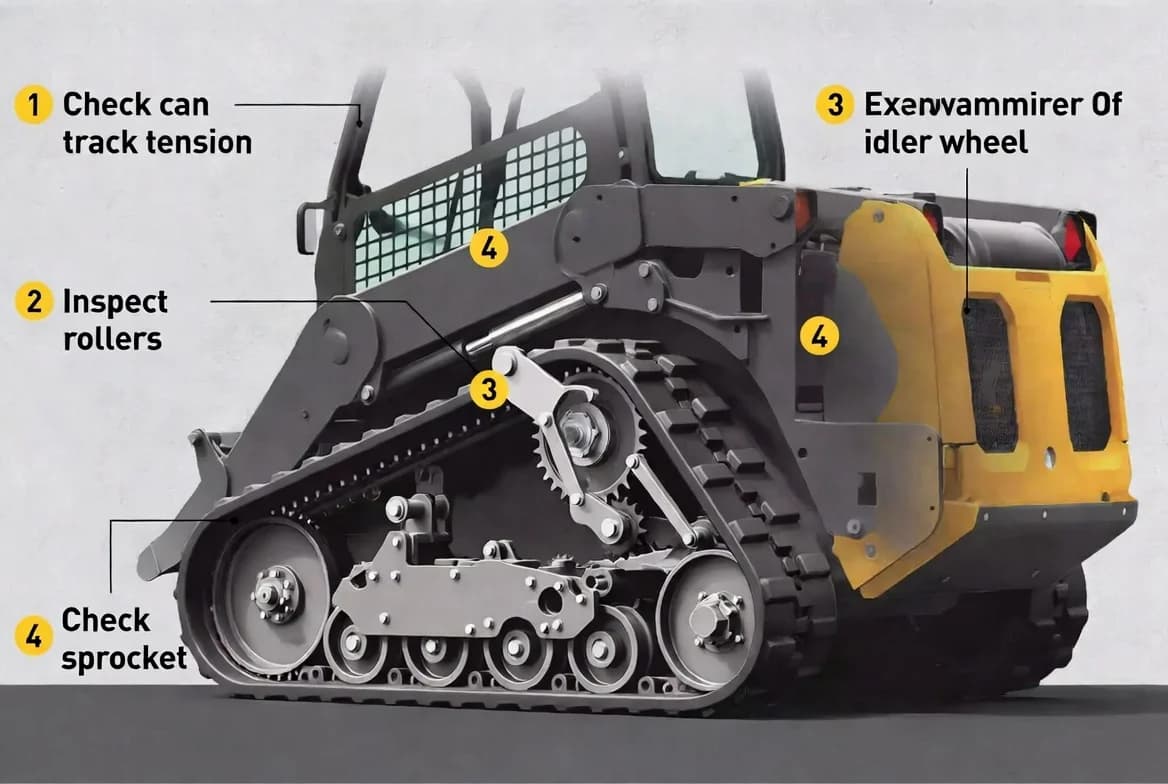

Rubber tracks on compact track loaders are a significant operating expense. Proper daily and periodic maintenance can easily double or triple track life, while neglect leads to premature failure and costly undercarriage repairs. A disciplined track-care program is one of the highest-return maintenance practices available to CTL owners.
Track tension is the single most important adjustable parameter. Tracks that are too tight accelerate wear on the track itself, the rollers, the idlers, and the drive sprockets, and they increase rolling resistance and fuel consumption. Tracks that are too loose can de-track, especially during turns or on side slopes, and they allow the track to slap against the undercarriage components. Manufacturers specify a precise sag measurement—usually taken at a designated point between the front idler and the first roller—with the machine on firm level ground. Tension should be checked daily or after the first few hours of operation with new tracks, because new tracks seat and stretch.
Daily visual inspection should include looking for cuts, embedded stones, missing or damaged track guides, and uneven wear patterns. Stones lodged between the track and the rollers or idlers must be removed promptly; they act as grinding media and can destroy both the track and the rollers in a short time. After working in mud, clay, or corrosive materials, tracks and undercarriage components should be cleaned so that abrasive material does not continue to grind during subsequent operation.
Rollers, Idlers, and Sprockets
Track rollers (bottom rollers) support the machine’s weight and must turn freely. Seized or worn rollers create flat spots on the track and accelerate wear. Idlers guide the track and maintain alignment; worn idler bearings or damaged idler faces cause tracking problems and edge wear. Drive sprockets engage the track lugs; worn or “hooked” sprocket teeth accelerate track wear and can eventually cause the track to jump. All of these components have measurable wear limits published by the manufacturer; replacing them before they exceed limits protects the more expensive track.
Alignment of the undercarriage is critical. Misalignment causes the track to run to one side, producing rapid edge wear and possible de-tracking. Alignment should be checked whenever rollers or idlers are replaced and whenever unusual wear patterns appear.
Operating Practices That Extend Track Life
Avoid high-speed travel on abrasive surfaces such as asphalt or concrete whenever possible. Make wide turns rather than sharp spin turns when practical. Minimize operation on slopes that force the tracks to work against side loads. When loading or unloading on a trailer, ensure the ramps and trailer deck are clean and free of debris that could damage the tracks. Finally, never operate with a track that has significant cuts or missing sections; the risk of complete failure and secondary damage is high.
In summary, systematic attention to track tension, daily cleaning and inspection, timely replacement of undercarriage components, and sensible operating habits dramatically extend track life and reduce the total cost of owning a compact track loader.
Get More Expert Guides & Updates
Subscribe for Machinery.org guide updates and product learning content.