

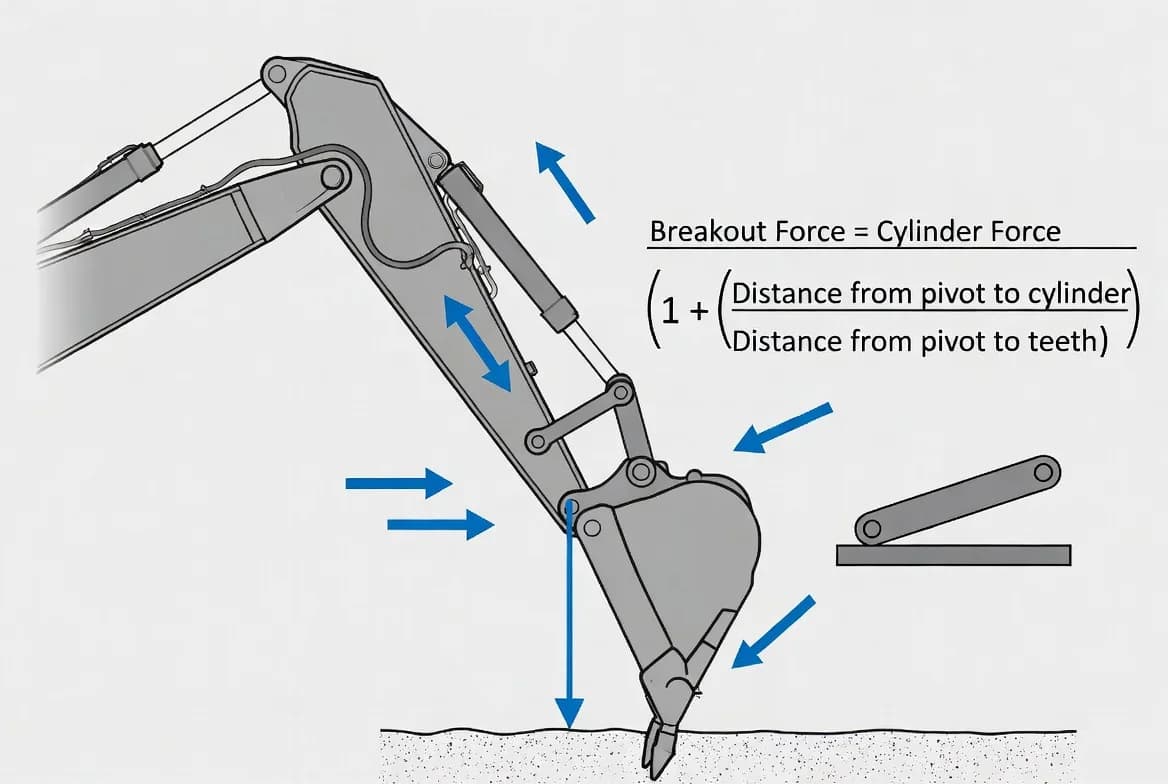

Bucket breakout force is a fundamental performance metric that describes the maximum force the excavator can apply at the bucket teeth to penetrate and lift material. It is one of the primary indicators of a machine’s ability to dig in hard or compacted ground. Understanding how breakout force is generated, how it is measured, and how it interacts with other machine parameters allows operators and equipment selectors to match the excavator to the material and to the required productivity.
Definition and Measurement
Breakout force is the force available at the cutting edge or teeth of the bucket when the bucket cylinder is fully pressurised and the linkage is in the position that produces maximum mechanical advantage. It is expressed in kilonewtons (kN) or pounds-force (lbf). Manufacturers measure breakout force according to standardised procedures (often based on ISO or SAE standards) with the machine on firm level ground and the boom and stick positioned so that the force is applied vertically or at a specified angle.
There are actually two related forces: bucket breakout force (generated by the bucket cylinder) and arm (or stick) crowd force (generated by the stick cylinder). Both are important. Breakout force is most critical when the bucket is curling to penetrate the ground; crowd force is most critical when the stick is pulling the bucket toward the machine through the material.
How Breakout Force Is Generated
The hydraulic cylinder produces a linear force equal to the system pressure multiplied by the effective piston area. This force is then multiplied by the mechanical advantage of the linkage. The geometry of the bucket linkage (the relative lengths of the levers formed by the bucket, the link, and the power link) determines the ratio between cylinder force and force at the teeth. As the bucket curls, the mechanical advantage changes; the maximum breakout force occurs at a specific angular position.
Because the mechanical advantage varies with bucket angle, the force available at the teeth is not constant throughout the curl cycle. Operators learn by experience the angular range in which the machine develops its highest digging force and try to keep the bucket within that range when penetrating hard material.
Factors Affecting Available Breakout Force
System hydraulic pressure is the most direct influence. Higher pressure produces higher cylinder force and therefore higher breakout force, provided the structural components can withstand the load. Modern excavators typically operate at 250–350 bar (approximately 3,600–5,000 psi) in the main circuits.
Cylinder diameter (bore) also matters. A larger-bore cylinder produces more force at the same pressure but requires greater oil volume to move, which can slow the cycle if pump flow is limited.
Linkage geometry is fixed for a given machine and stick/bucket combination, but changing to a different stick length or a different bucket can alter the effective lever arms and therefore the force at the teeth.
Finally, the condition of the cutting edge and teeth has a dramatic effect on the ability to utilise the available force. Worn, rounded teeth or a dull cutting edge increase the contact area and the force required to penetrate, effectively reducing the useful breakout capability of the machine.
Breakout Force Versus Digging Conditions
In soft material such as topsoil or loose sand, almost any modern excavator has more than enough breakout force. The limiting factor becomes bucket fill factor and cycle time. In medium-hard clay or compacted fill, breakout force becomes more important; a machine with higher force will dig with less effort and less wear on the teeth. In hardpan, frozen ground, or fractured rock, breakout force is critical. Machines with insufficient force will bounce, spin tracks, or simply fail to penetrate, leading to low productivity and high operator frustration.
When the material is too hard for the available breakout force, the correct solution is usually not to force the machine but to change the method—using a hydraulic breaker to fracture the material first, selecting a narrower or more aggressive bucket, or employing a larger machine with higher force ratings.
Practical Implications for Machine Selection
When comparing excavators, look at both the published breakout force and the crowd force. Also examine the hydraulic system pressure and pump flow, because these determine how quickly the force can be developed and how well the machine can sustain digging in tough conditions. A machine with high force but low flow may dig powerfully but slowly; a machine with moderate force and high flow may achieve higher overall production in mixed conditions.
Attachment choice also interacts with breakout force. A heavy rock bucket or a bucket with large teeth increases the penetration force concentration but also increases the structural load on the linkage. Using a tiltrotator or other intermediate coupler can slightly reduce the effective force at the teeth because of the added distance and weight.
In summary, bucket breakout force is a key indicator of an excavator’s ability to dig hard material. It is generated by the combination of hydraulic pressure, cylinder size, and linkage geometry, and it is utilised most effectively when the cutting edge is sharp and the operator keeps the bucket within the optimal angular range. Matching the available breakout force to the expected ground conditions is essential for productive and economical excavation.
Get More Expert Guides & Updates
Subscribe for Machinery.org guide updates and product learning content.