

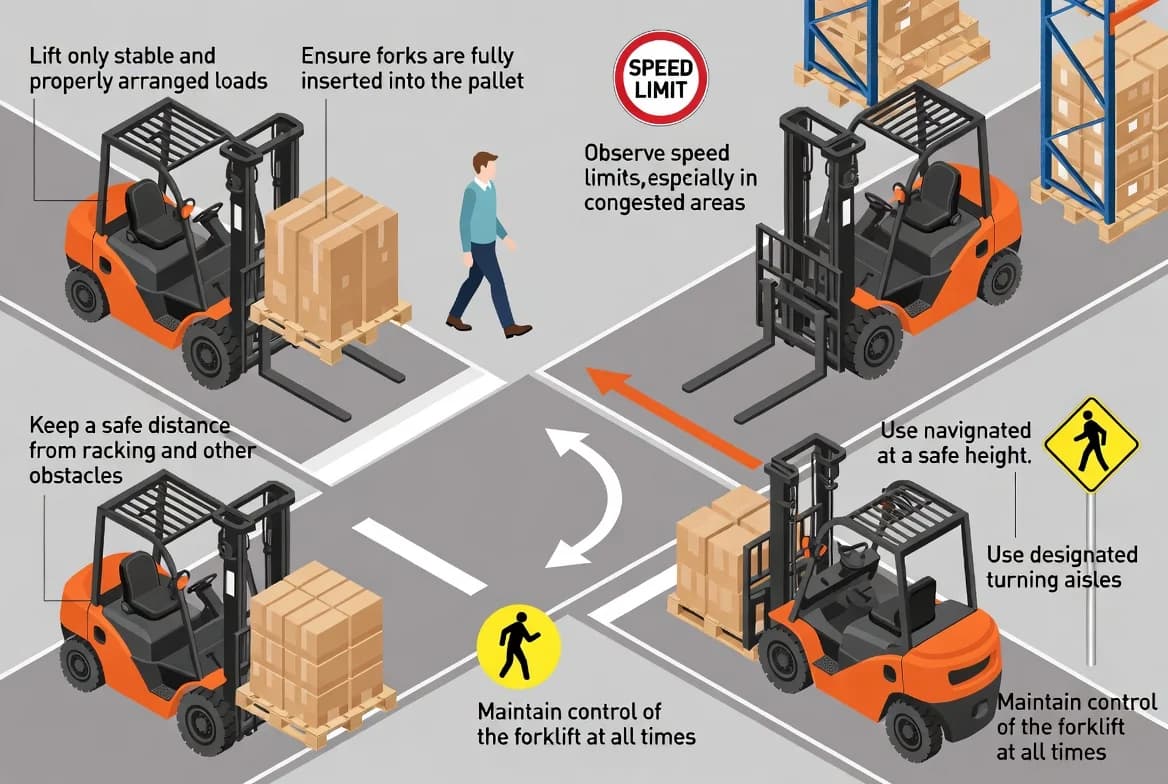

Warehouses concentrate forklift traffic, pedestrians, racking, and high-value inventory in a limited space. Effective safety management combines equipment condition, operator training, traffic rules, and facility design.
Operators must be trained and evaluated according to applicable regulations (OSHA in the United States, or equivalent national standards elsewhere). Training covers truck operation, load handling, stability, pedestrian awareness, and site-specific rules. Refresher training and evaluation are required after incidents, near-misses, or observed unsafe behavior, and at regular intervals.
Traffic management includes designated travel aisles, one-way systems where practical, speed limits (often 5–8 mph / 8–13 km/h in congested areas), stop signs or yield points at intersections, and physical separation of pedestrian walkways from vehicle routes wherever possible. Mirrors, convex mirrors at blind corners, and adequate lighting reduce collision risk.
Load stability is fundamental. Loads must be fully engaged on the forks, tilted back against the carriage for travel, and carried at a safe height (usually just high enough to clear the floor and any obstacles). Traveling with an elevated load raises the center of gravity and increases tip-over risk. Operators must sound the horn at intersections and when approaching pedestrians.
Racking must be inspected regularly for damage; any impact that bends or displaces uprights or beams requires immediate assessment and possible unloading of the affected bay. Floor condition—cracks, debris, oil, or ice—must be controlled because it directly affects traction and stability.
Personal protective equipment for operators typically includes safety shoes and high-visibility clothing; in some facilities hard hats or other PPE are required. Seat belts (or restraint systems) must be worn on trucks that are equipped with them. Dismounting procedures—parking brake on, forks lowered, controls neutralized—prevent uncontrolled movement.
A robust safety culture encourages reporting of near-misses, enforces rules consistently, and treats forklift operation as a professional skill rather than an incidental task. When these elements are in place, warehouses can achieve very low incident rates even with high traffic volumes.
Get More Expert Guides & Updates
Subscribe for Machinery.org guide updates and product learning content.