
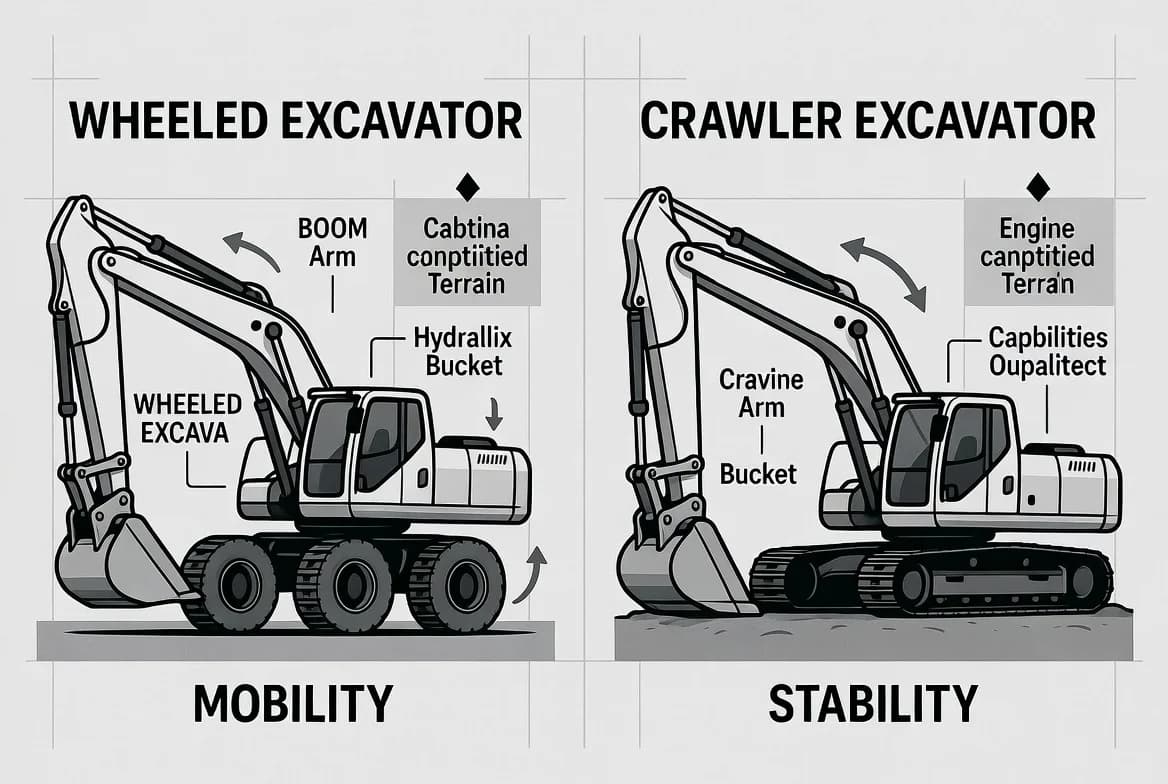
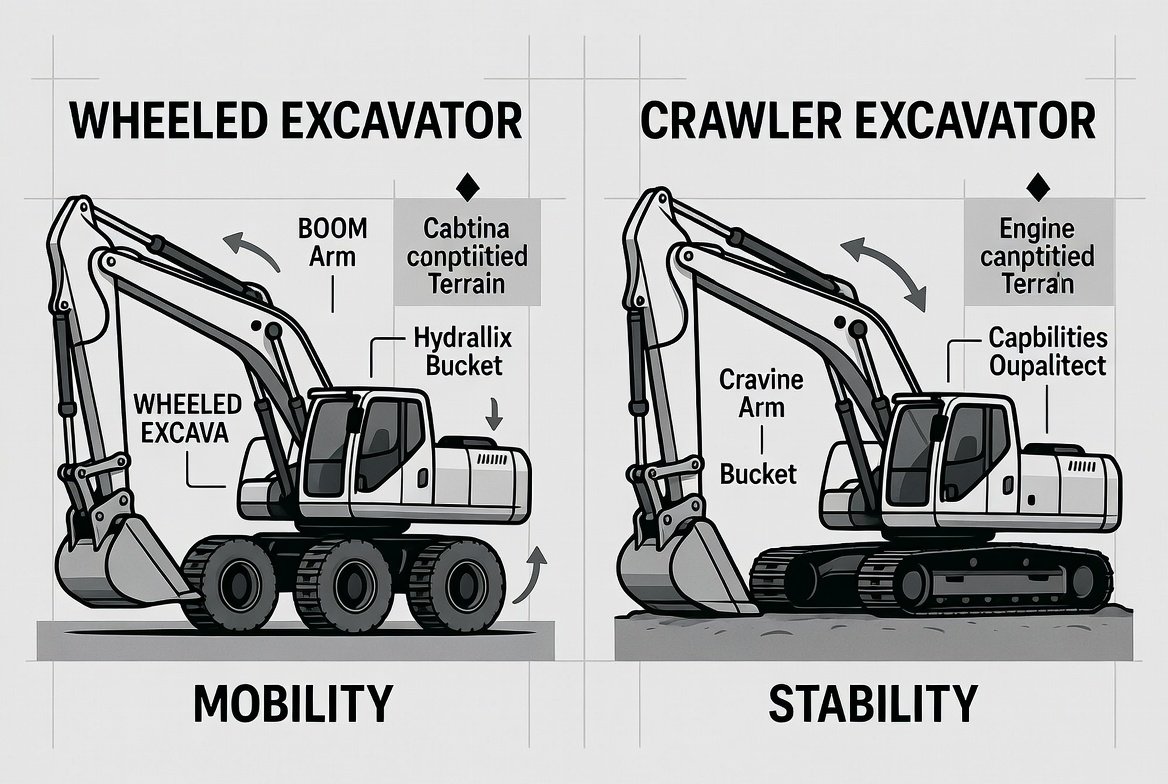
Crawler (tracked) excavators and wheeled excavators serve overlapping but distinct roles. Crawler excavators deliver low ground pressure (typically 4–6 psi), excellent stability and high traction on soft, uneven or sloping ground. Travel speed is low (3–6 km/h), so inter-site movement normally requires a low-bed trailer. Undercarriage maintenance forms a large portion of lifetime cost. Wheeled excavators travel at 25–40 km/h on roads, allowing self-deployment between urban or highway jobs. Ground pressure is higher (30–50 psi), so they are best suited to firm, prepared surfaces. Outriggers are deployed for heavy digging or lifting to restore stability. Maintenance is generally lower because tires replace the complex track system. Productivity on multi-site urban work can be higher because of reduced transport time, while pure digging productivity on soft ground favours the crawler. Selection therefore hinges on terrain, frequency of site moves, and whether road-legal self-transport is valuable.
When comparing specific models, always consult the current manufacturer specification sheets and load charts for the exact configuration under consideration. Published typical ranges above are drawn from industry sources current as of 2025–2026 and are intended for orientation; individual model performance can vary with options, undercarriage, and attachment configuration. A structured decision matrix that weights the factors most important to the intended application—terrain, duty cycle, transport, residual value, and operator preference—produces the most reliable selection.
Total cost of ownership remains the ultimate measure. Capital cost, fuel or energy, maintenance, transport, residual value and downtime must all be quantified over the planned ownership period. Side-by-side demonstration on the actual job site, when possible, remains the most conclusive validation of which machine will deliver the higher productivity and lower risk for a given contractor or fleet.
Get More Expert Guides & Updates
Subscribe for Machinery.org guide updates and product learning content.