
One of the most important design distinctions among modern excavators is the difference between conventional (or traditional) tail-swing machines and zero-tail-swing (or reduced-tail-swing) machines. This distinction has a profound effect on the machine’s suitability for confined spaces, urban work, and operations close to existing structures or live traffic. Understanding the geometry, advantages, and trade-offs of each design allows contractors to select the most appropriate machine for their typical work environment.
Conventional Tail-Swing Design
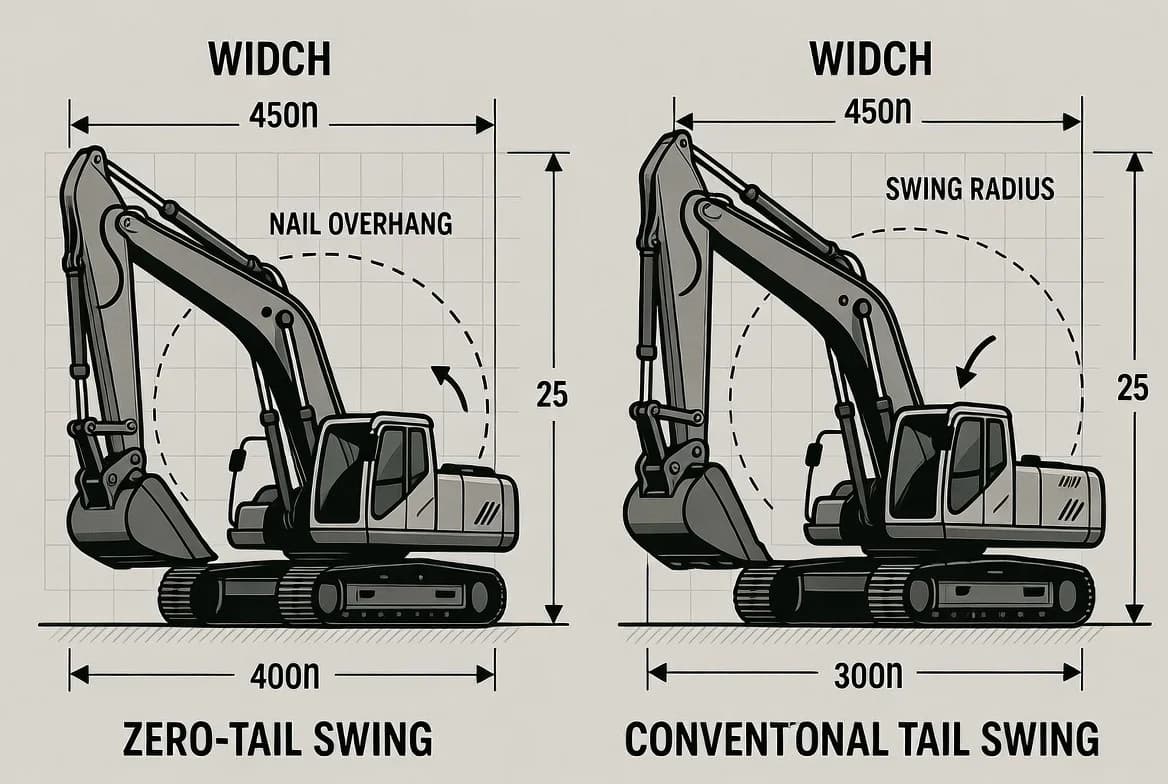
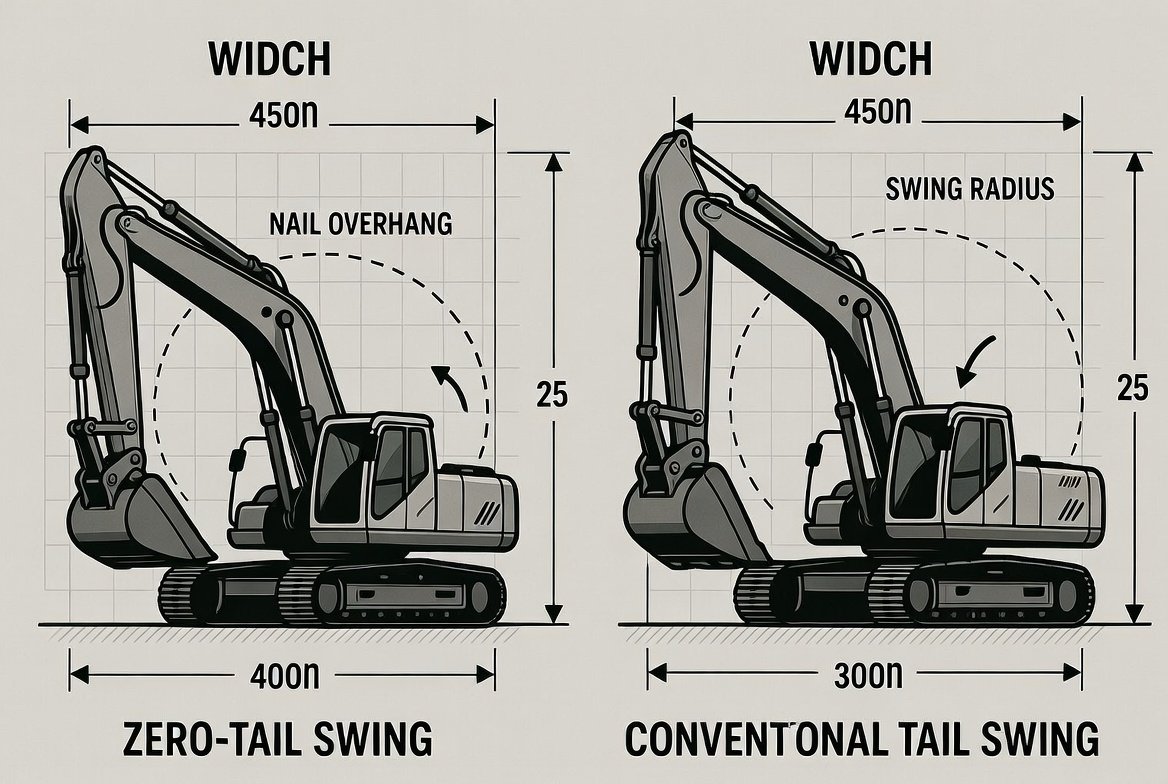
In a conventional excavator the upper structure (house) is mounted on a swing bearing, and a substantial counterweight extends rearward beyond the tracks. When the machine rotates, this counterweight swings through a radius that is significantly larger than the track width. The advantage of this design is that the counterweight can be made large and heavy, providing excellent stability when lifting or digging at maximum reach. The engine, hydraulic pumps, and cooling systems also have more space in which to be arranged, which can simplify maintenance access and allow for larger components.
The disadvantage is obvious: the swinging counterweight requires a large clear area around the machine. Working close to a building, a retaining wall, a trench edge, or a roadway becomes either impossible or highly risky. Operators must constantly monitor the rear of the machine, and many job sites simply cannot accommodate a conventional tail-swing excavator.
Zero-Tail-Swing Design
Zero-tail-swing excavators are engineered so that the rear of the upper structure stays within (or very nearly within) the width of the tracks throughout a full 360-degree rotation. This is achieved by carefully shaping the counterweight, relocating components, and often using a more compact engine and cooling package. The result is a machine that can work with its tracks parallel to a wall and still rotate fully without striking the wall.
True zero-tail-swing machines keep the entire upper structure inside the track width. Some manufacturers offer “minimal-tail-swing” or “reduced-tail-swing” designs in which a small portion of the counterweight still overhangs, but the overhang is far less than on a conventional machine. These intermediate designs offer a compromise between stability and compactness.
Advantages of Zero-Tail Swing
The primary advantage is the ability to work in confined spaces. Residential backyards, urban street work, interior demolition, and operations alongside live traffic lanes all become safer and more practical. Productivity often increases because the operator spends less time repositioning the machine to avoid striking obstacles. Safety is improved because the risk of the counterweight hitting a person, vehicle, or structure is greatly reduced.
Visibility can also be better on some zero-tail-swing models because the upper structure is more compact and the operator’s view of the rear is less obstructed. Many zero-tail-swing machines are also designed with excellent forward and side visibility to compensate for the fact that the operator may be working in tighter quarters.
Trade-offs and Limitations
The most significant trade-off is reduced lifting capacity and stability at maximum reach, especially over the side. Because the counterweight is smaller or more tightly packaged, the machine has less moment resistance when the boom is extended. Manufacturers compensate with careful weight distribution, wider track gauges on some models, and electronic stability systems, but the fundamental physics remain: a more compact rear means less counterbalancing mass.
Another consideration is serviceability. The more compact packaging of the engine and hydraulic components can make certain maintenance tasks more time-consuming. Cooling capacity can also be more of a challenge in hot climates or when running high-flow attachments for extended periods, although modern designs have largely overcome earlier limitations.
Purchase price for a zero-tail-swing machine is often higher than for a conventional machine of similar operating weight, reflecting the additional engineering required. However, the productivity gains on confined sites frequently offset the higher acquisition cost.
Choosing Between the Two Designs
If the majority of the work will be performed on open sites with ample clearance—large commercial developments, highway projects, or quarry work—a conventional tail-swing machine is usually the more economical and higher-capacity choice. If a significant portion of the work involves residential properties, urban streets, or any environment with limited clearance, a zero-tail-swing or minimal-tail-swing machine is almost always the better investment.
Many contractors who perform a mix of work keep both types in their fleet, or they choose a zero-tail-swing machine as the primary unit because of its greater versatility. When evaluating specific models, compare not only the tail-swing classification but also the actual measured swing radius, the over-side lifting capacity charts, and operator feedback on visibility and service access.
In conclusion, the choice between zero-tail swing and conventional tail swing is fundamentally a choice about the working environment. Zero-tail-swing designs have revolutionised the ability of excavators to operate safely and productively in confined spaces, while conventional designs continue to excel where maximum stability and capacity are the priorities. Understanding the geometry and the resulting performance trade-offs enables an informed decision that matches the machine to the job.
Get More Expert Guides & Updates
Subscribe for Machinery.org guide updates and product learning content.