
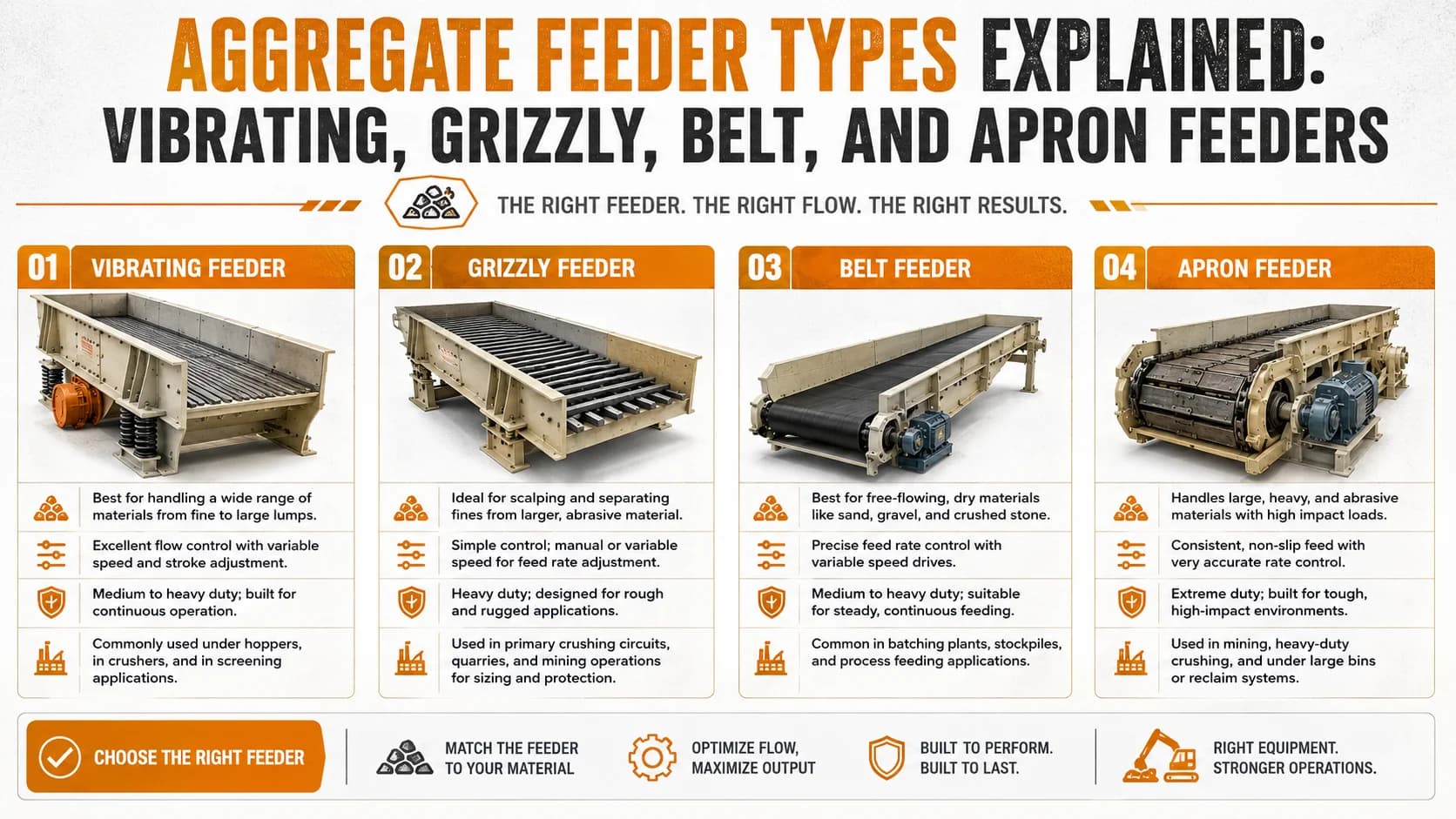
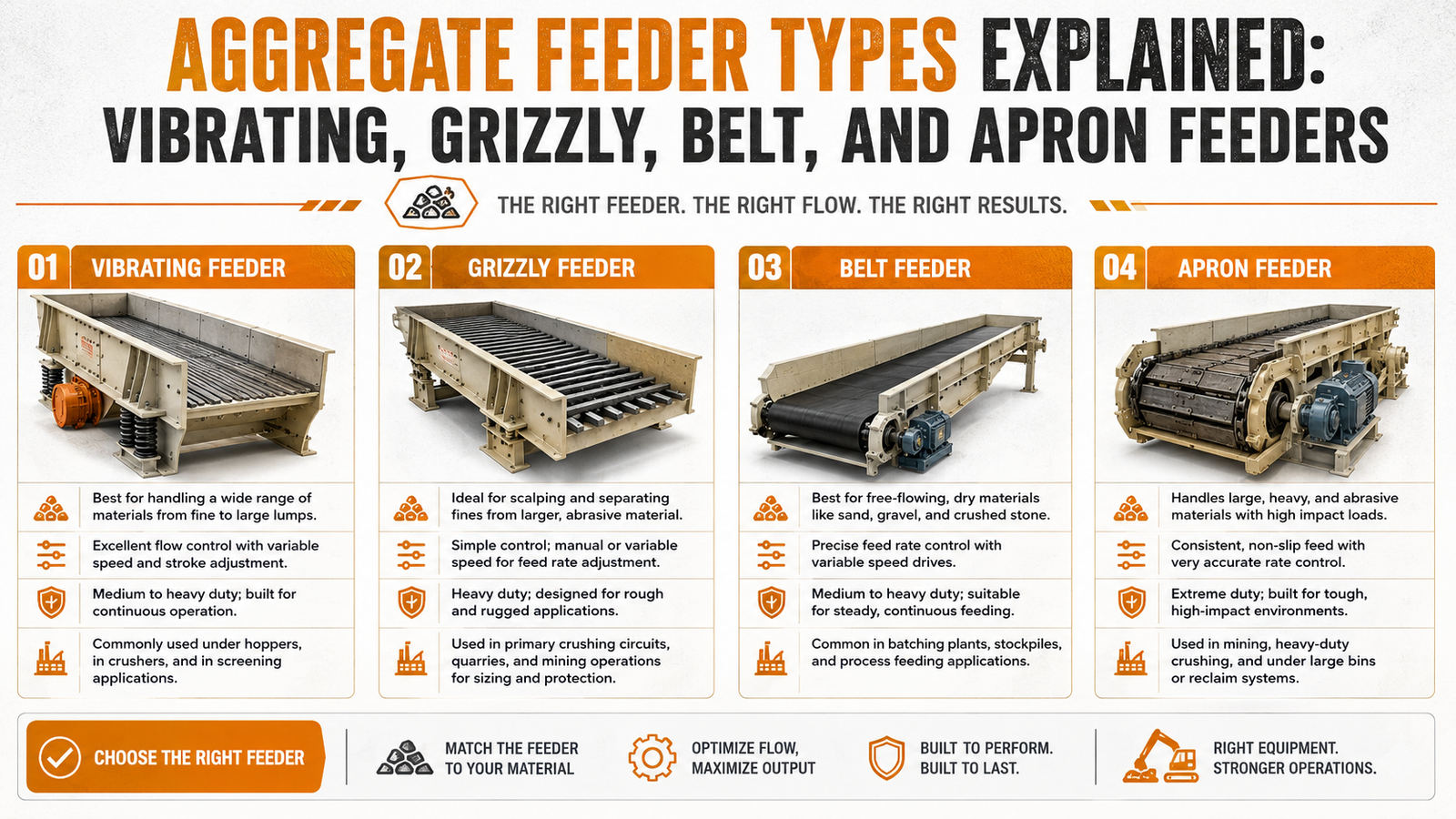
Feeders regulate how raw or processed material enters a crusher, screen, conveyor, or washing circuit. Their job is not simply to move rock. A feeder absorbs the irregular loading created by trucks, loaders, hoppers, and excavators and turns it into a more controlled flow for downstream equipment. Some feeder types also remove fines or withstand severe impact. Selecting the wrong feeder can cause crusher starvation, overload, bridging, rapid wear, and unstable plant production. This guide compares vibrating, grizzly, belt, and apron feeders and explains how to match them to material and duty.
1. Why Feeders Matter in Aggregate Plants
Truck and loader dumps create irregular surges while crushers and screens perform best with controlled loading. This is an important part of aggregate feeder types explained: vibrating, grizzly, belt, and apron feeders because the setting, component, or process does not operate in isolation. It changes the load seen by the next machine, the condition of the material, and the amount of useful product that can be produced. A feeder meters material so the downstream machine can operate near a stable target. Operators therefore need to understand both the mechanical function and the process consequence before they make adjustments.
From a process standpoint, The feeder must accept the largest credible lump and survive the loading impact. The practical result should be checked with measurements rather than appearance alone. Useful observations can include feed rate, product gradation, machine power or pressure, vibration, temperature, wear condition, recirculating load, moisture, and downtime, depending on the equipment involved. Its capacity must include short-duration peaks rather than only average hourly tonnage. When these observations are recorded consistently, normal variation becomes easier to separate from a developing fault.
In day-to-day operation, stability is usually more valuable than a short peak in output. A machine that alternates between starvation and overload may briefly show high production, yet it normally creates more wear, more product variation, and more operator intervention. The hopper and feeder should be designed together because poor hopper flow can starve even an oversized feeder. The best operating point is the one that can be repeated safely for the expected feed and product requirement, with enough reserve for normal changes in material condition.
For troubleshooting, make one controlled change at a time whenever production conditions allow. First document the symptom and current setup, then inspect the simplest causes before changing a major setting or replacing a component. Check the equipment immediately upstream and downstream as well, because many apparent machine problems are actually caused by unstable feeding, restricted discharge, poor separation, blocked chutes, incorrect line routing, or insufficient surge capacity. After a change, compare the result under similar operating conditions and keep the data for future reference.
Maintenance and safety requirements must be built into the operating method. Wear parts, guards, access doors, hydraulic systems, electrical drives, rotating components, and stored energy should be inspected and serviced using the manufacturer procedure and the site's isolation rules. Machine-specific capacities, allowable settings, pressures, speeds, wear limits, and inspection intervals vary by model, so general guidance should never replace the applicable manual. A clear inspection routine and accurate service history help prevent small defects from becoming production failures.
2. Vibrating Feeders
Vibrating feeders use oscillating motion to move material along a pan or trough. This is an important part of aggregate feeder types explained: vibrating, grizzly, belt, and apron feeders because the setting, component, or process does not operate in isolation. It changes the load seen by the next machine, the condition of the material, and the amount of useful product that can be produced. Vibratory motors or exciters generate the motion required to advance the material. Operators therefore need to understand both the mechanical function and the process consequence before they make adjustments.
From a process standpoint, Feed rate can be controlled with speed, amplitude, gate position, or a combination depending on design. The practical result should be checked with measurements rather than appearance alone. Useful observations can include feed rate, product gradation, machine power or pressure, vibration, temperature, wear condition, recirculating load, moisture, and downtime, depending on the equipment involved. They are widely used for sand, gravel, crushed rock, and many general aggregate duties. When these observations are recorded consistently, normal variation becomes easier to separate from a developing fault.
In day-to-day operation, stability is usually more valuable than a short peak in output. A machine that alternates between starvation and overload may briefly show high production, yet it normally creates more wear, more product variation, and more operator intervention. Springs, drives, fasteners, liners, and material buildup are important maintenance points. The best operating point is the one that can be repeated safely for the expected feed and product requirement, with enough reserve for normal changes in material condition.
For troubleshooting, make one controlled change at a time whenever production conditions allow. First document the symptom and current setup, then inspect the simplest causes before changing a major setting or replacing a component. Check the equipment immediately upstream and downstream as well, because many apparent machine problems are actually caused by unstable feeding, restricted discharge, poor separation, blocked chutes, incorrect line routing, or insufficient surge capacity. After a change, compare the result under similar operating conditions and keep the data for future reference.
Maintenance and safety requirements must be built into the operating method. Wear parts, guards, access doors, hydraulic systems, electrical drives, rotating components, and stored energy should be inspected and serviced using the manufacturer procedure and the site's isolation rules. Machine-specific capacities, allowable settings, pressures, speeds, wear limits, and inspection intervals vary by model, so general guidance should never replace the applicable manual. A clear inspection routine and accurate service history help prevent small defects from becoming production failures.
3. Grizzly Feeders
A grizzly feeder combines controlled feeding with coarse screening through spaced bars or stepped openings. This is an important part of aggregate feeder types explained: vibrating, grizzly, belt, and apron feeders because the setting, component, or process does not operate in isolation. It changes the load seen by the next machine, the condition of the material, and the amount of useful product that can be produced. Large material continues toward the primary crusher while smaller material can bypass the crushing chamber. Operators therefore need to understand both the mechanical function and the process consequence before they make adjustments.
From a process standpoint, Removing natural fines can reduce crusher wear and increase effective primary capacity. The practical result should be checked with measurements rather than appearance alone. Useful observations can include feed rate, product gradation, machine power or pressure, vibration, temperature, wear condition, recirculating load, moisture, and downtime, depending on the equipment involved. Bar spacing must match the desired bypass size and the shape of the material. When these observations are recorded consistently, normal variation becomes easier to separate from a developing fault.
In day-to-day operation, stability is usually more valuable than a short peak in output. A machine that alternates between starvation and overload may briefly show high production, yet it normally creates more wear, more product variation, and more operator intervention. Sticky clay and wet fines can blind the openings and reduce scalping efficiency. The best operating point is the one that can be repeated safely for the expected feed and product requirement, with enough reserve for normal changes in material condition.
For troubleshooting, make one controlled change at a time whenever production conditions allow. First document the symptom and current setup, then inspect the simplest causes before changing a major setting or replacing a component. Check the equipment immediately upstream and downstream as well, because many apparent machine problems are actually caused by unstable feeding, restricted discharge, poor separation, blocked chutes, incorrect line routing, or insufficient surge capacity. After a change, compare the result under similar operating conditions and keep the data for future reference.
Maintenance and safety requirements must be built into the operating method. Wear parts, guards, access doors, hydraulic systems, electrical drives, rotating components, and stored energy should be inspected and serviced using the manufacturer procedure and the site's isolation rules. Machine-specific capacities, allowable settings, pressures, speeds, wear limits, and inspection intervals vary by model, so general guidance should never replace the applicable manual. A clear inspection routine and accurate service history help prevent small defects from becoming production failures.
4. Belt Feeders
Belt feeders use a short, heavily supported conveyor belt to withdraw material from a hopper or bin. This is an important part of aggregate feeder types explained: vibrating, grizzly, belt, and apron feeders because the setting, component, or process does not operate in isolation. It changes the load seen by the next machine, the condition of the material, and the amount of useful product that can be produced. Variable speed provides smooth and accurate feed-rate control for free-flowing material. Operators therefore need to understand both the mechanical function and the process consequence before they make adjustments.
From a process standpoint, The belt is exposed to hopper pressure and therefore requires stronger support than a normal transfer conveyor. The practical result should be checked with measurements rather than appearance alone. Useful observations can include feed rate, product gradation, machine power or pressure, vibration, temperature, wear condition, recirculating load, moisture, and downtime, depending on the equipment involved. Skirts, hopper liners, tracking, tension, splice condition, and pulley lagging are key maintenance concerns. When these observations are recorded consistently, normal variation becomes easier to separate from a developing fault.
In day-to-day operation, stability is usually more valuable than a short peak in output. A machine that alternates between starvation and overload may briefly show high production, yet it normally creates more wear, more product variation, and more operator intervention. Severe impact from very large sharp lumps can make a belt feeder less suitable than a heavy apron feeder. The best operating point is the one that can be repeated safely for the expected feed and product requirement, with enough reserve for normal changes in material condition.
For troubleshooting, make one controlled change at a time whenever production conditions allow. First document the symptom and current setup, then inspect the simplest causes before changing a major setting or replacing a component. Check the equipment immediately upstream and downstream as well, because many apparent machine problems are actually caused by unstable feeding, restricted discharge, poor separation, blocked chutes, incorrect line routing, or insufficient surge capacity. After a change, compare the result under similar operating conditions and keep the data for future reference.
Maintenance and safety requirements must be built into the operating method. Wear parts, guards, access doors, hydraulic systems, electrical drives, rotating components, and stored energy should be inspected and serviced using the manufacturer procedure and the site's isolation rules. Machine-specific capacities, allowable settings, pressures, speeds, wear limits, and inspection intervals vary by model, so general guidance should never replace the applicable manual. A clear inspection routine and accurate service history help prevent small defects from becoming production failures.
5. Apron Feeders
Apron feeders use overlapping steel pans attached to chains and are designed for severe impact and heavy abrasive material. This is an important part of aggregate feeder types explained: vibrating, grizzly, belt, and apron feeders because the setting, component, or process does not operate in isolation. It changes the load seen by the next machine, the condition of the material, and the amount of useful product that can be produced. They can receive large run-of-mine lumps under primary dump pockets and heavy storage bins. Operators therefore need to understand both the mechanical function and the process consequence before they make adjustments.
From a process standpoint, Variable-speed drives allow controlled withdrawal while the steel pans handle high loads. The practical result should be checked with measurements rather than appearance alone. Useful observations can include feed rate, product gradation, machine power or pressure, vibration, temperature, wear condition, recirculating load, moisture, and downtime, depending on the equipment involved. Chains, rollers, sprockets, pans, fasteners, and lubrication systems create more maintenance points than simpler feeders. When these observations are recorded consistently, normal variation becomes easier to separate from a developing fault.
In day-to-day operation, stability is usually more valuable than a short peak in output. A machine that alternates between starvation and overload may briefly show high production, yet it normally creates more wear, more product variation, and more operator intervention. Their high initial cost is justified mainly in duties that require extreme durability. The best operating point is the one that can be repeated safely for the expected feed and product requirement, with enough reserve for normal changes in material condition.
For troubleshooting, make one controlled change at a time whenever production conditions allow. First document the symptom and current setup, then inspect the simplest causes before changing a major setting or replacing a component. Check the equipment immediately upstream and downstream as well, because many apparent machine problems are actually caused by unstable feeding, restricted discharge, poor separation, blocked chutes, incorrect line routing, or insufficient surge capacity. After a change, compare the result under similar operating conditions and keep the data for future reference.
Maintenance and safety requirements must be built into the operating method. Wear parts, guards, access doors, hydraulic systems, electrical drives, rotating components, and stored energy should be inspected and serviced using the manufacturer procedure and the site's isolation rules. Machine-specific capacities, allowable settings, pressures, speeds, wear limits, and inspection intervals vary by model, so general guidance should never replace the applicable manual. A clear inspection routine and accurate service history help prevent small defects from becoming production failures.
6. Material Behavior, Hopper Flow, and Bridging
Feeder selection must consider maximum lump size, gradation, density, abrasiveness, moisture, clay, and temperature. This is an important part of aggregate feeder types explained: vibrating, grizzly, belt, and apron feeders because the setting, component, or process does not operate in isolation. It changes the load seen by the next machine, the condition of the material, and the amount of useful product that can be produced. Hopper wall angle and outlet geometry determine whether material flows freely or forms arches. Operators therefore need to understand both the mechanical function and the process consequence before they make adjustments.
From a process standpoint, Large particles can interlock at a narrow opening even when the feeder has enough drive power. The practical result should be checked with measurements rather than appearance alone. Useful observations can include feed rate, product gradation, machine power or pressure, vibration, temperature, wear condition, recirculating load, moisture, and downtime, depending on the equipment involved. Flow aids or vibration should be engineered for the material rather than added randomly. When these observations are recorded consistently, normal variation becomes easier to separate from a developing fault.
In day-to-day operation, stability is usually more valuable than a short peak in output. A machine that alternates between starvation and overload may briefly show high production, yet it normally creates more wear, more product variation, and more operator intervention. Safe clearing methods are essential because workers should not enter or strike a loaded hopper to break a bridge. The best operating point is the one that can be repeated safely for the expected feed and product requirement, with enough reserve for normal changes in material condition.
For troubleshooting, make one controlled change at a time whenever production conditions allow. First document the symptom and current setup, then inspect the simplest causes before changing a major setting or replacing a component. Check the equipment immediately upstream and downstream as well, because many apparent machine problems are actually caused by unstable feeding, restricted discharge, poor separation, blocked chutes, incorrect line routing, or insufficient surge capacity. After a change, compare the result under similar operating conditions and keep the data for future reference.
Maintenance and safety requirements must be built into the operating method. Wear parts, guards, access doors, hydraulic systems, electrical drives, rotating components, and stored energy should be inspected and serviced using the manufacturer procedure and the site's isolation rules. Machine-specific capacities, allowable settings, pressures, speeds, wear limits, and inspection intervals vary by model, so general guidance should never replace the applicable manual. A clear inspection routine and accurate service history help prevent small defects from becoming production failures.
7. Capacity, Control, and Maintenance Comparison
Feeder width is influenced by lump size and required bed depth while speed or stroke determines rate. This is an important part of aggregate feeder types explained: vibrating, grizzly, belt, and apron feeders because the setting, component, or process does not operate in isolation. It changes the load seen by the next machine, the condition of the material, and the amount of useful product that can be produced. Bulk density and moisture change the mass flow produced by a given volumetric rate. Operators therefore need to understand both the mechanical function and the process consequence before they make adjustments.
From a process standpoint, Crusher power, bin level, belt scales, or weigh-feeder signals can be used for automatic control. The practical result should be checked with measurements rather than appearance alone. Useful observations can include feed rate, product gradation, machine power or pressure, vibration, temperature, wear condition, recirculating load, moisture, and downtime, depending on the equipment involved. Maintenance priorities differ by feeder type and should be planned around wear components and drive systems. When these observations are recorded consistently, normal variation becomes easier to separate from a developing fault.
In day-to-day operation, stability is usually more valuable than a short peak in output. A machine that alternates between starvation and overload may briefly show high production, yet it normally creates more wear, more product variation, and more operator intervention. The best feeder provides stable flow with acceptable lifecycle cost rather than the highest theoretical capacity. The best operating point is the one that can be repeated safely for the expected feed and product requirement, with enough reserve for normal changes in material condition.
For troubleshooting, make one controlled change at a time whenever production conditions allow. First document the symptom and current setup, then inspect the simplest causes before changing a major setting or replacing a component. Check the equipment immediately upstream and downstream as well, because many apparent machine problems are actually caused by unstable feeding, restricted discharge, poor separation, blocked chutes, incorrect line routing, or insufficient surge capacity. After a change, compare the result under similar operating conditions and keep the data for future reference.
Maintenance and safety requirements must be built into the operating method. Wear parts, guards, access doors, hydraulic systems, electrical drives, rotating components, and stored energy should be inspected and serviced using the manufacturer procedure and the site's isolation rules. Machine-specific capacities, allowable settings, pressures, speeds, wear limits, and inspection intervals vary by model, so general guidance should never replace the applicable manual. A clear inspection routine and accurate service history help prevent small defects from becoming production failures.
8. How to Choose the Right Feeder
Severe primary duty with large impact may favor heavy grizzly or apron feeders. This is an important part of aggregate feeder types explained: vibrating, grizzly, belt, and apron feeders because the setting, component, or process does not operate in isolation. It changes the load seen by the next machine, the condition of the material, and the amount of useful product that can be produced. Clean, free-flowing material that needs accurate metering may favor a vibrating or belt feeder. Operators therefore need to understand both the mechanical function and the process consequence before they make adjustments.
From a process standpoint, The need to scalp fines can strongly favor a grizzly arrangement. The practical result should be checked with measurements rather than appearance alone. Useful observations can include feed rate, product gradation, machine power or pressure, vibration, temperature, wear condition, recirculating load, moisture, and downtime, depending on the equipment involved. Selection should also consider foundations, noise, dust, power, access, lifting equipment, and local spare-parts support. When these observations are recorded consistently, normal variation becomes easier to separate from a developing fault.
In day-to-day operation, stability is usually more valuable than a short peak in output. A machine that alternates between starvation and overload may briefly show high production, yet it normally creates more wear, more product variation, and more operator intervention. Final sizing should be based on the real loading method and material properties, not a generic catalog capacity. The best operating point is the one that can be repeated safely for the expected feed and product requirement, with enough reserve for normal changes in material condition.
For troubleshooting, make one controlled change at a time whenever production conditions allow. First document the symptom and current setup, then inspect the simplest causes before changing a major setting or replacing a component. Check the equipment immediately upstream and downstream as well, because many apparent machine problems are actually caused by unstable feeding, restricted discharge, poor separation, blocked chutes, incorrect line routing, or insufficient surge capacity. After a change, compare the result under similar operating conditions and keep the data for future reference.
Maintenance and safety requirements must be built into the operating method. Wear parts, guards, access doors, hydraulic systems, electrical drives, rotating components, and stored energy should be inspected and serviced using the manufacturer procedure and the site's isolation rules. Machine-specific capacities, allowable settings, pressures, speeds, wear limits, and inspection intervals vary by model, so general guidance should never replace the applicable manual. A clear inspection routine and accurate service history help prevent small defects from becoming production failures.
Quick Reference
Feeder Type
Best Strength
Main Limitation
Vibrating
Controlled general aggregate flow
Not ideal for extreme impact unless heavy duty
Grizzly
Feeds and scalps fines
Can blind with sticky material
Belt
Smooth precise metering
Belt vulnerable to severe impact
Apron
Very heavy-duty large lumps
Higher cost and maintenance complexity
Final Takeaway
Successful equipment operation comes from matching the machine to the actual material or placement requirement, then controlling the whole workflow rather than one component in isolation. Stable feed or supply, correct settings, adequate downstream capacity, planned maintenance, and consistent records create reliable production. When performance changes, identify the symptom, verify the operating condition, inspect connected equipment, and use the manufacturer limits before making a major adjustment. This disciplined approach improves quality, controls wear and operating cost, and reduces avoidable downtime.
Get More Expert Guides & Updates
Subscribe for Machinery.org guide updates and product learning content.