

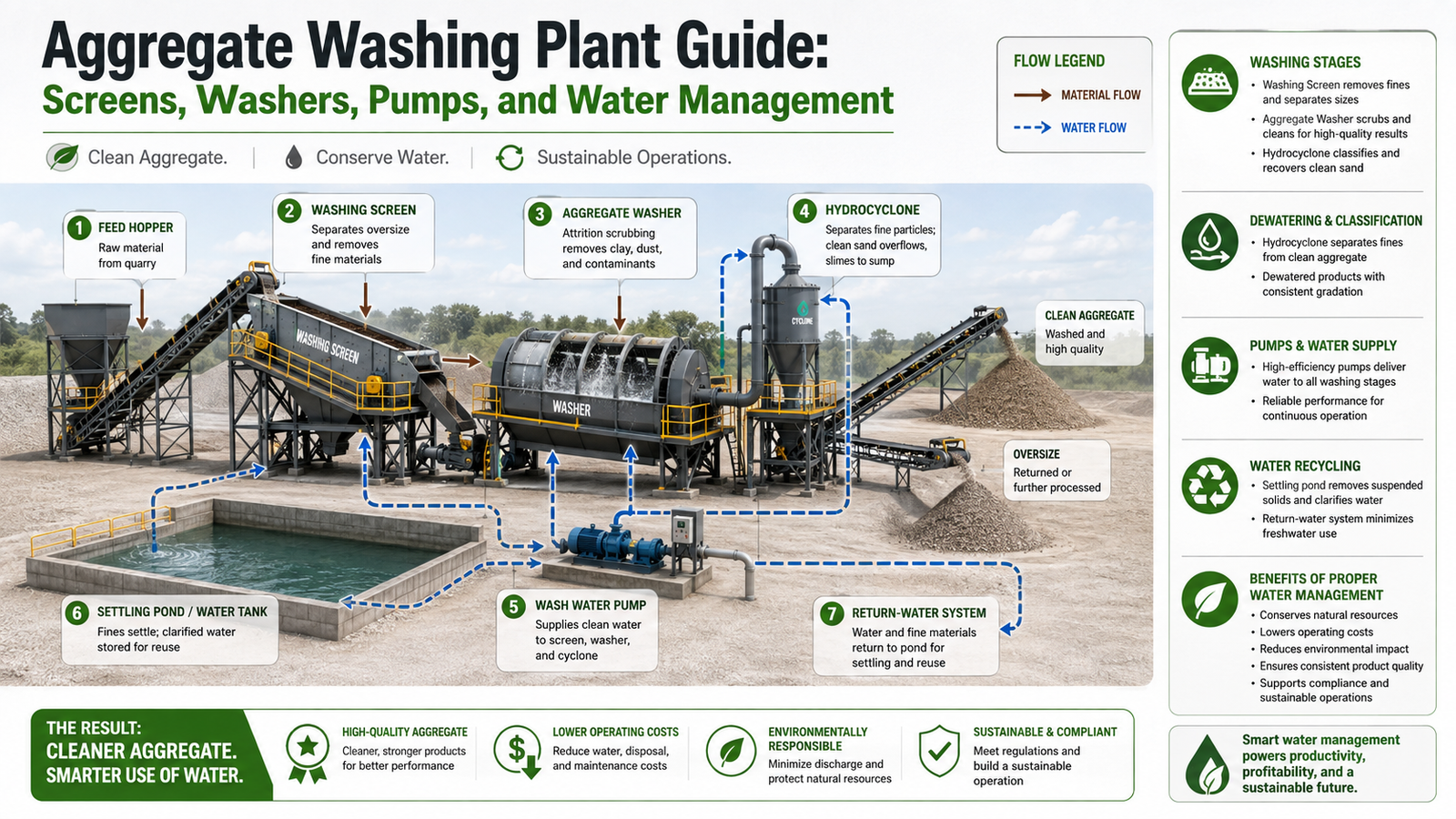
Aggregate washing removes clay, silt, crusher dust, organic contamination, and unwanted fines so sand, gravel, and crushed stone can meet product requirements. A washing plant is a solids-and-water process, not simply a screen with spray bars. Depending on the feed, it may include washing screens, blade mills, log washers, attrition cells, hydrocyclones, dewatering screens, slurry pumps, sumps, thickeners, ponds, and water-recovery equipment. The best plant matches the type of contamination to the correct cleaning intensity while recycling as much water as practical.
1. Why Aggregate Is Washed
Natural and crushed aggregate can contain clay, silt, dust, roots, or other contamination that dry screening cannot remove. This is an important part of aggregate washing plant guide: screens, washers, pumps, and water management because the setting, component, or process does not operate in isolation. It changes the load seen by the next machine, the condition of the material, and the amount of useful product that can be produced. Washing can improve cleanliness, grading consistency, and suitability for concrete, asphalt, drainage, and other products. Operators therefore need to understand both the mechanical function and the process consequence before they make adjustments.
From a process standpoint, The contamination should be identified before equipment is selected because loose dust and attached clay require different treatment. The practical result should be checked with measurements rather than appearance alone. Useful observations can include feed rate, product gradation, machine power or pressure, vibration, temperature, wear condition, recirculating load, moisture, and downtime, depending on the equipment involved. Product specifications should define the required fines content and cleanliness. When these observations are recorded consistently, normal variation becomes easier to separate from a developing fault.
In day-to-day operation, stability is usually more valuable than a short peak in output. A machine that alternates between starvation and overload may briefly show high production, yet it normally creates more wear, more product variation, and more operator intervention. More water is not automatically the solution when mechanical scrubbing is actually required. The best operating point is the one that can be repeated safely for the expected feed and product requirement, with enough reserve for normal changes in material condition.
For troubleshooting, make one controlled change at a time whenever production conditions allow. First document the symptom and current setup, then inspect the simplest causes before changing a major setting or replacing a component. Check the equipment immediately upstream and downstream as well, because many apparent machine problems are actually caused by unstable feeding, restricted discharge, poor separation, blocked chutes, incorrect line routing, or insufficient surge capacity. After a change, compare the result under similar operating conditions and keep the data for future reference.
Maintenance and safety requirements must be built into the operating method. Wear parts, guards, access doors, hydraulic systems, electrical drives, rotating components, and stored energy should be inspected and serviced using the manufacturer procedure and the site's isolation rules. Machine-specific capacities, allowable settings, pressures, speeds, wear limits, and inspection intervals vary by model, so general guidance should never replace the applicable manual. A clear inspection routine and accurate service history help prevent small defects from becoming production failures.
2. Washing Screens and Spray Systems
Washing screens combine particle sizing with water sprays that loosen and carry away fine contamination. This is an important part of aggregate washing plant guide: screens, washers, pumps, and water management because the setting, component, or process does not operate in isolation. It changes the load seen by the next machine, the condition of the material, and the amount of useful product that can be produced. Spray bars should distribute water evenly across the material bed. Operators therefore need to understand both the mechanical function and the process consequence before they make adjustments.
From a process standpoint, Screen motion exposes particle surfaces and helps fines reach the apertures. The practical result should be checked with measurements rather than appearance alone. Useful observations can include feed rate, product gradation, machine power or pressure, vibration, temperature, wear condition, recirculating load, moisture, and downtime, depending on the equipment involved. Blocked nozzles, poor coverage, torn media, or uneven feed can reduce washing quality. When these observations are recorded consistently, normal variation becomes easier to separate from a developing fault.
In day-to-day operation, stability is usually more valuable than a short peak in output. A machine that alternates between starvation and overload may briefly show high production, yet it normally creates more wear, more product variation, and more operator intervention. Water flow should be enough for cleaning without unnecessarily overloading pumps, sumps, and treatment systems. The best operating point is the one that can be repeated safely for the expected feed and product requirement, with enough reserve for normal changes in material condition.
For troubleshooting, make one controlled change at a time whenever production conditions allow. First document the symptom and current setup, then inspect the simplest causes before changing a major setting or replacing a component. Check the equipment immediately upstream and downstream as well, because many apparent machine problems are actually caused by unstable feeding, restricted discharge, poor separation, blocked chutes, incorrect line routing, or insufficient surge capacity. After a change, compare the result under similar operating conditions and keep the data for future reference.
Maintenance and safety requirements must be built into the operating method. Wear parts, guards, access doors, hydraulic systems, electrical drives, rotating components, and stored energy should be inspected and serviced using the manufacturer procedure and the site's isolation rules. Machine-specific capacities, allowable settings, pressures, speeds, wear limits, and inspection intervals vary by model, so general guidance should never replace the applicable manual. A clear inspection routine and accurate service history help prevent small defects from becoming production failures.
3. Log Washers, Blade Mills, and Attrition
Mechanical washers are used when contamination is attached strongly to the aggregate surface. This is an important part of aggregate washing plant guide: screens, washers, pumps, and water management because the setting, component, or process does not operate in isolation. It changes the load seen by the next machine, the condition of the material, and the amount of useful product that can be produced. Log washers use heavy paddles to lift, tumble, and scrub coarse material. Operators therefore need to understand both the mechanical function and the process consequence before they make adjustments.
From a process standpoint, Blade mills provide lighter scrubbing and can help break down soluble clay and remove fines. The practical result should be checked with measurements rather than appearance alone. Useful observations can include feed rate, product gradation, machine power or pressure, vibration, temperature, wear condition, recirculating load, moisture, and downtime, depending on the equipment involved. Attrition cells clean sand by rubbing particles against one another at high solids concentration. When these observations are recorded consistently, normal variation becomes easier to separate from a developing fault.
In day-to-day operation, stability is usually more valuable than a short peak in output. A machine that alternates between starvation and overload may briefly show high production, yet it normally creates more wear, more product variation, and more operator intervention. Retention time, loading, wear, and downstream classification capacity determine whether the extra scrubbing produces economic value. The best operating point is the one that can be repeated safely for the expected feed and product requirement, with enough reserve for normal changes in material condition.
For troubleshooting, make one controlled change at a time whenever production conditions allow. First document the symptom and current setup, then inspect the simplest causes before changing a major setting or replacing a component. Check the equipment immediately upstream and downstream as well, because many apparent machine problems are actually caused by unstable feeding, restricted discharge, poor separation, blocked chutes, incorrect line routing, or insufficient surge capacity. After a change, compare the result under similar operating conditions and keep the data for future reference.
Maintenance and safety requirements must be built into the operating method. Wear parts, guards, access doors, hydraulic systems, electrical drives, rotating components, and stored energy should be inspected and serviced using the manufacturer procedure and the site's isolation rules. Machine-specific capacities, allowable settings, pressures, speeds, wear limits, and inspection intervals vary by model, so general guidance should never replace the applicable manual. A clear inspection routine and accurate service history help prevent small defects from becoming production failures.
4. Hydrocyclones and Fine Sand Recovery
Hydrocyclones classify slurry using centrifugal flow rather than a physical screen aperture. This is an important part of aggregate washing plant guide: screens, washers, pumps, and water management because the setting, component, or process does not operate in isolation. It changes the load seen by the next machine, the condition of the material, and the amount of useful product that can be produced. Coarser solids tend to report to the underflow while finer solids and much of the water leave through the overflow. Operators therefore need to understand both the mechanical function and the process consequence before they make adjustments.
From a process standpoint, Feed pressure, slurry density, cyclone size, apex condition, and internal wear influence the separation. The practical result should be checked with measurements rather than appearance alone. Useful observations can include feed rate, product gradation, machine power or pressure, vibration, temperature, wear condition, recirculating load, moisture, and downtime, depending on the equipment involved. Cyclones are commonly used to recover fine sand before dewatering. When these observations are recorded consistently, normal variation becomes easier to separate from a developing fault.
In day-to-day operation, stability is usually more valuable than a short peak in output. A machine that alternates between starvation and overload may briefly show high production, yet it normally creates more wear, more product variation, and more operator intervention. The overflow still contains solids and must be handled in the water-recovery system. The best operating point is the one that can be repeated safely for the expected feed and product requirement, with enough reserve for normal changes in material condition.
For troubleshooting, make one controlled change at a time whenever production conditions allow. First document the symptom and current setup, then inspect the simplest causes before changing a major setting or replacing a component. Check the equipment immediately upstream and downstream as well, because many apparent machine problems are actually caused by unstable feeding, restricted discharge, poor separation, blocked chutes, incorrect line routing, or insufficient surge capacity. After a change, compare the result under similar operating conditions and keep the data for future reference.
Maintenance and safety requirements must be built into the operating method. Wear parts, guards, access doors, hydraulic systems, electrical drives, rotating components, and stored energy should be inspected and serviced using the manufacturer procedure and the site's isolation rules. Machine-specific capacities, allowable settings, pressures, speeds, wear limits, and inspection intervals vary by model, so general guidance should never replace the applicable manual. A clear inspection routine and accurate service history help prevent small defects from becoming production failures.
5. Dewatering Screens and Product Moisture
Dewatering screens remove free water from washed sand or fine aggregate so it can be stockpiled and handled. This is an important part of aggregate washing plant guide: screens, washers, pumps, and water management because the setting, component, or process does not operate in isolation. It changes the load seen by the next machine, the condition of the material, and the amount of useful product that can be produced. High-frequency motion helps water drain while retaining solids on the deck. Operators therefore need to understand both the mechanical function and the process consequence before they make adjustments.
From a process standpoint, Feed distribution, media condition, bed depth, and slurry loading influence final moisture. The practical result should be checked with measurements rather than appearance alone. Useful observations can include feed rate, product gradation, machine power or pressure, vibration, temperature, wear condition, recirculating load, moisture, and downtime, depending on the equipment involved. Damaged panels can lose valuable fine product. When these observations are recorded consistently, normal variation becomes easier to separate from a developing fault.
In day-to-day operation, stability is usually more valuable than a short peak in output. A machine that alternates between starvation and overload may briefly show high production, yet it normally creates more wear, more product variation, and more operator intervention. Stockpile drainage and customer moisture limits should be considered when judging dewatering performance. The best operating point is the one that can be repeated safely for the expected feed and product requirement, with enough reserve for normal changes in material condition.
For troubleshooting, make one controlled change at a time whenever production conditions allow. First document the symptom and current setup, then inspect the simplest causes before changing a major setting or replacing a component. Check the equipment immediately upstream and downstream as well, because many apparent machine problems are actually caused by unstable feeding, restricted discharge, poor separation, blocked chutes, incorrect line routing, or insufficient surge capacity. After a change, compare the result under similar operating conditions and keep the data for future reference.
Maintenance and safety requirements must be built into the operating method. Wear parts, guards, access doors, hydraulic systems, electrical drives, rotating components, and stored energy should be inspected and serviced using the manufacturer procedure and the site's isolation rules. Machine-specific capacities, allowable settings, pressures, speeds, wear limits, and inspection intervals vary by model, so general guidance should never replace the applicable manual. A clear inspection routine and accurate service history help prevent small defects from becoming production failures.
6. Pumps, Sumps, and Slurry Piping
Slurry pumps move water and solids between washing, classification, dewatering, and treatment stages. This is an important part of aggregate washing plant guide: screens, washers, pumps, and water management because the setting, component, or process does not operate in isolation. It changes the load seen by the next machine, the condition of the material, and the amount of useful product that can be produced. Pump selection must consider flow, head, solids concentration, particle size, and abrasiveness. Operators therefore need to understand both the mechanical function and the process consequence before they make adjustments.
From a process standpoint, Sumps provide buffer volume but poor sump design can allow air entrainment, sanding out, or oversized solids to reach a pump. The practical result should be checked with measurements rather than appearance alone. Useful observations can include feed rate, product gradation, machine power or pressure, vibration, temperature, wear condition, recirculating load, moisture, and downtime, depending on the equipment involved. Pipeline velocity must be high enough to transport solids without creating excessive wear. When these observations are recorded consistently, normal variation becomes easier to separate from a developing fault.
In day-to-day operation, stability is usually more valuable than a short peak in output. A machine that alternates between starvation and overload may briefly show high production, yet it normally creates more wear, more product variation, and more operator intervention. Pressure, motor load, vibration, and wet-end wear should be monitored during operation. The best operating point is the one that can be repeated safely for the expected feed and product requirement, with enough reserve for normal changes in material condition.
For troubleshooting, make one controlled change at a time whenever production conditions allow. First document the symptom and current setup, then inspect the simplest causes before changing a major setting or replacing a component. Check the equipment immediately upstream and downstream as well, because many apparent machine problems are actually caused by unstable feeding, restricted discharge, poor separation, blocked chutes, incorrect line routing, or insufficient surge capacity. After a change, compare the result under similar operating conditions and keep the data for future reference.
Maintenance and safety requirements must be built into the operating method. Wear parts, guards, access doors, hydraulic systems, electrical drives, rotating components, and stored energy should be inspected and serviced using the manufacturer procedure and the site's isolation rules. Machine-specific capacities, allowable settings, pressures, speeds, wear limits, and inspection intervals vary by model, so general guidance should never replace the applicable manual. A clear inspection routine and accurate service history help prevent small defects from becoming production failures.
7. Water Balance, Recycling, and Sludge
A washing plant should have a water balance showing fresh water, product moisture, return water, evaporation, and sludge streams. This is an important part of aggregate washing plant guide: screens, washers, pumps, and water management because the setting, component, or process does not operate in isolation. It changes the load seen by the next machine, the condition of the material, and the amount of useful product that can be produced. Ponds, thickeners, clarifiers, or other systems remove suspended solids so water can be reused. Operators therefore need to understand both the mechanical function and the process consequence before they make adjustments.
From a process standpoint, Recycled water that becomes too dirty can put fines back onto a clean product. The practical result should be checked with measurements rather than appearance alone. Useful observations can include feed rate, product gradation, machine power or pressure, vibration, temperature, wear condition, recirculating load, moisture, and downtime, depending on the equipment involved. Settled or thickened sludge still requires a planned handling and disposal route. When these observations are recorded consistently, normal variation becomes easier to separate from a developing fault.
In day-to-day operation, stability is usually more valuable than a short peak in output. A machine that alternates between starvation and overload may briefly show high production, yet it normally creates more wear, more product variation, and more operator intervention. Fresh-water use, return-water quality, and sludge volume should be treated as production metrics. The best operating point is the one that can be repeated safely for the expected feed and product requirement, with enough reserve for normal changes in material condition.
For troubleshooting, make one controlled change at a time whenever production conditions allow. First document the symptom and current setup, then inspect the simplest causes before changing a major setting or replacing a component. Check the equipment immediately upstream and downstream as well, because many apparent machine problems are actually caused by unstable feeding, restricted discharge, poor separation, blocked chutes, incorrect line routing, or insufficient surge capacity. After a change, compare the result under similar operating conditions and keep the data for future reference.
Maintenance and safety requirements must be built into the operating method. Wear parts, guards, access doors, hydraulic systems, electrical drives, rotating components, and stored energy should be inspected and serviced using the manufacturer procedure and the site's isolation rules. Machine-specific capacities, allowable settings, pressures, speeds, wear limits, and inspection intervals vary by model, so general guidance should never replace the applicable manual. A clear inspection routine and accurate service history help prevent small defects from becoming production failures.
8. Troubleshooting and Plant Design
Dirty product can result from insufficient scrubbing, poor spray coverage, contaminated return water, or overloaded equipment. This is an important part of aggregate washing plant guide: screens, washers, pumps, and water management because the setting, component, or process does not operate in isolation. It changes the load seen by the next machine, the condition of the material, and the amount of useful product that can be produced. Loss of fine sand can result from damaged media, incorrect cyclone operation, or excessive overflow losses. Operators therefore need to understand both the mechanical function and the process consequence before they make adjustments.
From a process standpoint, High product moisture can result from overloaded dewatering screens or poor drainage. The practical result should be checked with measurements rather than appearance alone. Useful observations can include feed rate, product gradation, machine power or pressure, vibration, temperature, wear condition, recirculating load, moisture, and downtime, depending on the equipment involved. Final plant design should use the feed gradation, clay type, fines percentage, product targets, water balance, and maintenance requirements. When these observations are recorded consistently, normal variation becomes easier to separate from a developing fault.
In day-to-day operation, stability is usually more valuable than a short peak in output. A machine that alternates between starvation and overload may briefly show high production, yet it normally creates more wear, more product variation, and more operator intervention. Pilot testing is valuable for difficult clay or fine-sand applications because contamination behavior is often site-specific. The best operating point is the one that can be repeated safely for the expected feed and product requirement, with enough reserve for normal changes in material condition.
For troubleshooting, make one controlled change at a time whenever production conditions allow. First document the symptom and current setup, then inspect the simplest causes before changing a major setting or replacing a component. Check the equipment immediately upstream and downstream as well, because many apparent machine problems are actually caused by unstable feeding, restricted discharge, poor separation, blocked chutes, incorrect line routing, or insufficient surge capacity. After a change, compare the result under similar operating conditions and keep the data for future reference.
Maintenance and safety requirements must be built into the operating method. Wear parts, guards, access doors, hydraulic systems, electrical drives, rotating components, and stored energy should be inspected and serviced using the manufacturer procedure and the site's isolation rules. Machine-specific capacities, allowable settings, pressures, speeds, wear limits, and inspection intervals vary by model, so general guidance should never replace the applicable manual. A clear inspection routine and accurate service history help prevent small defects from becoming production failures.
Quick Reference
Equipment
Main Role
Key Control
Washing screen
Rinse and size
Spray coverage and media
Log washer/blade mill
Mechanical scrubbing
Load and retention
Hydrocyclone
Classify and recover sand
Pressure and wear
Dewatering screen
Reduce product moisture
Feed distribution
Pond/thickener
Clarify return water
Solids removal capacity
Final Takeaway
Successful equipment operation comes from matching the machine to the actual material or placement requirement, then controlling the whole workflow rather than one component in isolation. Stable feed or supply, correct settings, adequate downstream capacity, planned maintenance, and consistent records create reliable production. When performance changes, identify the symptom, verify the operating condition, inspect connected equipment, and use the manufacturer limits before making a major adjustment. This disciplined approach improves quality, controls wear and operating cost, and reduces avoidable downtime.
Get More Expert Guides & Updates
Subscribe for Machinery.org guide updates and product learning content.