
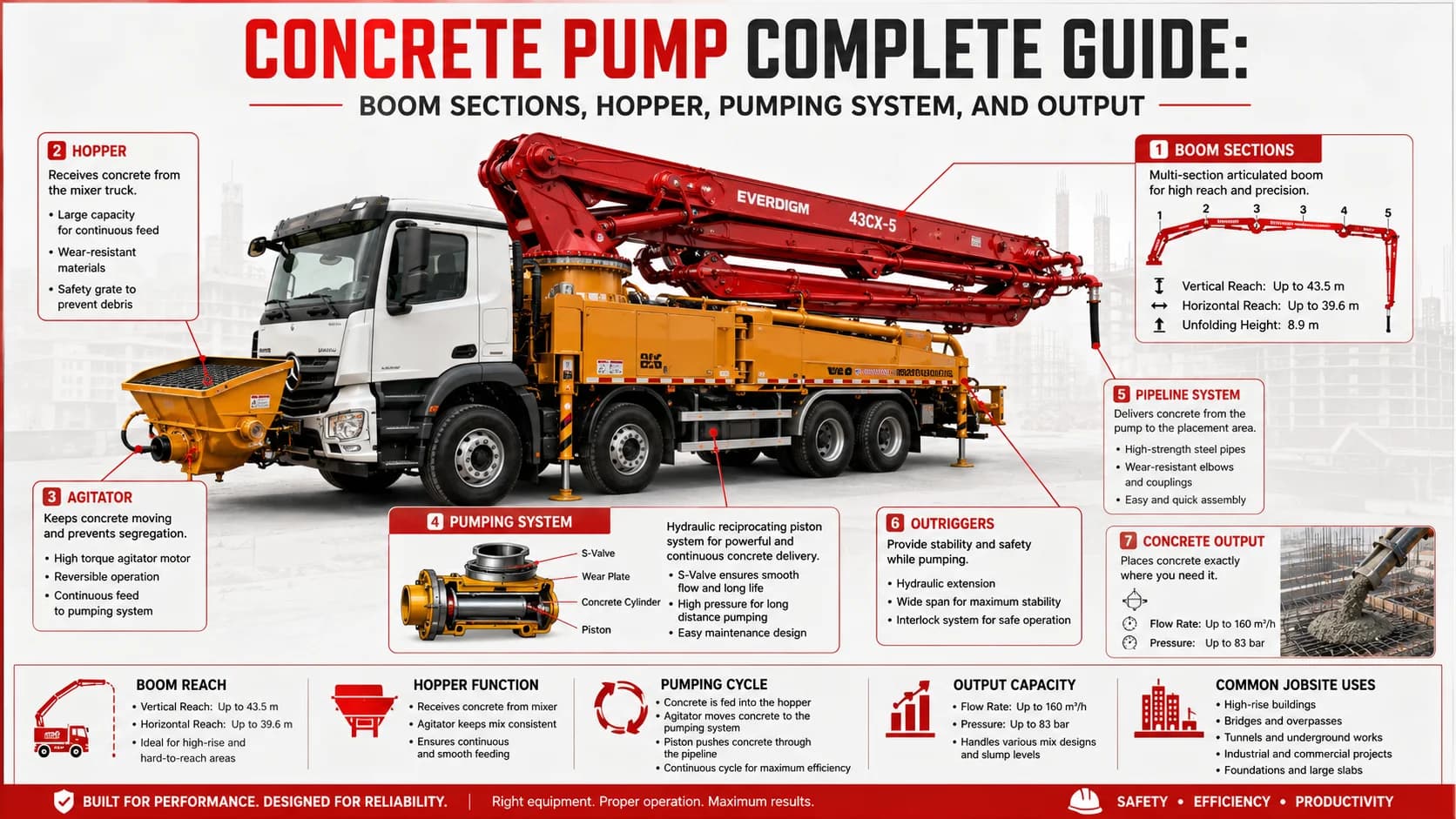
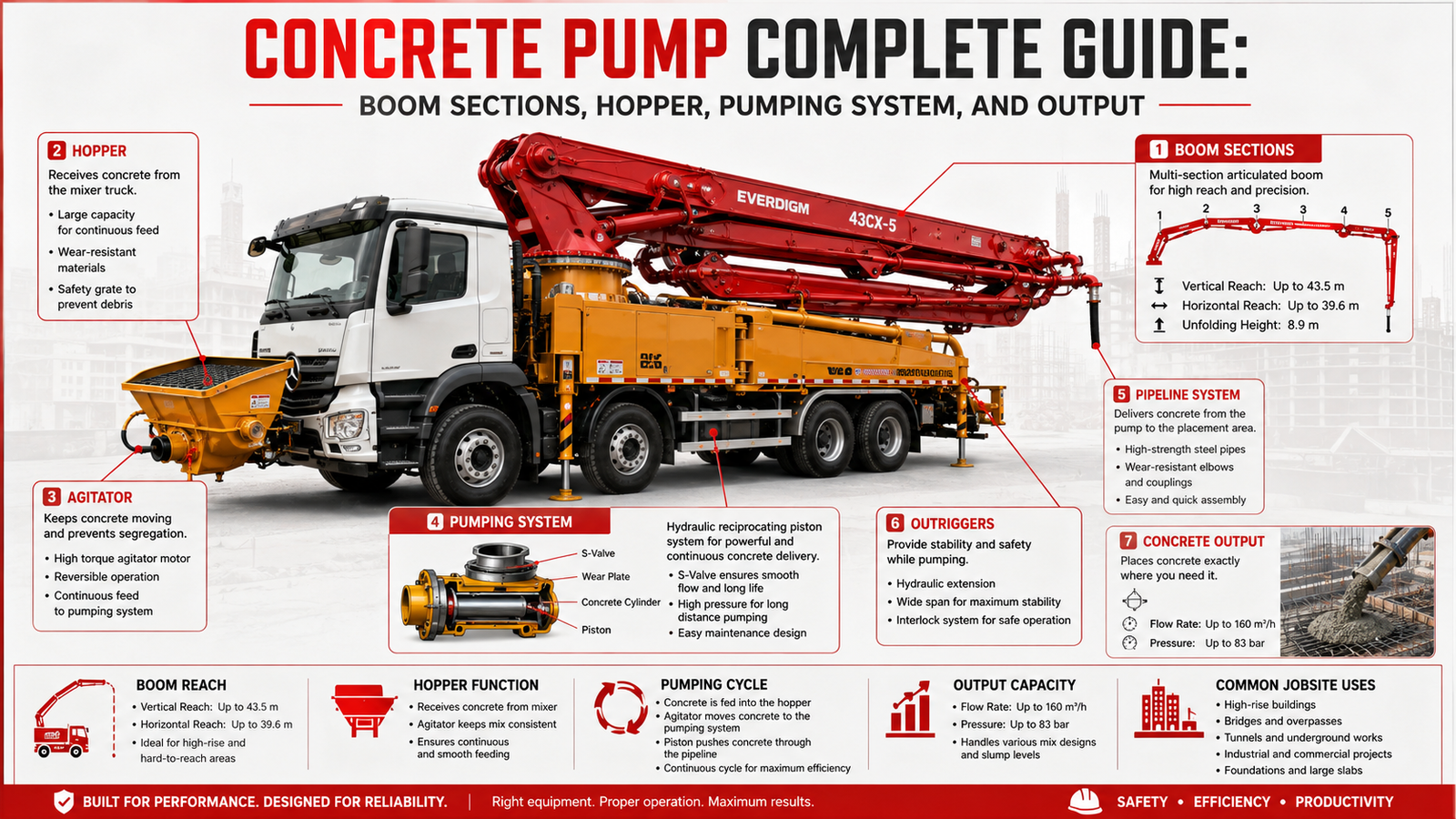
A concrete boom pump is a coordinated hydraulic, structural, and material-delivery system. Fresh concrete enters a hopper, an agitator keeps it moving, twin pumping cylinders alternately draw and discharge material through a transfer valve, and the resulting flow travels through steel pipeline carried by an articulated boom. Outriggers stabilize the machine while the operator positions the end hose at the pour. Real output depends on much more than the pump rating: concrete pumpability, line resistance, cylinder fill, valve wear, hopper level, truck supply, boom geometry, site conditions, and crew readiness all influence performance. This guide explains the complete system from hopper to discharge.
1. Main Components of a Boom Pump
A boom pump combines the hopper, agitator, pumping cylinders, transfer valve, hydraulic system, boom, delivery line, outriggers, controls, and chassis. This is an important part of concrete pump complete guide: boom sections, hopper, pumping system, and output because the setting, component, or process does not operate in isolation. It changes the load seen by the next machine, the condition of the material, and the amount of useful product that can be produced. Each component must work correctly for the machine to achieve stable output. Operators therefore need to understand both the mechanical function and the process consequence before they make adjustments.
From a process standpoint, A high-capacity pumping unit cannot perform if the hopper is starved or the delivery line is excessively restrictive. The practical result should be checked with measurements rather than appearance alone. Useful observations can include feed rate, product gradation, machine power or pressure, vibration, temperature, wear condition, recirculating load, moisture, and downtime, depending on the equipment involved. The articulated boom allows the end hose to be positioned around obstacles and across large placement areas. When these observations are recorded consistently, normal variation becomes easier to separate from a developing fault.
In day-to-day operation, stability is usually more valuable than a short peak in output. A machine that alternates between starvation and overload may briefly show high production, yet it normally creates more wear, more product variation, and more operator intervention. Daily inspection should cover both the concrete pumping system and the truck-mounted structural components. The best operating point is the one that can be repeated safely for the expected feed and product requirement, with enough reserve for normal changes in material condition.
For troubleshooting, make one controlled change at a time whenever production conditions allow. First document the symptom and current setup, then inspect the simplest causes before changing a major setting or replacing a component. Check the equipment immediately upstream and downstream as well, because many apparent machine problems are actually caused by unstable feeding, restricted discharge, poor separation, blocked chutes, incorrect line routing, or insufficient surge capacity. After a change, compare the result under similar operating conditions and keep the data for future reference.
Maintenance and safety requirements must be built into the operating method. Wear parts, guards, access doors, hydraulic systems, electrical drives, rotating components, and stored energy should be inspected and serviced using the manufacturer procedure and the site's isolation rules. Machine-specific capacities, allowable settings, pressures, speeds, wear limits, and inspection intervals vary by model, so general guidance should never replace the applicable manual. A clear inspection routine and accurate service history help prevent small defects from becoming production failures.
2. Boom Sections and Articulation
The placing boom is built from several hinged sections controlled by hydraulic cylinders. This is an important part of concrete pump complete guide: boom sections, hopper, pumping system, and output because the setting, component, or process does not operate in isolation. It changes the load seen by the next machine, the condition of the material, and the amount of useful product that can be produced. Different boom folding patterns are designed to reach over, under, and around obstacles. Operators therefore need to understand both the mechanical function and the process consequence before they make adjustments.
From a process standpoint, Steel delivery pipe is supported along the boom with flexible connections at articulation points. The practical result should be checked with measurements rather than appearance alone. Useful observations can include feed rate, product gradation, machine power or pressure, vibration, temperature, wear condition, recirculating load, moisture, and downtime, depending on the equipment involved. Maximum horizontal or vertical reach does not describe every position in the working envelope. When these observations are recorded consistently, normal variation becomes easier to separate from a developing fault.
In day-to-day operation, stability is usually more valuable than a short peak in output. A machine that alternates between starvation and overload may briefly show high production, yet it normally creates more wear, more product variation, and more operator intervention. Boom inspection includes welds, pins, bushings, cylinders, hoses, pipe clamps, and structural condition. The best operating point is the one that can be repeated safely for the expected feed and product requirement, with enough reserve for normal changes in material condition.
For troubleshooting, make one controlled change at a time whenever production conditions allow. First document the symptom and current setup, then inspect the simplest causes before changing a major setting or replacing a component. Check the equipment immediately upstream and downstream as well, because many apparent machine problems are actually caused by unstable feeding, restricted discharge, poor separation, blocked chutes, incorrect line routing, or insufficient surge capacity. After a change, compare the result under similar operating conditions and keep the data for future reference.
Maintenance and safety requirements must be built into the operating method. Wear parts, guards, access doors, hydraulic systems, electrical drives, rotating components, and stored energy should be inspected and serviced using the manufacturer procedure and the site's isolation rules. Machine-specific capacities, allowable settings, pressures, speeds, wear limits, and inspection intervals vary by model, so general guidance should never replace the applicable manual. A clear inspection routine and accurate service history help prevent small defects from becoming production failures.
3. Hopper, Grate, and Agitator
The hopper receives fresh concrete from mixer trucks and directs it toward the pumping cylinders. This is an important part of concrete pump complete guide: boom sections, hopper, pumping system, and output because the setting, component, or process does not operate in isolation. It changes the load seen by the next machine, the condition of the material, and the amount of useful product that can be produced. A grate helps prevent large foreign objects from entering the valve and cylinder area. Operators therefore need to understand both the mechanical function and the process consequence before they make adjustments.
From a process standpoint, Agitator paddles keep concrete moving and reduce segregation near the suction openings. The practical result should be checked with measurements rather than appearance alone. Useful observations can include feed rate, product gradation, machine power or pressure, vibration, temperature, wear condition, recirculating load, moisture, and downtime, depending on the equipment involved. The hopper should remain sufficiently full to avoid drawing air into the pumping system. When these observations are recorded consistently, normal variation becomes easier to separate from a developing fault.
In day-to-day operation, stability is usually more valuable than a short peak in output. A machine that alternates between starvation and overload may briefly show high production, yet it normally creates more wear, more product variation, and more operator intervention. Guards and the grate should remain in place during normal operation, and washout must be planned safely. The best operating point is the one that can be repeated safely for the expected feed and product requirement, with enough reserve for normal changes in material condition.
For troubleshooting, make one controlled change at a time whenever production conditions allow. First document the symptom and current setup, then inspect the simplest causes before changing a major setting or replacing a component. Check the equipment immediately upstream and downstream as well, because many apparent machine problems are actually caused by unstable feeding, restricted discharge, poor separation, blocked chutes, incorrect line routing, or insufficient surge capacity. After a change, compare the result under similar operating conditions and keep the data for future reference.
Maintenance and safety requirements must be built into the operating method. Wear parts, guards, access doors, hydraulic systems, electrical drives, rotating components, and stored energy should be inspected and serviced using the manufacturer procedure and the site's isolation rules. Machine-specific capacities, allowable settings, pressures, speeds, wear limits, and inspection intervals vary by model, so general guidance should never replace the applicable manual. A clear inspection routine and accurate service history help prevent small defects from becoming production failures.
4. Twin-Cylinder Pumping Cycle
Most high-output pumps use two concrete cylinders that alternate between suction and discharge strokes. This is an important part of concrete pump complete guide: boom sections, hopper, pumping system, and output because the setting, component, or process does not operate in isolation. It changes the load seen by the next machine, the condition of the material, and the amount of useful product that can be produced. One piston retracts and fills its concrete cylinder while the other piston advances and pushes concrete toward the transfer valve. Operators therefore need to understand both the mechanical function and the process consequence before they make adjustments.
From a process standpoint, At the end of the stroke the valve switches and the cylinder roles reverse. The practical result should be checked with measurements rather than appearance alone. Useful observations can include feed rate, product gradation, machine power or pressure, vibration, temperature, wear condition, recirculating load, moisture, and downtime, depending on the equipment involved. Correct hydraulic timing creates near-continuous flow even though pumping occurs in alternating strokes. When these observations are recorded consistently, normal variation becomes easier to separate from a developing fault.
In day-to-day operation, stability is usually more valuable than a short peak in output. A machine that alternates between starvation and overload may briefly show high production, yet it normally creates more wear, more product variation, and more operator intervention. Worn piston cups, cylinder surfaces, or poor filling can reduce volumetric efficiency and output. The best operating point is the one that can be repeated safely for the expected feed and product requirement, with enough reserve for normal changes in material condition.
For troubleshooting, make one controlled change at a time whenever production conditions allow. First document the symptom and current setup, then inspect the simplest causes before changing a major setting or replacing a component. Check the equipment immediately upstream and downstream as well, because many apparent machine problems are actually caused by unstable feeding, restricted discharge, poor separation, blocked chutes, incorrect line routing, or insufficient surge capacity. After a change, compare the result under similar operating conditions and keep the data for future reference.
Maintenance and safety requirements must be built into the operating method. Wear parts, guards, access doors, hydraulic systems, electrical drives, rotating components, and stored energy should be inspected and serviced using the manufacturer procedure and the site's isolation rules. Machine-specific capacities, allowable settings, pressures, speeds, wear limits, and inspection intervals vary by model, so general guidance should never replace the applicable manual. A clear inspection routine and accurate service history help prevent small defects from becoming production failures.
5. Transfer Valve and Wear Components
An S-tube or other transfer valve connects the active concrete cylinder to the delivery pipeline. This is an important part of concrete pump complete guide: boom sections, hopper, pumping system, and output because the setting, component, or process does not operate in isolation. It changes the load seen by the next machine, the condition of the material, and the amount of useful product that can be produced. Wear plates and wear rings seal the high-abrasion interface where pressurized concrete changes direction. Operators therefore need to understand both the mechanical function and the process consequence before they make adjustments.
From a process standpoint, Wear can increase internal leakage, reduce efficiency, and increase service requirements. The practical result should be checked with measurements rather than appearance alone. Useful observations can include feed rate, product gradation, machine power or pressure, vibration, temperature, wear condition, recirculating load, moisture, and downtime, depending on the equipment involved. Oversized aggregate or foreign objects can jam the valve area. When these observations are recorded consistently, normal variation becomes easier to separate from a developing fault.
In day-to-day operation, stability is usually more valuable than a short peak in output. A machine that alternates between starvation and overload may briefly show high production, yet it normally creates more wear, more product variation, and more operator intervention. The hopper and valve must be fully isolated before maintenance because hydraulic and mechanical stored energy can cause severe injury. The best operating point is the one that can be repeated safely for the expected feed and product requirement, with enough reserve for normal changes in material condition.
For troubleshooting, make one controlled change at a time whenever production conditions allow. First document the symptom and current setup, then inspect the simplest causes before changing a major setting or replacing a component. Check the equipment immediately upstream and downstream as well, because many apparent machine problems are actually caused by unstable feeding, restricted discharge, poor separation, blocked chutes, incorrect line routing, or insufficient surge capacity. After a change, compare the result under similar operating conditions and keep the data for future reference.
Maintenance and safety requirements must be built into the operating method. Wear parts, guards, access doors, hydraulic systems, electrical drives, rotating components, and stored energy should be inspected and serviced using the manufacturer procedure and the site's isolation rules. Machine-specific capacities, allowable settings, pressures, speeds, wear limits, and inspection intervals vary by model, so general guidance should never replace the applicable manual. A clear inspection routine and accurate service history help prevent small defects from becoming production failures.
6. Hydraulic System, Outriggers, and Stability
Hydraulic pumps provide force for the concrete cylinders, transfer valve, boom cylinders, outriggers, and auxiliary functions. This is an important part of concrete pump complete guide: boom sections, hopper, pumping system, and output because the setting, component, or process does not operate in isolation. It changes the load seen by the next machine, the condition of the material, and the amount of useful product that can be produced. Oil level, cleanliness, temperature, filters, coolers, and hose condition are critical to reliable operation. Operators therefore need to understand both the mechanical function and the process consequence before they make adjustments.
From a process standpoint, Outrigger loads can be high and change with boom position. The practical result should be checked with measurements rather than appearance alone. Useful observations can include feed rate, product gradation, machine power or pressure, vibration, temperature, wear condition, recirculating load, moisture, and downtime, depending on the equipment involved. Pads or mats distribute those loads into the supporting ground. When these observations are recorded consistently, normal variation becomes easier to separate from a developing fault.
In day-to-day operation, stability is usually more valuable than a short peak in output. A machine that alternates between starvation and overload may briefly show high production, yet it normally creates more wear, more product variation, and more operator intervention. Weak fill, underground voids, trenches, basements, and unsupported edges must be considered before setup. The best operating point is the one that can be repeated safely for the expected feed and product requirement, with enough reserve for normal changes in material condition.
For troubleshooting, make one controlled change at a time whenever production conditions allow. First document the symptom and current setup, then inspect the simplest causes before changing a major setting or replacing a component. Check the equipment immediately upstream and downstream as well, because many apparent machine problems are actually caused by unstable feeding, restricted discharge, poor separation, blocked chutes, incorrect line routing, or insufficient surge capacity. After a change, compare the result under similar operating conditions and keep the data for future reference.
Maintenance and safety requirements must be built into the operating method. Wear parts, guards, access doors, hydraulic systems, electrical drives, rotating components, and stored energy should be inspected and serviced using the manufacturer procedure and the site's isolation rules. Machine-specific capacities, allowable settings, pressures, speeds, wear limits, and inspection intervals vary by model, so general guidance should never replace the applicable manual. A clear inspection routine and accurate service history help prevent small defects from becoming production failures.
7. Delivery Pipeline, End Hose, and Pumpability
Concrete travels through steel pipe, elbows, reducers, couplings, seals, and a flexible end hose. This is an important part of concrete pump complete guide: boom sections, hopper, pumping system, and output because the setting, component, or process does not operate in isolation. It changes the load seen by the next machine, the condition of the material, and the amount of useful product that can be produced. Every bend, reduction, line length, elevation change, and smaller internal diameter increases flow resistance. Operators therefore need to understand both the mechanical function and the process consequence before they make adjustments.
From a process standpoint, Pipe wall thickness decreases with abrasive wear and must be monitored before pressure capability is lost. The practical result should be checked with measurements rather than appearance alone. Useful observations can include feed rate, product gradation, machine power or pressure, vibration, temperature, wear condition, recirculating load, moisture, and downtime, depending on the equipment involved. Concrete pumpability depends on aggregate grading, top size, paste volume, admixtures, fibers, workability, and temperature. When these observations are recorded consistently, normal variation becomes easier to separate from a developing fault.
In day-to-day operation, stability is usually more valuable than a short peak in output. A machine that alternates between starvation and overload may briefly show high production, yet it normally creates more wear, more product variation, and more operator intervention. The concrete supplier and pump company should coordinate difficult or unusual mixes before the pour. The best operating point is the one that can be repeated safely for the expected feed and product requirement, with enough reserve for normal changes in material condition.
For troubleshooting, make one controlled change at a time whenever production conditions allow. First document the symptom and current setup, then inspect the simplest causes before changing a major setting or replacing a component. Check the equipment immediately upstream and downstream as well, because many apparent machine problems are actually caused by unstable feeding, restricted discharge, poor separation, blocked chutes, incorrect line routing, or insufficient surge capacity. After a change, compare the result under similar operating conditions and keep the data for future reference.
Maintenance and safety requirements must be built into the operating method. Wear parts, guards, access doors, hydraulic systems, electrical drives, rotating components, and stored energy should be inspected and serviced using the manufacturer procedure and the site's isolation rules. Machine-specific capacities, allowable settings, pressures, speeds, wear limits, and inspection intervals vary by model, so general guidance should never replace the applicable manual. A clear inspection routine and accurate service history help prevent small defects from becoming production failures.
8. Output, Blockages, Maintenance, and Pour Planning
Actual pump output depends on cylinder displacement, stroke rate, fill efficiency, line resistance, concrete mix, hydraulic power, and valve condition. This is an important part of concrete pump complete guide: boom sections, hopper, pumping system, and output because the setting, component, or process does not operate in isolation. It changes the load seen by the next machine, the condition of the material, and the amount of useful product that can be produced. Mixer-truck delivery and the placing crew often limit practical output before the pump reaches its maximum rating. Operators therefore need to understand both the mechanical function and the process consequence before they make adjustments.
From a process standpoint, Rising pressure, falling output, irregular hose movement, or changed pumping sound can indicate a developing blockage. The practical result should be checked with measurements rather than appearance alone. Useful observations can include feed rate, product gradation, machine power or pressure, vibration, temperature, wear condition, recirculating load, moisture, and downtime, depending on the equipment involved. Blocked pipelines must be depressurized using approved procedures before any coupling is opened. When these observations are recorded consistently, normal variation becomes easier to separate from a developing fault.
In day-to-day operation, stability is usually more valuable than a short peak in output. A machine that alternates between starvation and overload may briefly show high production, yet it normally creates more wear, more product variation, and more operator intervention. High-productivity pours require planned truck access, outrigger support, boom reach, washout, concrete supply, communication, and a crew capable of handling the target rate. The best operating point is the one that can be repeated safely for the expected feed and product requirement, with enough reserve for normal changes in material condition.
For troubleshooting, make one controlled change at a time whenever production conditions allow. First document the symptom and current setup, then inspect the simplest causes before changing a major setting or replacing a component. Check the equipment immediately upstream and downstream as well, because many apparent machine problems are actually caused by unstable feeding, restricted discharge, poor separation, blocked chutes, incorrect line routing, or insufficient surge capacity. After a change, compare the result under similar operating conditions and keep the data for future reference.
Maintenance and safety requirements must be built into the operating method. Wear parts, guards, access doors, hydraulic systems, electrical drives, rotating components, and stored energy should be inspected and serviced using the manufacturer procedure and the site's isolation rules. Machine-specific capacities, allowable settings, pressures, speeds, wear limits, and inspection intervals vary by model, so general guidance should never replace the applicable manual. A clear inspection routine and accurate service history help prevent small defects from becoming production failures.
Quick Reference
System
Function
Key Control
Hopper/agitator
Receive and condition concrete
Maintain level and guards
Pumping cylinders
Create concrete flow
Wear and fill efficiency
Transfer valve
Switch flow to pipeline
Wear and blockage
Boom
Position delivery line
Reach and structural condition
Outriggers
Stabilize machine
Ground bearing capacity
Pipeline
Carry pressurized concrete
Wear, couplings, resistance
Final Takeaway
Successful equipment operation comes from matching the machine to the actual material or placement requirement, then controlling the whole workflow rather than one component in isolation. Stable feed or supply, correct settings, adequate downstream capacity, planned maintenance, and consistent records create reliable production. When performance changes, identify the symptom, verify the operating condition, inspect connected equipment, and use the manufacturer limits before making a major adjustment. This disciplined approach improves quality, controls wear and operating cost, and reduces avoidable downtime.
Word-Count Summary
Guide
Approx. Words
Cone Crusher Complete Guide: Crushing Chamber, Closed-Side Setting, and Output
3,665
Impact Crusher Guide: Blow Bars, Rotors, Reduction Ratio, and Applications
3,641
Mobile Crusher vs Stationary Crusher: Cost, Production, Mobility, and Site Setup
3,717
Screening Machine Guide: Screen Decks, Mesh Size, Stroke, and Material Separation
3,651
How to Design a Crushing and Screening Equipment Workflow
3,691
Conveyor Belt Tracking and Tension Guide for Aggregate and Quarry Equipment
3,697
Aggregate Feeder Types Explained: Vibrating, Grizzly, Belt, and Apron Feeders
3,692
Aggregate Washing Plant Guide: Screens, Washers, Pumps, and Water Management
3,663
Concrete Boom Pump vs Line Pump: Which Concrete Pump Is Right for Your Project?
3,790
Concrete Pump Complete Guide: Boom Sections, Hopper, Pumping System, and Output
3,731
Get More Expert Guides & Updates
Subscribe for Machinery.org guide updates and product learning content.