
Pile driving is one of the most important foundation operations in heavy construction because the equipment must transfer structural loads through weak surface soils into stronger material below, or develop sufficient skin friction along the pile. The choice of installation system affects production rate, noise, vibration, pile integrity, crane requirements, access, and the risk transferred to nearby structures. Impact hammers, vibratory hammers, and hydraulic press-in systems all place piles, but they do so by very different mechanisms. Understanding those mechanisms is the starting point for choosing equipment intelligently rather than simply selecting the largest machine available.
What a Pile Driver Does
A pile driver is a complete installation system rather than a single attachment. It typically combines a leader or guiding frame, a hammer or press mechanism, lifting equipment, pile handling tools, hydraulic power, controls, and site support. The system must keep the pile aligned while applying enough energy or force to overcome soil resistance. Steel H-piles, pipe piles, precast concrete piles, timber piles, and sheet piles can all be installed with pile-driving equipment, but the ideal method depends on pile geometry and soil response. The best setup balances penetration capability with control, because excessive energy can damage the pile while insufficient energy can produce slow production or refusal before design depth.
Impact Hammers Explained
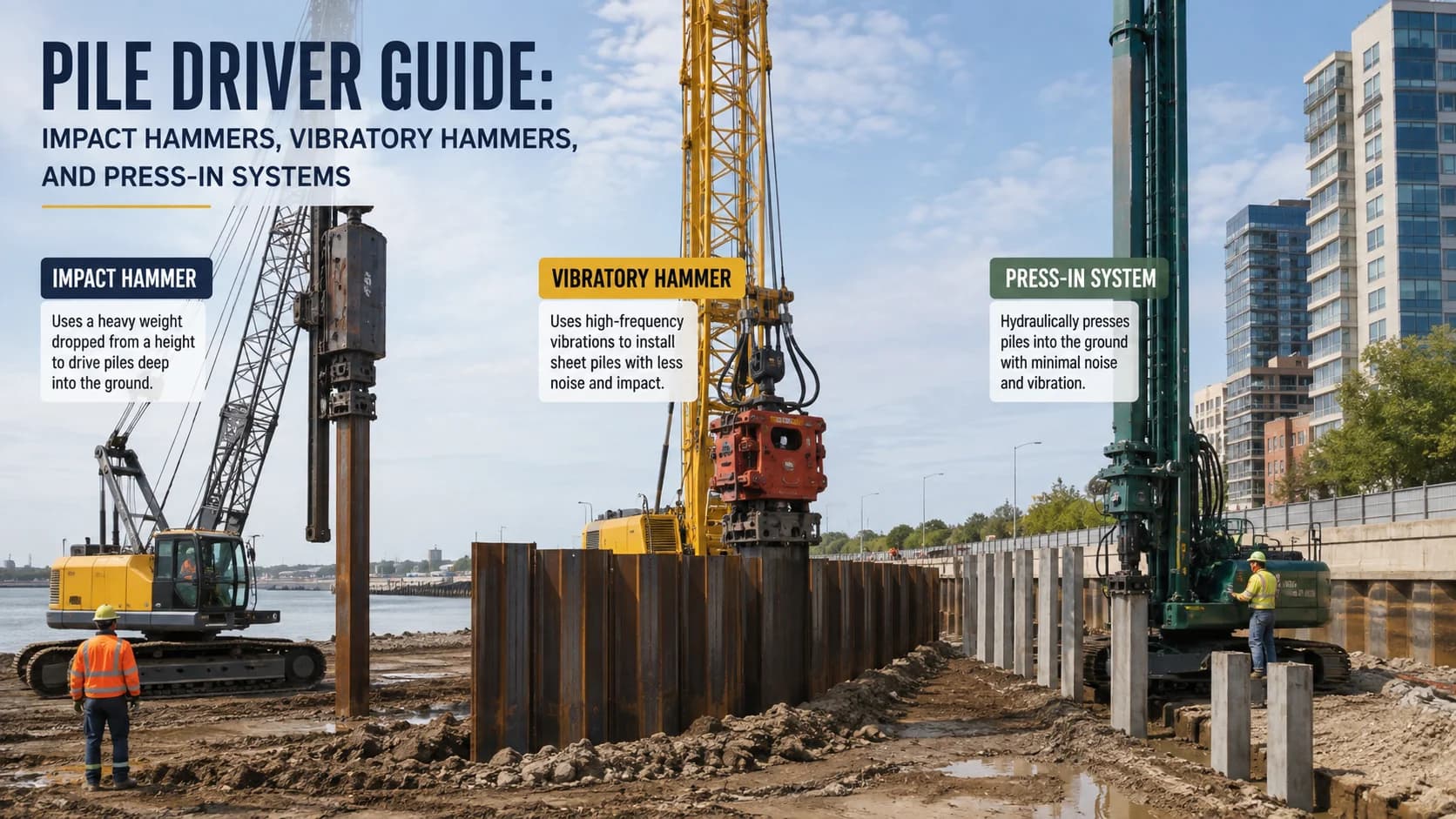
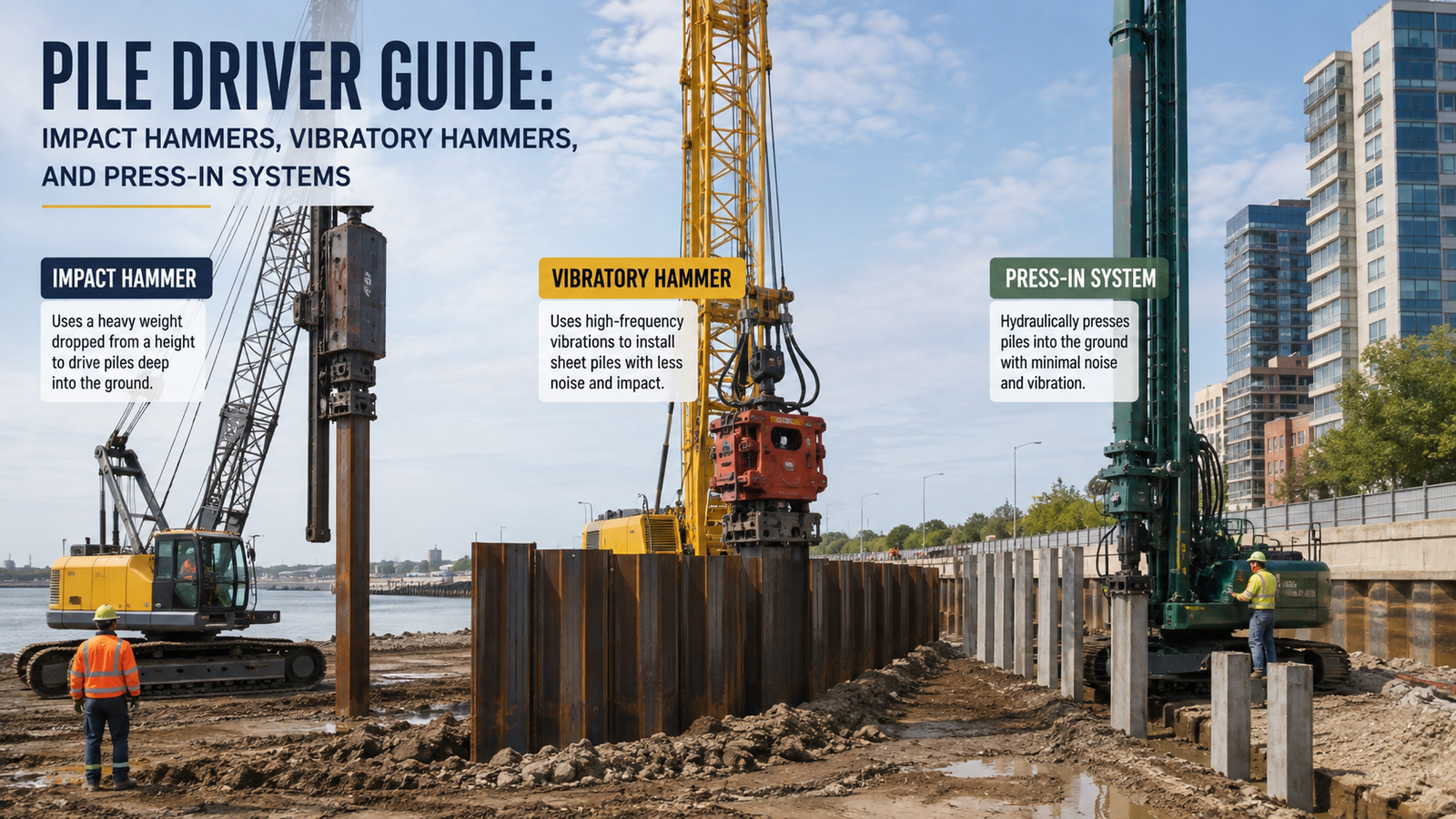
Impact hammers install piles by repeatedly delivering high-energy blows to the pile head. Modern systems include diesel hammers and hydraulic impact hammers. A helmet or drive cap transfers the impact into the pile while cushioning elements protect the pile head and hammer. Impact driving is especially useful when piles must penetrate dense soil, weathered material, or layers that resist vibration. It also produces measurable driving resistance that engineers can relate to bearing behavior. However, impact driving creates significant noise and ground vibration, and the pile must be checked for stresses caused by each blow. Proper hammer energy, cushion condition, alignment, and blow count observation are therefore essential.
Vibratory Hammers Explained
Vibratory hammers use rotating eccentric weights to generate rapid vertical oscillation. The vibration temporarily reduces soil resistance around the pile, allowing it to penetrate under the combined effect of vibration and static weight. They are widely used for sheet piles, pipe piles, casings, and extraction work. Vibratory systems can be extremely productive in granular soils and are often faster than impact hammers for sheet-pile walls. Performance becomes less predictable in cohesive clays or very dense layers, where vibration may not sufficiently reduce resistance. Frequency selection also matters near vibration-sensitive structures because different frequencies can interact with soil and nearby foundations in different ways.
Press-In Systems Explained
Press-in or silent piling systems install piles using hydraulic reaction force instead of impact or high-amplitude vibration. The machine grips previously installed piles or a reaction frame and pushes the next pile into the ground. This method is valuable in dense urban areas, near hospitals, railways, utilities, historic structures, or other locations where noise and vibration must be tightly controlled. Press-in systems can provide excellent alignment and controlled force, but they require suitable reaction capacity and may struggle in very hard obstructions unless paired with pre-augering, water jetting, or other ground-assistance techniques. Their biggest advantage is controlled installation in constrained environments.
Matching the System to Ground Conditions
Granular soils often respond well to vibratory driving because vibration rearranges particles and lowers shaft resistance. Cohesive soils may respond better to impact energy or static press-in force, depending on strength and sensitivity. Dense gravel, cobbles, or weathered rock can create abrupt refusal and may require impact hammers, predrilling, or a change in pile type. Groundwater also influences behavior because saturated sand can transmit vibration differently from dry fill. Before mobilization, contractors should review geotechnical borings, expected layer changes, groundwater, obstructions, and target tip elevations. Choosing a system based only on pile length or nominal hammer size ignores the most important variable: how the ground will react during installation.
Pile Type and Hammer Compatibility
The pile itself limits the installation method. Thin sheet piles need clamping systems that distribute force without tearing the interlocks. Precast concrete piles need caps and cushions that control stress concentrations. Pipe piles may require internal or external clamps depending on whether the pile will be driven, vibrated, or extracted. H-piles tolerate impact well but can deviate when they encounter hard inclusions. Timber piles are relatively forgiving but can broom or split if the hammer energy is poorly matched. Every hammer-pile combination should be checked for fit, alignment, expected stresses, and lifting method before production begins.
Leads, Leaders, and Alignment Control
Pile-driving leads guide the hammer and pile so that the driving axis stays consistent. Fixed leads, swinging leads, and telescopic leader systems each offer different combinations of control and mobility. Poor alignment wastes energy and can bend or damage piles, so setup accuracy matters. Verticality should be checked before driving and after the pile begins to penetrate. Batter piles require even more planning because the crane, leads, and pile handling sequence must all support the required angle. A production-focused crew treats alignment as part of cycle time rather than as a separate quality task; getting the first few meters correct usually prevents larger problems later.
Production and Cycle Planning
Pile-driving productivity is driven by more than penetration rate. Crews must account for unloading, staging, splicing, welding, surveying, moving the rig, repositioning templates, changing cushions, refueling, and quality documentation. A fast hammer does not create a fast project if piles arrive in the wrong order or welding delays every joint. Production planning should map the pile sequence, access lanes, crane swing path, spoil or extraction areas, and locations where leads can safely rotate. Daily targets are most reliable when based on full cycle time per pile, not just minutes of active driving.
Monitoring Installation
Monitoring helps confirm that the pile reaches the required resistance without being damaged. Common observations include penetration per blow, blow count over a specified interval, hammer stroke or energy, penetration rate under vibration, hydraulic press force, pile set, pile rebound, and final elevation. More advanced projects may use dynamic testing, vibration monitoring, settlement instrumentation, or automated data logging. The objective is not to collect numbers for their own sake; it is to compare actual behavior with design assumptions and recognize unusual conditions early. Sudden changes in resistance can indicate layer transitions, damage, obstructions, or alignment problems.
Noise, Vibration, and Environmental Constraints
Urban piling projects often succeed or fail based on how well nuisance effects are managed. Impact driving can generate high airborne noise, while both impact and vibratory systems can transmit ground vibration. Press-in methods reduce those effects but may require additional tooling or predrilling. Contractors should establish monitoring points, work-hour limits, exclusion zones, communication procedures, and contingency thresholds before work begins. Sensitive utilities, laboratories, hospitals, heritage buildings, and occupied residences may require conservative limits. Environmental planning should also address hydraulic leaks, sediment control, water near marine piling, and safe handling of removed piles or contaminated soil.
Maintenance and Wear Points
Pile-driving equipment sees shock, vibration, heat, and contamination, so preventive maintenance directly affects production. Impact hammers require attention to ram guides, cushions, hoses, accumulators, drive caps, bolts, and lubrication. Vibratory hammers need bearing condition, eccentric gears, clamps, hydraulic motors, and hoses checked regularly. Press-in systems depend on clean hydraulic oil, grip-jaw condition, sensors, cylinders, and reaction components. Daily inspections should look for loose fasteners, cracked welds, leaking fittings, unusual temperatures, damaged cables, and wear that could reduce clamping force or alignment control.
Safe Work Practices
Pile driving combines suspended loads, high-energy machinery, unstable ground, long slender members, and limited visibility. Safe planning therefore starts with exclusion zones and a clear communication system between operator, signal person, rigger, welder, and survey crew. Personnel should never stand under suspended piles or between a pile and fixed object. Rig stability, crane capacity, leader configuration, wind limits, lifting points, access, and overhead hazards must be reviewed before each setup. The manufacturer’s operating instructions and the project lift and piling plans should control the work; field improvisation around energized hammers or suspended piles is unacceptable.
Practical Planning Notes
Planning note 1. Use the geotechnical profile to predict where installation behavior may change, then assign a response for each likely layer rather than waiting for refusal to occur. In practical terms, this should be converted into a written field decision rather than left as an informal expectation. The crew should know what will be checked, who is responsible, what condition triggers a change, and how that change affects the rest of the pile driver guide operation. Good planning also uses observable data such as cycle time, machine loading, ground response, component temperature, fuel use, wear, or finished-work quality. When these observations are recorded consistently, supervisors can separate normal variation from a developing problem and make adjustments before production is lost. The most effective jobsites treat these checks as part of normal production management, not as paperwork added after the work is complete.
Planning note 2. Confirm that the hammer, cap, clamp, or press jaws match the actual pile section delivered to site; small dimensional differences can create major fit and damage problems. In practical terms, this should be converted into a written field decision rather than left as an informal expectation. The crew should know what will be checked, who is responsible, what condition triggers a change, and how that change affects the rest of the pile driver guide operation. Good planning also uses observable data such as cycle time, machine loading, ground response, component temperature, fuel use, wear, or finished-work quality. When these observations are recorded consistently, supervisors can separate normal variation from a developing problem and make adjustments before production is lost. The most effective jobsites treat these checks as part of normal production management, not as paperwork added after the work is complete.
Planning note 3. Stage piles in installation order and orient them so the rig can pick them without unnecessary travel or rehandling. In practical terms, this should be converted into a written field decision rather than left as an informal expectation. The crew should know what will be checked, who is responsible, what condition triggers a change, and how that change affects the rest of the pile driver guide operation. Good planning also uses observable data such as cycle time, machine loading, ground response, component temperature, fuel use, wear, or finished-work quality. When these observations are recorded consistently, supervisors can separate normal variation from a developing problem and make adjustments before production is lost. The most effective jobsites treat these checks as part of normal production management, not as paperwork added after the work is complete.
Planning note 4. Treat splice welding, survey checks, templates, and pile cut-off work as part of production planning, because these tasks often control the daily output more than hammer speed. In practical terms, this should be converted into a written field decision rather than left as an informal expectation. The crew should know what will be checked, who is responsible, what condition triggers a change, and how that change affects the rest of the pile driver guide operation. Good planning also uses observable data such as cycle time, machine loading, ground response, component temperature, fuel use, wear, or finished-work quality. When these observations are recorded consistently, supervisors can separate normal variation from a developing problem and make adjustments before production is lost. The most effective jobsites treat these checks as part of normal production management, not as paperwork added after the work is complete.
Planning note 5. Define criteria for acceptable refusal, unexpected early resistance, and damaged pile heads before work starts so the crew knows when to stop and escalate. In practical terms, this should be converted into a written field decision rather than left as an informal expectation. The crew should know what will be checked, who is responsible, what condition triggers a change, and how that change affects the rest of the pile driver guide operation. Good planning also uses observable data such as cycle time, machine loading, ground response, component temperature, fuel use, wear, or finished-work quality. When these observations are recorded consistently, supervisors can separate normal variation from a developing problem and make adjustments before production is lost. The most effective jobsites treat these checks as part of normal production management, not as paperwork added after the work is complete.
Planning note 6. Check ground-bearing capacity beneath cranes and piling rigs, especially where fill, excavations, buried services, or recently backfilled trenches are present. In practical terms, this should be converted into a written field decision rather than left as an informal expectation. The crew should know what will be checked, who is responsible, what condition triggers a change, and how that change affects the rest of the pile driver guide operation. Good planning also uses observable data such as cycle time, machine loading, ground response, component temperature, fuel use, wear, or finished-work quality. When these observations are recorded consistently, supervisors can separate normal variation from a developing problem and make adjustments before production is lost. The most effective jobsites treat these checks as part of normal production management, not as paperwork added after the work is complete.
Planning note 7. Establish vibration and noise monitoring before the first pile when nearby structures or utilities are sensitive, rather than using monitoring only after complaints occur. In practical terms, this should be converted into a written field decision rather than left as an informal expectation. The crew should know what will be checked, who is responsible, what condition triggers a change, and how that change affects the rest of the pile driver guide operation. Good planning also uses observable data such as cycle time, machine loading, ground response, component temperature, fuel use, wear, or finished-work quality. When these observations are recorded consistently, supervisors can separate normal variation from a developing problem and make adjustments before production is lost. The most effective jobsites treat these checks as part of normal production management, not as paperwork added after the work is complete.
Planning note 8. Keep spare consumables such as cushions, clamp inserts, hoses, filters, and critical fasteners on site because waiting for small parts can idle a very expensive piling spread. In practical terms, this should be converted into a written field decision rather than left as an informal expectation. The crew should know what will be checked, who is responsible, what condition triggers a change, and how that change affects the rest of the pile driver guide operation. Good planning also uses observable data such as cycle time, machine loading, ground response, component temperature, fuel use, wear, or finished-work quality. When these observations are recorded consistently, supervisors can separate normal variation from a developing problem and make adjustments before production is lost. The most effective jobsites treat these checks as part of normal production management, not as paperwork added after the work is complete.
Common Mistakes to Avoid
- Selecting equipment from nominal capacity alone without checking the actual site, material, access, duty cycle, or support requirements of the pile driver guide.
- Allowing production pressure to override inspection, setup, or maintenance checks that protect the machine and finished work.
- Using average conditions for planning when one steep grade, weak area, hard layer, narrow access point, or large starting load can control the whole operation.
- Failing to record operating data, which makes it difficult to identify whether a problem comes from the machine, material, road, tooling, operator technique, or maintenance condition.
- Changing several variables at once when troubleshooting, which makes it impossible to know which adjustment actually improved or worsened performance.
A useful way to think about pile driver guide is as a system rather than a single machine or component. Equipment selection, site conditions, operator technique, maintenance, logistics, and quality requirements interact continuously. Improving only one element can move the bottleneck somewhere else. For example, a faster machine may create queues at loading, dumping, servicing, or material handling if the rest of the process is not prepared. This systems view is especially important on large projects because small inefficiencies repeat over hundreds or thousands of cycles. Measuring the complete process and adjusting it deliberately is usually more valuable than chasing the highest theoretical machine specification.
Frequently Asked Questions
Which pile driver is best for sheet piles?
Vibratory hammers are commonly very productive for sheet piles in suitable granular soils, while press-in systems are attractive where noise and vibration must be minimized. Impact driving may be used to finish a pile or penetrate dense layers when vibration alone is insufficient.
Can a vibratory hammer install piles in clay?
It can, but performance may be less predictable than in sand or gravel because cohesive soils do not lose resistance in the same way. Trial driving, geotechnical review, and a contingency method are important.
Why use a press-in system?
Press-in systems offer controlled installation with low noise and low vibration, which can be decisive in urban or highly sensitive areas.
What causes pile refusal?
Refusal can result from dense soil, rock, cobbles, obstructions, pile damage, poor alignment, inadequate hammer energy, or an installation criterion being reached. The cause should be evaluated before simply increasing energy.
Final Takeaway
The best results with pile driver guide come from matching equipment capability to real working conditions and then managing the complete production system. Specifications provide the starting point, but field success depends on setup, material behavior, access, maintenance, operator decisions, and the way the machine interacts with the rest of the project. Before work begins, define the expected duty, identify the conditions most likely to reduce performance, and establish clear limits for when the crew should stop, inspect, or change the plan. During production, use simple measurable indicators such as cycle time, penetration, payload, fuel use, wear, temperature, quality, or electrical loading to confirm that the system is operating as intended. That disciplined approach improves productivity while protecting equipment, workers, and the finished construction work.
Get More Expert Guides & Updates
Subscribe for Machinery.org guide updates and product learning content.