
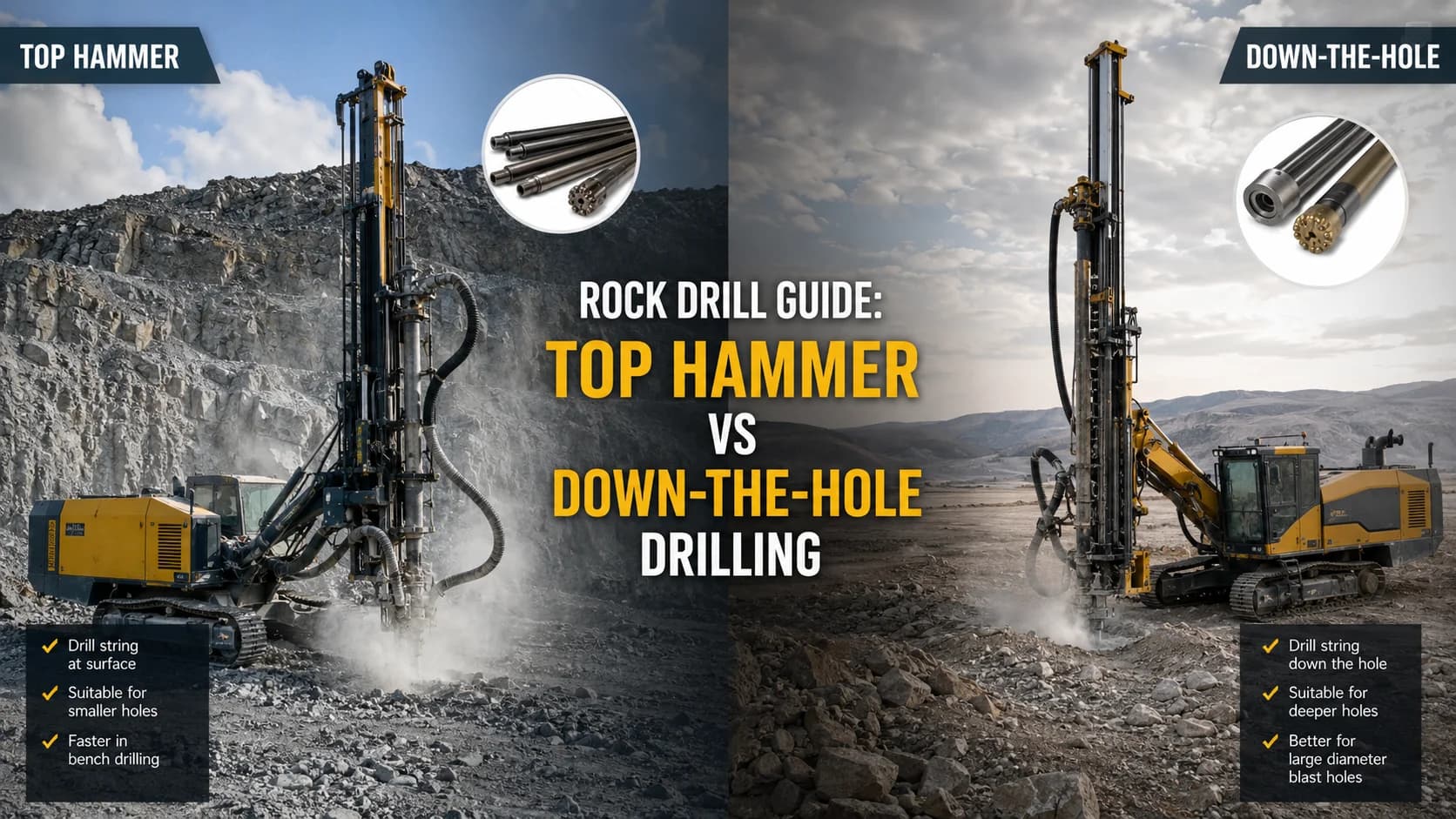
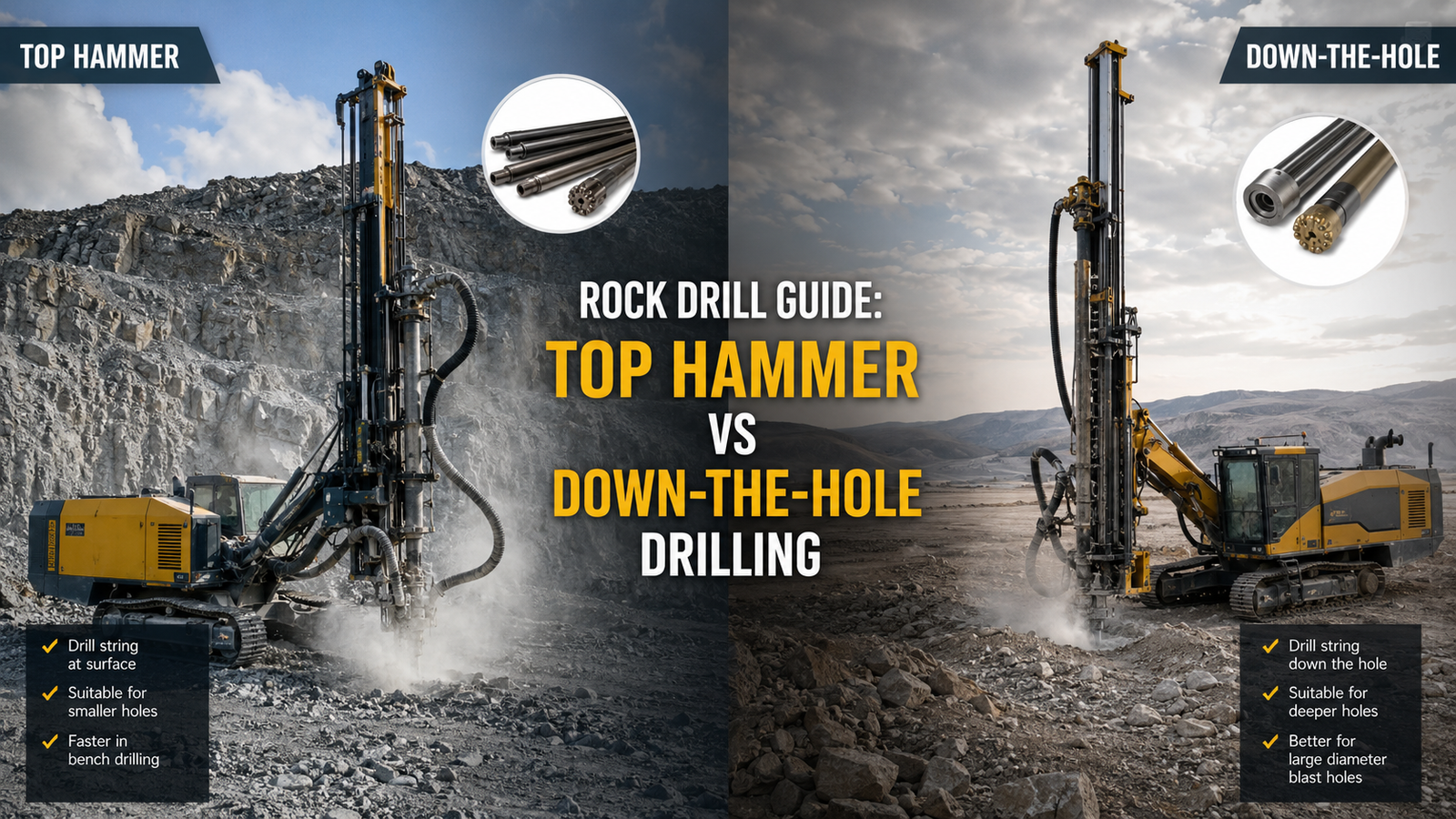
Rock drilling converts machine power into controlled fracture at the bottom of a borehole. The two most common percussive methods in surface construction, quarrying, and mining are top-hammer drilling and down-the-hole, or DTH, drilling. Both use repeated impacts plus rotation to crush rock, but they deliver impact energy in different places. Top-hammer systems strike the drill string from the rig end, while DTH systems place the hammer directly behind the bit at the bottom of the hole. That single difference affects hole diameter, depth capability, straightness, air demand, tooling wear, penetration rate, and operating cost.
How Percussive Rock Drilling Works
Percussive drilling breaks rock through thousands of repeated impacts while the bit rotates between blows. Rotation brings fresh rock under the buttons or cutting structure, and flushing removes crushed cuttings from the hole. Efficient drilling therefore depends on four linked functions: percussion, rotation, feed force, and flushing. Too little feed allows the tool to bounce and wastes impact energy; too much feed increases wear and may stall rotation. Insufficient flushing recuts material and raises temperature. The rig, rock drill, drill string, bit, and compressor must work as a matched system.
Top Hammer Drilling
In a top-hammer rig, a hydraulic drifter mounted on the feed beam delivers impact energy into a shank adapter. The energy travels through couplings and drill rods to the bit. Top hammer is widely used for bench drilling, construction blasting, road cuts, foundations, and smaller-diameter holes. It is known for high penetration rates in suitable rock and relatively compact compressors because flushing demand can be lower than DTH. The main limitation is energy loss and wave reflection through joints as hole depth increases. Rod condition, coupling tightness, and alignment become increasingly important for deeper holes.
Down-the-Hole Drilling
DTH drilling places a pneumatic hammer immediately behind the bit. Compressed air powers a piston that strikes the bit while also carrying cuttings up the annulus. Because the impact is generated at the bottom, energy transmission does not degrade through the drill string in the same way. DTH excels in deeper holes, larger diameters, and applications where straightness is important. It is common in production blasting, quarrying, water wells, geothermal work, and deep foundation drilling. The tradeoff is high compressor demand and sensitivity to air pressure, air volume, and water inflow.
Hole Diameter and Depth
Top-hammer systems are generally strongest in smaller to medium hole diameters and shallow to moderate depths, although modern rigs can work beyond traditional ranges. DTH becomes attractive as diameter and depth increase because the hammer maintains impact efficiency at the bit. The correct choice is not defined by one fixed diameter threshold; rock strength, required straightness, bench height, drilling pattern, compressor availability, and total cost per meter all matter. Contractors should compare complete production economics rather than simply asking which method can technically make the hole.
Hole Straightness and Accuracy
Deviation affects blasting results, foundation quality, and the ability to place anchors or casings. Top-hammer drill strings are relatively slender and can bend or follow fractures, especially in deep holes or strongly bedded rock. DTH assemblies are stiffer near the bit and often produce straighter holes. However, poor collaring, worn bits, incorrect feed, misaligned feeds, and unstable benches can make either method deviate. Accurate setup at the collar is critical because a small angular error at the surface becomes a large positional error at depth.
Air and Flushing Requirements
Top hammer commonly uses air or water primarily for flushing, while DTH relies on compressed air both to power the hammer and remove cuttings. Compressor selection therefore has a major effect on DTH performance. Pressure must be adequate to operate the hammer effectively at depth, and volume must be sufficient to lift cuttings at the required annular velocity. Excessive water inflow can reduce hammer performance and increase the amount of air required. Undersized air supply is one of the most common reasons a DTH system performs below expectation.
Tooling and Consumables
Top-hammer tooling includes shank adapters, couplings, extension rods or tubes, and button bits. Wear occurs at threaded connections as well as on the bit. DTH tooling includes the hammer, drill pipes, and DTH bit, with critical wear occurring on the piston, wear sleeve, chuck, bit shank, and valves. Tool cost should be measured per drilled meter, not per component. A more expensive bit that holds gauge and drills straighter may be cheaper overall than a low-cost bit that slows penetration and increases deviation.
Rock Type and Drilling Response
Hard, abrasive rock demands strong carbide grades and good button retention. Fractured rock can create jamming and poor flushing. Soft or weathered formations may drill quickly but create large volumes of cuttings and hole instability. Top hammer often performs exceptionally well in hard competent rock at moderate depth, while DTH maintains energy well in deeper and larger holes. Mixed formations complicate the decision because the best setup for a hard band may not be ideal in softer layers. Trial drilling and careful parameter logging can reveal the best balance.
Feed, Rotation, and Percussion Settings
Modern rigs allow operators to adjust percussion pressure, feed pressure, rotation speed, and flushing. Efficient settings maintain firm bit contact without overloading the string. High rotation can wear buttons and threads, while low rotation recuts the same rock. Excessive feed raises bending loads; low feed allows rebound. The best settings change with rock hardness, hole angle, tool diameter, and depth. Experienced operators watch penetration rate, vibration, sound, pressure readings, cuttings quality, and bit condition rather than relying on one fixed setting all day.
Productivity and Cost per Meter
True productivity includes collaring, drilling, rod changes, hole cleaning, moving between holes, setup, maintenance, and delays. Top hammer may drill very quickly but require more rod handling on deeper holes. DTH may have slightly slower collaring but maintain consistent penetration with depth. Compressor fuel use can dominate DTH operating cost, while drill-string wear can be a major top-hammer cost. The most useful comparison is cost per acceptable finished meter, including deviation, redrilling, fuel, tooling, labor, and support equipment.
Common Failure Modes
Top-hammer crews commonly encounter loose couplings, thread damage, bent rods, shank wear, and lost energy through worn joints. DTH crews may face hammer jamming, poor lubrication, blocked passages, worn wear sleeves, broken bit shanks, or insufficient air. Both methods can suffer from stuck tools, collapsed holes, excessive deviation, and poor collaring. Early warning signs include sudden penetration changes, unusual vibration, excessive dust or water behavior, pressure changes, and cuttings that differ from the expected formation.
Safety Around Rock Drills
Rock drilling creates rotating components, compressed air, hydraulic pressure, dust, noise, flying cuttings, unstable ground, and the possibility of unexploded explosives on drill-and-blast sites. Operators should work from stable benches with defined exclusion zones. Dust suppression and respiratory controls are essential where silica-bearing rock is drilled. Drill steels and rods must be handled with appropriate tools rather than by hand near rotating components. Maintenance requires isolation of hydraulic, pneumatic, and mechanical energy. Site procedures and manufacturer instructions always take priority over general guidance.
Practical Planning Notes
Planning note 1. Choose the method by finished-hole requirements, not just raw penetration rate; straightness and diameter control may be more valuable than speed. In practical terms, this should be converted into a written field decision rather than left as an informal expectation. The crew should know what will be checked, who is responsible, what condition triggers a change, and how that change affects the rest of the rock drill guide operation. Good planning also uses observable data such as cycle time, machine loading, ground response, component temperature, fuel use, wear, or finished-work quality. When these observations are recorded consistently, supervisors can separate normal variation from a developing problem and make adjustments before production is lost. The most effective jobsites treat these checks as part of normal production management, not as paperwork added after the work is complete.
Planning note 2. Confirm compressor pressure and free-air delivery at the working altitude and temperature before selecting a DTH hammer. In practical terms, this should be converted into a written field decision rather than left as an informal expectation. The crew should know what will be checked, who is responsible, what condition triggers a change, and how that change affects the rest of the rock drill guide operation. Good planning also uses observable data such as cycle time, machine loading, ground response, component temperature, fuel use, wear, or finished-work quality. When these observations are recorded consistently, supervisors can separate normal variation from a developing problem and make adjustments before production is lost. The most effective jobsites treat these checks as part of normal production management, not as paperwork added after the work is complete.
Planning note 3. Track penetration rate by rock unit or bench zone so tooling and parameters can be adjusted to real conditions instead of average geology. In practical terms, this should be converted into a written field decision rather than left as an informal expectation. The crew should know what will be checked, who is responsible, what condition triggers a change, and how that change affects the rest of the rock drill guide operation. Good planning also uses observable data such as cycle time, machine loading, ground response, component temperature, fuel use, wear, or finished-work quality. When these observations are recorded consistently, supervisors can separate normal variation from a developing problem and make adjustments before production is lost. The most effective jobsites treat these checks as part of normal production management, not as paperwork added after the work is complete.
Planning note 4. Inspect rods and threads before they fail in the hole; a damaged connection is far cheaper to replace on the surface than to fish at depth. In practical terms, this should be converted into a written field decision rather than left as an informal expectation. The crew should know what will be checked, who is responsible, what condition triggers a change, and how that change affects the rest of the rock drill guide operation. Good planning also uses observable data such as cycle time, machine loading, ground response, component temperature, fuel use, wear, or finished-work quality. When these observations are recorded consistently, supervisors can separate normal variation from a developing problem and make adjustments before production is lost. The most effective jobsites treat these checks as part of normal production management, not as paperwork added after the work is complete.
Planning note 5. Use accurate collaring procedures and feed alignment because the first meter largely determines final deviation. In practical terms, this should be converted into a written field decision rather than left as an informal expectation. The crew should know what will be checked, who is responsible, what condition triggers a change, and how that change affects the rest of the rock drill guide operation. Good planning also uses observable data such as cycle time, machine loading, ground response, component temperature, fuel use, wear, or finished-work quality. When these observations are recorded consistently, supervisors can separate normal variation from a developing problem and make adjustments before production is lost. The most effective jobsites treat these checks as part of normal production management, not as paperwork added after the work is complete.
Planning note 6. Match bit design and carbide grade to abrasivity as well as hardness; abrasive medium-hard rock can consume tooling faster than very hard but less abrasive rock. In practical terms, this should be converted into a written field decision rather than left as an informal expectation. The crew should know what will be checked, who is responsible, what condition triggers a change, and how that change affects the rest of the rock drill guide operation. Good planning also uses observable data such as cycle time, machine loading, ground response, component temperature, fuel use, wear, or finished-work quality. When these observations are recorded consistently, supervisors can separate normal variation from a developing problem and make adjustments before production is lost. The most effective jobsites treat these checks as part of normal production management, not as paperwork added after the work is complete.
Planning note 7. Plan dust collection or water suppression as part of the drilling system, not as an accessory added after production begins. In practical terms, this should be converted into a written field decision rather than left as an informal expectation. The crew should know what will be checked, who is responsible, what condition triggers a change, and how that change affects the rest of the rock drill guide operation. Good planning also uses observable data such as cycle time, machine loading, ground response, component temperature, fuel use, wear, or finished-work quality. When these observations are recorded consistently, supervisors can separate normal variation from a developing problem and make adjustments before production is lost. The most effective jobsites treat these checks as part of normal production management, not as paperwork added after the work is complete.
Planning note 8. Record fuel, compressor loading, meters drilled, and consumables so method selection can be based on cost per finished meter on future projects. In practical terms, this should be converted into a written field decision rather than left as an informal expectation. The crew should know what will be checked, who is responsible, what condition triggers a change, and how that change affects the rest of the rock drill guide operation. Good planning also uses observable data such as cycle time, machine loading, ground response, component temperature, fuel use, wear, or finished-work quality. When these observations are recorded consistently, supervisors can separate normal variation from a developing problem and make adjustments before production is lost. The most effective jobsites treat these checks as part of normal production management, not as paperwork added after the work is complete.
Common Mistakes to Avoid
- Selecting equipment from nominal capacity alone without checking the actual site, material, access, duty cycle, or support requirements of the rock drill guide.
- Allowing production pressure to override inspection, setup, or maintenance checks that protect the machine and finished work.
- Using average conditions for planning when one steep grade, weak area, hard layer, narrow access point, or large starting load can control the whole operation.
- Failing to record operating data, which makes it difficult to identify whether a problem comes from the machine, material, road, tooling, operator technique, or maintenance condition.
- Changing several variables at once when troubleshooting, which makes it impossible to know which adjustment actually improved or worsened performance.
A useful way to think about rock drill guide is as a system rather than a single machine or component. Equipment selection, site conditions, operator technique, maintenance, logistics, and quality requirements interact continuously. Improving only one element can move the bottleneck somewhere else. For example, a faster machine may create queues at loading, dumping, servicing, or material handling if the rest of the process is not prepared. This systems view is especially important on large projects because small inefficiencies repeat over hundreds or thousands of cycles. Measuring the complete process and adjusting it deliberately is usually more valuable than chasing the highest theoretical machine specification.
Frequently Asked Questions
Which is faster, top hammer or DTH?
Top hammer can be extremely fast in shallow to moderate holes, while DTH often maintains more consistent penetration as depth and diameter increase. The faster method depends on rock, hole geometry, and support equipment.
Which method gives straighter holes?
DTH often has an advantage in deeper holes because the impact is delivered directly behind the bit and the bottom-hole assembly is relatively stiff, but setup and geology still matter.
Why does DTH need a large compressor?
Compressed air powers the hammer and must also lift cuttings to the surface, so both pressure and volume requirements can be substantial.
Can top hammer drill deep holes?
Yes, but energy losses, rod handling, and deviation become more significant as depth increases. The economic crossover with DTH should be evaluated for the specific project.
Final Takeaway
The best results with rock drill guide come from matching equipment capability to real working conditions and then managing the complete production system. Specifications provide the starting point, but field success depends on setup, material behavior, access, maintenance, operator decisions, and the way the machine interacts with the rest of the project. Before work begins, define the expected duty, identify the conditions most likely to reduce performance, and establish clear limits for when the crew should stop, inspect, or change the plan. During production, use simple measurable indicators such as cycle time, penetration, payload, fuel use, wear, temperature, quality, or electrical loading to confirm that the system is operating as intended. That disciplined approach improves productivity while protecting equipment, workers, and the finished construction work.
Get More Expert Guides & Updates
Subscribe for Machinery.org guide updates and product learning content.