
Drill-bit selection is one of the most underestimated decisions in drilling. A powerful rig cannot compensate for a bit that is poorly matched to the ground, because the bit controls how machine energy is converted into cutting, crushing, scraping, or mixing at the face. Rock, clay, sand, gravel, fill, and mixed ground behave differently under load. Some formations need hard carbide buttons that crush rock; others need open auger flights that carry sticky cuttings; still others need aggressive cutters and generous flow paths to stay clean. Choosing the right bit means matching cutting structure, body shape, flushing, gauge protection, and wear material to the formation and drilling method.
Start With the Drilling Method
A bit cannot be selected in isolation from the drilling system. Rotary augers, top-hammer drills, DTH hammers, rotary blast-hole rigs, casing systems, coring rigs, and foundation drills all require different bit connections and cutting actions. The first question is therefore how the rig delivers energy: rotation only, percussion plus rotation, or cutting with crowd force. Next comes hole diameter, depth, angle, flushing medium, and whether casing must advance at the same time. Only after those constraints are defined should the crew select cutting structure and materials.
Bits for Hard Rock
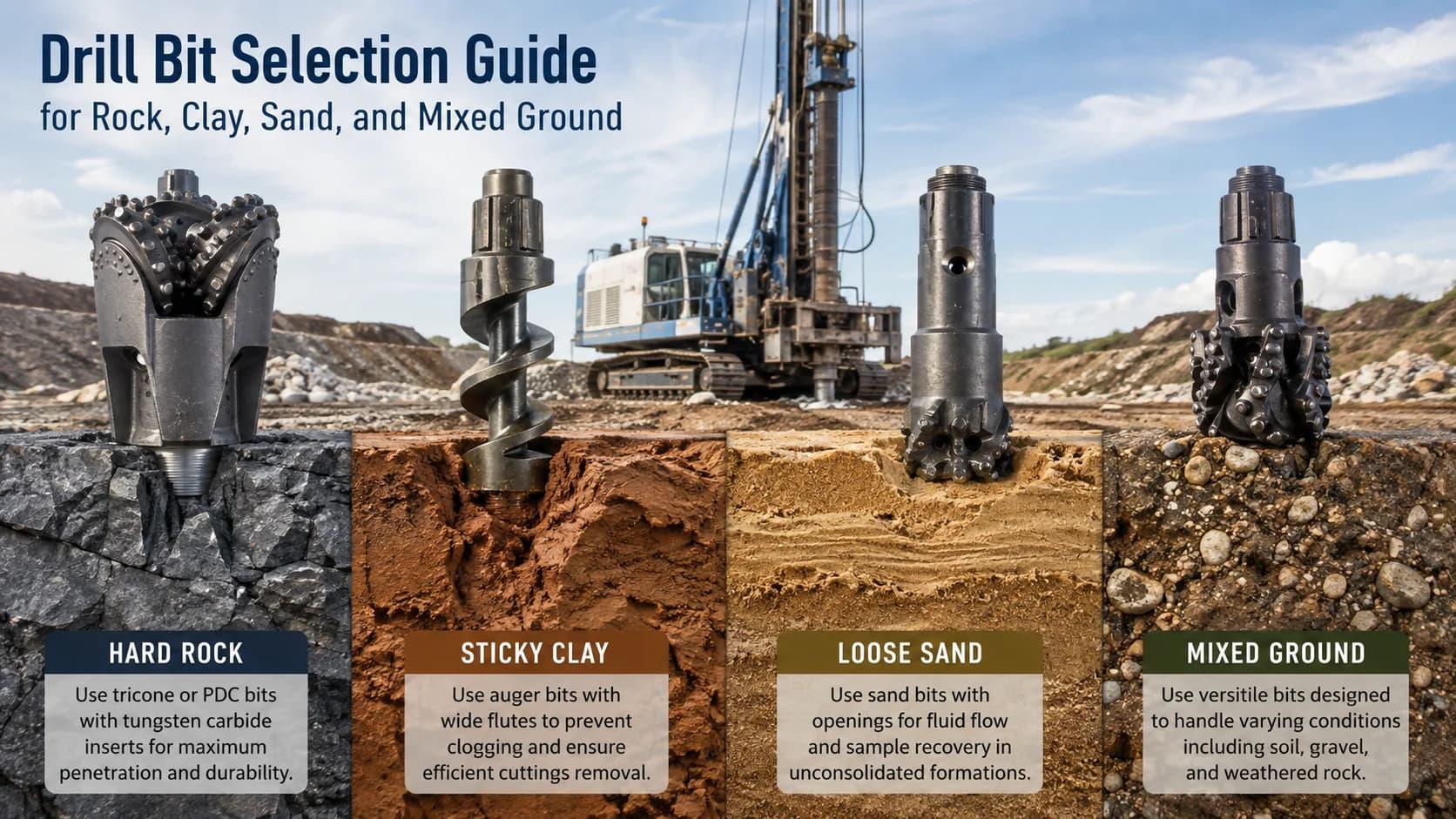
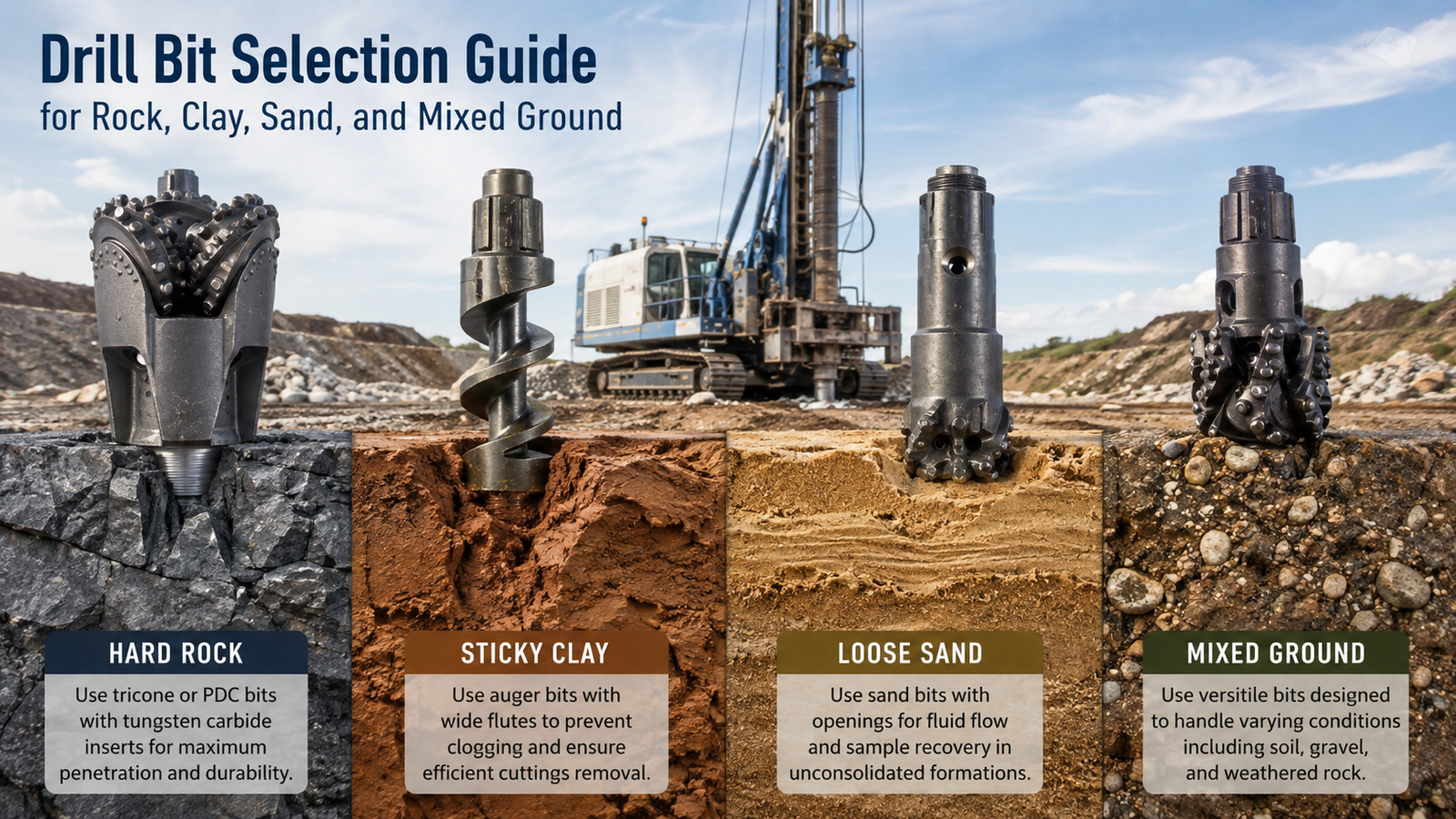
Hard competent rock is commonly drilled with button bits, DTH bits, tricone roller bits, or fixed-cutter systems such as PDC in suitable applications. Tungsten-carbide inserts concentrate load into small contact areas to fracture the rock. Button shape influences penetration and wear: ballistic buttons can penetrate aggressively in less abrasive formations, while spherical or semi-ballistic buttons offer robust wear resistance. Gauge buttons must stay in good condition because diameter loss makes following tools difficult. In abrasive rock, a slightly slower bit with stronger carbide and more gauge protection can reduce cost per meter.
Bits for Fractured and Weathered Rock
Fractured rock presents a different problem from solid hard rock. Large chips, open joints, clay seams, and broken zones can trap the bit or allow cuttings to fall around the tool. Bits with strong gauge protection, good flushing, and a body profile that resists wedging are preferred. Operators may need lower feed and careful rotation when crossing voids or highly broken zones. If the hole repeatedly collapses, the correct solution may be casing or another drilling system rather than a more aggressive bit.
Bits for Clay
Clay tends to smear, ball up, and stick to tools rather than fracture cleanly. Auger bits with open geometry and adequate flight pitch are common because they cut and transport soil upward. In very sticky clay, small openings and crowded cutter arrangements quickly plug, so open faces and large evacuation paths are valuable. Teeth should slice rather than crush. Cleaning methods and rotation speed matter as much as tooth type because clay that packs around the bit can increase torque dramatically and reduce advance to almost zero.
Bits for Sand
Loose sand is easy to cut but difficult to keep stable and remove efficiently. Openings must allow drilling fluid, air, or slurry to carry material without eroding critical bit surfaces. In auger drilling, sand can fall from the flights when the tool is withdrawn, which affects sample recovery and hole cleanliness. In fluid-supported drilling, the bit must work with the circulation system rather than restricting flow. Sand containing sharp quartz can also be highly abrasive, so wear protection may be necessary even though the formation is mechanically soft.
Bits for Gravel and Cobbles
Gravel and cobbles are challenging because the tool encounters particles much larger than typical soil grains. Standard soil augers may bounce, displace stones without cutting them, or jam. Rock augers with stronger teeth, core barrels, roller bits, or casing-advancement systems may be required. The best approach depends on cobble size, density, matrix material, and hole diameter. A mixed gravel layer over rock often justifies a combination of tooling rather than trying to force one bit through every layer.
Mixed Ground Strategy
Mixed ground may alternate between clay, sand, gravel, fill, weathered rock, and hard bands over only a few meters. The objective is not to find a perfect universal bit, because one rarely exists. Instead, select a robust primary tool that performs acceptably across most of the profile and plan an efficient changeover to specialty tooling when needed. Some crews use combination bits with both scraping and carbide cutting features. Others change from soil augers to rock augers, core barrels, or DTH systems at a defined depth.
Cutting Structure and Geometry
Cutter spacing, attack angle, body diameter, flute geometry, face openness, and gauge protection determine how the bit loads the formation and clears cuttings. Closely spaced cutters can create a smooth face but may plug in clay. Aggressive teeth penetrate well but can shock the drivetrain in cobbles. Wide open faces improve cleaning but reduce structural support for cutters. The design must also maintain hole diameter after wear begins. A bit that performs well only when new may be more expensive than a design that maintains geometry over a long service life.
Flushing and Cuttings Removal
Cuttings must leave the face as fast as they are produced. Air drilling relies on annular velocity, water flushing on flow and pressure, slurry systems on circulation and suspension, and auger systems on mechanical transport along the flights. If cuttings recirculate, the bit wastes energy grinding already-broken material. Poor cleaning also raises temperature, increases wear, and can trap the tool. Bit ports, nozzles, fluid passages, and junk slots should therefore be selected as part of the overall flushing design.
Wear, Sharpening, and Replacement
Wear changes drilling behavior long before a bit becomes visibly destroyed. Rounded carbide buttons reduce penetration and increase heat. Worn teeth increase torque and make the rig work harder. Lost gauge causes undersize holes, while body erosion can expose welds or weaken cutter retention. Maintenance programs should define inspection intervals and objective replacement criteria. Some button bits can be reground, but grinding must restore the intended shape without overheating the carbide. Soil teeth and holders should be replaced before excessive wear damages the more expensive bit body.
Evaluating Cost per Meter
Lowest purchase price is not the same as lowest drilling cost. A high-quality bit can be economical if it drills faster, stays in gauge, reduces machine load, and lasts longer. Cost per meter should include bit price, sharpening, teeth, labor, fuel, downtime, redrilling, and the consequences of a stuck or lost tool. Record keeping is essential because operators often remember dramatic failures but overlook gradual productivity losses from worn tooling. A simple log of meters, hours, formation, and bits used creates valuable selection data.
Safety and Handling
Drill bits are heavy, sharp, and often contaminated with grease, cuttings, or drilling fluid. Changing them can expose workers to suspended loads, stored hydraulic pressure, hot components, and pinch points. Use mechanical handling where practical, stabilize the drill string, isolate energy, and keep hands out of threaded or clamping areas. Carbide grinding produces hazardous dust and requires appropriate controls. Tool changes should follow the machine and tooling manufacturer’s instructions, especially for large DTH hammers, core barrels, and casing systems.
Practical Planning Notes
Planning note 1. Review the bore log or geotechnical profile before ordering tooling so the expected percentage of each ground type is understood. In practical terms, this should be converted into a written field decision rather than left as an informal expectation. The crew should know what will be checked, who is responsible, what condition triggers a change, and how that change affects the rest of the drill bit selection guide operation. Good planning also uses observable data such as cycle time, machine loading, ground response, component temperature, fuel use, wear, or finished-work quality. When these observations are recorded consistently, supervisors can separate normal variation from a developing problem and make adjustments before production is lost. The most effective jobsites treat these checks as part of normal production management, not as paperwork added after the work is complete.
Planning note 2. Carry at least one alternate tool for the formation most likely to stop the primary bit; contingency tooling is cheaper than an idle drill crew. In practical terms, this should be converted into a written field decision rather than left as an informal expectation. The crew should know what will be checked, who is responsible, what condition triggers a change, and how that change affects the rest of the drill bit selection guide operation. Good planning also uses observable data such as cycle time, machine loading, ground response, component temperature, fuel use, wear, or finished-work quality. When these observations are recorded consistently, supervisors can separate normal variation from a developing problem and make adjustments before production is lost. The most effective jobsites treat these checks as part of normal production management, not as paperwork added after the work is complete.
Planning note 3. Inspect gauge diameter regularly because gradual undersize wear can create casing, anchor, or blast-design problems that are discovered only after the hole is complete. In practical terms, this should be converted into a written field decision rather than left as an informal expectation. The crew should know what will be checked, who is responsible, what condition triggers a change, and how that change affects the rest of the drill bit selection guide operation. Good planning also uses observable data such as cycle time, machine loading, ground response, component temperature, fuel use, wear, or finished-work quality. When these observations are recorded consistently, supervisors can separate normal variation from a developing problem and make adjustments before production is lost. The most effective jobsites treat these checks as part of normal production management, not as paperwork added after the work is complete.
Planning note 4. Use flushing performance as a diagnostic signal; slow returns or unusually fine cuttings can indicate recirculation, plugging, or a worn bit. In practical terms, this should be converted into a written field decision rather than left as an informal expectation. The crew should know what will be checked, who is responsible, what condition triggers a change, and how that change affects the rest of the drill bit selection guide operation. Good planning also uses observable data such as cycle time, machine loading, ground response, component temperature, fuel use, wear, or finished-work quality. When these observations are recorded consistently, supervisors can separate normal variation from a developing problem and make adjustments before production is lost. The most effective jobsites treat these checks as part of normal production management, not as paperwork added after the work is complete.
Planning note 5. Avoid assuming that soft ground is non-abrasive; quartz sand and some weathered formations can consume teeth and hardfacing very quickly. In practical terms, this should be converted into a written field decision rather than left as an informal expectation. The crew should know what will be checked, who is responsible, what condition triggers a change, and how that change affects the rest of the drill bit selection guide operation. Good planning also uses observable data such as cycle time, machine loading, ground response, component temperature, fuel use, wear, or finished-work quality. When these observations are recorded consistently, supervisors can separate normal variation from a developing problem and make adjustments before production is lost. The most effective jobsites treat these checks as part of normal production management, not as paperwork added after the work is complete.
Planning note 6. Standardize bit records by formation and machine so future projects can use actual cost-per-meter history instead of vendor claims alone. In practical terms, this should be converted into a written field decision rather than left as an informal expectation. The crew should know what will be checked, who is responsible, what condition triggers a change, and how that change affects the rest of the drill bit selection guide operation. Good planning also uses observable data such as cycle time, machine loading, ground response, component temperature, fuel use, wear, or finished-work quality. When these observations are recorded consistently, supervisors can separate normal variation from a developing problem and make adjustments before production is lost. The most effective jobsites treat these checks as part of normal production management, not as paperwork added after the work is complete.
Planning note 7. Coordinate bit selection with torque, pullback, feed force, and compressor capacity so the rig can operate the tool efficiently. In practical terms, this should be converted into a written field decision rather than left as an informal expectation. The crew should know what will be checked, who is responsible, what condition triggers a change, and how that change affects the rest of the drill bit selection guide operation. Good planning also uses observable data such as cycle time, machine loading, ground response, component temperature, fuel use, wear, or finished-work quality. When these observations are recorded consistently, supervisors can separate normal variation from a developing problem and make adjustments before production is lost. The most effective jobsites treat these checks as part of normal production management, not as paperwork added after the work is complete.
Planning note 8. Change worn teeth early when replacement is inexpensive and easy; delaying until holders or the bit body are damaged greatly increases repair cost. In practical terms, this should be converted into a written field decision rather than left as an informal expectation. The crew should know what will be checked, who is responsible, what condition triggers a change, and how that change affects the rest of the drill bit selection guide operation. Good planning also uses observable data such as cycle time, machine loading, ground response, component temperature, fuel use, wear, or finished-work quality. When these observations are recorded consistently, supervisors can separate normal variation from a developing problem and make adjustments before production is lost. The most effective jobsites treat these checks as part of normal production management, not as paperwork added after the work is complete.
Common Mistakes to Avoid
- Selecting equipment from nominal capacity alone without checking the actual site, material, access, duty cycle, or support requirements of the drill bit selection guide.
- Allowing production pressure to override inspection, setup, or maintenance checks that protect the machine and finished work.
- Using average conditions for planning when one steep grade, weak area, hard layer, narrow access point, or large starting load can control the whole operation.
- Failing to record operating data, which makes it difficult to identify whether a problem comes from the machine, material, road, tooling, operator technique, or maintenance condition.
- Changing several variables at once when troubleshooting, which makes it impossible to know which adjustment actually improved or worsened performance.
A useful way to think about drill bit selection guide is as a system rather than a single machine or component. Equipment selection, site conditions, operator technique, maintenance, logistics, and quality requirements interact continuously. Improving only one element can move the bottleneck somewhere else. For example, a faster machine may create queues at loading, dumping, servicing, or material handling if the rest of the process is not prepared. This systems view is especially important on large projects because small inefficiencies repeat over hundreds or thousands of cycles. Measuring the complete process and adjusting it deliberately is usually more valuable than chasing the highest theoretical machine specification.
Frequently Asked Questions
What bit is best for hard rock?
Button bits, DTH bits, roller-cone bits, and other carbide-based rock tools are common. The correct choice depends on the drilling method, diameter, rock hardness, abrasivity, and required hole quality.
Why do bits clog in clay?
Sticky clay adheres to closely packed cutters and small passages. More open geometry, suitable rotation, cleaning, and the right auger or cutting structure help prevent balling.
Can one bit drill mixed ground?
Combination tooling can work across a range of conditions, but severe changes often justify switching tools or drilling methods. Planning fast changeovers is usually better than forcing one bit through every layer.
How do I know when a bit is worn out?
Watch penetration rate, torque, gauge diameter, cutter shape, body erosion, and machine load. Replacement should occur before wear damages holders or causes unacceptable hole quality.
Final Takeaway
The best results with drill bit selection guide come from matching equipment capability to real working conditions and then managing the complete production system. Specifications provide the starting point, but field success depends on setup, material behavior, access, maintenance, operator decisions, and the way the machine interacts with the rest of the project. Before work begins, define the expected duty, identify the conditions most likely to reduce performance, and establish clear limits for when the crew should stop, inspect, or change the plan. During production, use simple measurable indicators such as cycle time, penetration, payload, fuel use, wear, temperature, quality, or electrical loading to confirm that the system is operating as intended. That disciplined approach improves productivity while protecting equipment, workers, and the finished construction work.
Get More Expert Guides & Updates
Subscribe for Machinery.org guide updates and product learning content.