
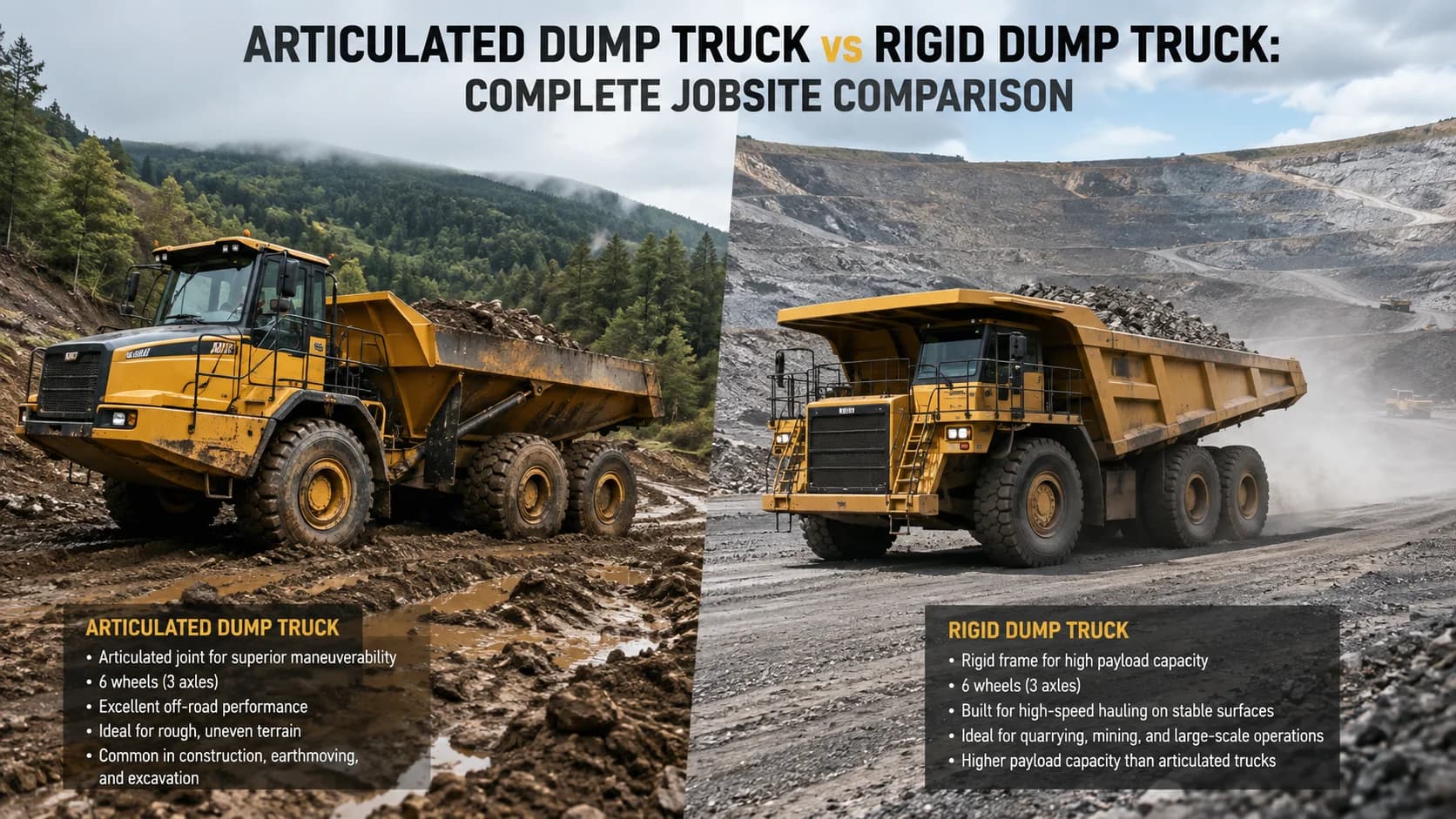
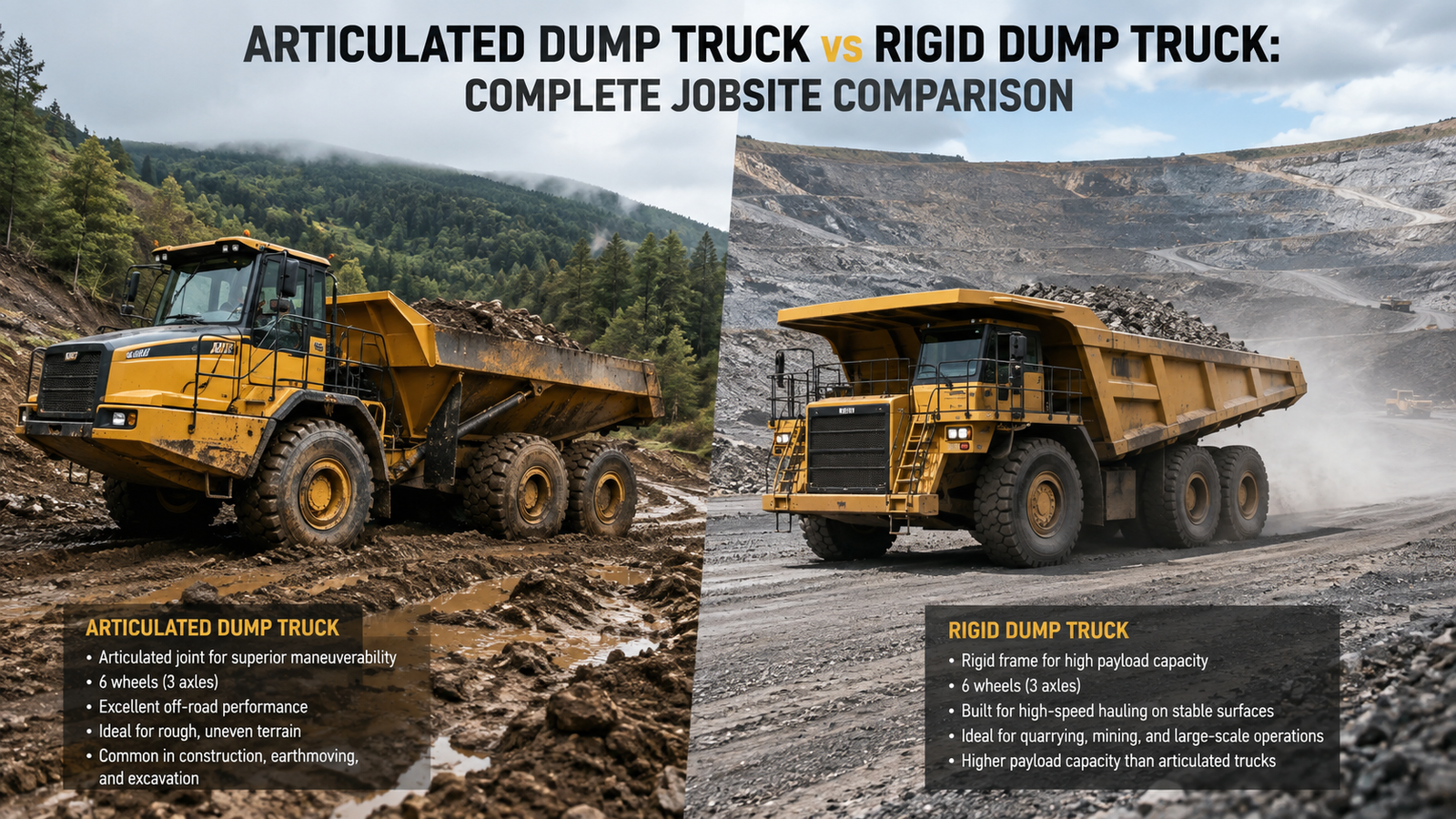
Haul trucks convert loading productivity into moved material, so choosing the wrong truck can limit an entire earthmoving or mining system. Articulated dump trucks, commonly called ADTs, and rigid dump trucks both carry bulk material, but they are optimized for very different conditions. ADTs use an articulated frame, all-wheel drive, and high suspension travel to maintain mobility on rough or soft ground. Rigid trucks use a single rigid chassis and are built around high payload, durability, and speed on well-maintained haul roads. The right choice depends on payload, underfoot conditions, grade, cycle distance, road quality, loading equipment, and the stability of the project over time.
How Articulated Dump Trucks Work
An ADT is built in two main frame sections joined by an articulation and oscillation joint. Steering occurs through hydraulic articulation rather than front-wheel steering, and the joint allows the tractor and dump body to twist relative to each other over uneven terrain. Most modern ADTs use six-wheel drive, automatic traction management, retarding systems, and suspension designed for variable site conditions. Their strength is the ability to keep moving where rigid trucks would require much better roads. That mobility is valuable in early-stage earthworks, quarries with changing faces, wet sites, and jobs with temporary haul routes.
How Rigid Dump Trucks Work
Rigid dump trucks use a one-piece frame with conventional steering and a rear dump body. Large tires, heavy axles, powerful engines or electric-drive systems, and high-capacity braking or retarding systems allow them to move very large payloads efficiently. They are most productive on firm, wide, well-graded roads with controlled grades and generous turning radii. Rigid trucks dominate many large mines and high-volume quarries because the infrastructure can be designed around them and haul routes remain stable for long periods.
Payload and Fleet Size
Rigid trucks generally offer much higher payload ranges than ADTs, so fewer truck cycles may be needed for the same tonnage. However, payload alone does not determine fleet size. A high-capacity rigid truck that moves slowly through mud or waits for road repairs can deliver less material than a smaller ADT fleet. The loader also needs to match the truck: ideal pass matching fills the body efficiently without excessive loading time or overload risk. Fleet calculations should compare payload multiplied by completed cycles per hour, adjusted for availability and queueing.
Ground Conditions and Traction
This is where the two types differ most. ADTs can operate on softer, rougher, and more variable surfaces because all-wheel drive, articulation, and oscillation keep more tires in contact with the ground. Rigid trucks need firm support and smoother surfaces to protect frames, tires, and suspension while maintaining speed. If a project cannot justify continuous road maintenance, ADTs may be the more reliable choice. Conversely, when haul roads are engineered and stable, the lower rolling resistance and high payload of rigid trucks can create major cost advantages.
Grades and Retarding
Steep grades increase power demand uphill and braking demand downhill. Both truck types use engine braking, transmission retarders, hydraulic retarders, or electric retarding depending on design. ADTs are often comfortable on variable grades and slippery surfaces, while rigid trucks can climb and descend significant grades when roads are designed appropriately. The critical issue is sustained speed without overheating brakes, engines, or drivetrains. Fleet modeling should use manufacturer performance charts for the actual loaded and empty grade profile rather than a single average grade.
Haul Distance
Short, changing hauls often favor ADTs because their mobility reduces the need for road construction and because they can travel directly across rough ground. As distance increases and the route becomes more permanent, road speed and rolling resistance become increasingly important. Rigid trucks can be highly efficient on long, well-maintained hauls where they can sustain speed. There is no universal crossover distance because payload class, road quality, fuel cost, grade, and loading time all change the economics.
Turning Radius and Site Geometry
ADTs can maneuver effectively in tight or irregular sites because articulation reduces turning radius and the rear body follows the tractor through turns. Rigid trucks require wider curves, broader intersections, and more space at loading and dumping areas. On constrained civil projects, the cost of widening haul roads may make ADTs preferable even if rigid trucks offer lower cost per ton on paper. Large mine plans, by contrast, can be designed around rigid-truck geometry from the start.
Tires, Suspension, and Ride
Tire cost is significant for both categories. ADTs use multiple high-flotation tires and flexible suspension to manage rough ground, while rigid trucks use extremely large tires designed for heavy loads and high heat capacity. Rough roads increase tire damage, heat, and structural loading dramatically. The cheapest way to reduce tire cost is often to improve the road rather than change tire brand. Operators also need to manage speed because hitting rough sections too fast multiplies forces on tires, suspension, and frames.
Loading and Dumping
A productive match minimizes loader waiting and truck waiting. Body capacity, density of material, heaping behavior, and loader bucket size should be considered together. Dump areas must be stable and level enough for safe body raising. ADTs can reach rougher fills and embankments, but articulation and uneven ground can also create rollover risk if the body is raised while the tractor and trailer are misaligned. Rigid trucks need controlled dumps with adequate berms and edge management due to their size and payload.
Fuel, Maintenance, and Availability
ADTs carry more driveline components because power is distributed to all axles and articulation adds hydraulic and structural systems. Rigid trucks have massive wheel groups, suspension, and braking systems, and on large machines tire and component costs are substantial. Fuel efficiency should be compared per ton moved, not per machine-hour. Availability is equally important: a truck that burns slightly more fuel but finishes more cycles can still be cheaper. Maintenance infrastructure, technician skills, parts support, and site experience often influence the practical choice.
Safety and Operator Factors
Both truck types create significant line-of-fire and visibility hazards. Traffic management should separate light vehicles, define right-of-way rules, control dumping edges, and establish communication protocols. Seat-belt use, speed management, berm standards, fatigue control, and reversing procedures are fundamental. ADT operators must understand articulation and body stability on side slopes. Rigid-truck operators must manage blind spots and the high momentum of large payloads. OEM limits and site traffic plans should govern operation.
Choosing Between ADT and Rigid
The strongest decision process compares total cost per ton under realistic site conditions. Start with material quantity, density, haul profile, ground strength, road-development budget, weather, and project duration. Then model truck payload, travel speed, queueing, loading time, dumping time, fuel, tire cost, maintenance, and availability. If road conditions will remain variable, ADTs often win through flexibility. If the project can support engineered haul roads and high sustained tonnage, rigid trucks often become more economical.
Practical Planning Notes
Planning note 1. Model wet-season road conditions as well as dry-season conditions; a fleet that only works on the best days is not a reliable production plan. In practical terms, this should be converted into a written field decision rather than left as an informal expectation. The crew should know what will be checked, who is responsible, what condition triggers a change, and how that change affects the rest of the articulated vs rigid dump truck operation. Good planning also uses observable data such as cycle time, machine loading, ground response, component temperature, fuel use, wear, or finished-work quality. When these observations are recorded consistently, supervisors can separate normal variation from a developing problem and make adjustments before production is lost. The most effective jobsites treat these checks as part of normal production management, not as paperwork added after the work is complete.
Planning note 2. Match loader bucket size to truck body capacity so the target payload is reached in a consistent number of passes without excessive heaping. In practical terms, this should be converted into a written field decision rather than left as an informal expectation. The crew should know what will be checked, who is responsible, what condition triggers a change, and how that change affects the rest of the articulated vs rigid dump truck operation. Good planning also uses observable data such as cycle time, machine loading, ground response, component temperature, fuel use, wear, or finished-work quality. When these observations are recorded consistently, supervisors can separate normal variation from a developing problem and make adjustments before production is lost. The most effective jobsites treat these checks as part of normal production management, not as paperwork added after the work is complete.
Planning note 3. Use actual rolling-resistance estimates for different road sections instead of assuming all unpaved roads perform the same. In practical terms, this should be converted into a written field decision rather than left as an informal expectation. The crew should know what will be checked, who is responsible, what condition triggers a change, and how that change affects the rest of the articulated vs rigid dump truck operation. Good planning also uses observable data such as cycle time, machine loading, ground response, component temperature, fuel use, wear, or finished-work quality. When these observations are recorded consistently, supervisors can separate normal variation from a developing problem and make adjustments before production is lost. The most effective jobsites treat these checks as part of normal production management, not as paperwork added after the work is complete.
Planning note 4. Budget haul-road construction and maintenance as part of truck economics; rigid-truck efficiency depends heavily on road quality. In practical terms, this should be converted into a written field decision rather than left as an informal expectation. The crew should know what will be checked, who is responsible, what condition triggers a change, and how that change affects the rest of the articulated vs rigid dump truck operation. Good planning also uses observable data such as cycle time, machine loading, ground response, component temperature, fuel use, wear, or finished-work quality. When these observations are recorded consistently, supervisors can separate normal variation from a developing problem and make adjustments before production is lost. The most effective jobsites treat these checks as part of normal production management, not as paperwork added after the work is complete.
Planning note 5. Evaluate dump-area stability and width because body-up incidents often occur where the truck is stationary but the ground is uneven or weak. In practical terms, this should be converted into a written field decision rather than left as an informal expectation. The crew should know what will be checked, who is responsible, what condition triggers a change, and how that change affects the rest of the articulated vs rigid dump truck operation. Good planning also uses observable data such as cycle time, machine loading, ground response, component temperature, fuel use, wear, or finished-work quality. When these observations are recorded consistently, supervisors can separate normal variation from a developing problem and make adjustments before production is lost. The most effective jobsites treat these checks as part of normal production management, not as paperwork added after the work is complete.
Planning note 6. Track payload distribution, not only average payload, because repeated overloads increase tire, frame, and drivetrain cost. In practical terms, this should be converted into a written field decision rather than left as an informal expectation. The crew should know what will be checked, who is responsible, what condition triggers a change, and how that change affects the rest of the articulated vs rigid dump truck operation. Good planning also uses observable data such as cycle time, machine loading, ground response, component temperature, fuel use, wear, or finished-work quality. When these observations are recorded consistently, supervisors can separate normal variation from a developing problem and make adjustments before production is lost. The most effective jobsites treat these checks as part of normal production management, not as paperwork added after the work is complete.
Planning note 7. Include queueing time at the loader and crusher or dump point in fleet models; adding trucks beyond the system capacity can reduce efficiency. In practical terms, this should be converted into a written field decision rather than left as an informal expectation. The crew should know what will be checked, who is responsible, what condition triggers a change, and how that change affects the rest of the articulated vs rigid dump truck operation. Good planning also uses observable data such as cycle time, machine loading, ground response, component temperature, fuel use, wear, or finished-work quality. When these observations are recorded consistently, supervisors can separate normal variation from a developing problem and make adjustments before production is lost. The most effective jobsites treat these checks as part of normal production management, not as paperwork added after the work is complete.
Planning note 8. Review tire temperature, cuts, and inflation as production data because tire condition often reveals road and operating problems early. In practical terms, this should be converted into a written field decision rather than left as an informal expectation. The crew should know what will be checked, who is responsible, what condition triggers a change, and how that change affects the rest of the articulated vs rigid dump truck operation. Good planning also uses observable data such as cycle time, machine loading, ground response, component temperature, fuel use, wear, or finished-work quality. When these observations are recorded consistently, supervisors can separate normal variation from a developing problem and make adjustments before production is lost. The most effective jobsites treat these checks as part of normal production management, not as paperwork added after the work is complete.
Common Mistakes to Avoid
- Selecting equipment from nominal capacity alone without checking the actual site, material, access, duty cycle, or support requirements of the articulated vs rigid dump truck.
- Allowing production pressure to override inspection, setup, or maintenance checks that protect the machine and finished work.
- Using average conditions for planning when one steep grade, weak area, hard layer, narrow access point, or large starting load can control the whole operation.
- Failing to record operating data, which makes it difficult to identify whether a problem comes from the machine, material, road, tooling, operator technique, or maintenance condition.
- Changing several variables at once when troubleshooting, which makes it impossible to know which adjustment actually improved or worsened performance.
A useful way to think about articulated vs rigid dump truck is as a system rather than a single machine or component. Equipment selection, site conditions, operator technique, maintenance, logistics, and quality requirements interact continuously. Improving only one element can move the bottleneck somewhere else. For example, a faster machine may create queues at loading, dumping, servicing, or material handling if the rest of the process is not prepared. This systems view is especially important on large projects because small inefficiencies repeat over hundreds or thousands of cycles. Measuring the complete process and adjusting it deliberately is usually more valuable than chasing the highest theoretical machine specification.
Frequently Asked Questions
Are articulated dump trucks better off road?
Generally yes. Their articulation, oscillation, all-wheel drive, and suspension are designed for rough and variable ground.
Why are rigid dump trucks used in mines?
Large rigid trucks can carry very high payloads efficiently on permanent, well-maintained haul roads, which suits high-volume mining.
Which truck is cheaper to operate?
It depends on the site. Compare cost per ton moved, including road maintenance, fuel, tires, maintenance, availability, and cycle time.
Can an ADT replace a rigid truck on a long haul?
It can, but on long smooth routes the ADT may give up speed and payload efficiency. The correct answer comes from cycle and cost modeling.
Final Takeaway
The best results with articulated vs rigid dump truck come from matching equipment capability to real working conditions and then managing the complete production system. Specifications provide the starting point, but field success depends on setup, material behavior, access, maintenance, operator decisions, and the way the machine interacts with the rest of the project. Before work begins, define the expected duty, identify the conditions most likely to reduce performance, and establish clear limits for when the crew should stop, inspect, or change the plan. During production, use simple measurable indicators such as cycle time, penetration, payload, fuel use, wear, temperature, quality, or electrical loading to confirm that the system is operating as intended. That disciplined approach improves productivity while protecting equipment, workers, and the finished construction work.
Get More Expert Guides & Updates
Subscribe for Machinery.org guide updates and product learning content.