
Site dumpers are compact haul machines designed to move soil, rubble, aggregate, concrete, landscaping material, and other bulk loads around confined construction sites. They fill the space between wheelbarrows, loaders, and full-size dump trucks. Their small footprint allows them to work inside building sites, trenches, utility corridors, landscaping projects, and narrow access routes where larger trucks cannot maneuver. The machines look simple, but payload, skip design, steering geometry, visibility, ground conditions, and dumping method have a major effect on productivity and safety.
Understanding Payload
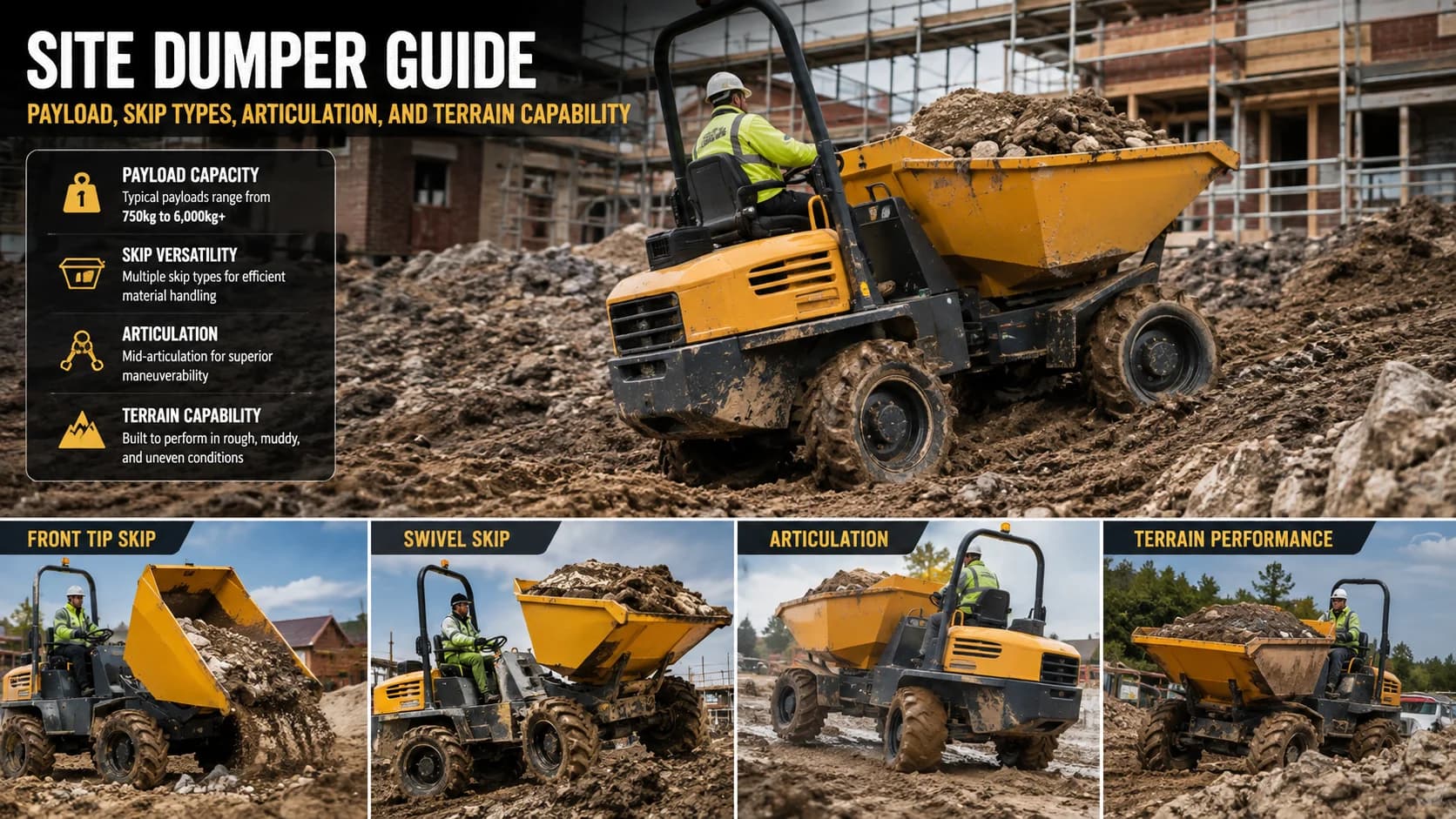
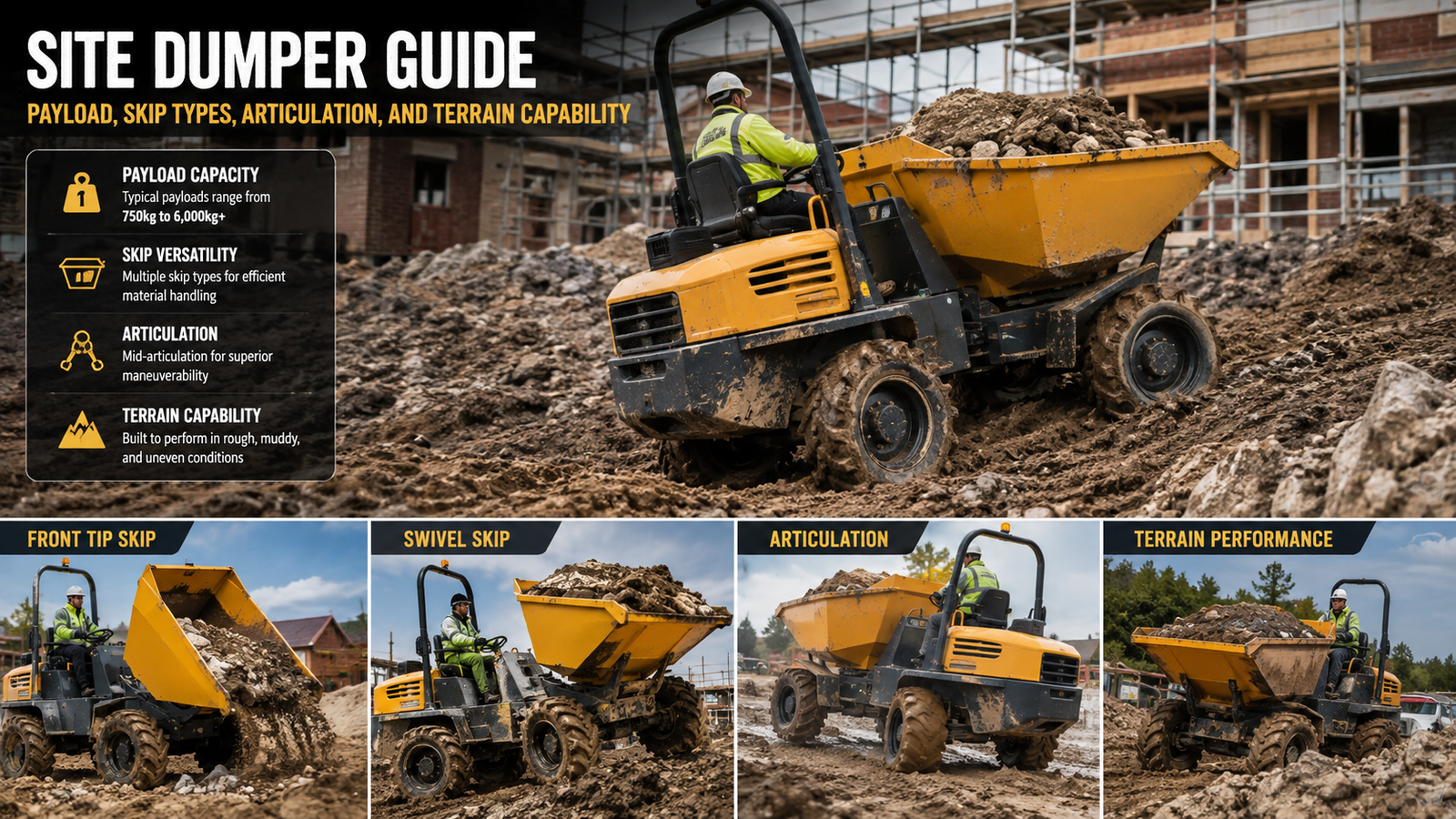
Rated payload is the maximum material mass the dumper is designed to carry under specified conditions. Payload should be matched to material density because a skip that is visually full of wet clay can weigh far more than the same volume of mulch. Overloading increases braking distance, axle and tire loads, frame stress, and rollover risk. Underloading, on the other hand, wastes cycle capacity. Crews should know the approximate density of common materials and use consistent loading practices rather than filling every skip to the same height.
Front-Tip Skips
Front-tip dumpers raise and rotate the skip forward to discharge directly ahead. This is the simplest and often the most robust configuration. It works well for stockpiles, backfilling, and general hauling where the machine can approach the dump point squarely. The operator must leave enough space to raise the skip and maintain safe distance from edges or trenches. Front-tip machines are usually easier to understand for new operators but provide less placement flexibility than swivel systems.
Swivel and Rotating Skips
Swivel skips can rotate to discharge left or right, allowing the dumper to place material without turning the entire machine. This is extremely useful in narrow corridors, roadworks, trench backfill, and sites where turning space is limited. The operator must understand how a raised and rotated load shifts the center of gravity. Dumping sideways on a slope or unstable surface can reduce stability significantly. Swivel mechanisms also add pins, bearings, hydraulic cylinders, hoses, and locking systems that require inspection.
High-Tip and Self-Loading Variants
High-tip dumpers can raise the skip to discharge into a larger container or over an obstruction. Self-loading dumpers use a small loading shovel or scoop so the machine can load loose material without another machine. These features can reduce support-equipment needs on small jobs, but they increase complexity and change the stability envelope. High-tip operations should be performed on firm level ground, and the operator should avoid traveling with the skip elevated because the higher center of gravity increases rollover risk.
Articulation and Steering
Many site dumpers steer through a central articulation joint. This gives a tight turning radius and helps the machine follow narrow routes, but it creates a pinch point at the center joint and changes the machine’s shape during turning. Some compact dumpers use skid steering or conventional axle steering instead. Articulated machines can also oscillate between front and rear frames to keep tires in contact on uneven surfaces. Operators should avoid placing people near the articulation joint and should understand how the rear section tracks through turns.
Terrain Capability
Site dumpers are built for unpaved surfaces, but they are not immune to weak ground. Tire selection, drive system, ground clearance, machine weight, and payload determine flotation and traction. Mud, steep slopes, loose fill, trench edges, and soft shoulders can all create rollover or bogging risk. Four-wheel-drive models provide good traction, while tracked dumpers spread weight over a larger area and can excel on very soft ground. The route should still be prepared and maintained rather than treating mobility as a substitute for road management.
Grade and Slope Management
Slope limits depend on machine design, load, travel direction, surface condition, and manufacturer requirements. A loaded dumper behaves differently uphill, downhill, and across a side slope. Side slopes are particularly critical because the load can move the combined center of gravity toward the downhill wheels. Operators should keep the skip low during travel, avoid sudden steering or braking, and use approved routes. If the route is too steep or uneven for stable travel, the correct solution is to improve the route or use different equipment.
Loading the Dumper
Excavators, skid steers, compact loaders, and small wheel loaders commonly load dumpers. The loading machine should be positioned so its bucket does not pass over the dumper operator. Ideally the dumper operator parks, applies the brake, follows the site’s safe-position procedure, and maintains clear communication. Bucket size should suit the skip to prevent impact damage and overspill. Uneven loading can also shift the center of gravity. Consistent passes and controlled bucket placement improve both safety and cycle time.
Dumping and Edge Safety
Dumping near trenches, retaining walls, or stockpile edges requires controlled approach and adequate edge protection. Material can collapse under the tires even when the surface looks firm. Stop blocks or berms may be required, but they are not substitutes for competent ground assessment. The machine should be aligned before the skip is raised. If the machine leans or settles during dumping, the operator should lower the skip and stop rather than trying to complete the discharge.
Maintenance and Daily Checks
Daily inspection should include tires or tracks, wheel nuts, articulation pins, steering, brakes, hydraulic hoses, skip pivots, seat restraints, lights, alarms, mirrors or cameras, and fluid levels. Mud and concrete buildup can hide defects and add unnecessary weight. Greasing articulation and skip pivots reduces wear. Hydraulic leaks near hot components or on braking surfaces need immediate attention. Small dumpers often work in abrasive dirty environments, so cleaning and inspection are essential rather than cosmetic.
Visibility and Site Traffic
Compact machines are frequently assumed to be low risk because they are small, but limited visibility and close interaction with workers make site dumpers a significant hazard. Reversing routes should be minimized. Pedestrian walkways, crossing points, and exclusion zones need to be defined even on small projects. Cameras, mirrors, alarms, and high-visibility aids support the operator but do not replace separation. Tight urban jobs benefit from one-way routes and planned passing areas to reduce reversing.
Selecting the Right Site Dumper
Start with payload, material density, route width, turning space, grade, underfoot conditions, and required dumping height. Then decide whether front tip, swivel, high tip, self-loading, wheeled, or tracked configuration adds value. A larger payload is not automatically better if it increases rutting, blocks narrow routes, or cannot be loaded efficiently. The best dumper fits the entire material cycle and can work safely in the actual site geometry.
Practical Planning Notes
Planning note 1. Estimate material density before selecting payload class, especially for wet soil, concrete, broken rock, and saturated aggregate. In practical terms, this should be converted into a written field decision rather than left as an informal expectation. The crew should know what will be checked, who is responsible, what condition triggers a change, and how that change affects the rest of the site dumper guide operation. Good planning also uses observable data such as cycle time, machine loading, ground response, component temperature, fuel use, wear, or finished-work quality. When these observations are recorded consistently, supervisors can separate normal variation from a developing problem and make adjustments before production is lost. The most effective jobsites treat these checks as part of normal production management, not as paperwork added after the work is complete.
Planning note 2. Walk the complete travel route and identify side slopes, soft shoulders, blind corners, reversing areas, overhead restrictions, and dumping edges. In practical terms, this should be converted into a written field decision rather than left as an informal expectation. The crew should know what will be checked, who is responsible, what condition triggers a change, and how that change affects the rest of the site dumper guide operation. Good planning also uses observable data such as cycle time, machine loading, ground response, component temperature, fuel use, wear, or finished-work quality. When these observations are recorded consistently, supervisors can separate normal variation from a developing problem and make adjustments before production is lost. The most effective jobsites treat these checks as part of normal production management, not as paperwork added after the work is complete.
Planning note 3. Use swivel skips where side discharge materially reduces turning and reversing, not simply because the feature is available. In practical terms, this should be converted into a written field decision rather than left as an informal expectation. The crew should know what will be checked, who is responsible, what condition triggers a change, and how that change affects the rest of the site dumper guide operation. Good planning also uses observable data such as cycle time, machine loading, ground response, component temperature, fuel use, wear, or finished-work quality. When these observations are recorded consistently, supervisors can separate normal variation from a developing problem and make adjustments before production is lost. The most effective jobsites treat these checks as part of normal production management, not as paperwork added after the work is complete.
Planning note 4. Keep the skip low during travel to maintain the lowest practical center of gravity. In practical terms, this should be converted into a written field decision rather than left as an informal expectation. The crew should know what will be checked, who is responsible, what condition triggers a change, and how that change affects the rest of the site dumper guide operation. Good planning also uses observable data such as cycle time, machine loading, ground response, component temperature, fuel use, wear, or finished-work quality. When these observations are recorded consistently, supervisors can separate normal variation from a developing problem and make adjustments before production is lost. The most effective jobsites treat these checks as part of normal production management, not as paperwork added after the work is complete.
Planning note 5. Match loading-machine bucket size to the skip so each pass is controlled and does not strike the body or overload one side. In practical terms, this should be converted into a written field decision rather than left as an informal expectation. The crew should know what will be checked, who is responsible, what condition triggers a change, and how that change affects the rest of the site dumper guide operation. Good planning also uses observable data such as cycle time, machine loading, ground response, component temperature, fuel use, wear, or finished-work quality. When these observations are recorded consistently, supervisors can separate normal variation from a developing problem and make adjustments before production is lost. The most effective jobsites treat these checks as part of normal production management, not as paperwork added after the work is complete.
Planning note 6. Define pedestrian separation even for very small dumpers; compact equipment frequently works closest to labor crews. In practical terms, this should be converted into a written field decision rather than left as an informal expectation. The crew should know what will be checked, who is responsible, what condition triggers a change, and how that change affects the rest of the site dumper guide operation. Good planning also uses observable data such as cycle time, machine loading, ground response, component temperature, fuel use, wear, or finished-work quality. When these observations are recorded consistently, supervisors can separate normal variation from a developing problem and make adjustments before production is lost. The most effective jobsites treat these checks as part of normal production management, not as paperwork added after the work is complete.
Planning note 7. Clean mud from steps, pedals, articulation areas, and controls so the machine remains inspectable and safe to access. In practical terms, this should be converted into a written field decision rather than left as an informal expectation. The crew should know what will be checked, who is responsible, what condition triggers a change, and how that change affects the rest of the site dumper guide operation. Good planning also uses observable data such as cycle time, machine loading, ground response, component temperature, fuel use, wear, or finished-work quality. When these observations are recorded consistently, supervisors can separate normal variation from a developing problem and make adjustments before production is lost. The most effective jobsites treat these checks as part of normal production management, not as paperwork added after the work is complete.
Planning note 8. Use tracked dumpers when ground pressure and flotation matter more than road speed, but still assess the effect of turning on fragile surfaces. In practical terms, this should be converted into a written field decision rather than left as an informal expectation. The crew should know what will be checked, who is responsible, what condition triggers a change, and how that change affects the rest of the site dumper guide operation. Good planning also uses observable data such as cycle time, machine loading, ground response, component temperature, fuel use, wear, or finished-work quality. When these observations are recorded consistently, supervisors can separate normal variation from a developing problem and make adjustments before production is lost. The most effective jobsites treat these checks as part of normal production management, not as paperwork added after the work is complete.
Common Mistakes to Avoid
- Selecting equipment from nominal capacity alone without checking the actual site, material, access, duty cycle, or support requirements of the site dumper guide.
- Allowing production pressure to override inspection, setup, or maintenance checks that protect the machine and finished work.
- Using average conditions for planning when one steep grade, weak area, hard layer, narrow access point, or large starting load can control the whole operation.
- Failing to record operating data, which makes it difficult to identify whether a problem comes from the machine, material, road, tooling, operator technique, or maintenance condition.
- Changing several variables at once when troubleshooting, which makes it impossible to know which adjustment actually improved or worsened performance.
A useful way to think about site dumper guide is as a system rather than a single machine or component. Equipment selection, site conditions, operator technique, maintenance, logistics, and quality requirements interact continuously. Improving only one element can move the bottleneck somewhere else. For example, a faster machine may create queues at loading, dumping, servicing, or material handling if the rest of the process is not prepared. This systems view is especially important on large projects because small inefficiencies repeat over hundreds or thousands of cycles. Measuring the complete process and adjusting it deliberately is usually more valuable than chasing the highest theoretical machine specification.
Frequently Asked Questions
What is the difference between front-tip and swivel dumpers?
Front-tip machines discharge straight ahead, while swivel dumpers rotate the skip to discharge to either side. Swivel systems are useful in confined routes but require extra attention to stability.
Are tracked dumpers better than wheeled dumpers?
Tracked machines offer better flotation on very soft ground, while wheeled dumpers usually travel faster and are efficient on firmer routes.
Can a site dumper travel on steep slopes?
Only within the manufacturer’s limits and with suitable ground conditions. Load position, direction of travel, and side slope all affect stability.
How should a dumper be loaded?
Use controlled bucket placement, avoid passing the loader bucket over the operator, distribute material evenly, and stay within the rated payload.
Final Takeaway
The best results with site dumper guide come from matching equipment capability to real working conditions and then managing the complete production system. Specifications provide the starting point, but field success depends on setup, material behavior, access, maintenance, operator decisions, and the way the machine interacts with the rest of the project. Before work begins, define the expected duty, identify the conditions most likely to reduce performance, and establish clear limits for when the crew should stop, inspect, or change the plan. During production, use simple measurable indicators such as cycle time, penetration, payload, fuel use, wear, temperature, quality, or electrical loading to confirm that the system is operating as intended. That disciplined approach improves productivity while protecting equipment, workers, and the finished construction work.
Get More Expert Guides & Updates
Subscribe for Machinery.org guide updates and product learning content.